
















Imagine a sudden market shock – a cascade of redemptions, plummeting asset values, and a liquidity crisis that ripples across the financial ecosystem. How prepared are we to mitigate such risks?
Liquidity management is no longer just a back-office operation; it’s at the forefront of ensuring financial stability in an ever-evolving economic landscape. This article dives into the world of liquidity management tools (LMTs), exploring their critical role, challenges, and solutions, with insights drawn from Cognizant Consulting's detailed study.
Overview: The Pulse of liquidity management tools
Liquidity management tools are the lifeline of financial institutions. Designed to ensure adequate cash flow, they help businesses meet financial obligations under normal and stressed conditions.
The scope of LMTs spans cash flow forecasting, working capital management, redemption gates, swing pricing, and more. Under directives such as the Alternative Investment Fund Managers Directive (AIFMD) and the Undertakings for Collective Investment in Transferable Securities (UCITS), the European Securities and Markets Authority (ESMA) has set harmonized standards to strengthen the EU regulatory regime.
These tools safeguard investor protection and maintain financial stability, especially in times of market upheaval.
Understanding core challenges
Despite their importance, liquidity management tools face several challenges:
- Operational Complexities: Implementing mechanisms like swing pricing, redemption gates, or side pockets involves intricate setups that demand precision and fairness.
- Regulatory Arbitrage: Inconsistent application of LMTs across EU member states leads to potential unfair treatment of investors.
- Market Uncertainty: Managing liquidity during stress periods requires real-time decision-making, often hindered by gaps in data quality and tool calibration.
- Investor Dynamics: Balancing short-term redemption behavior with long-term investor interests is a delicate task requiring robust anti-dilution strategies.
Operational bottlenecks
Operational hurdles further complicate liquidity management:
- Determining activation thresholds for tools like redemption gates and side pockets.
- Managing the dynamics of dual pricing and swing pricing during volatile market conditions.
- Addressing liquidity risks emanating from fund structures, margin calls, and asset profiles.
- Ensuring seamless compliance with regulatory requirements, especially when rules evolve.
For instance, in 2018 leading European Investments faced major challenges, where assets under management dropped significantly, underscore the importance of a well-calibrated liquidity management framework.
Where and how do we start?
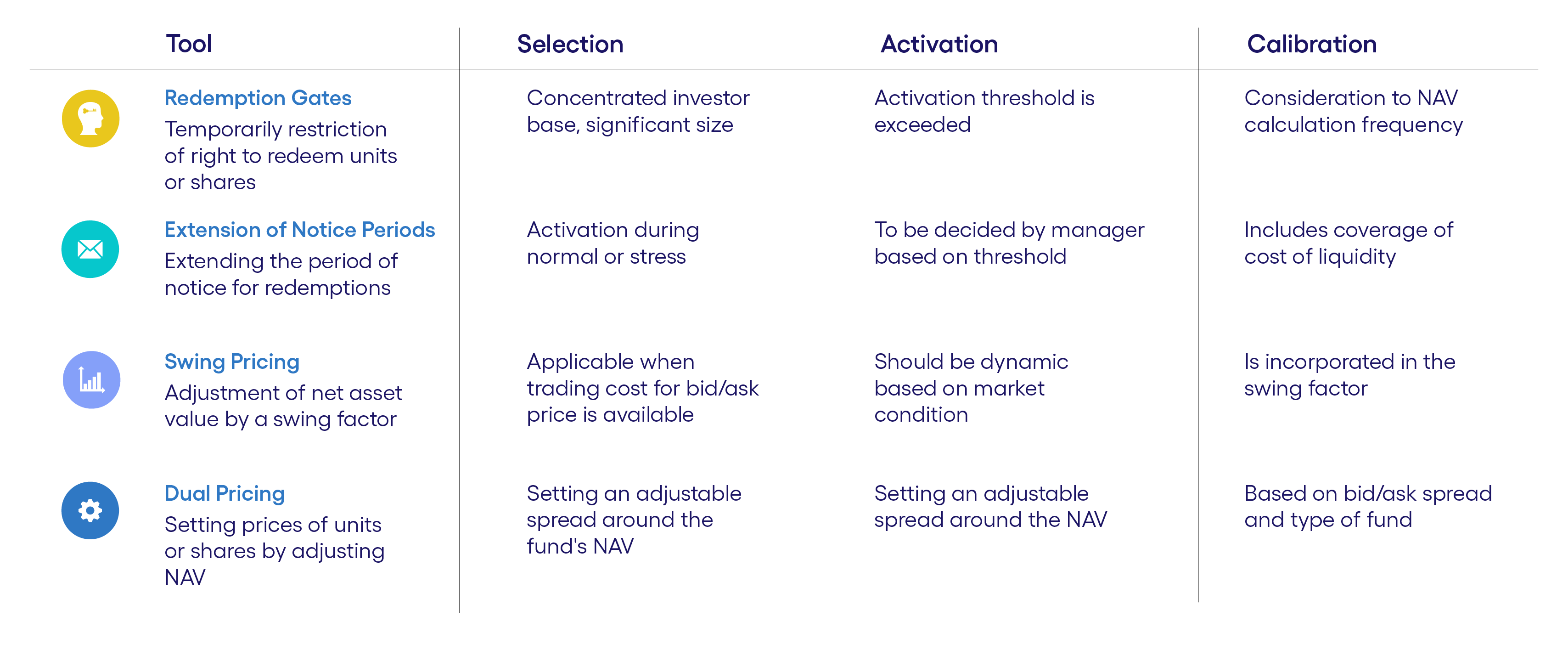
The EU has issued directives and guidelines on the use of liquidity management tools, effective from April 2025. These outline the characteristics and criteria for selecting, activating and calibrating key LMTs across fund types and market conditions.
To support practical implementation, the following visual summarizes the core tools and their operational parameters.