

















In Part I, we examined six failure modes that play out when organisations deploy AI without the right governance in place: objectives that encoded the wrong outcomes, models that scaled conviction without testing assumptions, systems that enforced the documented process over operational reality, AI that optimised silos while nobody owned coherence, metrics that worked while strategy quietly eroded, and capabilities that outran the judgement required to use them responsibly.
These failures share a single root cause: no one in the organisation had both the authority and the perspective to ask whether the system’s objective was right. What follows is the case for a specific role designed to fix that, and a blueprint specific enough to implement.
PART II: THE SOLUTION - OPERATING MODEL’S MISSING ROLE
Why your existing leaders can’t do this.
The reasonable objection: “I already have people for this. My CFO challenges objectives. My COO sees across silos. My CTO understands the technology. My General Counsel owns risk.”
They do. And none of them can perform this function. Not because they lack capability; because their incentive structures, information flows, and time horizons make it structurally impossible.
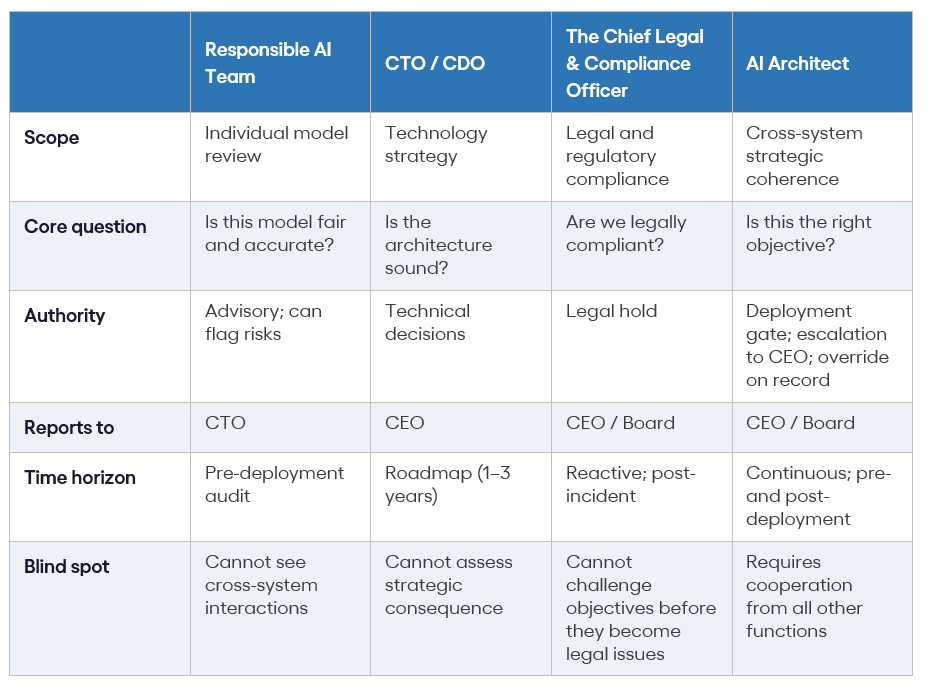
The CFO sees financial risk but doesn’t interrogate model logic. They can tell you a system’s ROI is declining. They cannot tell you its objective function is encoding bias. Financial controls sit downstream of the problem.
The CTO understands model architecture but not strategic consequence. They know a model is performing well against its training data. They are not positioned to judge whether “performing well” is producing outcomes that contradict the company’s values. Technical excellence and strategic alignment are different questions answered by different people.
The COO sees operations but not the interaction effects between automated systems. The sales-versus-risk conflict above is invisible to a COO unless someone maps it. Nobody in their reporting line will.
The Chief Legal & Compliance Officer evaluates systems one at a time, for compliance against existing regulation. They are not resourced to assess whether a portfolio of AI systems is strategically coherent, or to challenge an objective before it becomes a legal problem.
This is not a criticism of these leaders. It is a description of organisational physics. The architect role exists in the gap between their perspectives, the gap where Zillow lost half a billion, where Ofqual downgraded 280,000 students, where the Post Office wrongfully convicted 900 innocent people and the Dutch government took 2,000 children into care.
Your governance framework probably doesn’t cover this.
Most organisations with AI at scale have a responsible AI team, a model review board, or an ethics committee. Necessary. Not sufficient.
These teams review models in isolation. They assess individual systems for bias and compliance. They rarely examine how multiple AI systems interact, whether their combined outputs are strategically coherent, or whether the objectives they’re collectively optimising for still reflect what leadership intended. They are compliance-oriented, not strategically empowered. They report to the CTO, not the CEO. They can flag a problem. They cannot stop a deployment. And when their flags are overruled, nothing on paper records the decision. The architect role is designed to invert both halves of that pattern.
Every case in this piece shares the same structural feature: not the absence of governance, but the absence of anyone with both the authority and the perspective to challenge whether the system’s objective was right. Ofqual had a regulator. The Dutch tax authority had civil servants. The Post Office had auditors. Zillow had data scientists. None were empowered to challenge the logic before it caused harm at scale.
What the architect does.
The architect is a senior strategic function, not a committee, not a working group, not an additional responsibility stapled to an existing role. What follows is specific enough to implement on Monday morning.
1. Pre-deployment objective review
Every AI system above a defined risk tier requires a signed objective review before deployment. The question is not “Does the model work?” It is “What happens to the rest of the organisation when this model succeeds?” The review covers the system’s explicit objective, the incentives it creates, the populations it affects, the second-order consequences of optimisation at scale, and the interaction with other AI systems in the portfolio. The architect can approve, require modification, or escalate to the CEO. This is a gate, not a suggestion.
2. Cross-system coherence audit
Quarterly, the architect maps every AI system operating in overlapping decision spaces and tests for definitional consistency and objective conflicts. Do the sales model and the risk model share a definition of “good customer”? Does the fraud-detection system’s threshold align with the customer-experience team’s tolerance for false positives? The output is a coherence report to the CEO and the board, with findings, risk ratings, and required actions.
3. Deployment authority
The architect can delay any AI deployment by 48 to 72 hours pending objective review. For the highest risk tier, systems affecting customers, pricing, credit, or public-facing decisions, the architect holds a mandatory sign-off. This mirrors how chief risk officers operate in regulated financial services: not a veto over every decision, but a defined gate for material risk.
The Dutch tax authority had civil servants who were supposed to review flagged claims. They had no information and no authority to challenge the model. That was not oversight. It was theatre. The architect’s deployment authority is designed to be the opposite: informed, empowered, and accountable.
4. Strategic translation
The architect sits in board and executive committee discussions as a strategist, not a technologist. Their job is to explain what AI systems are doing to the business, not how models work. They are the person who says: “This system is working exactly as designed, and that is the problem.”
5. Value creation
This is not a defensive role. Cross-system mapping routinely surfaces value that siloed teams cannot see: complementary data assets, contradictory models that can be reconciled into a single better one, objectives that can be reframed to unlock revenue the current configuration leaves on the table. In the sales-versus-risk example, the architect doesn’t just identify the £25 million conflict, they design the shared customer definition that lets both systems work in concert. The role pays for itself in the gap between silos.
Where the architect sits.
The architect does not replace existing functions. They fill the structural gap between them.