What Makes an Organisation Agent-Ready
Here is what separates organisations that succeed with hybrid teams from those that accumulate expensive pilots:
Contracts, vs mere instructions. The most effective agent deployments treat operational standards — tests, documentation, design patterns, style guides — as machine-readable contracts. When your processes are self-consistent and explicitly defined, agents can operate within them reliably. When they are ambiguous or contradictory, agents compound the ambiguity at machine speed. Think about feature planning, scope management, the Definition of Done. In an agent-powered world, these are no longer just team agreements. They are executable specifications.
Consistent patterns at scale. If two different teams use two different APIs for the same operation, a human might ask a colleague which one to use. An agent will guess. And if it guesses wrong in Step 1, it will double down in Step 2, magnifying the error. Organisational consistency — in processes, tools, and design patterns — is not a nice-to-have in an agent-powered world. It is a prerequisite.
The multiplier cuts both ways and I learned this the hard way. Earlier this year, our project management agent started generating tickets from standup minutes. Sounds reasonable, yet it started to produce many tickets that were disconnected from milestones, the statement of work, and the delivery roadmap. The agent was doing exactly what it thought needed to happen. It just had no awareness of the golden thread between a standup action item and the contractual scope it needed to trace back to. We spent days cleaning up that mess. The fixed ensured had to be more explicit definition of relationships between systems — SOW to roadmap, roadmap to epics, epics to sprint backlog — and to define trigger phrases and rules of engagement that both the agent and the human team were trained on. The same vocabulary. The same escalation signals. The same understanding of what "in scope" means, reducing assumptions by role definition alone.
Governance as architecture, not afterthought. Governance in this context means the guardrails and parameters which safeguard the operations and integrity of both development and releases. It is the infrastructure equivalent of giving your team members a clear list of sanctioned tools, approved patterns, and operational boundaries. Without it, you get shadow AI: agents using unmanaged, unmonitored capabilities that create security and compliance exposure.
One crucial piece of gotcha here: avoid hamstringing development teams by forcing a specific model or model quota. This creates unintended consequences — particularly in early development work where sub-par tooling leads to half-hearted pursuit of the optimal solution. The irony is that the solution a team would have discovered with proper latitude is often the one that becomes the new default, the new process, the new standard. Restricting exploration restricts innovation.
The Applied AI Engineering Discipline
All of this points to an emerging professional discipline that I believe will define the next decade of enterprise technology: Applied AI Engineering.
This is not data science. It is not DevOps. It is not prompt engineering either. Some call it Product Engineering, tracing the value from requirements to development and solution realisation. It is the discipline of designing, deploying, governing, and operating AI agent systems within real enterprise constraints — security reviews, compliance requirements, budget ceilings, organisational politics, and the overnight production incident that nobody planned for.
The Applied AI Engineer is T-shaped: deep in at least one technical domain — cloud architecture, data engineering, software development — but broad across the full lifecycle. From business process analysis through agent design, orchestration, testing, deployment, monitoring, and continuous improvement. The vertical depth provides credibility. The horizontal breadth provides impact.
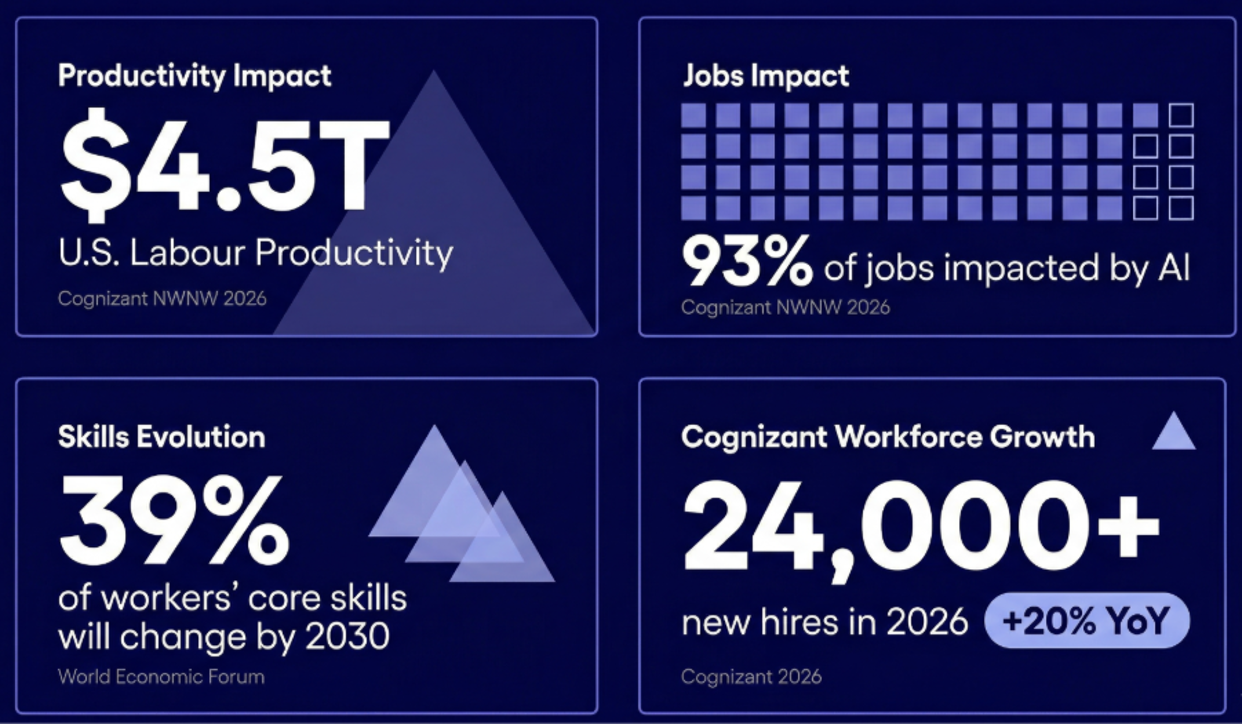
The World Economic Forum projects that 39% of workers' core skills will change by 2030. Demand is rising for AI engineers, data specialists, and domain-led solution architects — alongside enduring needs for leadership, analytical thinking, and socio-emotional skills. The result is a move towards human-led, AI-enabled teams, where productivity gains come from orchestration rather than substitution.
Cognizant's decision to hire 24,000 to 25,000 new talent in 2026 — a 20% increase over 2025 — reflects this reality. The workforce is not shrinking. It is restructuring. The organisations that thrive will be those that invest in developing Applied AI Engineering capability, not those that wait for the perfect model or the perfect tool.
The Design Decision
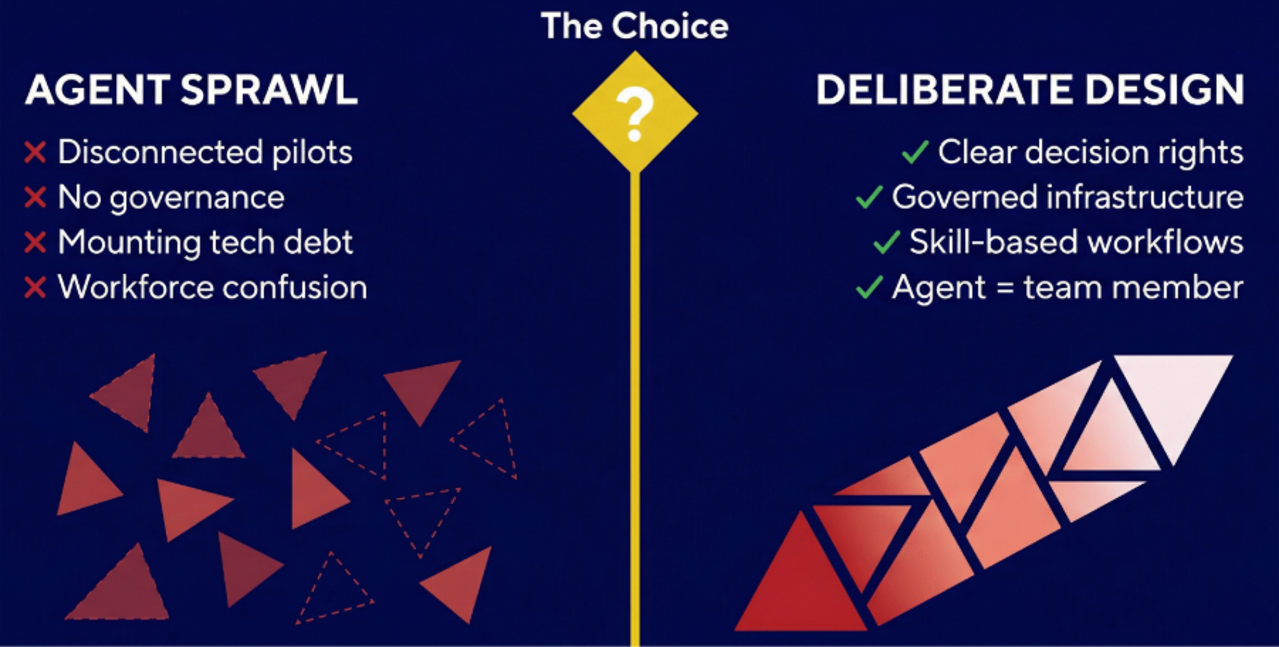
Every enterprise is making a choice right now, whether they realise it or not.
One path leads to agent sprawl: dozens of disconnected pilots, no governance framework, mounting technical debt, and a workforce confused about its role alongside autonomous systems.