














Skip to main content Skip to footer
  • "com.cts.aem.core.models.NavigationItem@79c97200" Careers
  • "com.cts.aem.core.models.NavigationItem@3b20098f" News
  • "com.cts.aem.core.models.NavigationItem@3de4cf69" Events
  • "com.cts.aem.core.models.NavigationItem@25dd9099" Investors
Cognizant Blog

While banks debate strategy, their customers are rapidly embracing an AI-powered world. European financial institutions must lay proper foundations for agentic AI or risk being perpetually behind competitors who invested in the right infrastructure.

JPMorgan Chase made headlines in late September with its blueprint to become "the world's first fully AI-powered megabank," with Chief Analytics Officer Derek Waldron interviewed by CNBC. The bank's LLM Suite platform can now create investment banking decks in 30 seconds—work that previously took teams of junior bankers hours to complete. But here's the crucial detail: JPMorgan spent years building the foundation first.

Some 96% of enterprises are expanding their use of AI agents, according to Cloudera's April 2025 survey of IT leaders across 14 countries. Banking is facing an unprecedented transformation, in which agentic systems—capable of independently executing complex, multi-step tasks and learning from interactions—have transitioned from experimental technology to essential infrastructure.

The global agentic AI market in financial services reached $2.1 billion in 2024 and is projected to hit $80.9 billion by 2034, representing a 43.8% compound annual growth rate, Market.us reported earlier in 2025. North America leads adoption, but European institutions are rapidly closing the gap as they recognize agentic capabilities as core business infrastructure.

This shift reflects broader market pressures. Consumer purchasing behavior is evolving toward intelligent, anticipatory experiences. Regulatory complexity continues to increase across European jurisdictions. Cost-income ratios demand optimization amid uncertain economic growth. Traditional operational models—built for human-centric workflows—struggle to address these converging challenges simultaneously.

Yet implementation remains problematic. While banks understand agentic potential, many struggle with execution. Pilot programs proliferate but fail to scale. Legacy systems resist integration. Workforces lack preparation for synthetic collaboration. The gap between strategic intent and operational reality creates competitive vulnerability for institutions that delay building proper foundations.

The October 2025 Evident AI Index tells the story: JPMorgan Chase leads global banks in AI readiness, while two European institutions—UBS and HSBC—slipped in rankings despite significant investments. Meanwhile, Bank of America and Morgan Stanley made dramatic gains, demonstrating that speed matters less than investing in a systematic foundation.

This three-part series examines how European banks can successfully navigate agentic transformation, starting with the foundational investments that determine long-term success.
 

Agentic future vs today's reality

Sarah, a product owner at a progressive European bank, arrives at her office in 2027 with business cases already prepared. Her AI agents worked overnight, analyzing customer behavior patterns and stress-testing regulatory compliance. Where she once spent weeks gathering information, she now spends time making strategic decisions. Her "sparring agent"—trained to think like a former Big Four auditor—has already flagged potential weaknesses in her proposals.

Meanwhile, business owner Fred receives his daily briefing, which shows automatically compiled business unit performance metrics, optimised cost-income ratios across product lines, and strategic growth opportunities ranked by market potential. This is only achievable because Fred has four unique agents—his Finance agent, Product Manager agent, Business Manager agent, and Strategy agent—all interacting and challenging one another. The Finance agent questions the Product Manager about revenue projections. The Business Manager agent validates market assumptions. The Strategy agent synthesizes their debate into actionable recommendations.

Elsewhere, Elena, the technical owner, discovers that 47 applications were deployed seamlessly while she slept, and that three security vulnerabilities were detected, patched, and documented without human intervention.

Some institutions are already building toward this future. However, most European banks remain stuck between ambition and execution, planning for transformation while struggling to implement it.

Back in 2025, Sarah manually reviews call center reports from yesterday's complaints, scheduling meetings to address problems that occurred 18 hours ago. Information gathering consumes most of her strategic thinking time. Fred discovers business unit underperformance through quarterly reviews—issues that real-time analytics could have flagged weeks earlier. His strategic planning remains reactive rather than predictive. Elena's team worked overnight on system patches, with manual deployment processes creating bottlenecks.

The distance between today's manual processes and tomorrow's autonomous possibilities represents more than technological evolution. It represents a competitive transformation that will separate market leaders from followers.
 

Consumer expectations gap

Consumer behavior is shifting faster than banking transformation. Cognizant's New Minds, New Markets research shows that AI-powered consumers could drive up to 55% of spending by 2030. These customers already experience AI-powered interactions across various industries, including retail, entertainment, and travel. They expect the same from their banks.

Yet financial institutions face a critical implementation gap. While many plan to adopt generative systems, fewer have implemented cross-enterprise solutions at scale. This gap creates more than competitive pressure. It threatens the fundamental economics of the banking industry.

Realizing agentic AI benefits is central to closing the consumer expectations gap and creating necessary headroom in cost-income ratios for the uncertain growth ahead.

Banks are on a journey to find ROI from AI investments. Despite significant spending on proof-of-concepts and pilots, many institutions struggle to demonstrate meaningful returns. Agentic AI can deliver those returns if properly embraced.

The transformation requires a shift from the analog mindset. Like the industrial revolution, successful adoption means lower workforce requirements but dramatically higher output. One progressive European bank shared its workforce planning: 800 human employees will be supported by 2,200 autonomous systems by 2027, with thousands of agents sitting behind these systems. This represents workforce expansion through synthetic collaboration, not replacement.

But achieving this requires foundation investment. Banks attempting agentic transformations without proper groundwork encounter predictable barriers: data trapped in silos, systems that can't communicate, and workforces unprepared for synthetic colleagues.
 

Foundation pillars

Success requires five critical foundations that must work as an integrated system, creating the architecture needed to deliver speed, scale, and sustainable value.
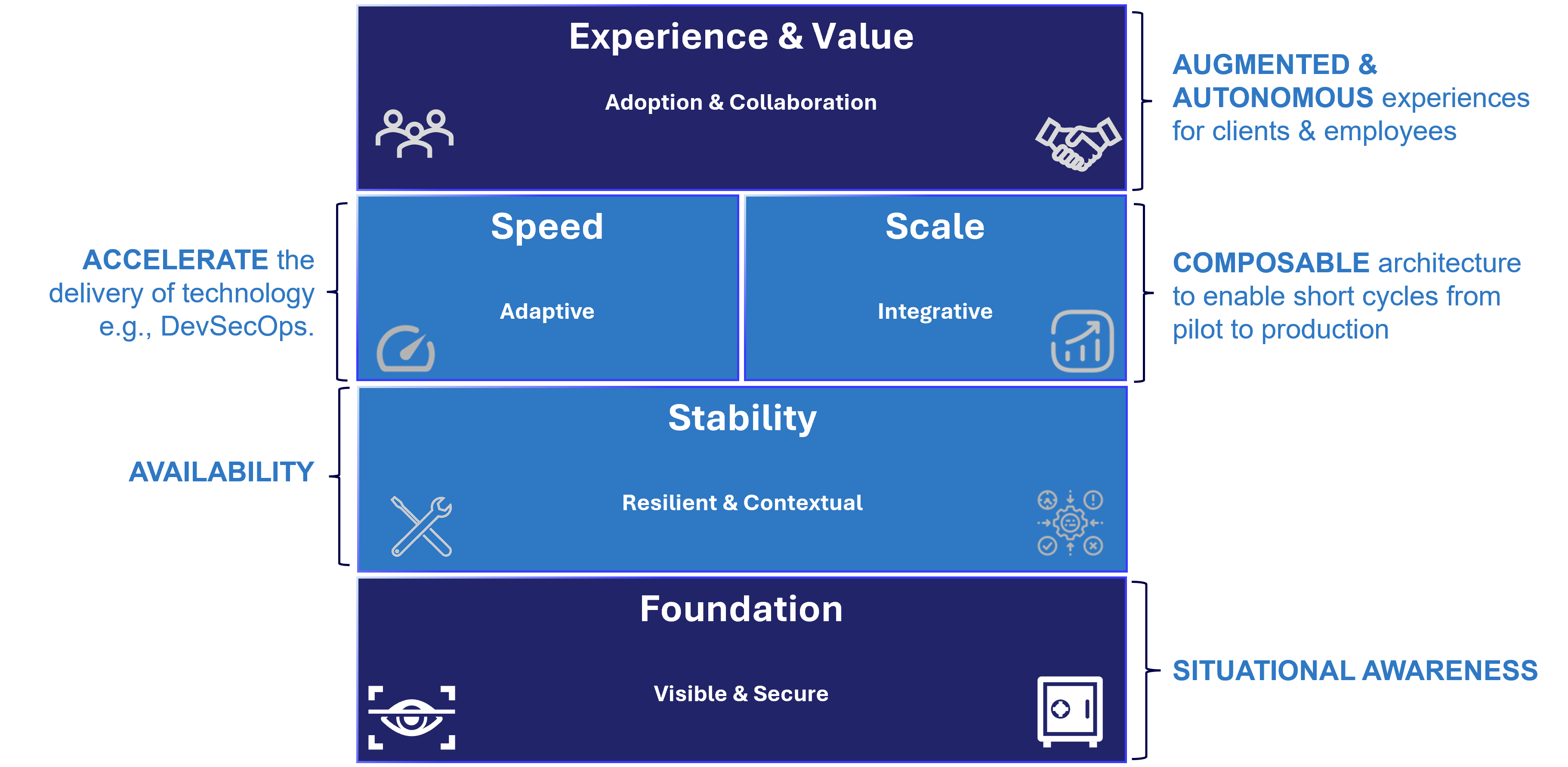

Diagram showing key pillars of an integrated system - Foundation, Stability, Speed, Scale and Experience & Value

Data readiness forms the first pillar. Unified data architectures enable seamless information flow across the organization. Elastic cloud computing scales with demand. Breaking down data silos prevents the communication failures that doom agentic implementations.

Process transformation represents the second pillar. This means redesigning workflows for human-autonomous collaboration, moving beyond simply adding technology to existing processes. The goal is creating orchestrated systems that work as integrated wholes.

Human capability development completes the third pillar. Change management prepares workforces for collaboration with autonomous systems. Skills development focuses on oversight rather than execution. Cultural preparation enables expanded synthetic workforces.

Agent development and orchestration forms the fourth critical pillar. Banks need systematic approaches to building, cataloging, and deploying agents across the enterprise. This includes establishing both a Repository (where agents are stored for reuse) and a Registry (where agents are tracked for governance, utilization, and retirement). Without this foundation, banks face agent sprawl—the same reconciliation agent built 3,000 times across different business units.

Coexistence architecture represents the fifth pillar. Banks can't stop operations to rebuild everything. They need architectures that allow legacy systems, modernization efforts, and agentic capabilities to run in parallel—essentially building a new plane from inside the existing aircraft while it remains in flight.

These pillars must align. Banks with strong data architectures but unchanged processes will struggle. Institutions with modern processes but unprepared people will face cultural resistance. Those deploying agents without orchestration frameworks will create chaos at scale. Foundation investment before deployment determines success.

European banks can transform regulatory complexity into competitive advantage. The sophisticated compliance requirements that seem burdensome create differentiation. Institutions that master agentic compliance capabilities can expand confidently into other jurisdictions.

European approaches to workforce transformation also offer sustainability advantages. Rather than Silicon Valley's intensive work culture, progressive institutions adopt learning-first models: morning hours dedicated to development, afternoons focused on high-value collaboration with autonomous systems.
 

Implementation lessons and strategic imperatives

Client work reveals consistent patterns. Banks attempting agentic implementations without proper foundations encounter the same challenges: fragmented data architectures, disconnected automation systems, and workforces unprepared for synthetic collaboration.

One major European institution—anonymized for confidentiality—experienced pilot paralysis: endless proof-of-concepts that never scaled because they were built on legacy operating models. It achieved an impressive £11 million in savings initially, then stalled for 18 months. Why? No control framework. No agent registry. Compliance teams couldn't answer basic questions about what agents existed or what they were doing. Foundation investment proved essential before system deployment.

Another progressive bank succeeded by treating change management as a critical success factor. They understood that expanding synthetic workforces requires sophisticated cultural preparation, not just technical deployment.

Banks will deploy thousands of autonomous agents within 18 months—agents that will need to be controlled, monitored, understood for utilization, pushed into retirement when obsolete, and validated to be more efficient than their human counterparts. The window for strategic advantage is narrowing rapidly. Foundation investment today determines tomorrow's competitive position.

The choice is binary: leading transformation or responding to competitors' outperformance. Institutions that act decisively now, building proper foundations for agentic operations, will shape the industry's future.

Consumer expectations continue shifting toward intelligent, anticipatory experiences. Competitive dynamics reward early movers. The Evident AI Index shows the spread: JPMorgan Chase sits comfortably at number one, while some European banks continue slipping despite investments. The preparation gap is stark. But for institutions ready to move beyond pilots to production-ready systems, the opportunity remains substantial.

Agentic banking represents more than technological advancement. It offers a pathway to sustainable competitive advantage through proper foundation building. Like performing surgery while the patient remains active, the complexity is enormous, but the alternative is falling progressively behind.

Sarah's 2027 morning—business cases prepared overnight by interacting agents, strategic decisions prioritized over information gathering—awaits banks willing to invest in the foundations that make agentic operations possible.

Banks that understand foundations matter as much as speed will define the industry's next chapter. Yet foundations alone aren't enough. The transformation requires strategic choices: Do you automate roles, redesign processes, or optimize entire value chains? Each approach demands different orchestration methods and delivers different returns.

The next challenge is how to scale agentic capabilities across your organization. That means choosing your vector: enabling hyper-productivity, industrializing AI development, or gentrifying people-intensive workflows. Get the foundations right, and these paths become possible. Skip them, and you're building on sand.

This blog, created in partnership with Microsoft, is the first in our Agentic Banking series. Next in this series: 'Three vectors for enterprise-scale agentic transformation: experience-led learnings at the speed markets demand' and 'The confluence advantage: combining AI with emerging technologies to unlock unprecedented growth'.


References

https://www.cnbc.com/2025/09/30/jpmorgan-chase-fully-ai-connected-megabank.html

https://www.cloudera.com/about/news-and-blogs/press-releases/2025-04-16-96-percent-of-enterprises-are-expanding-use-of-ai-agents-according-to-latest-data-from-cloudera.html

https://market.us/report/agentic-ai-for-financial-services-market/

https://evidentinsights.com/ai-index/

https://www.cognizant.com/us/en/cmp/ai-consumer-journey-new-minds-new-markets


Cognizant UK & Ireland
Author Image

Our experts are contributing exciting insights about what's going on within technology and innovation.


In focus

Latest blog posts

More blog posts