














Skip to main content Skip to footer
  • "com.cts.aem.core.models.NavigationItem@297f4a91" Careers
  • "com.cts.aem.core.models.NavigationItem@155586ab" News
  • "com.cts.aem.core.models.NavigationItem@186edd34" Events
  • "com.cts.aem.core.models.NavigationItem@8197b2d" Investors
Cognizant Blog

European banks are embracing enterprise-scale agentic AI, but there's no single route forward. Cognizant's experience working with financial institutions reveals three distinct vectors for prioritization—and why consciously choosing matters more than following a predetermined path.

Agentic transformation is more than a technology shift—it’s a defining leadership moment. European banks that move decisively can set new standards for customer-centric innovation and unlock new growth models. Yet, with decades of complex systems and processes, IT leaders recognize that success demands a tailored, strategic approach to implementation.

What's emerging from Cognizant's work with European financial institutions is experience-led insight rather than prescriptive blueprints. Three distinct vectors deliver different outcomes at different speeds.

  • Vector one enables product development and accelerates the elimination of technical debt.
  • Vector two pioneers agent development cycles to help enterprises build new AI products and services.
  • Vector three represents a perennial objective: do more with less.

The vector you prioritize first determines which teams you empower, how you measure success, and whether you're building toward enterprise scale or accumulating scattered experiments. Each bank's transformation will unfold differently, but the strategic choices remain consistent.

Vector one: enabling product development and accelerating technical debt elimination

Vector one transforms the software development lifecycle itself. Current teams typically run a set of developers under one manager, clustered in expensive locations. Vector one reconfigures this to a four-to-one ratio, with half the team working from cost-efficient cities. Development cycles run around the clock, passing work across time zones.

JPMorgan Chase exemplifies this approach, as the first article in this three-piece series points out. Its LLM Suite creates investment banking decks in 30 seconds—work that previously took teams hours. The same principle applies to code development, testing, and deployment.

The shift moves from traditional Software Development Life Cycle (SDLC) to what's emerging as ADLC: Agentic Development Lifecycle. You'll maintain some conventional development, but successful banks achieve 80-20 or even 90-10 splits, with agentic frameworks handling routine work. The ADLC becomes dominant: agents handle the actual development while humans focus on architecture, observability, and decision-making.

Technical debt that accumulated over decades starts unwinding at pace. Product development that took quarters compresses to weeks. The constraint shifts from development capacity to strategic prioritization.

Strategic fit: Choose vector one if development capacity constrains your organization, technical debt drowns your modernization efforts, or you need to match competitor velocity. This vector delivers the fastest visible returns with the least organizational disruption.

Vector two: pioneering agent development cycles to build new AI products and services

Vector two addresses what happens after initial success: how do you industrialize agent development to build new AI products and services at scale? This is where most banks can stumble—they prove the concept, then hit the industrialization wall.

The parallel with robotic process automation (RPA) is instructive. Organizations deployed bots across business units. Productivity surged initially. Then they hit 150 bots with no clear ownership, no tracking of what was executed where, and no way to measure which bots delivered value.

Agentic AI provides the intelligence that RPA lacked—genuine decision-making rather than just rules-based automation. But it creates a different challenge: inventory management at scale. Without systematic industrialization, you end up with thousands of agents doing similar tasks across different business units, with no coordination or reuse.

Banks succeeding at scale focus on operations and back-office processes with proper governance frameworks established before expanding deployments.

Vector two establishes three critical components:

  1. Agent repository: Where components live for reuse across the enterprise. Build once, deploy everywhere. This functions like GitHub for agents—version control, component management, and central improvement.
  2. Agent registry: Where agents are tracked for governance, utilization, and cost management. How many agents are deployed? What business services are they executing? Which ones consume excessive compute power relative to the value delivered?
  3. Agent orchestration: How agents coordinate with each other and existing systems. This is the difference between deploying 200 isolated agents versus deploying an orchestrated system where agents pass information, divide work, and escalate to humans appropriately.

Strategic fit: Choose vector two if you're ready to build institutional AI product capabilities, have development and infrastructure teams that can support systematic deployment, or want to establish competitive differentiation through proprietary agents.

Vector three: unlocking new spend pools through workflow transformation

Vector three represents a perennial objective: do more with less. This is the most ambitious path, fundamentally transforming people-intensive workflows to unlock spend pools that weren't previously addressable. This goes beyond replacing human efforts with agents—it's about reimagining entire workflows to deliver outcomes that weren't economically viable under traditional operating models.

The strategic question becomes: where do you intervene?

Three distinct paths emerge, each aligned with different organizational priorities.
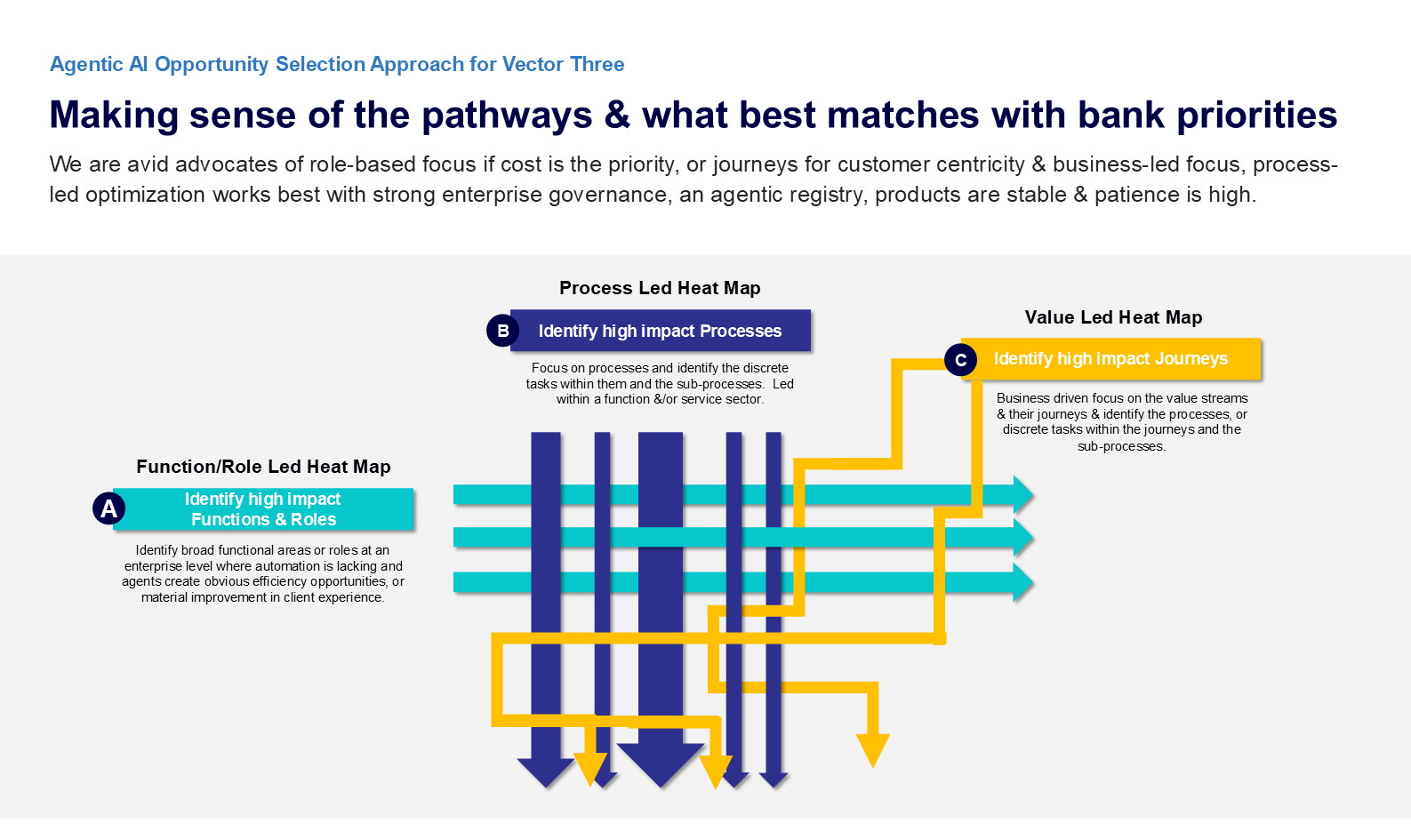
Agentic AI Opportunity Selection Approach for Vector Three

Path A: Role and function-based automation targets specific job functions or roles horizontally across the organisation. Reconciliations, for instance, exist multiple times within the enterprise and are targeted regardless of which product or process they sit within.

This delivers fast cost reduction and addresses talent shortages. The trade-off is creating horizontal capabilities that cut across multiple processes without achieving end-to-end transformation. Eventually, you'll need to consolidate these into cleaner architectures.

When cost is the priority, role-based focus works best.

Path B: Process-based automation focuses on discrete processes and identifies specific tasks within them. Led within a function or service sector, this redesigns entire business processes vertically. Trade confirmations, client onboarding, and regulatory reporting—each process is completely rearchitected.

This produces cleaner architectures and addresses root causes. It works best with strong enterprise governance, an agentic registry, stable products, and a high level of patience.

Path C: Value stream optimization takes the diagonal approach: end-to-end value delivery from initial client contact through revenue generation. This delivers direct P&L impact by focusing on business outcomes rather than solely on efficiency gains.

The complexity arises when orchestrating across multiple functions and systems simultaneously, requiring sophisticated change management and executive sponsorship. When customer centricity is the priority, value streams deliver stronger results.

Most banks will eventually use elements of all three approaches. Vector three succeeds when you consciously choose your primary path based on strategic priorities rather than letting individual business units each pursue their own approaches independently.

Strategic fit: Choose vector three if you have executive sponsorship for comprehensive transformation, clear P&L metrics, and organizational maturity to navigate complexity across functions.

Three paths, one bank

Sarah, Fred, and Elena—the three personas from the first article —now face different strategic choices within the same institution.

Sarah's product team prioritized vector one. Her development cycles compressed from quarters to weeks. Technical debt that paralyzed innovation started unwinding. Her agents draft user stories, generate test cases, and automatically flag regulatory implications. The trade-off? Her team still works alongside legacy systems, creating the coexistence complexity the bank must manage.

Fred's operations division wrestled with vector two. After early success, his reconciliation agents proliferated across business units. Fred pushed for the agent registry that would track utilization and cost. The governance infrastructure felt like bureaucracy to teams wanting speed, but Fred recognized that without it, they'd recreate the RPA chaos.

Elena's infrastructure team is building vector three capabilities: the orchestration framework allowing agents to work across the entire value chain. When Sarah's development agents deploy code, they interact with Elena's infrastructure agents. When Fred's reconciliation agents detect issues, they trigger workflows spanning multiple systems. Elena orchestrates human and synthetic workforces across 40 business services simultaneously.

What experience teaches

Three practical realities determine which banks scale successfully:

Declare your vector priority early. Sarah, Fred, and Elena each chose different paths based on their constraints. Banks that let each unit pursue its own approach end up with scattered experiments. Build competency in one vector before expanding.

Build coexistence architecture from the start. Legacy systems, modernization efforts, and agentic capabilities must run in parallel. Sarah's team proves this daily—new agents working alongside systems built in the 1990s. There's no other viable path.

Establish a registry before you need it. Fred learned this from the RPA era. Without visibility into what agents exist, where they execute, and what value they create, you're flying blind and recreating duplicates. The registry isn't bureaucracy; it's survival.

Few banks pull ahead through systematic execution, while others slip despite significant investments because spending without systematic prioritization delivers scattered experiments rather than enterprise-scale transformation. The Evident AI Index shows the pattern clearly.

The lesson from Cognizant's experience isn't about following best practices—it's too early for those in the agentic AI space. Instead, it’s about choosing your priorities consciously and building the capabilities to execute at scale. Each bank will embrace agentic transformation in its own way, but the strategic framework for making that choice remains remarkably consistent.

This blog, created in partnership with Microsoft, is the second in our Agentic Banking series. Read the first one: Agentic banking: why foundations matter as much as speed

Next in the series: The confluence advantage: when banks combine AI with emerging technologies to unlock unprecedented growth.

References

https://www.cnbc.com/2025/09/30/jpmorgan-chase-fully-ai-connected-megabank.html

https://www.cognizant.com/uk/en/insights/blog/articles/banking-outlook-2025

https://evidentinsights.com/ai-index/


Cognizant UK & Ireland
Author Image

Our experts are contributing exciting insights about what's going on within technology and innovation.


In focus

Latest blog posts

More blog posts