


















Discover industry-specific solutions and expertise.
Solve your toughest A&D challenges with Belcan.
Ignite peak performance and efficiency in your business.
Reimagine your manufacturing competitive advantage.
Accelerate growth with customer-focused solutions.
Deepen customer loyalty, drive long-term relationships and boost profitability.
Meet customer demands for a digital, personalized online insurance experience—while reducing risk.
Digitally transform to empower a more intelligent, agile and high-performing enterprise.
Helping US federal, state and local governments modernize technology, reimagine processes and transform experiences.
Deep industry expertise to propel your business into the future.
Turning Agentic AI into governed enterprise value
Modernization that secures and enables enterprise AI
Real-time AI governance, security and trust at scale
Scaling sovereign enterprise intelligence
Maintain high integrity across the AI lifecycle.
Transforming workforces at the speed of AI
AI-powered business operations automation
AI insights to inspire enterprise transformation.
Uncover the $6 trillion in trapped AI potential hidden in the workforce.
Turn AI spending into real productivity gains by investing in workforce skilling.
Discover how to become a high AI performer—and realize billions in AI returns.
Explore the latest in AI in our newsletter released bimonthly.
Explore how our expertise can help you sense opportunities sooner and outpace change.
Written by Luka Stanisavljević
08 August, 2023

At Cognizant Benelux, we try hard to make the content we present to our users understandable. Let’s elaborate on how two main figures of speech – metaphor and metonymy – can help to be clear and concise, and how they can have adverse effects if used incorrectly.
Why are these two figures of speech the main ones? Because they are the basis of two main mental processes on which every creation relies: selection, which provides basic building blocks, and composition, which puts them together. It is important to understand how each of them works, because individuals have different abilities to perceive them; therefore, understanding the distinction is essential when writing content with cognitive accessibility in mind.
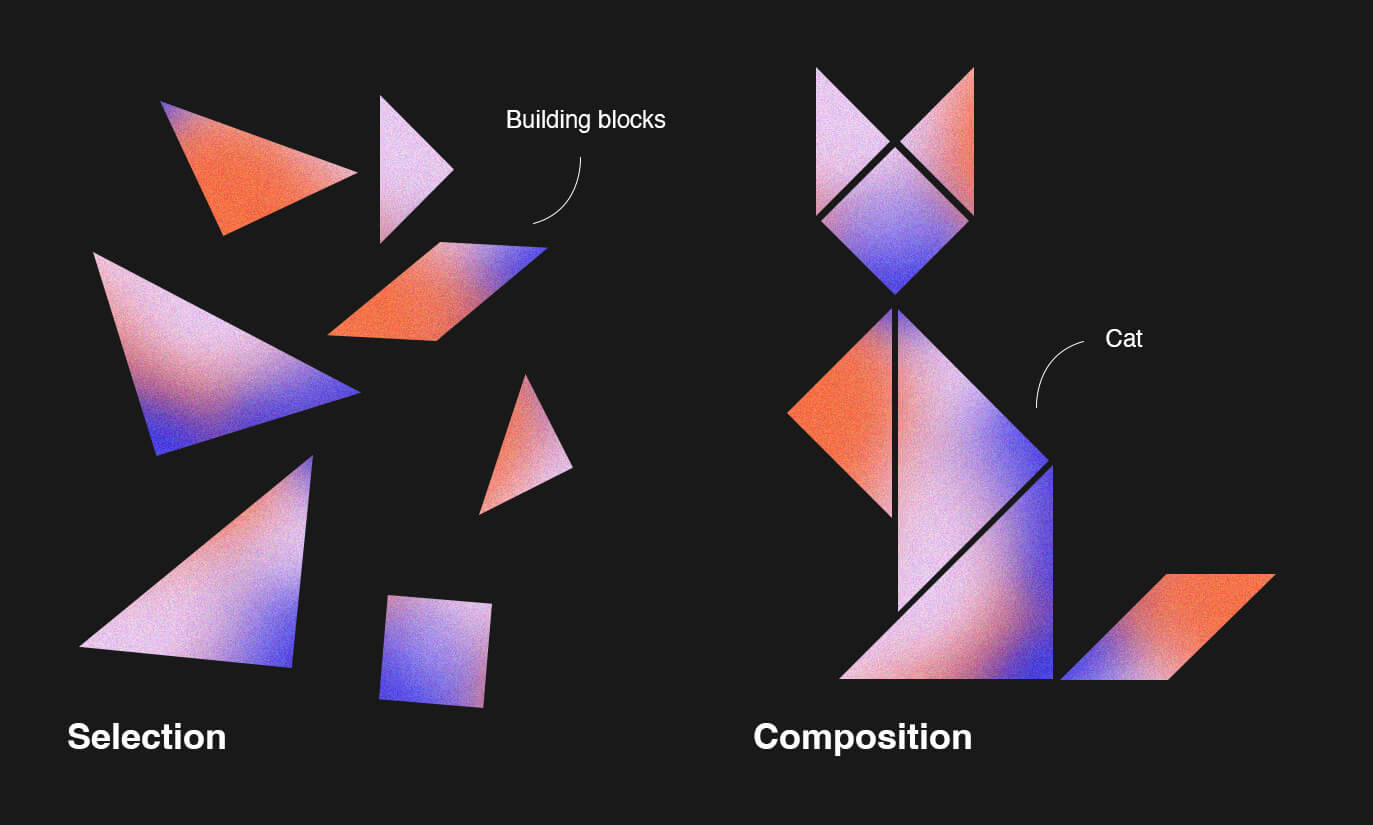
Images by Mariëlla van de Stolpe
Metaphor is the first figure of speech that comes to most people’s minds. It replaces one word or expression with another, to make it more understandable, interesting, or memorable. It relies on comparison and similarity. For example, Virginia Woolf calls the human mind “the most capricious of insects”; referring to something abstract by comparing it to something visible.
But metaphor isn’t only a writer’s tool. Jargon of the street, office, news media, sport, or even product development, includes metaphors too:
Metaphor has a less-known, but equally widely-used sibling, called metonymy. They are both used to make content either more memorable or easier to understand. But it is important to grasp the difference, because different mental processes drive them.
Metonymy doesn’t compare to anything else but replaces the word with something from its own context. For example, the tool with the tool’s purpose, part with the whole, verb with the corresponding noun, and so on:
Metaphor and metonymy aren’t just two figures of speech. They are fundaments of two different ways of perceiving the world. Linguist Roman Jakobson wrote an influential essay in 1956, in which he researched two types of aphasia, reflecting on the lack of understanding of either metaphor or metonymy.
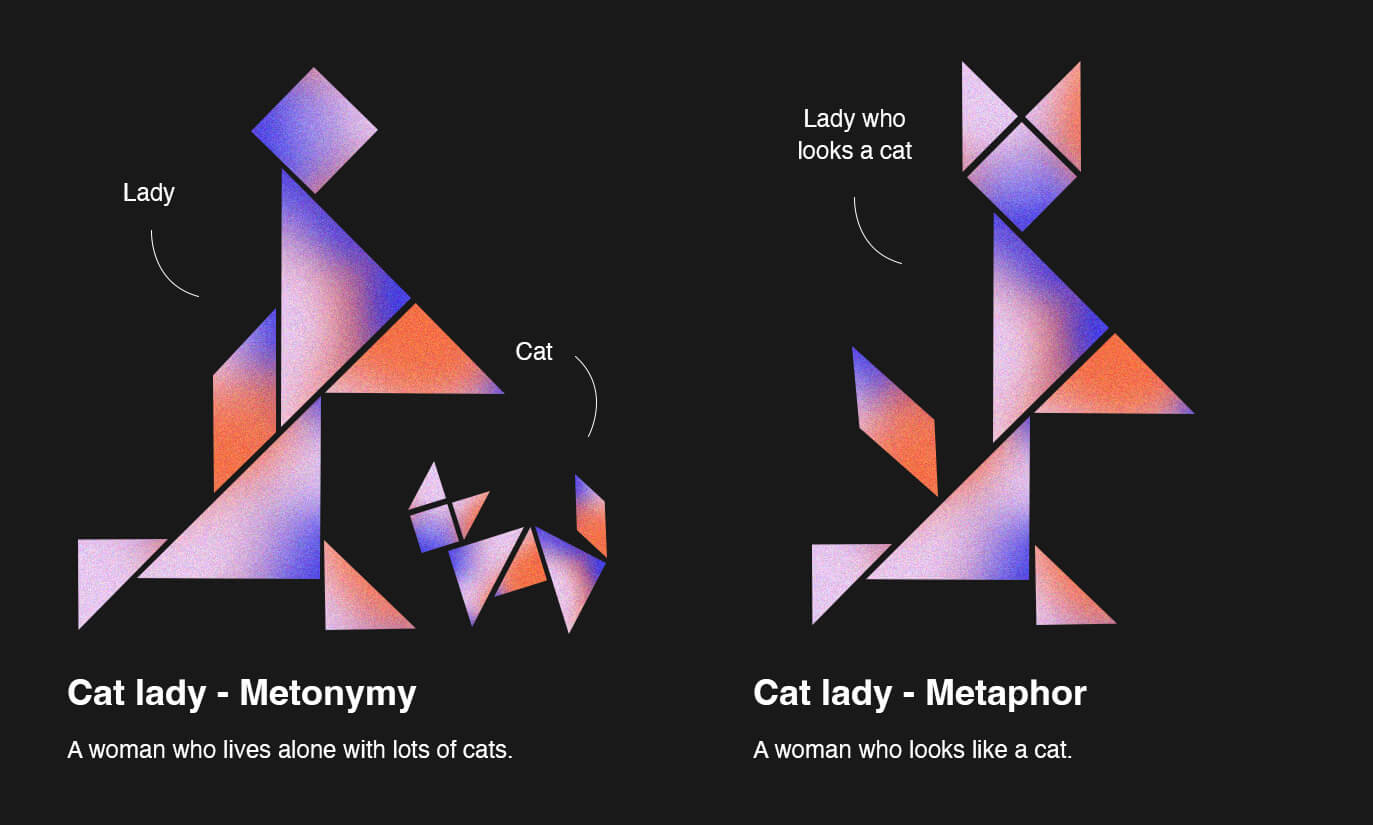
Images by Mariëlla van de Stolpe
Like with all types of accessibility concerns, there is a whole range of potential recipients with a certain impairment present in different degrees, from barely noticeable to the extreme. In the case of understanding metaphor and metonymy issues, these extremes are called similarity disorder and contiguity disorder.
Important is that between these two extremes lays the whole range. Think about what makes it difficult for you when learning a new language. If it’s grammar, you are a more “metaphorical” type of person. If it’s vocabulary, you are more “metonymical”.
Does this all mean we should drop metaphors or metonymies? Certainly not. But we should acknowledge the difference between the two and be aware that there are people who have difficulties understanding one or the other. Here are just a few things you can do out of the box (which is a metaphor) and a few no-nos (which is a metonymy):
Again, if all this looks like suggesting yet another limitation to the copywriter’s creativity, it really isn’t. On the contrary, both metaphor and metonymy help make your content more accessible if you use them the right way. It applies to both accessibility and inclusivity, which aren't mutually exclusive.
In one of the following articles, we will discuss how metaphor and metonymy reflect in visual content, from Rembrandt’s paintings to icons on a website. You choose whether to stay tuned (metaphor) or to keep your eyes peeled (metonymy).
References:
1. Woolf, Virginia. (1953) A Writer's Diary. Edited by Leonard Woolf. Oxford University Press, 2003.
2. Jakobson, Roman. (1956). Two Aspects of Language and Two Types of Aphasic Disturbances. In Jakobson, R., & Halle, M. (Eds.), Fundamentals of Language (pp. 27-87). The Hague: Mouton.