


















Spanning luxury properties, budget chains, and independents, the UK hotel industry was valued at £24.3 billion in 2024 – a sharp rise from £18.4 billion in 2019 [1][2].
Yet a host of factors – from shifting customer expectations and rising costs to regulatory changes and sustainability demands – now threaten revenue growth. Innovative strategies are urgently needed.
With competition intensifying and guest demand surging, how can hotels achieve sustainable growth? The answer lies in harnessing data-driven insights, digital channels, and new business models.
Challenges on all sides
Hotels face multiple pressures, including increased demand, fast-changing customer behaviours, and the rise of ‘bleisure’ travel, where business trips double as leisure breaks.
With nearly 60% of reservations now online, digital excellence is essential — from seamless booking journeys and personalised offers to data-driven social media marketing. Urban decentralisation to secondary cities requires tailored offerings, while labour shortages drive fierce competition for talent. Add sustainability imperatives, rising costs, and higher National Insurance contributions, and the scale of the challenge is clear.
Solutions to drive growth
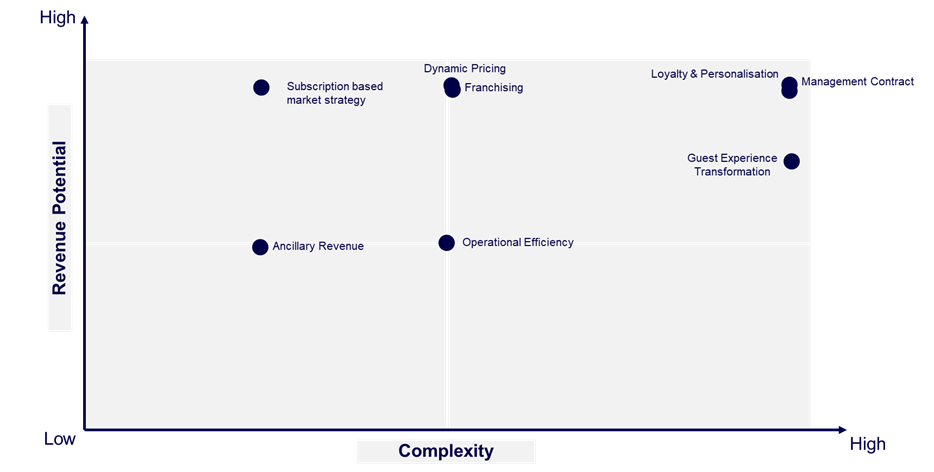
Short-term tactics like raising room rates won’t deliver lasting results. Hotels need new revenue models that support sustainable growth. Key strategies include:
- Embrace AI and dynamic pricing: AI-driven pricing engines continuously adjust rates based on demand, events and competitors, tailoring offers through personalisation. Integration with revenue intelligence tools can lift RevPAR by 12–15% [3].
- Unlock ancillary revenue: Ancillaries can represent up to 25% of revenue, but most hotels capture under 10% [4]. Opportunities include hourly room bookings, upselling upgrades and services, premium Wi-Fi, parking, early/late check-in, spa and dining packages, e-commerce, and partnerships with local experiences.
- Boost loyalty and personalisation: Only 35% of UK travellers use loyalty programmes. Hotels should build first-party data through CRM platforms and offer tiered schemes, including via white-labelled solutions. Expanding partnerships with wellness, travel, dining, fitness, and e-commerce brands can further enhance value.
- Transform guest experiences: Transformation should span pre- to post-booking. Reducing reliance on OTAs through SEO/SEM and CRM personalisation improves customer journeys; shifting just 10% of bookings from OTAs to direct channels can boost margins by 5–7% [6].
- Improve operational efficiency: Lean operations, energy analytics, and AI-driven automation can significantly reduce cost per occupied room (CPOR) and streamline workflows. Comprehensive diagnostics across labour, utilities, tech, marketing, and F&B can achieve 20–25% cost savings [7].
- Adopt subscription models: Recurring fees for stays, amenities, and exclusive experiences — plus monetising underused areas as co-working spaces, event venues, or pop-up retail outlets — open new revenue streams. Suburban hotel co-working space use has grown by 30% [8], with targeted campaigns boosting inbound bookings by 18% in 2024 [9].
- Expand through franchising and management contracts: These models enable brands to scale with minimal capital and ensure operational consistency. Currently, only 13–17% of UK hotels use franchising — far below the Middle East (84%) and US (70%) [10][11][12].