

















Telecommunications operators face a fundamental shift—AI agents that converge network operations with customer engagement, detect issues, assess customer impact, and proactively deliver next-best actions to both the customer and the network.
It's 3am in April 2027. A mobile base station serving London's financial district breaches latency thresholds, affecting 200 customers, including 50 enterprise accounts. Within seconds, the system maps affected subscribers, triggers proactive notifications, raises a ServiceNow ticket, and initiates self-optimising protocols to reallocate radio resources.
The entire incident lifecycle happens autonomously. No engineer was woken. No customer service agent intervened. This is the agentic future of telecommunications operations.
Over 50 million hours and £3.7 billion were lost by UK businesses in 2023 due to internet failures, according to research published by Beaming, an Internet Service Provider (ISP). Additionally, a surge in internet dependence—supercharged by the advent of generative AI—has sent the cost of downtime soaring to some 400% above 2019 levels, the study shows. Given that traditional Network Operations Centres (NOCs) require three shifts daily to cover 24 hours, the staffing model is expensive and increasingly unsustainable.
Meet the digital workforce converging network and customer operations
The traditional telecoms model segregates network and customer operations. Network teams detect issues, assess technical impact, and restore service. Customer teams field complaints, manage communications, and handle escalations. The handoff between these domains creates delays, information gaps, and missed opportunities to transform service degradation into proactive engagement.
The agentic model bridges this divide through specialised AI agents that translate network events into customer and revenue impact within seconds. Digital labour collaborates autonomously across both domains, making contextual decisions to enhance customer experience.
Picture a network operations manager in 2027. Optimal ROI scenarios for network expansion arrive prepared. Customer churn risk correlates with service quality overnight. Compliance is stress-tested. Recommendations come pre-vetted by agents trained to think like the network strategy and planning team. The human role shifts from information gathering to strategic decision-making.
Network operations already use machine learning for fault detection and performance optimisation. What's changing is the shift to AI agents—autonomous systems that act, not just analyse. The critical distinction: avoid building isolated micro-agents or single-purpose pilots that can't evolve or interconnect. Instead, build modular components that scale as one coherent ecosystem where knowledge compounds over time.
Embracing the convergence supercharged by AI agents
Building this convergence requires more than individual AI agents. It demands sophisticated orchestration that coordinates specialised agents to detect network issues, assess customer impact, execute remediation, and engage customers—all autonomously.
Cognizant has built Neuro® SAN—short for System of Agentic Network—as our proprietary orchestration platform designed specifically for cross-agentic interactions. Built on the open-source LangChain framework, it coordinates AI agents across SaaS providers like Salesforce, ServiceNow, Amdocs; Hyperscalers like Google, Amazon; and custom-built platforms, enabling what we call a heterogeneous Agent-2-Agent ecosystem.
Think of it as a digital workforce, with each member handling a specific aspect of network operations and customer engagement. The platform discovers agent capabilities, securely authenticates agents, understands the intent, routes tasks to appropriate agents, orchestrates complex workflows across agents, and provides end-to-end observability with audit trails for every autonomous decision.
For instance, your digital team might include:
• Your network engineer is now OutageGuard, an AI agent that monitors network health, detecting faults before they cascade.
• NetworkAware conducts health checks, comparing latency and throughput against baselines to predict degradation.
• And ServiceAware maps network resources to services, identifying affected customers by connecting subscriber data to infrastructure.
This is where convergence happens. ActionIQ triages customers, enriching network data with CRM intelligence to flag VIP status, churn risk and revenue value. This translates technical problems into business impact. CareConnect manages communications and triggers proactive notifications through preferred channels, informed by network context and customer history. Remediate resolves faults by triggering self-optimising protocols. FixIt handles ticketing and assignment across both operational domains.
When problems can't be resolved autonomously, agents escalate to human engineers with full context logged across the network and customer systems. Data flows into a knowledge base for reinforcement learning. The system gets smarter with each incident.
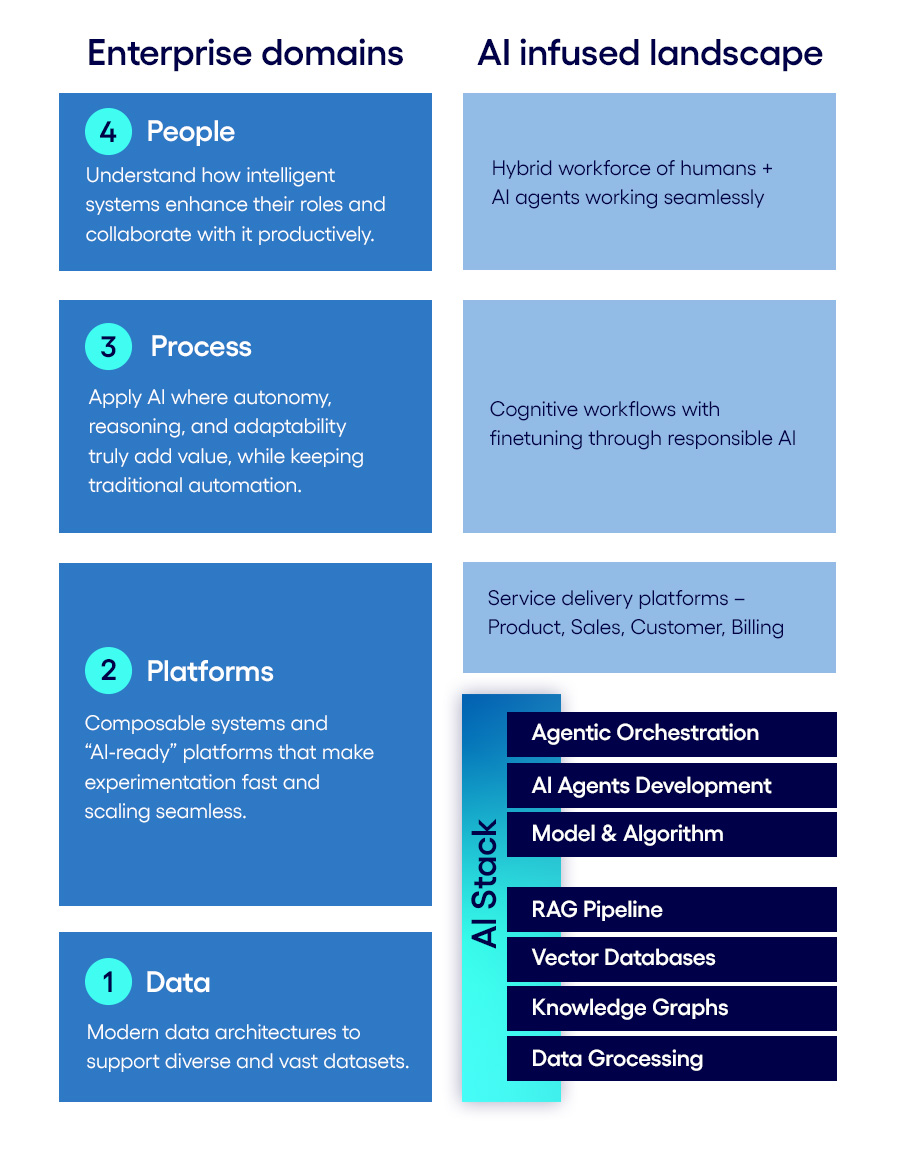
This agentic future requires re-architecting the enterprise: the data; platforms; processes; and people.