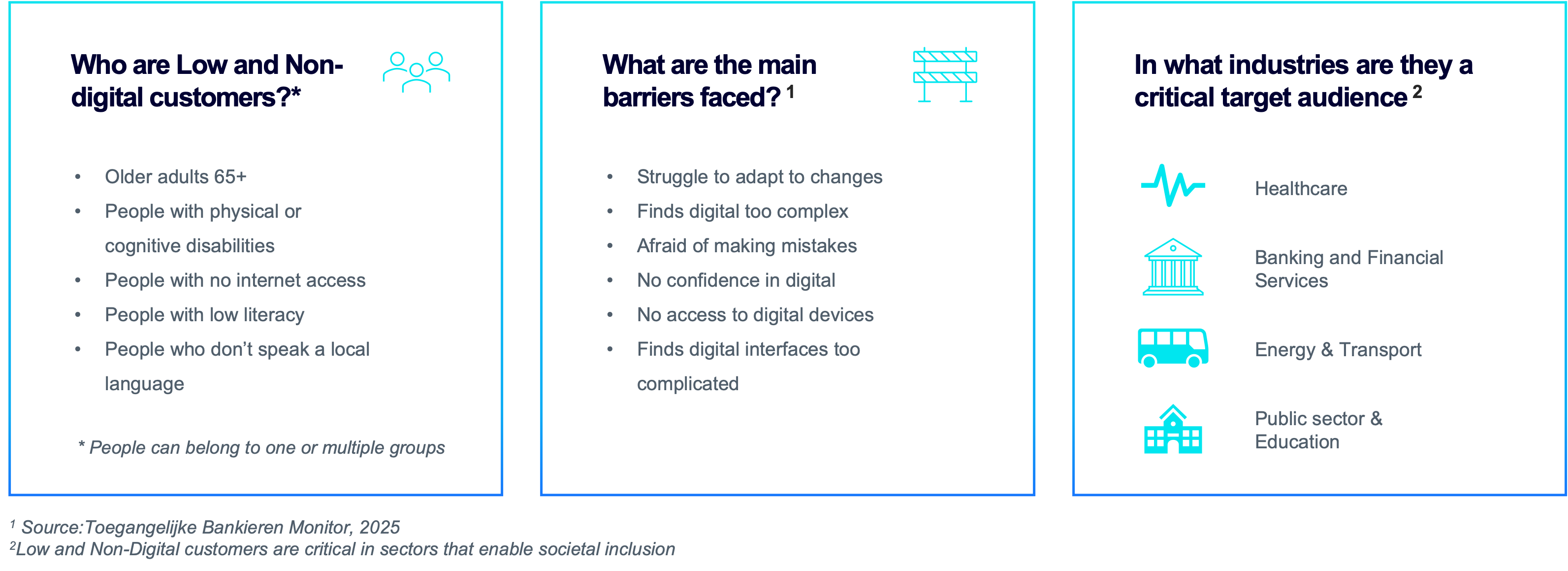
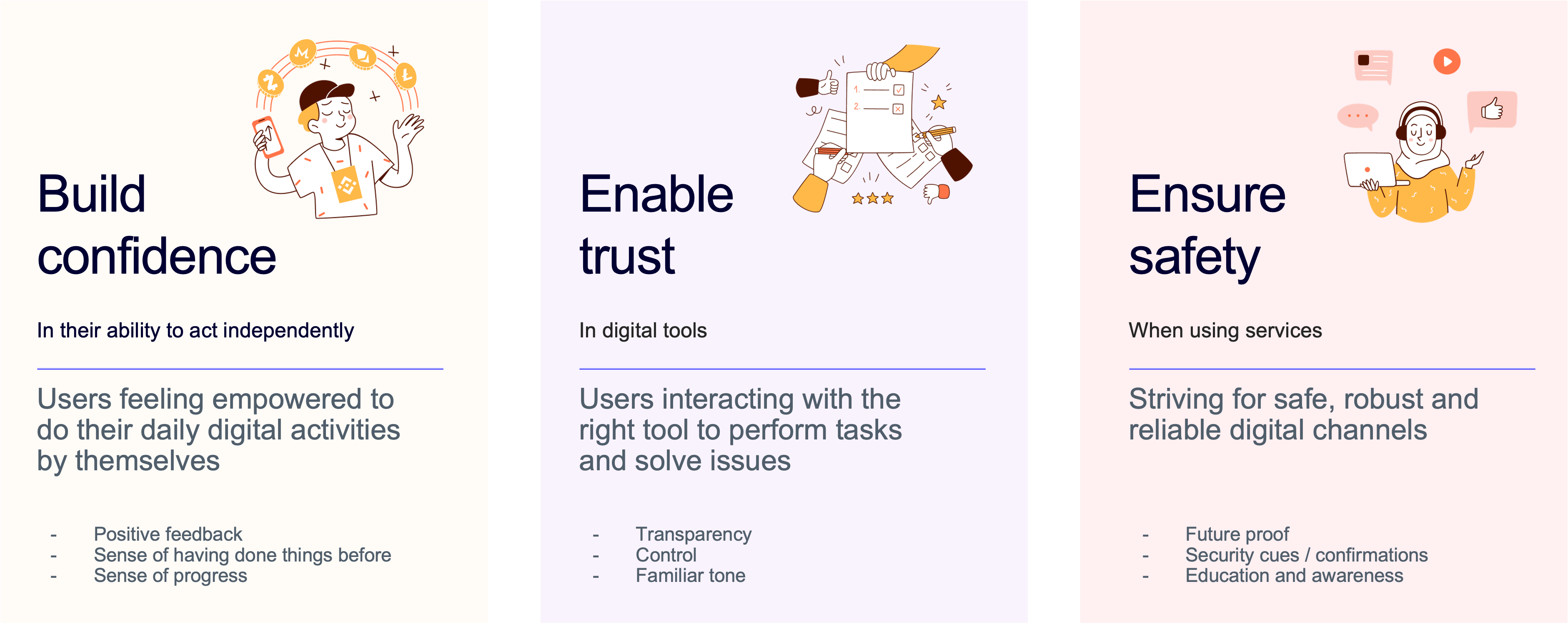
Figure 2 Experience principles for Low and Non Digital customers.
2. Support the supporters
The help provided by family members or other personal connections to low and non-digital is often disregarded but an essential part of the challenge to solve. Despite their fundamental role, these ‘supporters’ are usually not recognised by the service providers, nor facilitated in their function. Many organisations are (rightly) concerned about the risks around potential misuse of support, (e.g. customers sharing their log-in credentials or loosing total control of their digital profiles). Enabling ways to allow support to happen in a safe way is critical step forward.
3. Responsible AI as a digital enabler
Emerging technologies can help bridge the gap, but only when designed through Responsible human-‑centered approaches that protect agency, support human ways of learning, and remain transparent and ethical. For example, AI interactions can be built to detect or act on self-reported conditions, calibrate speed, adjust words, change language and complexity or become a step-by step tutor. This personalization can bring more accurate personalisation, lower barriers (e.g. language, speed, explainability) and enable the independence of many digitally excluded. However, Inclusive AI and design iterations needs to be deeply embedded in these developments.
It’s important to note that given the systemic nature of this challenge, no single solution will act as a silver bullet. Effective progress requires collaboration across the entire ecosystem, along with an approach that combines both short and long-term strategies and interventions.
Key takeaways
- The challenge of improving services for low and non-digital customers is a systemic one. A wide range of complex factors are involved — such as education, financial and digital literacy, and the availability of accessible and flexible services — and they all influence the adoption of digital solutions. This means that only a holistic approach, combining short- and long-term, local and systemic interventions, will lead to meaningful change.
- There will always be a segment of customers requiring support in their digital interactions, due to the rapid pace of technological advancement, to an increasingly ageing population and to structural educational gaps in literacy and complex services skills. Efforts for this target audience need to be part of day-to-day design and strategic decisions and deserve iteration and focus.
- Initiatives for this audience can benefit all customers. Interventions to support low and non-digital customers go beyond accessibility and can have a huge positive impact in the experience of digital customers. They simplify experiences and stress test them for unseen/unexpected situations.
Designing for low and non-digital customers is key to develop future and more resilient solutions that empower and deliver seamless experiences for all.
References
(1) Accessible Banking Monitor (2025). Annual accessibility benchmarking report.
https://toegankelijkbankieren.nl/2025/05/13/tweede-monitor-toegankelijk-bankieren/
(2) Eurostat (2025). Digital banking adoption statistics by age group. In: Digitalisation in Europe – 2025 edition.
https://ec.europa.eu/eurostat/web/interactive-publications/digitalisation-2025
(3) “New Economy Skills: Building AI, Data and Digital Capabilities for Growth”, World Economic Forum White Paper.
https://reports.weforum.org/docs/WEF_New_Economy_Skills_2025.pdf
(4) Central Bureau of Statistics, The Netherlands, Population Forecast: more elderly than young people. https://www.cbs.nl/en-gb/news/2025/51/population-forecast-more-elderly-than-young-people NL about percentage of 80+ increase in the next 10 years
(5) OECD Digital Economy Outlook 2024 (Volume 2),
https://www.oecd.org/en/publications/2024/11/oecd-digital-economy-outlook-2024-volume-2_9b2801fc/full-report/skills-for-the-digital-age_da6162fb.html
(6) OECD (2025). PISA financial literacy results [Assessment Report]
https://www.oecd.org/en/about/programmes/pisa.html
(7) 2023 Eurobarometer survey results:
https://finance.ec.europa.eu/news/eurobarometer-survey-reveals-low-levels-financial-literacy-across-eu-2023-07-18_en