















Skip to main content Skip to footer
  • "com.cts.aem.core.models.NavigationItem@2ea72341" Careers
  • "com.cts.aem.core.models.NavigationItem@161b815e" News
  • "com.cts.aem.core.models.NavigationItem@67759948" Events
  • "com.cts.aem.core.models.NavigationItem@439d83e5" Investors
Cognizant Blog

As part of River Deep Mountain AI, we are releasing the latest version of our open-source remote-sensing model  capable of detecting bare winter croplands, which represent potential sources of  non-point pollution in river catchments.

In England, agriculture is one of many sources of pollution impacting water quality. For instance, around 60% of nitrate, 25% of phosphorus and 75% of sediment in water bodies is estimated to originate from agriculture. These pollutants, together with others, contribute to only 14% of water bodies in England meeting the “good ecological status” defined by the Water Framework Directive.

When assessing the pollution risk of a river catchment, it’s often necessary to do walkovers next to the river to detect areas with increased run-off risks. These walkovers are time-consuming, inefficient and ideally need to be undertaken during wet weather to give an accurate understanding of potential pollution risks.

To try and help reduce the financial costs associated with time-consuming walkovers, we are developing several remote sensing-based models utilising computer vision and satellite imagery to detect potential sources of pollution. Now, we are releasing the first one, focused on detecting bare croplands.

These models will help enable catchment managers and other stakeholders to quickly pinpoint some of the potential sources of pollution within a catchment for targeted investigations.

Detecting bare cropland 

Bare cropland detection is useful for identifying areas with greater runoff risk, where pollutants like fertilisers, pesticides, and sediment are more likely to be transported into nearby water bodies during periods of rainfall. Identifying bare cropland can assist in pinpointing potential pollution hotspots for targeted measures to mitigate water contamination.
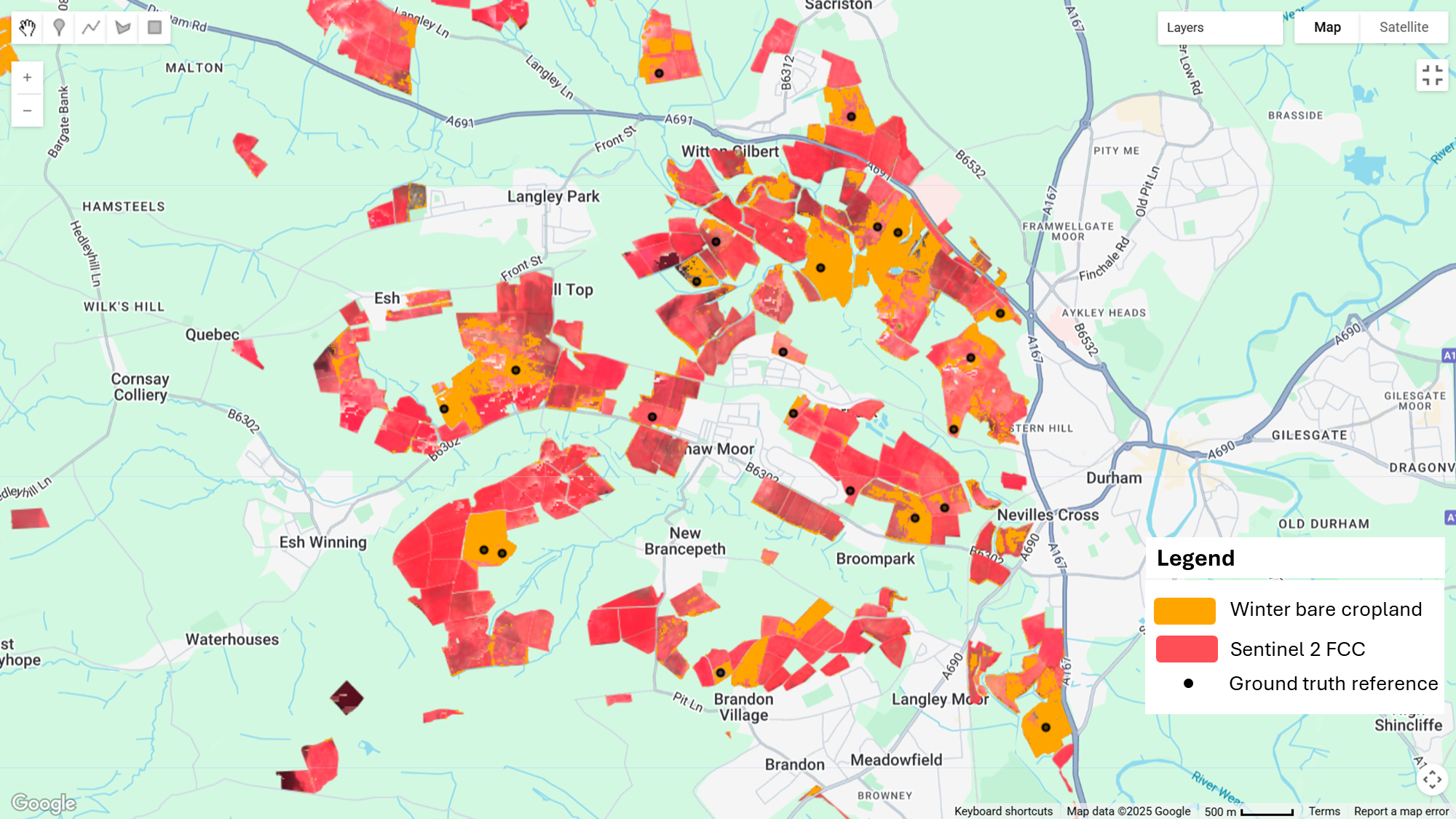
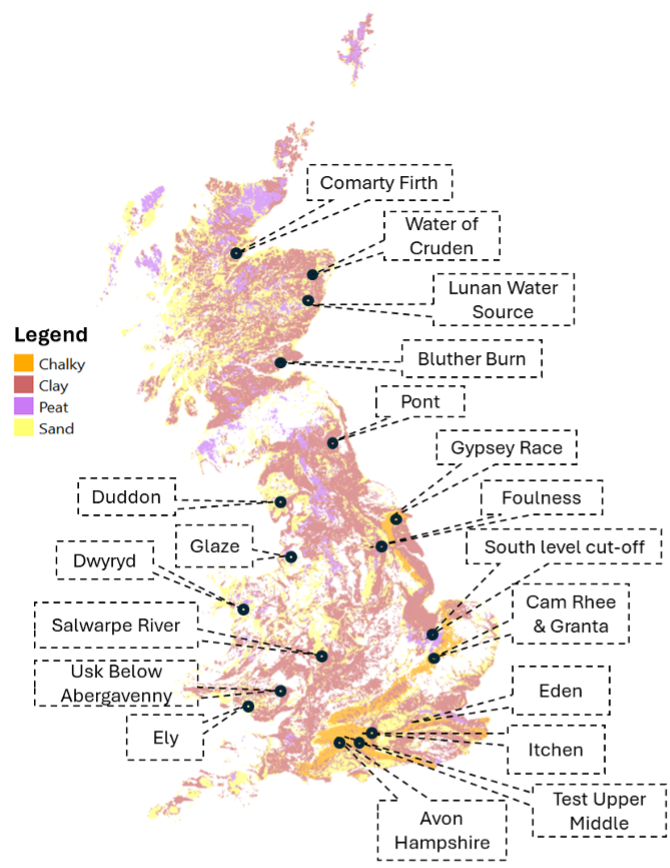
Image: Satellite imagery can reveal great level of detail, for example, Sentinel-2 has a 10-m spatial resolution and 13 spectral bands. Derived indices evaluate surface conditions across different seasons and challenging weather conditions, ensuring accurate detection of bare cropland. 


Our remote sensing-based model focuses on identifying bare cropland at sub-annual timescales, primarily utilising the Bare Soil Index (BSI). To support and enhance the accuracy of BSI, we also analyse Soil-Adjusted Vegetation Index (SAVI), Normalized Difference Moisture Index (NDMI), and Normalized Difference Snow Index (NDSI). This methodology allows for monitoring across multiple time periods during a year, ensuring that changes in land cover are accurately tracked and managed. The method demonstrates an accuracy exceeding 80%. Therefore,  the model can efficiently detect bare cropland across any given date range, offering a reliable tool for environmental monitoring and management.   

Since the first release of our model  (in June 2025), it has undergone extensive validation to confirm that the accuracy seen in the initial development also applies to new catchments.  For this purpose, a total of 19 UK catchments were chosen to represent a wide range of spatial and environmental variability, supporting robust validation of the model output across diverse landscapes.

map of great Britain

Image:Selected catchments of different soil types for validation (source: BGS). 


The model demonstrated strong and consistent performance across different regions and soil types. Across all four soil types, the Open Bare Cropland Detection Model had an average accuracy of 94% (ranging from 93% to 94%)   . The model development, validation and performance metrics are explored in-depth in the Model Output Report shared alongside the model on GitHub.

A collaborative and open-sourced approach

The overarching objective of River Deep Mountain AI is to bring key stakeholders involved in waterbody health together and collaboratively develop open-source AI/ML models that can inform effective actions to tackle waterbody pollution.  

Our Open Bare Cropland Detection Model is part of a suite of remote sensing models focused on detecting potential sources of pollution. All our models will be released open source to democratise artificial intelligence and benefit the entire water sector. 

Access our AI and remote sensing-based models open source via GitHub.

River Deep Mountain AI is funded by the Ofwat Innovation Fund and consists of 6 core partners: Northumbrian Water, Cognizant Ocean, Xylem Inc, Water Research Centre Limited, The Rivers Trust and ADAS. The project is further supported by 6 water companies across the United Kingdom and Ireland.


Cognizant Nordics

Our experts are contributing with exciting insights about what is going on within technology and innovation.


Latest posts
Related posts