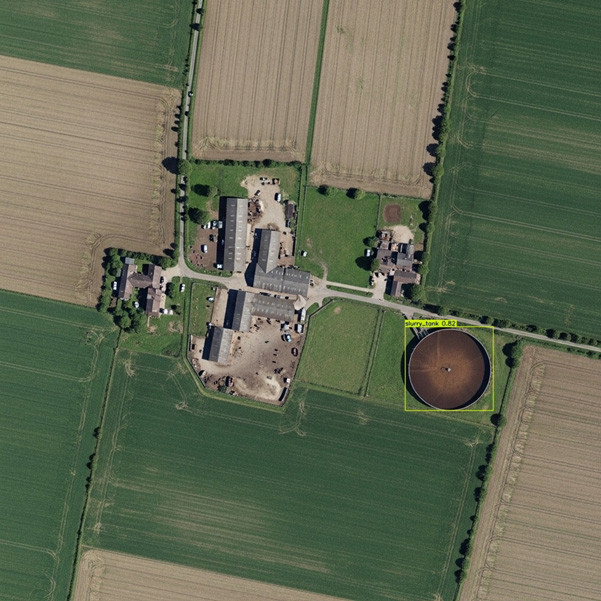



















As part of River Deep Mountain AI, we are releasing the latest version of our remote-sensing model capable of detecting above-ground, circular slurry tanks. Slurry tanks are important as they represent potential sources of diffuse agricultural pollution in river catchments. In England, agriculture is one of many sources of pollution impacting water quality. For instance, around 60% of nitrate, 25% of phosphorus and 75% of sediment in water bodies is estimated to originate from agriculture[1]. These pollutants, together with others, contribute to only 14% of water bodies in England meeting the ‘good ecological status’ defined by the Water Framework Directive.
When assessing the pollution risk of a river catchment, it’s often necessary to do walkovers next to the river to detect areas with increased run-off (diffuse pollution) risks. These walkovers are time-consuming, inefficient and ideally need to be undertaken during wet weather to give an accurate understanding of potential pollution risks.
To try and help reduce the financial costs associated with time-consuming walkovers, we are developing several remote sensing-based models utilising computer vision and satellite imagery to detect potential sources of pollution. Now, we are releasing the first of these models, focused on detecting circular slurry tanks.
The models will enable catchment managers and other stakeholders to quickly pinpoint some of the potential sources of pollution within a catchment for targeted investigations.
Developing a novel dataset of slurry tanks
Slurry tanks are critical livestock farming infrastructures constructed to store animal waste in the form of liquid and sludge. Leakage from these structures can pose risks of contamination of water, soil and air. The high volumes of phosphorus-based and nitrogen-based compounds present in slurry tanks represent a pollution risk that can lead to contamination and eutrophication of groundwater and surface waters. The pathogens present in slurry tanks also represent a risk to drinking water abstraction points and public bathing water sites.
Detecting slurry tanks from satellite imagery has become increasingly feasible at scale with the rise of remote sensing and artificial intelligence. AI object detection models that can scan imagery for specific features in near real-time enables large-scale environmental monitoring.