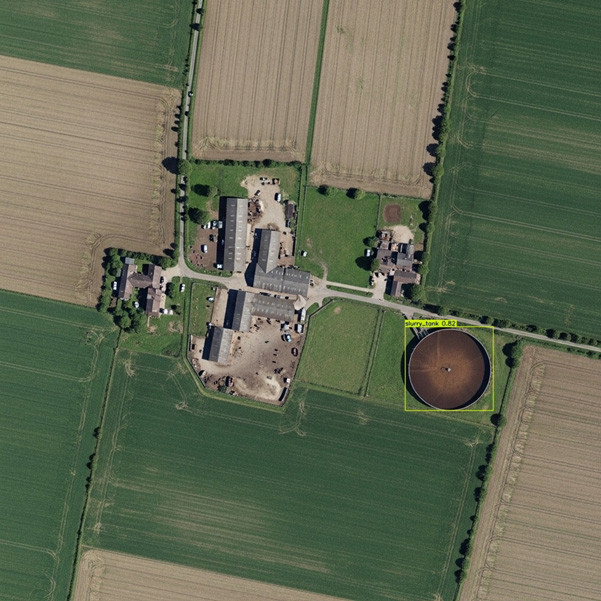
Image: Our slurry tank detection model currently have a precision of 94.5% , recall of 77.8%, and an average precision of 88.3%.
For the current work, we deployed YOLO (You Only Look Once), a popular algorithm used for object detection tasks. Unlike traditional methods, this model transforms object detection into a single-pass prediction task, making the process both fast and efficient.
Our model was trained on aerial imagery from known locations of slurry tanks in England, Wales and Denmark. Images were adjusted for brightness, contrast, and hue to simulate different lighting angles, noise and other real-world variations. Mosaics of the images were produced to improve the model performance, especially for detecting small objects and in diverse contexts. Our training process leveraged YOLOv8 with an AdamW optimiser considering seven additional classes of above-ground storage tanks, building upon previous work published by Robinson et al. (2024). This reduces overfitting through more effective weight regularisation and allows for identification of real-world objects.
The model provides image identification and adds geographic intelligence by linking detections to spatial coordinates. This allows for the precise geo-location identification of slurry tanks, supporting management and environmental protection actions that focus on reducing the environmental risk and potential impacts caused by leaking slurry tanks.
Moving forward, ahead of our second iteration, we plan to validate the model results against high resolution imagery. Furthermore, we plan to run our model on a larger geographical area to produce the first versions of novel slurry tank datasets. We are also working toward packaging the trained model for seamless integration within common geospatial analysis platforms, enabling users to run detections directly on imagery layers across larger geographic extends.
A collaborative and open-sourced approach
The overarching objective of River Deep Mountain AI is to bring key stakeholders involved in waterbody health together and collaboratively develop open-source AI/ML models that can inform effective actions to tackle waterbody pollution.
To democratise artificial intelligence in the water sector, all our models will be released open source to benefit the entire sector. The first iterations of our models are released now, and the second iterations will be released in November 2025.
The first batch of our remote sensing-based models are accessible open source via GitHub.
River Deep Mountain AI is funded by the Ofwat Innovation Fund and consists of 6 core partners: Northumbrian Water, Cognizant Ocean, Xylem Inc, Water Research Centre Limited, The Rivers Trust and ADAS. The project is further supported by 4 water companies across the United Kingdom.