Similar Accounts Across Europe and Beyond
Several countries already operate comparable frameworks:
- Denmark – Aktiesparekonto (ASK)
- Finland – Osakesäästötili (OST)
- France – Plan d’Épargne en Actions (PEA)
- Italy – PIR (Piani Individuali di Risparmio)
- Norway – Aksjesparekonto (ASK)
- UK (non‑EU) – Individual Savings Account (ISA)
These national experiences form the backbone of the EU’s SIA blueprint.
How SIAs Drive Higher Retail Participation: Evidence from Sweden
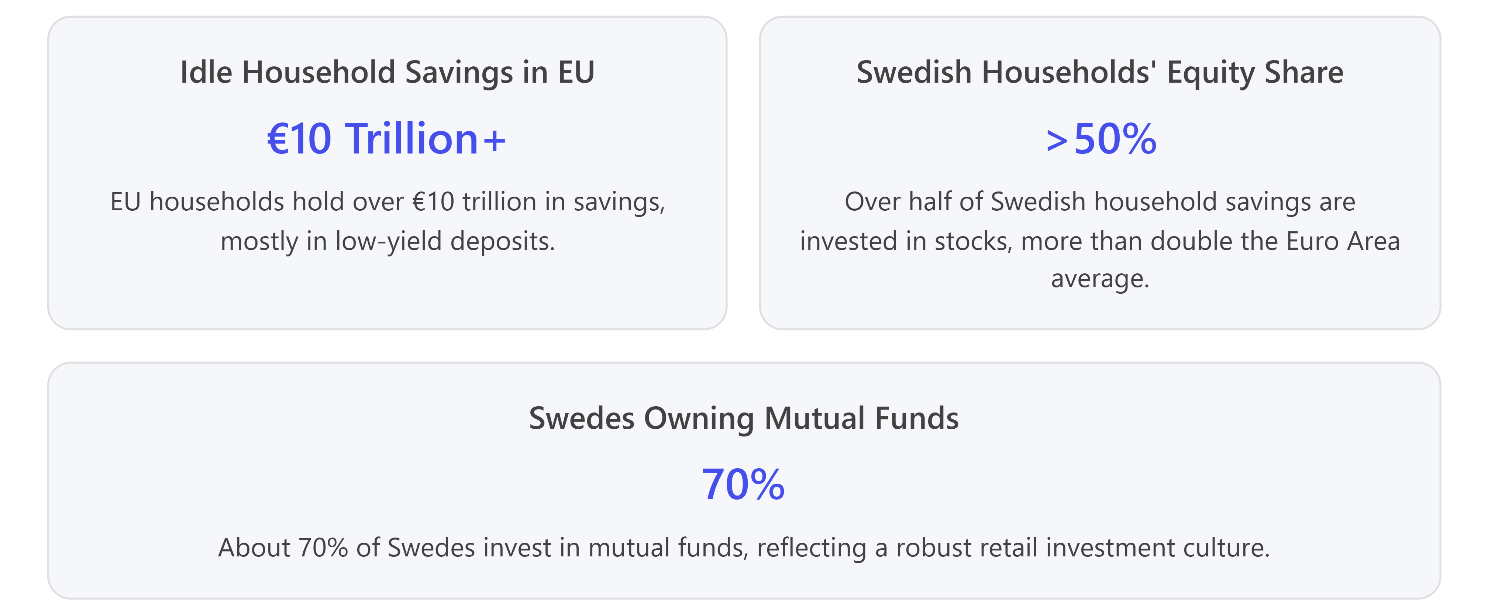
Sweden demonstrates how simplicity beats complexity. Since the introduction of ISK:
- Nearly half of the adult population holds at least one ISK account
- Assets held in ISKs now represent around 30% of Sweden’s GDP
- Retail investors account for one of the highest equity participation rates in Europe
Crucially, Sweden’s success is not driven by tax incentives alone. Studies highlight that ease of use, predictable taxation and digital accessibility played a far greater role in normalizing equity investment for households.
What an Ideal EU‑Wide SIA Should Look Like?
Drawing from EU guidance and Nordic best practices, we think an effective EU‑wide SIA template should have:
- Simplicity
- Fully digital onboarding
- No transaction‑level tax reporting for investors
- Neutral and Predictable Taxation
- Annual or deferred taxation at account level
- Clear visibility of tax impact upfront
- Broad Product Eligibility
- Equities, ETFs, UCITS, ELTIFs and diversified funds
- Avoid overly restrictive national product lists
- Portability and Competition
- Seamless transfers between providers
- Cross‑border portability to support labor mobility
- Low and Transparent Costs
- Clear disclosure of fees
- Caps on transfer and exit costs
The EU‑Wide Impact: What If All Member States Adopt SIAs?
If adopted consistently across all EU member states, SIAs could deliver transformational outcomes:
- Higher household wealth creation through long‑term equity exposure
- Deeper and more liquid EU capital markets, reducing reliance on bank financing
- Stronger funding for SMEs, innovation and green transitions
- Reduced fragmentation, supporting a truly single European investment market
Analysts estimate that matching Nordic‑level retail participation could unlock several trillion euros in additional long‑term investment capital across Europe—without increasing public debt.
The success of the SIU will ultimately depend not on regulation alone, but on whether investing becomes simple, accessible and intuitive for every European citizen.
How European Banks Should Prepare for SIA Products
For European banks, the rollout of SIAs is more than a product launch — it represents a strategic shift in how retail customers engage with capital markets. Banks that move early and decisively will not only capture new flows of long-term savings but also strengthen their position in an increasingly competitive wealth landscape. To be SIA-ready, banks need to act across six interconnected dimensions:
- Define a clear SIA strategy and target segments: Decide whether the SIA proposition is a mass-market entry product, a complement to existing wealth offerings, or a flagship for affluent customers. This choice will shape pricing, distribution, and capability investments.
- Reimagine onboarding and the digital experience: The Nordic experience shows adoption is driven by simplicity. Banks must deliver fully digital, mobile-first onboarding with eKYC/AML, instant account activation, intuitive product selection, and frictionless funding — comparable to the best neobrokers in the market.
- Modernize the underlying platforms: Many EU banks still operate fragmented brokerage, custody, and wealth systems. SIAs require integrated platforms capable of supporting account-level tax computation, real-time portfolio views, broad instrument coverage (equities, ETFs, UCITS, ELTIFs), and seamless portability between providers.
- Get the pricing right: SIAs are inherently low-margin, high-volume products. Banks need transparent, low-cost fee structures that remain commercially viable at scale, supported by efficient operations and automated servicing.
- Invest in financial education and customer trust: In-app education, simple risk and goal-based guidance, and clear performance communication are essential to convert savers into long-term investors.
- Strengthen regulatory and operational readiness: SIA frameworks will require new controls around tax reporting, MiFID suitability, cross-border portability, and provider-to-provider transfers. Banks should map regulatory expectations early and build the data, reporting, and digital infrastructure to support them.