

















September 24, 2025
Savvy Australians eager to embrace AI shopping experiences

Savvy Australians eager to embrace AI shopping experiences
New research shows Australians want AI to make buying smarter and simpler. Can companies move faster to serve these progressive customers?
AI savvy consumers in Australia are set to drive $903 billion (AUD) in spending by 2030, according to research from the Cognizant ‘New Minds, New Markets’ report.
Our report explored insights from over 8,000 respondents across the USA, Germany, the UK and Australia. By looking at the trends, we have predicted that by 2030, just five years from today, consumers who embrace AI could be driving up to 55% of spending. These consumers are ready to build new habits today, with product and service providers who deliver smarter experiences gaining the advantage in capturing loyalty.
Australian adopters
Australia as a nation has a history of early adoption. Alongside anecdotal stories of leadership on digital revolutions such as smartphones and contactless payments, DataReportal insights show Australia is well ahead of the world on internet use and social media, while our country ranks 15th on the IMD World Digital Competitiveness Ranking.
Our New Minds, New Markets research defines categories of AI-ready consumers: Early Adopters, Accelerators, and Anchors. You can read the full global report for more detail on how they were defined and identified. In Australia, we see note-worthy differences in the Early Adopter and Accelerator groups compared to global. They are demographically young, highly educated, and holding the highest purchasing power of all our groups.
The attitudes held by Australian Accelerators is 9% more bullish than global counterparts, offering the greatest demand for AI fuelled purchasing journeys. Accelerators were aged 18-44, fitting the median age of Australian consumers (37/38). The even more enthusiastic subset of Accelerators, the Early Adopters, were 18-24, while Australian Anchors were aged 55+. Econometric analysis of these groups shows Accelerators were highly likely to earn income in the top three tiers of our study, skewing toward the highest.
Australian Early Adopters and Accelerators were ahead of the global trends for comfort with AI in purchasing experiences by 28% and 31%, respectively, with our per capita spend expectations well ahead of the other nations in the research. While they are 25% of the market, they represent over $900 billion in spending by 2030.
Together this data tells a story of an Australia that sits firmly at the head of this curve. The strongest Accelerator and Early Adopter cohort, aligned to a young and high-income subset of Australians eager to embrace new digital and in-store experiences that bring AI into the journey.
Building the AI-powered purchase journey
AI offers great utility across any purchase journey, and our AI Early Adopters and Accelerators reveal where tools are likely to be most effective in the years ahead.
Our study breaks down the purchase journey into three stages: The Learn phase, where consumers research their purchase decisions. The Buy phase, when they commit to the purchase. And the Use phase, where support is administered, such as ongoing supplies and maintenance. Our data revealed that AI-ready consumers are most enthusiastic for AI support in the Learn phase, with the Use phase close behind.
Across these phases, we garnered comments from research participants to better understand where they felt AI can improve their experience and found that personalisation, simplification, and automation are highly desirable.
What shoppers are saying about the AI opportunity
As part of our research, we conducted focus sessions which helped measure sentiment on how AI helped or hindered the customer journey.
AI for efficient, personalised shopping
“I feel optimistic about AI helping me buy products and services because it has potential to make the process more personalised, efficient, and less stressful.”
AI for curation and suggestion
“I think it’s just handy to have a ‘personal assistant’ like this, because a lot of these things are everyday things you do but it just makes your life more efficient.”
Automated repurchasing has potential
“I’d likely use AI repurchasing for low value consumable items (groceries, pharmaceuticals, clothing). The higher the price, the more unlikely I’d use this without providing a confirmation.”
Dynamic pricing concerns
“I prefer the price for a product or service to be set. Otherwise, one cannot plan and also high demand may mean only richer people can obtain the product or people are panicked into purchasing something they cannot afford.”
Maintaining support for Anchors while moving ahead
The low affinity Anchors remain an important market. This 55+ age demographic can be particularly important in financial planning, superannuation, hospitality, and insurance sectors. As AI features are added to the mix for any business, maintaining concurrent options will encourage new ways of engaging for Accelerators and Adopters while keeping traditional options available to serve Anchors in the market. The dial can be turned to hit the right mix over time as we ramp into the future.
Industry leading AI capabilities
The Australian enterprise is already taking advantage of the AI opportunity. Different forms of AI are in production across every industry today. The AI pilots of 2024 are well into production in 2025, with much of this work focused on operational solutions to drive efficiency throughout an organisation.
Cognizant is already working with industry leaders to progress their AI capability, taking advantage of trends in the market to deliver measurable outcomes. Here’s practical activity in market across four key sectors where AI is delivering real value.
Retail: using generative AI with one partner, we are greatly improving the accuracy of out-of-stock product substitutions for online orders to reduce manual intervention requirements, improving customer satisfaction and reducing churn.
Telecommunications: we have a team productionising a new AI solution with a major Australian telco that triggers highly personalised responses to abandoned ecommerce carts. This increases the potential to close sales by choosing the best time of day and contact channel to use, as well as adding recommendations to proactively reengage the customer to maximise the opportunity to convert.
Insurance: work is live with one major insurer that offers proactive AI information retrieval systems to assist workers during customer calls. They are targeting 40% reduction in call times and improved ticket resolution thanks to better insights from policy and disclosure documents.
Banking: Cognizant is augmenting the engineering team at one institution to pilot generative AI as part of a data science platform, helping to interrogate large and disparate data sets. It is helping to process conversations and their sentiment, while also personalising support thanks to proactive data retrieval to achieve resolution faster.
Personalisation and recommender systems are already a mature part of the consumer purchasing process, offering easy wins for those yet to adopt while improving readiness to push onward into deeper AI integration opportunities.
We are also in the early stages of piloting consumer multi-agent facilities, but the impact potential is exciting in its ability to offer tremendous flexibility to business. It’s an area we are moving quickly to explore with more clients in the year ahead.
From here to 2030
Along with $903 billion here in Australia we see $4.4 trillion (USD) in AI savvy consumer spending in the US by 2030. By developing new AI purchase journeys for Australia’s world leading Early Adopters and Accelerators, businesses can be preparing for global leadership as AI shopping systems grow in prominence in the five years to come.
Deliberate and considered action today is required to build a ramp toward this exciting future. We can continue to succeed in service of every customer while opening the door to this next generation AI consumer.
Footnotes:
1. Summary of Australian comfort quotients:
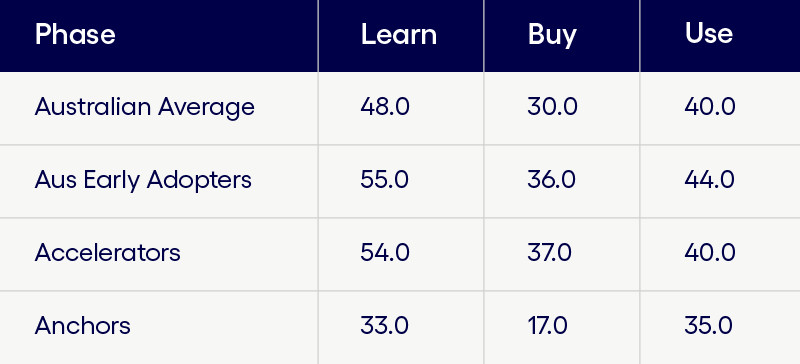
Global comfort quotient data can be found in global report
2. % differences calculated by comparing Australian Adopters/Accelerators/Anchors in specific phases to the global averages. E.g Australian Early Adopter comfort quotient in buy phase is 36, compared to 27 of Global average = 28.6% difference.


Latest posts

Related posts
Keep up with AI innovations for business
AI is moving fast. Our bimonthly LinkedIn newsletter helps you do the same. Subscribe for breaking AI news and actionable insights.