


















November 02, 2026
COGNIZANT RESEARCH
India’s AI opportunity: What an AI-ready workforce can add to the national output

Our research shows AI adoption is already making employees in India meaningfully more productive. If these productivity gains scale across a broader share of economic activity, India stands to unlock as much as $830 billion in additional annual GDP.
As AI becomes more deeply embedded in businesses in India, the country is on the brink of realizing significant productivity gains. Based on our recent study of 700 employees and 75 business leaders across 10 industries in India, it’s clear that many of the foundational elements are in place for enterprises to realize success with their AI initiatives.
According to our study, which surveyed organizations with annual revenue ranging from $100 million to over $10 billion, enterprises in India have built a strong technology and data foundation for AI, while continuing to prioritize investments in AI innovation. The workforce is similarly prepared and hands-on with the technology, with almost all employees (97%) already experiencing productivity benefits from AI use.
If organizations and national policy continue to enable AI adoption, India stands to unlock an estimated $28 billion to $84 billion in additional nominal GDP under our realistic scenario modeling. However, more sweeping adoption of AI across India’s entire workforce could theoretically result in a GDP uplift to as much as $830 billion.
Key findings from the study include:
- The productivity signs for India are already here. Employees in India appear well-prepared for the AI era. Three-quarters have completed AI training, well above the global average, and they report high proficiency levels with AI tools. The vast majority are experiencing some level of productivity improvement from AI use, with an average 15% productivity uplift. Top AI use cases identified by employees include data analysis and reporting, research and summarization, forecasting and trend analysis.
- The gains are unevenly spread across sectors. AI-enabled productivity is not realized uniformly across India's economy. Healthcare is seeing the greatest productivity gains, with 38% of employees reporting gains above 20%. The lowest productivity boost is in retail and consumer goods, where just 18% of employees report greater than 20% gains.
- The enabling conditions for AI are already in place. Senior leaders express high confidence in their technology and data readiness for AI deployment. The vast majority (79%) say their organization's existing technology infrastructure is accelerating (versus inhibiting) their AI rollout.
- Business leaders and policy makers have a unique opportunity to harness significant economic gains. Organizations need to close gaps in access to AI tools, provide better-fitted tools and translate employee productivity gains into enterprise outcomes. How quickly they do this will determine where India lands on the economic scale, from $28 billion to $830 billion.
In this report, leaders will learn where businesses in the region stand in terms of workers’ adoption of AI, their realized productivity gains, how this varies by industry and the factors in India that are enabling AI use. We’ve also mapped out three scenarios for AI value realization in the nation. Knowing this, executives can focus their efforts on what matters most for attaining the full potential of AI.
Signs of AI productivity are already visible
Employee adoption of AI is a critical component of unlocking economic gains from AI. While our previous research estimates AI could impact 93% of jobs, roughly 90% of that AI exposure is AI augmenting human workers, not doing the work on its own. If employees don’t adopt AI, its economic impact will never arrive.
As such, employees’ AI skills, proficiency and expectations are a direct line into understanding how AI will deliver results within organizations, and for entire nations.
When it comes to AI skills, India’s workforce stands out in many respects. Nearly three-quarters (74%) of employees have completed AI training provided by their organization, 19 points above the global average of 56%. Organizations in India also train their employees more extensively. Fully 42% of employees receive more than 30 hours of training annually, compared with the global average of 27%.
The type of training in the region is also likely to be more relevant to workers. Role-specific enablement—the training format most aligned to employees' day-to-day tasks—reaches 40% of employees in India.
Workers are also keen to invest in themselves. A total of 65% of workers in the region have spent at least $250 on their own AI training, while 35% have spent over $250.
As established by our previous research, workers trained to use AI not only have a stronger grasp of how it works, but they are also more comfortable using it and more aware of its potential. Nearly three in four workers (73%) in India say they have clear or expert understanding of generative AI, while over half (54%) say the same about agentic AI.
This strong tool proficiency helps employees develop a clear understanding of where AI can best be deployed and, ultimately, enable the movement of AI into more complex tasks. Over half of workers identified AI use cases in data analysis and reporting (52%), research and summarization (49%) and forecasting and trend analysis (44%).
With all these pieces in place, it’s not surprising that AI-driven productivity is surging. Almost all employees (97%) in India report a productivity boost from AI use. On average, employees are seeing a 15% productivity increase, and more than half (66%) say they’ve seen a 10% increase.
High levels of skilling and proficiency, high productivity outcomes
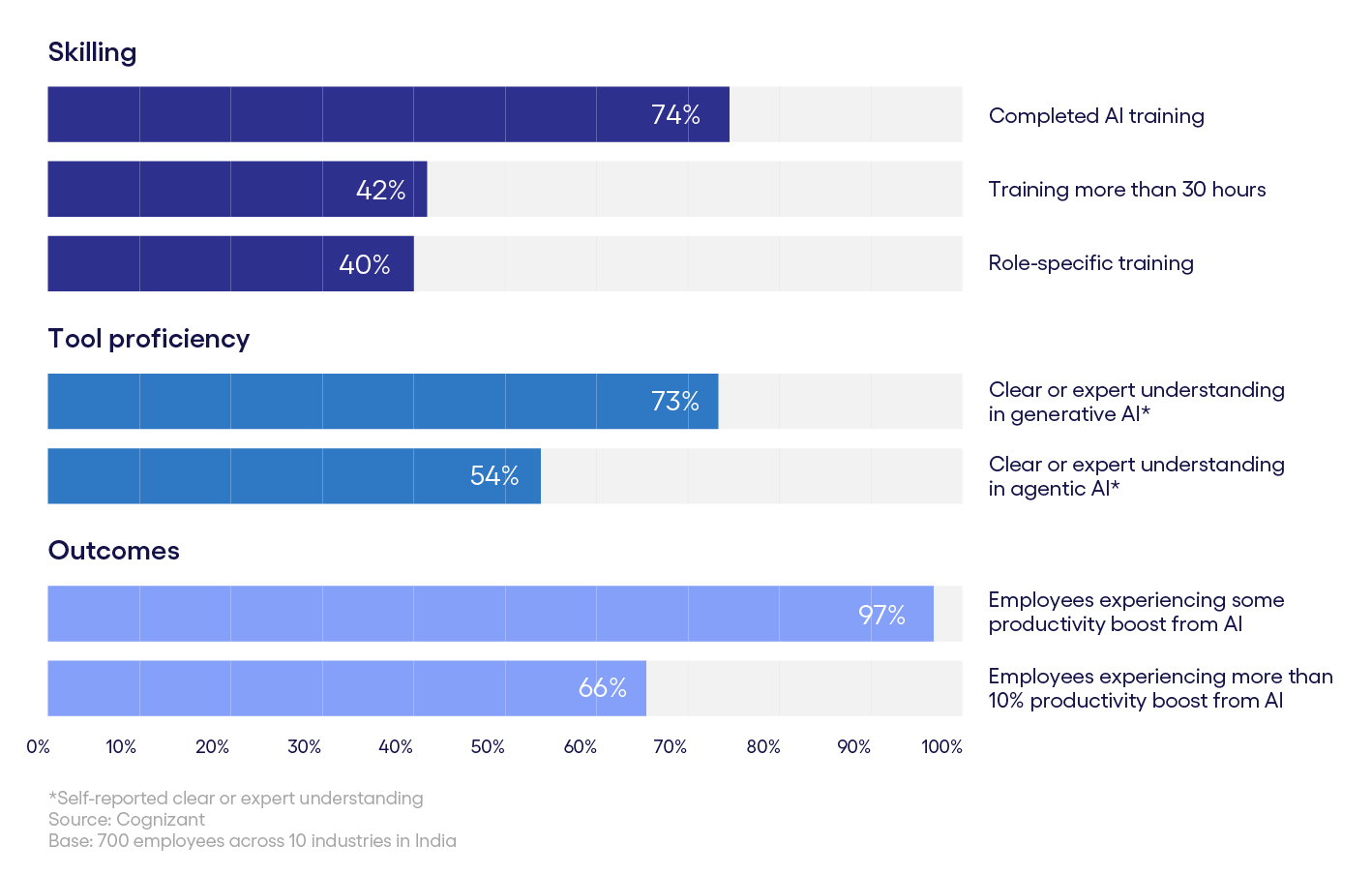
Figure 1
What AI value could mean for India’s economy
To understand what AI productivity means for India’s economy as a whole, we analyzed worker sentiment and productivity expectations, alongside the percent of the economy that’s been impacted by AI. We used this metric rather than workers’ AI adoption rates because of the difficulty measuring some areas of India’s vast and complex economy and the uneven distribution of GDP contribution across a range of sectors.
By combining this analysis with public economic data, we’ve developed a range of scenarios that detail realistic low- and high-end scenarios, as well as a purely theoretical possibility based on ubiquitous AI uptake. (See the full methodology for our modeling at the end of the report.)
Scenario 1 (ubiquitous AI uptake): The first scenario helps us estimate the raw opportunity AI offers. It assumes ubiquitous access to AI across the nation’s entire workforce, representing 100% of GDP, an employee productivity boost of 20%, and 100% of labor productivity passing straight through to GDP.
Such a scenario is informative but also unrealistic. For example, our survey shows organizations in the region making AI accessible to just 36% of their employees, on average. Further, productivity gains experienced by workers may not be fully realized, and worker productivity historically translates into GDP at a much lower rate.
Scenario 2 (realistic high-end scenario): Our second scenario is far more measured. It assumes a smaller pool of employees across the nation have access to AI, representing 30% of today’s GDP, a 15% productivity uplift and 45% labor productivity gains passing through to GDP at 45%.
Scenario 3 (realistic low-end scenario): In our most conservative scenario, just 15% of the workforce has access to AI, productivity gains are 10% and the pass-through rate to GDP is 45%.
The results of each scenario are detailed in the figure below.
Three scenarios for AI outcomes in India
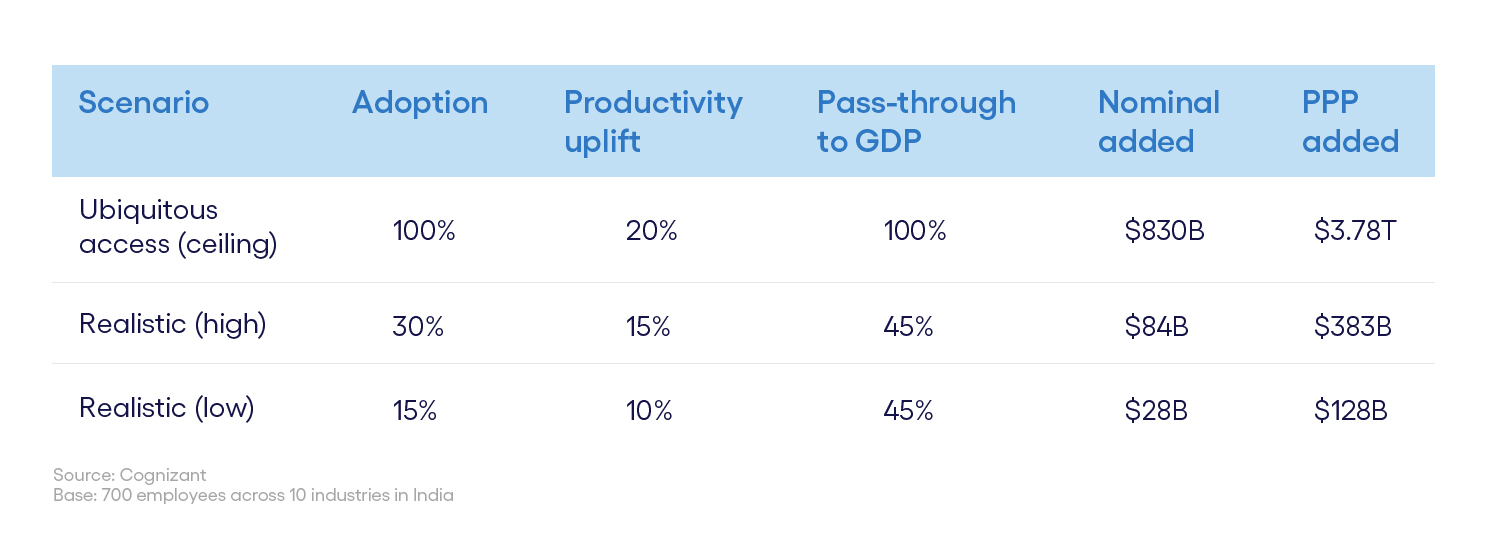
Figure 2
Taken together, we can see the full gamut of the national opportunity, from a $28 billion floor to an $830 billion ceiling—representing a nearly 30 times difference in AI value. The wide range is reflective of the degree to which adoption spreads from early-adopter to mainstream use, as well as how cleanly worker-level gains convert into national output.
Productivity gains vary sharply by industry
While the productivity opportunity in India is significant, it varies widely among industries (see Figure 3). This becomes apparent when looking at the percent of employees in each sector reporting productivity gains above 20%.
Productivity tier by industry
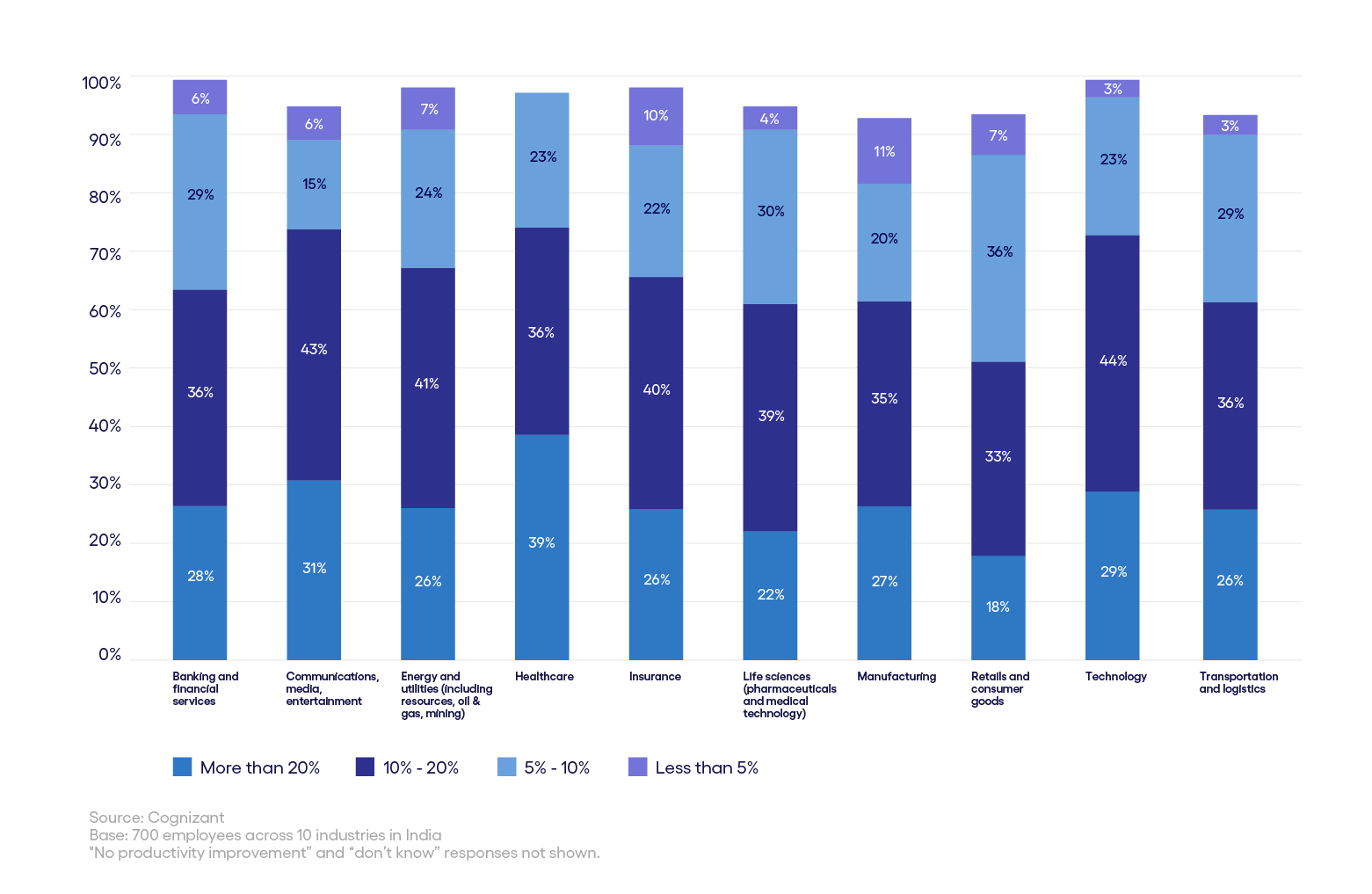
Figure 3
The healthcare sector, named as a priority sector for India’s AI mission, records the highest share of employees (39%) reporting productivity gains at the 20% level or above and the greatest percentage of employees (97%) reporting some level of productivity gain.
Other sectors that follow closely include communication (with 31% of employees in the greater-than-20% productivity band) and technology (29% of employees). Both industries are historically considered the backbone of digital technologies in India.
The banking and insurance sectors—which also benefit from India's shared digital public infrastructure platforms like Aadhaar, UPI and DigiLocker—sit in the upper middle, with 28% and 26% of employees reporting more than 20% productivity, respectively.
At the other end of the spectrum are retail and CPG, which have just 18% of employees reporting gains above 20%. Manufacturing has the lowest share of employees reporting any level of productivity gain, at 82%. However, over one-quarter (27%) expect to see gains above 20%.
This industry data further highlights the gap between today's productivity signal and tomorrow's economic opportunity. Realizing India's economic opportunity in the upper end of the range will require industries with lower reported gains to move further up the distribution.
The enabling conditions are largely in place
That said, at a national level, our research shows many of the enabling conditions are already present to support India in realizing tangible economic impact from AI.
On the enterprise side, 64% of senior leaders report having a strong, centralized budget for AI initiatives, and 73% directly link AI spending to the specific business value it is expected to generate.
Senior execs also believe they have the robust compute and data architecture required to scale AI deployments. Across every dimension we measured, leaders overwhelmingly rate their compute and data posture as good or excellent (see Figure 4). That confidence carries into their view of their infrastructure’s role in AI adoption: 79% say their organization's existing technology infrastructure is accelerating (versus inhibiting) their AI rollout.
Leaders report strong tech and data infrastructures
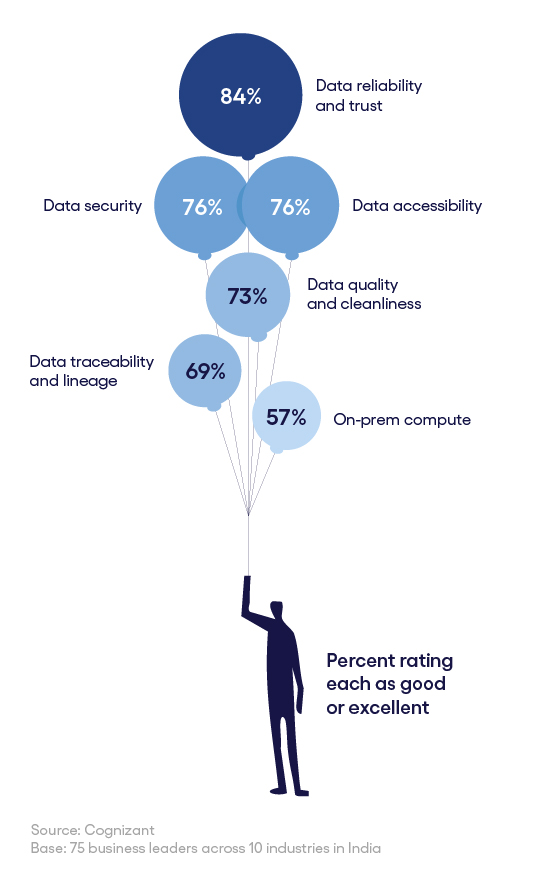
Figure 4
As seen in our previous research, organizations with strong data and technology foundations are seeing greater success with converting AI use into measurable business productivity gains.
On the national infrastructure side, confidence is equally strong. In all, 68% of senior leaders see the nation’s infrastructure as an accelerator to AI adoption, and nearly half (44%) of employees believe current national policies are designed to enhance AI use.
When asked what accelerates AI adoption in India, 80% of execs identified investor sentiment, the highest of any accelerator. This likely reflects sustained public policy and organizational readiness for AI.
The path to unlocking India’s AI opportunity
The opportunity for India, and the businesses and workers that power the economy, is significant. AI represents a pathway to unprecedented productivity gains and, according to our research, many of the foundations are already in place.
However, with an economic opportunity ranging from $28 billion to $830 billion, business leaders and policy makers need to take direct action in key areas.
Rebalance investments to improve adoption
Despite 74% of employees completing AI training, business leaders say just 36% of their employees, on average, have access to AI. This gap is also visible in businesses’ top AI investment priorities. Workforce enablement and talent acquisition rank the lowest of all investment categories, with just 8% and 5% of leaders naming these as top priorities, respectively—well behind technology infrastructure (24%) and AI innovation and product development (23%). Closing the employee enablement gap can take organizations one step closer to the higher end of the economic model through improved adoption.
Broaden AI use cases to complex tasks
The productivity uplift assumptions in our three scenarios range from 10% to 20%. Today, reported gains are clustered toward the lower half of the range because the work that employees overwhelmingly report gains from are assistive, low-complexity tasks, such as data analysis and reporting (52%), research and summarization (49%) and forecasting and trend analysis (44%). These are genuine gains on paper, but they assist current work already being done.
Moving toward the economic model’s upper productivity levels requires AI to be used for high-complexity work where more productivity can be unlocked. India is already showing signs of this transition. For example, when asked where AI can realistically deliver value, the complex tasks employees identified include generating novel business model or product concepts (27%), directing autonomous agents or digital workers (26%) and simulating or leading complex negotiations (22%).
Bridge the tools gap
When asked how much more productive they could be if they had access to the AI tools they need, the share of employees reporting more than a 20% productivity gain rises from 27% (with current tools) to 32%. Notably, the number of employees in the lower productivity bands declined by four points when asked this question.
Providing employees with relevant tools for their needs would directly impact productivity and potentially shorten the distance between the realistic and ubiquitous scenarios.
Another area for opportunity is tool customization. More so than their global peers, employees in India report their tools cannot be customized or tweaked for their needs, and 40% now resort to non-sanctioned tools. However, just 16% of executives are aware this is happening.
Monitor and measure AI deployments to find gains
While over one-third (35%) of senior leaders believe they’ve realized worker productivity gains, the results are less encouraging beyond productivity. In all, 84% of execs have yet to see AI lowering costs, and 91% have seen no impact on revenue. Most importantly, more than one-third (37%) have paused or stopped AI projects due to lack of ROI.
Our research shows employees reporting benefits from AI, but these are not yet recognized at the enterprise level. The next phase is to ensure individual accomplishments with AI translate to enterprise value.
Methodology notes
GDP impact is calculated against a nominal GDP base of approximately $4.15 trillion. Each scenario multiplies the share of economic activity touched by AI, the productivity uplift applied and the pass-through rate to GDP against the base.
On a purchasing-power-parity basis, India’s GDP is larger(approximately $18.9 trillion base), but nominal terms are used throughout the report for consistency.
Adoption and uplift figures in the scenarios reflect our own estimates. All figures are modeled, and estimates are based on self-reported survey responses and should be read as directional.
Why we apply a pass-through discount, and why 45% for India: Gains in labor productivity do not translate into GDP one-for-one. Labor is only one input to output—capital, infrastructure and other factors aren’t immediately made more efficient by AI—so a given percentage gain in labor productivity raises GDP by less than the same percentage, especially in the short term.
This mechanism follows Acemoglu (2024), “The Simple Macroeconomics of AI,” which calibrates this discount at 53%–57% for the US economy based on labor’s share of output.
However, India’s pass-through rate is likely to be lower. A larger part of India’s economy operates informally, sitting largely outside tax, digital payment and formal survey coverage. The Ministry of Statistics and Programme Implementation (MoSPI) reports that India’s informal sector—unregistered, unincorporated, largely cash-based enterprises—contributed approximately 45% of India’s GDP in FY 2022-23, per its National Accounts Division consultation on informal-sector GDP estimation (January 2025).
To reflect this, alongside two scenarios with conservative adoption rates of 15% and 30% to accommodate challenges in AI adoption, we also apply a 45% pass-through assumption for India to reflect a reduced rate of impact to GDP where areas of the economy do adopt AI, but it is not effectively passed through to GDP.
The “ubiquitous, high” scenario assumes 100% pass-through as a deliberate simplification to show a theoretical ceiling, not a realistic estimate. This first-order approach excludes capital deepening and new-task effects, which could shift long-run impacts in either direction.
