
No skills, no payoff: Why AI value lives or dies with the workforce
<p><br> <span class="small">June 15, 2026</span></p>
<h2><span class="h6">Our latest research reveals the intrinsic connection between workforce skilling and AI returns. Yet at precisely the time when the stakes couldn’t be higher, businesses are underinvesting in the very thing needed for AI success: the people expected to use it.</span></h2>
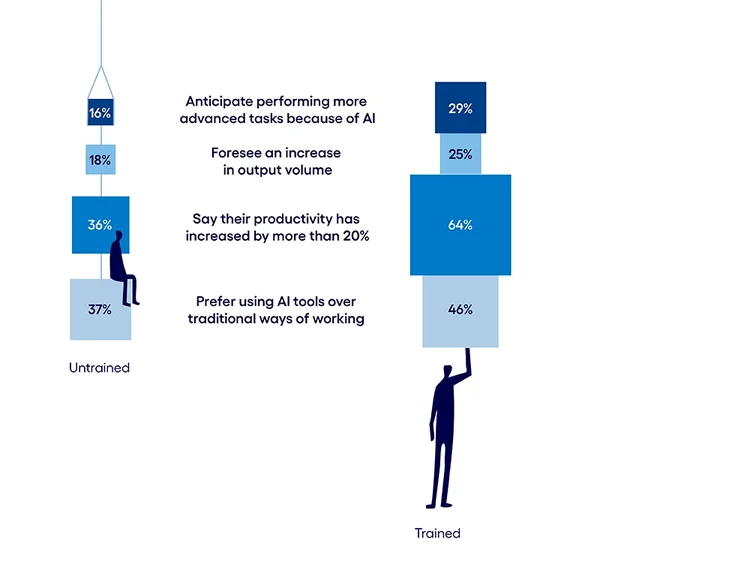
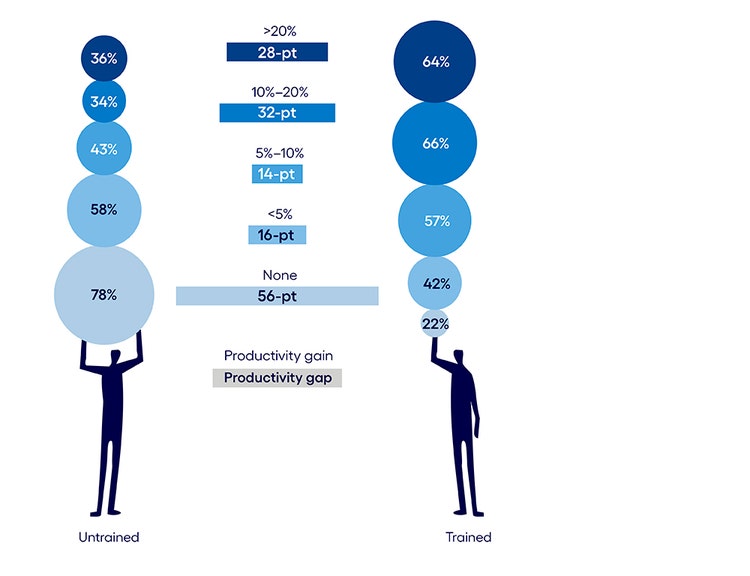
<p>Despite enormous investments in AI, most business leaders are still waiting for the returns. CEOs and boards are left to speculate why these powerful machines are not delivering on promised productivity gains. </p> <p>One answer to this question has less to do with AI being able to drive productivity itself and more to do with ensuring the workforce has the skills to do so. Our recent research reveals a clear link between the two: Employees who receive AI skill development outperform their untrained peers on every metric measured—productivity, output volume, advanced task performance and technology adoption. </p> <p>In short, skilled workers don’t just use AI more—they use it more effectively. It’s this behavior that ultimately drives business results.</p> <p>Yet despite these clear advantages, skilling investment remains remarkably low. The businesses in our study—predominantly G2000 companies—allocate just over 0.2% of annual revenue to AI training, a small fraction of their AI technology investment. While companies race to acquire AI technology, many are not making the skilling investments required to make that technology pay off. Without a course correction, the promise of AI will remain out of reach, no matter how powerful the tools become. </p> <p>The data makes the stakes clear:</p> <ul> <li><b><a href="https://www.cognizant.com/en\_us/aem-i/document/ai-and-the-future-of-work-report/new-work-new-world-2026-how-ai-is-reshaping-work\_new.pdf" target="_blank" rel="noopener noreferrer">AI will affect 93% of jobs</a>, yet nearly three-quarters (72%) of senior executives report that fewer than half their employees received any AI skilling in the past year</b>. In contrast, the majority of workers themselves (74%) express enthusiasm for AI skilling.<br> <br> </li> <li><b>Only half (50%) of business leaders believe their current AI skilling programs effectively equip employees to do their jobs</b>—meaning half are investing in programs they themselves doubt.<br> <br> </li> <li><b>Yet, business leaders assert that skilling pays off faster than most expect:</b> Even when just 25% of workers are trained, companies report a measurable positive impact on productivity.<br> <br> </li> <li><b>The productivity gap between trained and untrained workers is striking: </b>There is a full 28 percentage-point difference between trained (64%) and untrained workers (36%) when it comes to employees reporting productivity gains of 20% or more. <br> <br> </li> <li><b>Higher investment accelerates results:</b> Among organizations spending more than $10 million on AI skilling, 60% already report productivity gains—compared with 40% among lower spenders.</li> </ul> <h4><span class="h5">Profile of trained vs. untrained workers</span></h4>
<p><span class="small"><b>Base:</b> 1,100 senior business leaders and 4,400 employees <br> <b>Source:</b> Cognizant</span></p> <p>Armed with this evidence, we developed an AI capability maturity model that makes the path from skilling to enterprise value concrete and actionable. The model traces how organizations progress through five stages—awareness, skilling, adoption, productivity and ROI—making clear that workforce capability is not just a supporting factor in AI success but a key mechanism through which success is achieved. </p> <p>Organizations that shortcut the early stages, moving to deploy AI before their people are ready to use it, consistently find themselves stuck: tools adopted but underused, investments made with no returns.</p> <p>This analysis is part of our series of studies exploring the numerous elements necessary for closing the gap between AI's technical capabilities and real-world results. Our research is based on a survey of 1,100 senior business leaders and 4,400 employees at G2000 companies and 100 startups across 10 industries.</p> <p>In this report, executives will learn about the intrinsic connection between AI skilling and AI outcomes, as well as the level of investment needed to prepare workers for AI. We also offer an AI maturity path that maps the progression from AI awareness and skilling, to adoption, productivity and ROI.</p>
<h3><span class="h4">The AI skilling advantage</span></h3> <p>Our study reveals a clear distinction between workers who have received AI skilling and those who have not. Workers trained to use AI not only have a stronger grasp of how it works, but they are also more comfortable using it and more aware of its potential. This gives them a sense of being more productive and valuable in their work. </p> <p>For example, skilled workers were much more likely to feel proficient across all five categories of AI tools in our study, with an average of 63% declaring a “clear” or “expert” level of understanding vs. 47% of untrained workers (see Figure 1). The capability gap is relatively consistent across AI tools, from the widely used generative AI, to emerging technologies like agentic AI.</p> <h4><span class="h5">The AI capability gap is consistent across a range of tools</span></h4>
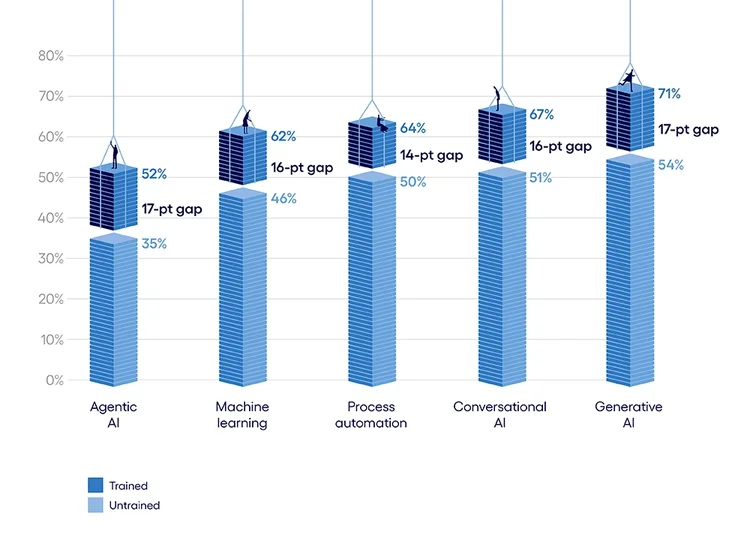
<p><i>Percent of respondents who said they had a clear or expert level of understanding</i></p> <p><b data-rte-class="rte-temp"><span class="small"><b>Figure 1<br> Base:</b> 1,100 senior business leaders and 4,400 employees<br> <b>Source:</b> Cognizant</span></b></p> <p>The skilling advantage extends beyond developing AI tool expertise, to enthusiastically embracing the use of AI tools. Consider that by a 9-point margin (46% to 37%), trained employees say they prefer using AI tools over traditional ways of working.</p> <p>This preference signals an important turning point for AI adoption overall. As <a target="_blank" href="https://www.sciencedirect.com/topics/social-sciences/technology-acceptance-model" rel="noopener noreferrer">research on The Technology Acceptance Model</a> demonstrates, the major driver of adoption is the user’s psychological intent to use the technology. And what drives that intent is the user’s belief that the tools are easy to use and will be useful on the job.</p> <p>As our results show, skilling leads to a greater propensity to adopt AI, even when it means shedding old behaviors and adopting new ones. This suggests that skilling enhances the perception of AI’s ease of use and usefulness, which leads to adoption.</p>
<h3><span class="h4">How skilling translates to productivity</span></h3> <p>Even more important, AI skilling translates into employees’ own perception of becoming more productive (see Figure 2). While the majority of people who report no productivity gains from AI fall squarely in the untrained camp (78%), trained workers are far more likely to report gains of 10% to 20% or more. </p> <p>In fact, trained workers hold a 32-point margin over untrained workers when it comes to perceiving productivity gains of 10% to 20% and a 28-point margin over those who say their productivity has increased by 20% or more.</p> <h4><span class="h5">Trained workers are far more likely to cite productivity gains due to AI</span></h4>
#
<p><i>Percent of respondents in each productivity band who were trained vs. untrained</i></p> <p><b data-rte-class="rte-temp"><span class="small"><b>Figure 2<br> Base:</b> 1,100 senior business leaders and 4,400 employees <br> <b>Source:</b> Cognizant</span></b></p> <p>How these productivity gains will manifest is another point of distinction between trained and untrained workers. Of the workers who say they can perform more advanced tasks due to AI, nearly one-third have had training, compared with just 16% of untrained workers. Additionally, of those who foresee an increase in output volume, 25% have undergone skilling, compared with 18% of their untrained counterparts.</p> <p>Trained workers are also better able to envision a career path where AI helps them unlock potential and achieve more. The majority of trained workers (56%) believe AI will have a positive influence on their career.</p> <p>In all cases, there is a clear argument that AI skilling is a way to finally get traction on achieving an historically difficult goal: developing an engaged workforce that is invigorated to invest in their own future and the future of the company because they are energized about learning new, more effective ways to work.</p>
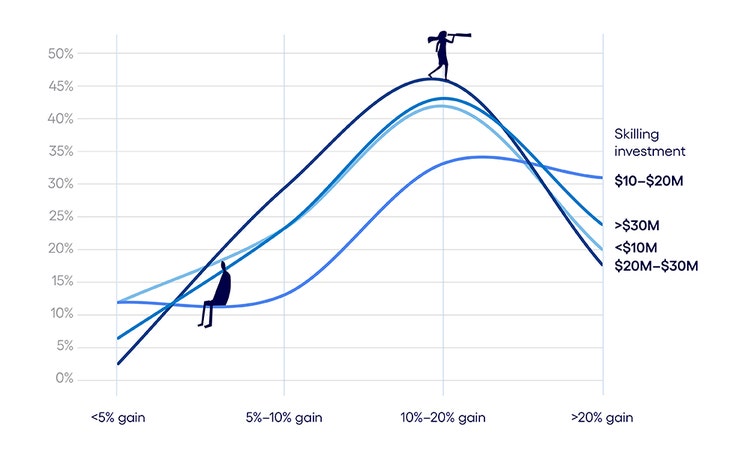
<h3><span class="h4">Skilling investment speeds AI returns </span></h3> <p>Currently, however, relative to their immense investments into AI technology, companies are making miniscule investments into AI skills development. Survey respondents are large organizations, with over 90% reporting annual revenues that exceed $1 billion. While the mean company size in this study is roughly $7.6 billion in revenue, the mean allocation toward AI skilling is just over $17.2 million. Over half of respondents actually fall well below the mean spending level. </p> <p>This means that the skilling allocation to revenue ratio for these companies is 0.2%. This ratio begs the question of whether that is enough to support the desired AI productivity gains for companies of this size.</p> <p>There is little question that business leaders are highly focused on investing in their AI implementations. Over half (61%) of execs say they have done a good or excellent job in establishing a dedicated budget for their AI initiatives. Similarly, 60% said they have formally linked AI spending to the specific business value or ROI derived from AI. </p> <p>However, the same cannot be said for skill development: </p> <ul> <li><b>Only half (50%)</b> mostly or strongly agree that their company’s AI training initiatives effectively equip employees to use AI in their work. </li> <li><b>61% said they rely on their workers</b> to learn AI on the job. However, less than half (44%) said their company provides dedicated time for employee AI skill development.</li> <li><b>Over half of employees themselves</b> say they are driven to seek training from outside sources, often at their own expense.</li> </ul> <p>And yet, business leaders cite productivity gains when they do engage in skill development. In businesses where over 25% of workers are trained for AI, leaders say they’ve already seen an impact on worker productivity. </p> <p>Even with a relatively low skilling investment, businesses expect to see at least some level of productivity gain. In fact, of those that invest less than $10 million in skilling, 42% expect to see 10% to 20% worker productivity gains. These expectations are very similar to those spending even more. Of those investing between $20 million and $30 million, 46% expect roughly the same returns (see Figure 3). Meanwhile, almost one-quarter of leaders expect to exceed the 20% worker productivity improvement level, no matter how much they spend.</p> <p>In effect, business leaders’ expected productivity returns are similar across an array of spending levels. This suggests that while an investment needs to be made, it does not need to be massive to get a decent return in worker productivity. At the same time, mileage will inevitably vary. A $10 million investment in skill development at one company will not necessarily have the same impact as another. </p> <h4><span class="h5">Productivity trends are similar across various spending ranges </span></h4>
#
<p><span class="small"><b>Figure 3<br> Base:</b> 1,100 senior business leaders and 4,400 employees <br> <b>Source:</b> Cognizant</span></p> <p>At the same time, the fastest results are expected by those spending more than $10 million. Over half (60%) of the senior execs who say they’re already seeing increased worker productivity are spending over $10 million on skilling (see Figure 4). Of those spending under $10M, just 40% can make this claim. </p> <h4><span class="h5">The $10 million spending threshold means faster productivity gains</span></h4>
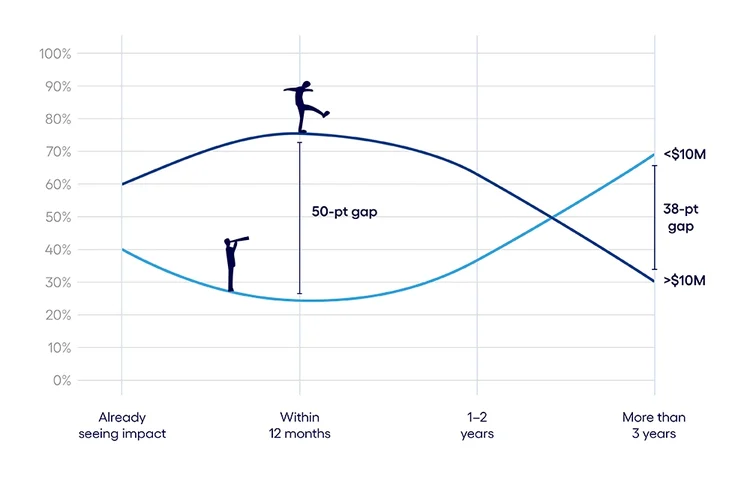
<p><span class="small"><b>Figure 4<br> Base: </b>1,100 senior business leaders and 4,400 employees<br> </span><b data-rte-class="rte-temp"><span class="small"><b>Source: </b>Cognizant</span></b></p> <p>The disparity in spending vs. expected timing of results becomes more glaring the further you look out. Of those spending over $10 million, far more (three-quarters) expect a productivity impact within the next 12 months compared with those spending under $10 million (one-quarter). Meanwhile, of those spending less than $10M, 69% will wait over three years to see returns, compared with just 31% of those spending over $10M: a 38-point gap. In short, investment size will determine the speed of obtaining urgently needed results.</p>
<h3><span class="h4">The staged path from AI skilling to enterprise value</span></h3> <p>The link between building AI capabilities in the workforce and realizing AI returns is irrefutable. Organizations that invest in AI skilling see measurable results. Those that don’t are leaving significant value on the table.</p> <p>However, while every organization will approach the work of AI capability-building differently, all will progress through and build on similar stages of maturity as they move toward realizing enterprise value from AI. </p> <p>In our view, the path to maturity begins with awareness and skilling, and progresses through to adoption, productivity and, finally, ROI (see Figure 5). Bypassing the foundational stages doesn't accelerate progress—it stalls it, leaving organizations with capable tools but incapable workers. How companies prepare for and execute these stages, and build on them, will largely influence their AI readiness, which will ultimately shape their success.</p> <h4><span class="h5">The AI capability maturity model</span></h4>
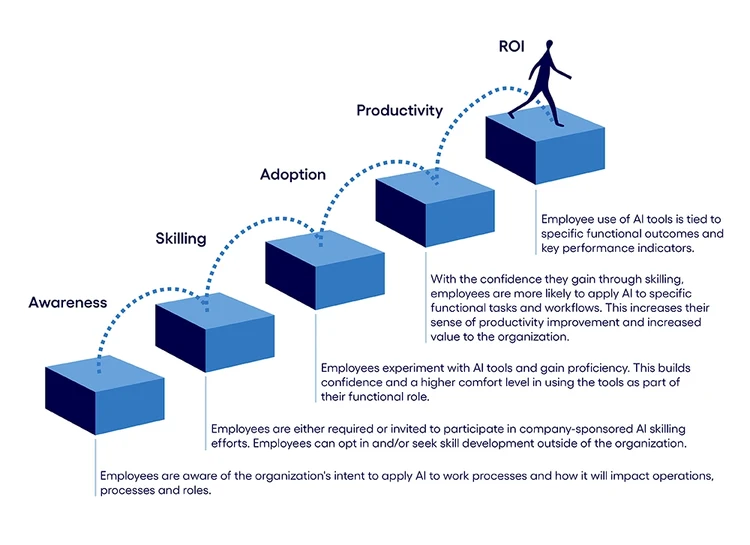
<p><span class="small"><b>Figure 5<br> Source:</b> Cognizant</span></p> <h4><span class="h5">Awareness: People need to know “why AI” </span></h4> <p>Communicating AI strategy can often be undisciplined. People get a clear message from the very top of the enterprise that they need to use it. But why? That’s less often addressed. </p> <p>This is why the first phase of AI maturity is establishing awareness of what the organization intends to do with AI and how it will impact operations and workers. The shared understanding of business goals—which shape and guide organizational plans, actions and KPIs—is considered a key success factor in almost <a rel="noopener noreferrer" href="https://www.pmi.org/-/media/pmi/documents/public/pdf/learning/thought-leadership/pulse/elevate-success-infographic.pdf" target="_blank">three-quarters</a> of IT projects, according to academic research, and in this regard, AI is no different. Further, a lack of clarity over organizational AI ambitions will ultimately lead to misdirected resources and dampened urgency behind AI skilling initiatives.</p> <p>In our research, over half (54%) of employees strongly or mostly agreed that their respective organization had clearly communicated its AI strategy and implementation plans. Yet, more than one-third of employees (36%) said they did not feel clearly informed specifically on how AI will be used in their role or function. </p> <h4><span class="h5">Skilling: When employees understand AI goals, it fortifies their appetite to learn</span></h4> <p>Once people understand the purpose behind AI use in their organization, they need to acquire the skills to use it. However, nearly three-quarters (72%) of senior executives say fewer than half their employees received any AI skilling in the past year. </p> <p>Further, one-quarter (27%) of employees said their organization did not offer access to structured training, and 26% said the training at their organization does not address their specific role or job functions. One-third (34%) indicated their company’s AI training did not equip them to use AI in their work.</p> <p>The intensity of the skilling program also matters. In our study, 29% said they’d received very little (less than 10 hours) of skilling from inside the organization, and 60% received less than 30 hours. </p> <h4><span class="h5">Adoption: Employees’ confidence in AI encourages more widespread use </span></h4> <p>According to technology acceptance theory, employees are more likely to use a new technology if they feel confident in their ability to use the tool. The link between employee comfort with AI and its adoption is a largely understated factor in realizing AI goals.</p> <p>Our study finds that while employees feel a sense of expertise for easier to use AI tools, like generative AI and conversational AI (62% and 61%, respectively), that diminishes when it comes to the more complex AI types, like agentic AI (46%). The flip side of this coin is that 54% of employees say they have only a basic or no understanding of agentic AI, while 38% say the same about generative AI. </p> <p>These uneven scores are to be expected at this stage of the adoption cycle. However, considering the intended ubiquity of AI in business operations, it is essential that organizations close this gap through more proactive, supportive training policies. </p> <h4><span class="h5">Productivity: As AI use grows, so does employees’ belief in increased productivity</span></h4> <p>While our study reveals a clear distinction between trained and untrained workers when it comes to perceived productivity, a sizable majority (90%) of all workers felt they’d seen at least some productivity boost (more than a 5% increase) from using AI. Almost half (46%) say they have increased their productivity by 10%, while less than one-quarter (17%) say they have increased it by more than 20%. </p> <p>As expected, those workers who said they had a better understanding of an AI tool also asserted a higher perception of productivity. For example, employees who said they had expert knowledge of agentic AI reported a 10% to 20% improvement in productivity. For the easier to use tools, those with only a basic understanding of conversational AI cited 10% productivity gains.</p> <h4><span class="h5">ROI: With productivity comes enterprise value</span></h4> <p>These perceived productivity gains matter. Again, applying technology acceptance theory, a worker believing they are getting 20% more work done because of AI can be considered an early signal of return on value, and a likely source of more measurable results further down the line.</p> <p>Workers also believe AI use will largely improve their work experience. Over one-quarter said they thought it would reduce their work hours and enable them to develop innovative processes and workflows.</p> <p>When asked which outcomes would most likely be impacted by AI adoption, the greatest percentage (33%) of workers cited their ability to accelerate completion of their current workload (again, trained employees outpaced untrained workers). Another 23% said it would enable them to perform higher-level tasks.</p>
<h3><span class="h4">Making the connection between AI skilling and AI value</span></h3> <p>Our research underscores a simple truth: AI will lead to enterprise productivity gains only when it’s paired with the human ability to use it. While that may sound obvious, the gap between trained and untrained workers could not be more glaring—or more important for businesses to close.</p> <p>Enterprises have a clear opportunity to turn the AI experimentation of today into measurable impact tomorrow. This will require reframing skilling not as a supplemental activity but as a core part of their AI strategy, supported by structured programs and investment levels aligned with their AI ambitions.</p> <p>The organizations that thrive will be those that understand that AI’s true power lies with people. By elevating workforce capability in tandem with AI investment, enterprises can realize the long-promised productivity outcomes with AI.</p>
Jump to a section
The AI skilling advantage #spy-1
How skilling translates to productivity #spy-2
Skilling investment speeds AI returns #spy-3
The staged path from AI skilling to enterprise value #spy-4
Making the connection between AI skilling and AI value #spy-5
<h5>Authors</h5>