













Skip to main content Skip to footer
  • "com.cts.aem.core.models.NavigationItem@5046de2e" Careers
  • "com.cts.aem.core.models.NavigationItem@6a660890" News
  • "com.cts.aem.core.models.NavigationItem@21b87d8e" Events
  • "com.cts.aem.core.models.NavigationItem@145d74e6" Investors
Cognizant Blog

As part of River Deep Mountain AI, we are releasing the latest iteration of our Open Flow Model on GitHub. Our model represents an initial step towards filling in current gaps in river flow data using artificial intelligence.

Understanding river flow is essential for effective catchment and river management. Flow data, typically measured in cubic meters per second (m³/s), describes the volume of water moving past a location on a river at a given time. This information is critical for predicting floods, identifying and tracing pollution sources, and managing ecosystems and water quality. However, flow data are often sparse or entirely missing, especially in smaller or remote rivers. This is largely due to the high cost of installing and maintaining monitoring stations, leaving many catchments ungauged and without direct observations. 

Catchment managers and regulators often rely on surrogate data, either simulated or from comparable catchments, existing paid-for datasets or conduct expensive monitoring campaigns.  While these approaches can be useful, they are limited in scalability and timeliness, especially when rapid or wide-scale assessments are needed.

To overcome this challenge, we have developed a Long Short-Term Memory (LSTM) model based on a recurring neural network (RNN) architecture that integrates static and dynamic data sources to estimate daily mean river flow in ungauged catchments. Our Open Flow Model can be used as an additional support tool for decision makers to get a faster and cheaper understanding of river flow characteristics.
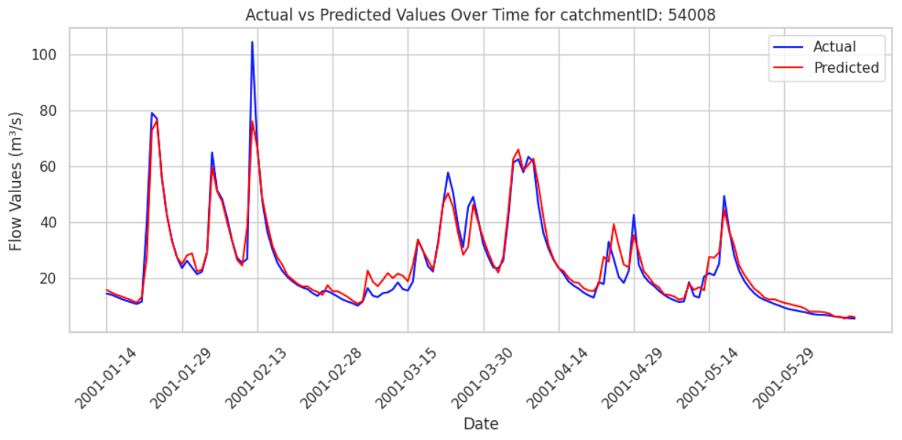
graph

Image: As part of validating our model, we have evaluated its performance on pseudo-ungauged rivers. Example of a time-series estimation from one of our validation runs. 


Using more than 40 years of daily river flow data for England

To ensure transferability between rivers and catchments, we have intentionally focused our model development on open datasets with national coverage, ensuring the development of a robust and general model for predicting river flow across England.

Our flow prediction model compiles historical flow, weather and catchment data from the CAMELS-GB dataset, the Environment Agency’s Hydrology Data Explorer, and a curated list of chalk streams from Natural England. This includes 40 years of daily river flow data from 409 catchments across England, enabling our model to understand the relationship between weather, topography, catchment attributes and river flow.

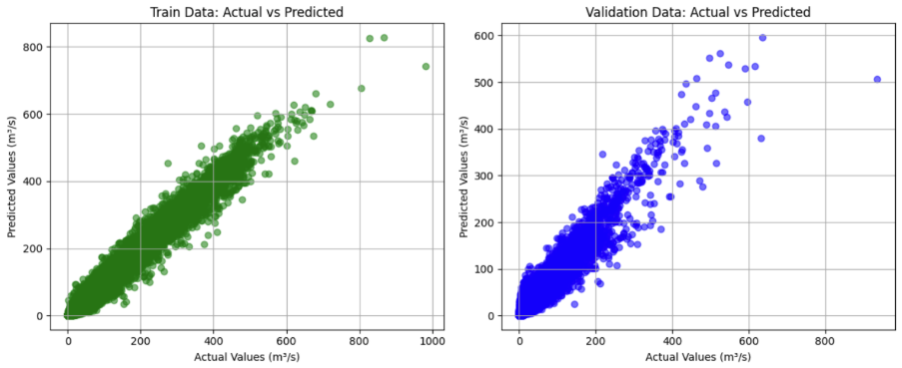
prediction graphs

Image: As part of validating our model, we have evaluated its performance on pseudo-ungauged rivers. Comparison between actual river flow and predicted river flow. 

For our model, we have implemented a dual-branch architecture. One branch incorporates a LSTM layer designed to handle time-varying variables, such as weather conditions. The LSTM takes the past 30 days of weather data, and use that to make a prediction. The other branch is an encoder, which processes catchment attributes, such as elevation, land cover and soil type. The outputs of these two branches are concatenated and passed through a final dense layer, which  produces a prediction of daily mean flow (m3/s). Our results, data analysis and validation metrics are highlighted in our whitepaper, and are also detailed in the model output report, released alongside the model on GitHub.

The Open Flow model released today showcase that AI/ML can be applied as a useful addition to traditional monitoring and hydrological modelling, reducing the overal l cost of flow estimation and increasing the access to critical river health data.

A collaborative and open-sourced approach

The overarching objective of River Deep Mountain AI is to bring key stakeholders involved in waterbody health together and collaboratively develop open-source AI/ML models, that can inform effective actions to tackle waterbody pollution.  

All our models will be released in the public domain  to democratise the use of artificial intelligence and benefit the entire water sector.

Access our Open Flow Model open source via GitHub.

River Deep Mountain AI is funded by the Ofwat Innovation Fund and consists of 6 core partners: Northumbrian Water, Cognizant Ocean, Xylem Inc, Water Research Centre Limited, The Rivers Trust and ADAS. The project is further supported by 6 water companies across the United Kingdom and Ireland.


Cognizant Nordics

Our experts are contributing with exciting insights about what is going on within technology and innovation.


Latest posts
Related posts