

March 3, 2026
What Problems Are People Actually Trying to Solve with Multi-Agent AI?

What Problems Are People Actually Trying to Solve with Multi-Agent AI?
Insights and key takeaways on multi-agent systems from the India AI Impact Summit 2026.
At the India AI Impact Summit 2026, we had the opportunity to showcase Cognizant's Neuro AI Multi-Agent Accelerator (neuro-san), an open-source multi-agent framework that lets developers define, configure, and deploy agent networks.
We invited the attendees to try out the Agent Network Designer, one of neuro-san’s defining features, and vibe-code an agent network for their use case. By the end of the summit, attendees vibe-coded roughly 70 agent networks spanning multiple domains. This made us curious to learn what domains people were most eager to agentify and what that reveals about how enterprises are thinking about multi-agent systems today.
HOCON: The Language of Agent Networks
In neuro-san, every agent network is defined in a HOCON file. Think of HOCON as JSON with extra bells and whistles: comments, variable substitution, etc. Each file fully describes a network: the agents' names, descriptions, instructions, the tools they have access to, and how they connect to one another. This makes agent networks more accessible than what would’ve been possible if they were written purely in a programming language.
Making agents even more accessible is neuro-san's built-in Agent Network Designer. Users can "vibe-code" an agent network in minutes: describe the problem you're trying to solve, and the designer leverages the LLM's knowledge to produce a ready-to-run agent network. The resulting HOCON is saved to disk and immediately available in the studio to experiment with.
That's exactly how the 70 networks at the Summit were created and attendees described their use cases in natural language and watched as the designer wove them an agent network in minutes, if not seconds.
What emerged from this exercise was not just experimentation, but a real-time glimpse into how professionals across industries conceptualize intelligent systems when given the freedom to design them from scratch.
Where the Energy Is: Industry Distribution
A Note on Methodology:
To analyse the 70 generated agent network, we first used Claude Sonnet 4.6 get a concise summary of the agent network’s purpose. As noted above, the HOCON definition makes it quite simple. Then we passed all the summaries to Claude Opus 4.6 with adaptive thinking turned on to categorize the agent networks into the major industry to which it may belong to. We explicitly asked the model to contain the taxonomy to 10 industry categories. We wanted to keep things simple enough to be meaningful without being exhaustive. The increased context size of these modern LLMs makes this effortless. After this, all that was left was to extract the data in structured format with a tool call and compute the distributions and generate the visualizations that you see below using Python.
To study the functional decomposition of agents in each of the categories that we found in the step above, we again make use of Sonnet 4.6. We passed the agent networks belonging to a category to the LLM and asked it to categorize them based on broad primary function that they were performing. As before, we extracted the data using a tool call and crunched the numbers in Python. Here we again, constrain the number of agent function categories to keep things simple.
We found that Technology and Finance led the pack, together accounting for over 40% of all agent networks created. Retail, Travel & Hospitality, and Healthcare rounded out the top five, reflecting the sectors where operational complexity and data volume make multi-agent coordination especially compelling.
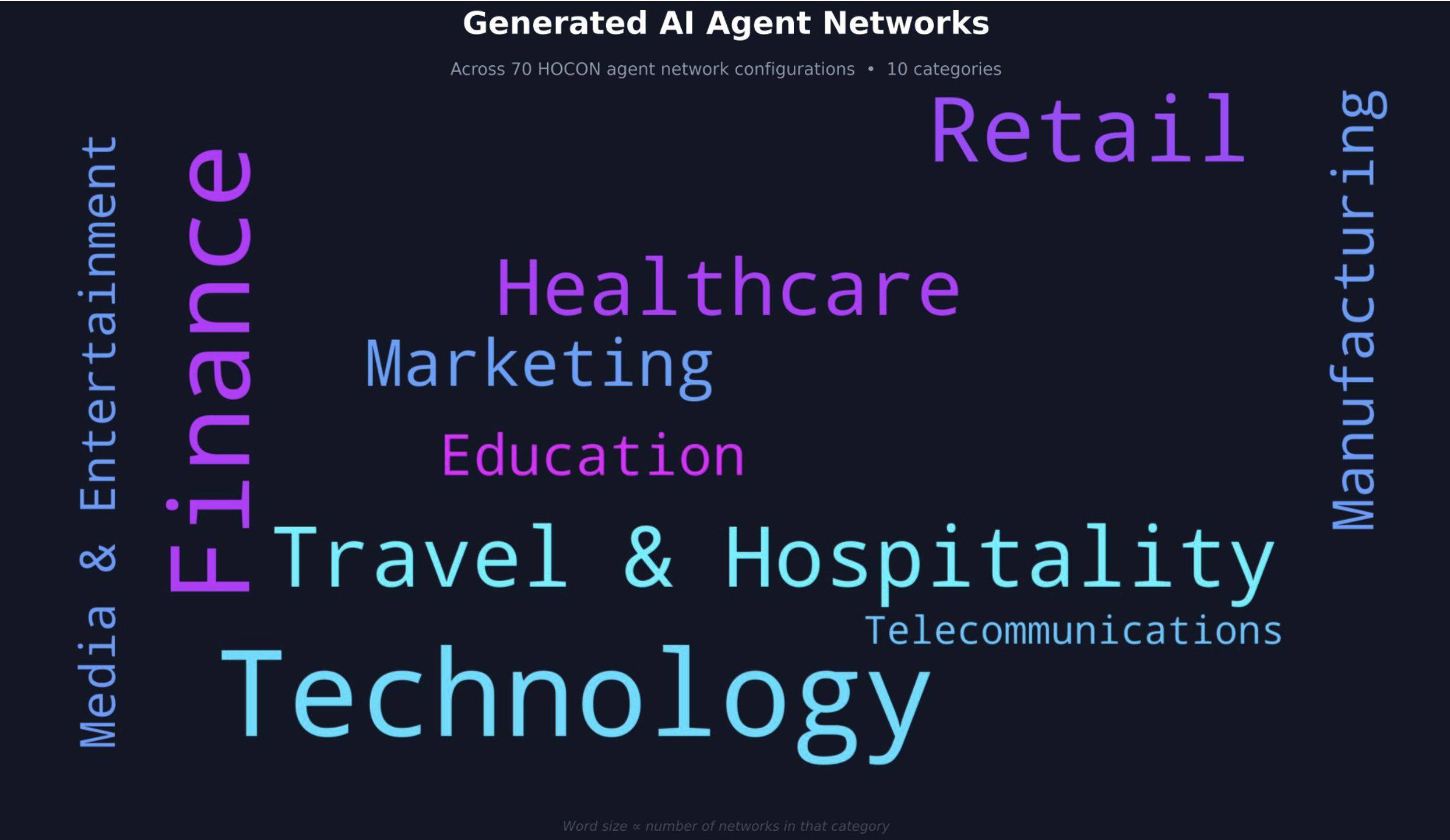
Figure 1. Distribution of generated agent networks across industries. Word size proportional to number of networks.
From verticals such as Telecommunications to Media & Entertainment to Manufacturing, we can see that multi-agent thinking is no longer confined to tech-forward organizations. It is crossing into every corner of the enterprise.
What Agents Are Actually Doing: Function-Level Analysis
Beyond industry categories, we dug into the functional roles of individual agents within each network. Every agent was tagged with its primary purpose. This breakdown reveals how people and LLMs conceptualize intelligent systems when given the freedom to design them from scratch.
Interestingly, the majority of networks were not single-agent automations but structured systems consisting of orchestration agents coordinating specialized agents. This structural pattern appeared consistently across industries.
Architectural Patterns Across Networks
Across the generated HOCON files, we also observed recurring structural compositions beyond functional tagging. A majority of networks followed a hierarchical architecture, with a central orchestration agent delegating tasks to domain-specific specialist agents. It suggests that when practitioners design multi-agent systems, they instinctively gravitate toward structured coordination models rather than flat or fully decentralized agent swarms. The mental model resembles an organizational hierarchy more than a distributed mesh.
This has important implications for enterprise deployment. Hierarchical coordination simplifies traceability, monitoring, and governance. It also aligns closely with how enterprises already structure decision authority, which may explain why this architecture pattern emerged so consistently across independently generated designs.
neuro-san enables autonomous delegation of tasks among the agent networks vastly simplifying orchestration. We find Orchestration to be a core function across nearly every vertical. This is of no surprise since Multi-agent thinking inherently involves coordination and it is understood instinctively both by people and LLMs. Hence, let us focus more on other functions the agents were responsible for.
Finance, Healthcare, Technology, Retail, Marketing & Travel
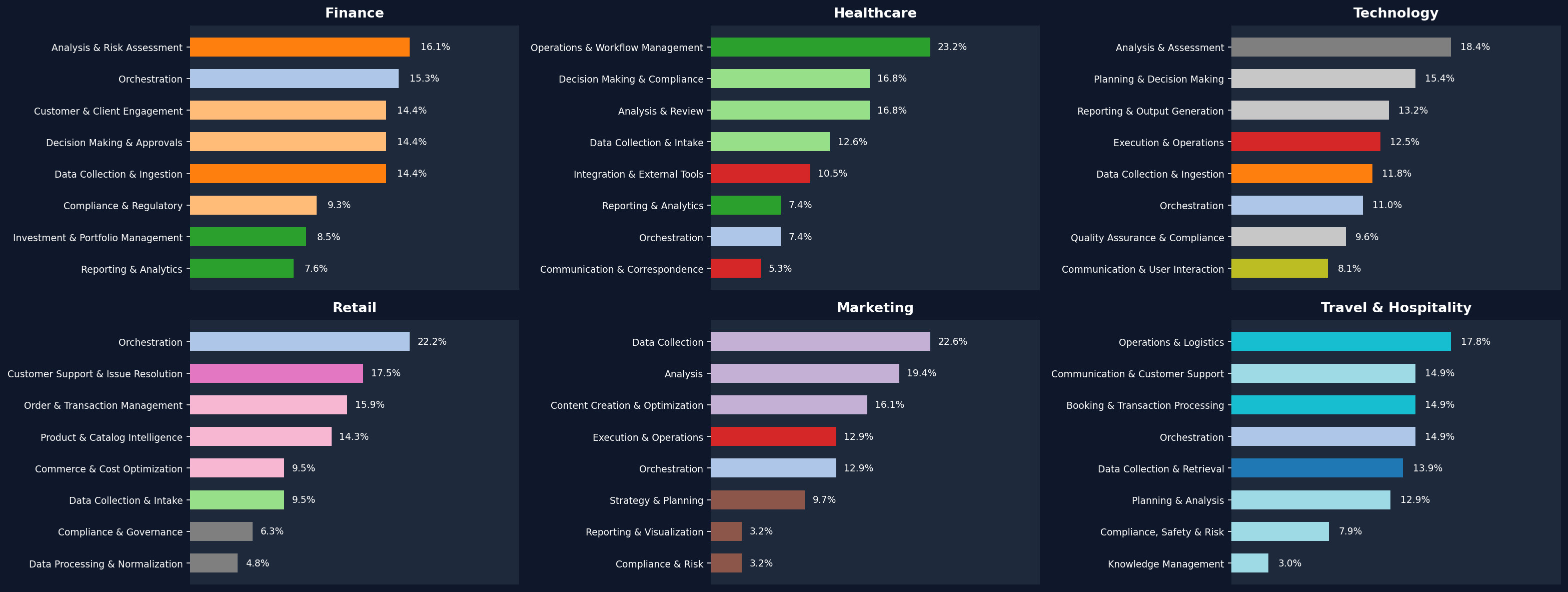
Figure 2. Agent function distribution across Finance, Healthcare, Technology, Retail, Marketing, and Travel & Hospitality.
In Finance, the dominant functions were Analysis & Risk Assessment (16.1%), with Customer & Client Engagement, Decision Making & Approvals, and Data Collection & Ingestion each accounting for a further 14.4% which indicates that participants see multi-agent systems primarily as decision-support infrastructure, not just automation pipelines.
Healthcare networks were anchored by Operations & Workflow Management (23.2%), followed closely by Decision Making & Compliance and Analysis & Review (both 16.8%). The emphasis on compliance-aware decision-making reflects the regulatory stakes inherent to healthcare AI.
In Retail, Customer Support & Issue Resolution (17.5%) and Order & Transaction Management (15.9%) led the substantive functions, with Product & Catalog Intelligence (14.3%) close behind which painting a picture of multi-agent systems as the connective tissue of the customer experience stack.
Education, Manufacturing, Telecommunications & Media
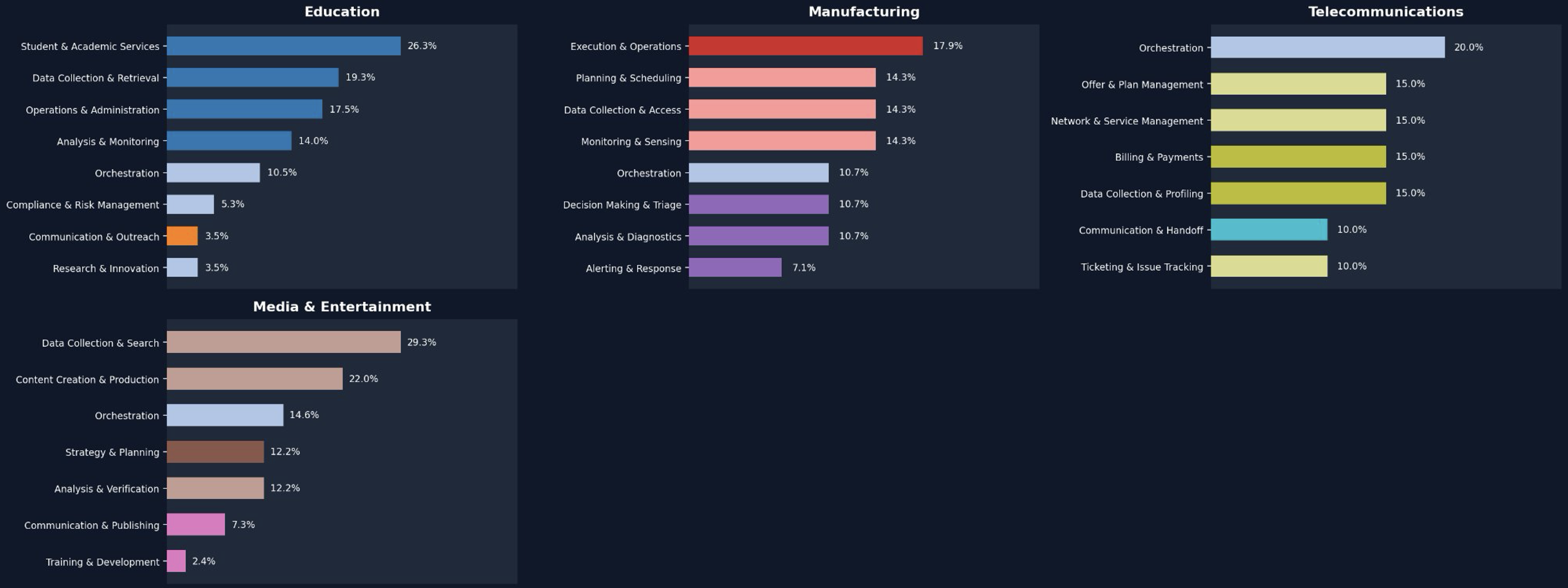
Figure 3. Agent function distribution across Education, Manufacturing, Telecommunications, and Media & Entertainment.
Education stood out with Student & Academic Services commanding 26.3% of agent functions. This was the highest single-function concentration across any vertical. Participants in this space are thinking about AI agents as direct enablers of the learner journey, not just back-office efficiency tools.
Manufacturing networks emphasized Execution & Operations (17.9%) alongside Planning & Scheduling, Data Collection & Access, and Monitoring & Sensing (all at 14.3%). The balance between real-time sensing and structured planning reflects the operational tempo of industrial environments.
Media & Entertainment led with Data Collection & Search (29.3%) and Content Creation & Production (22.0%). This signals a strong appetite for agent-powered content pipelines that can source, synthesize, and generate at scale.
Three Patterns Worth Noting
Data collection is the foundation. Whether labelled as Data Collection & Ingestion, Data Collection & Retrieval, or Data Collection & Search, the act of gathering structured and unstructured information was a consistent need. Intelligence requires inputs. Before decision-making or automation, there is retrieval and structuring of information. The prevalence of data-centric agents reinforces this foundation.
Domain specificity matters. The top function in each vertical was almost always unique to that sector. Student & Academic Services in Education, Operations & Workflow Management in Healthcare, Data Collection & Search in Media. This suggests that effective multi-agent design requires deep domain encoding, not just generic orchestration templates.
While orchestration patterns appear across industries, value creation remains domain-specific.
Compliance as an intrinsic design consideration in regulated domains. In verticals subject to regulatory oversight, notably Finance, Healthcare, Retail, and Education, compliance-oriented agent functions were explicitly represented within the generated network taxonomies. This finding is of particular interest: rather than treating regulatory adherence as an external constraint imposed post-deployment, practitioners appear to encode compliance as a first-order design concern at the agent architecture level.
Conclusion
The 70 networks generated at the India AI Impact Summit tell a story about how people are eager to experiment and map their operational challenges onto an agentic architecture.
While the process of multi-agent system may be daunting, we found our attendees to be quite surprised about how easy neuro-san makes it to start that journey. From ideation to deployment, it's production-grade infrastructure for the age of intelligent agents.
What stood out most was the shift in framing. Participants were not asking how to automate a task. They were asking what set of collaborating agents would best solve a problem. That mindset reflects a deeper architectural approach to enterprise AI.
The networks created at the Summit are just the beginning. If you're curious what a multi-agent system for your own domain might look like, neuro-san makes it remarkably easy to find out. Describe your problem, generate your HOCON, and start experimenting within minutes.
We invite you to explore the framework, fork the repo, and build your own agent network on Github.
Please drop a star if you loved it! We'd love to see what you build. We welcome feedback and contributions from the broader AI community.

Praveen Tanguturi turns complex data into simple, impactful outcomes and drives Data and AI strategy with a strong focus on business growth.

Babak Hodjat is the Chief AI Officer at Cognizant and former co-founder & CEO of Sentient. He is responsible for the technology behind the world’s largest distributed AI system.

Technologist working on practical AI, multi-agent systems, and federated learning, with a focus on building scalable, real-world intelligent systems.