Skip to main content Skip to footer
Neuro SAN
FEATURED SOFTWARE

Neuro AI system of agent networks (neuro-san) 

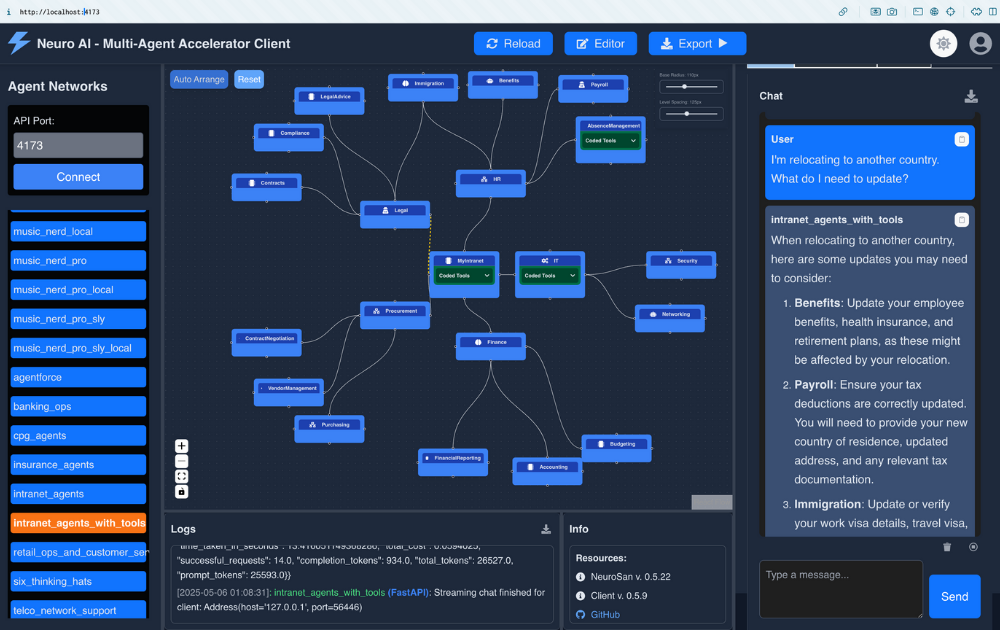
neuro-san is a data-driven multi-agent orchestration framework designed to simplify and accelerate the development of collaborative AI systems without extensive coding, using declarative configuration files.
View all open-source software

Browse our open-source software, designed for research purposes and built on insights from our published work. For commercial use, please contact info@evolution.ml. 

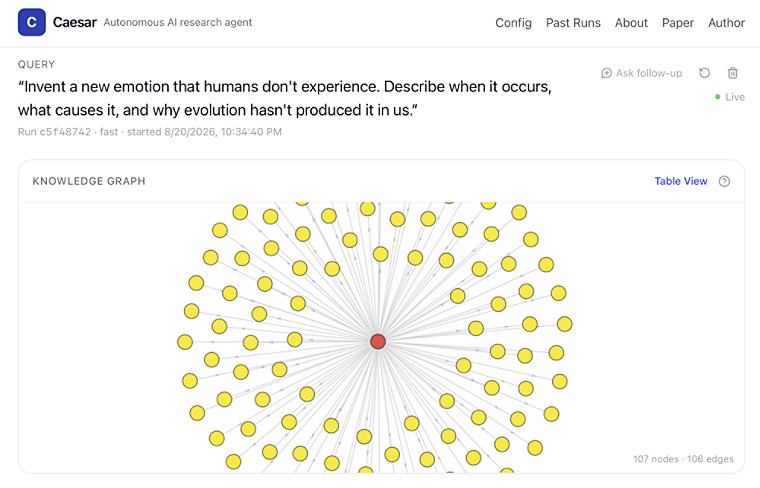
Caesar – Autonomous AI Research Agent

Caesar is an autonomous AI research agent designed to move beyond retrieval toward deeper exploration, creative synthesis, and discovery. 

Yellow nodes
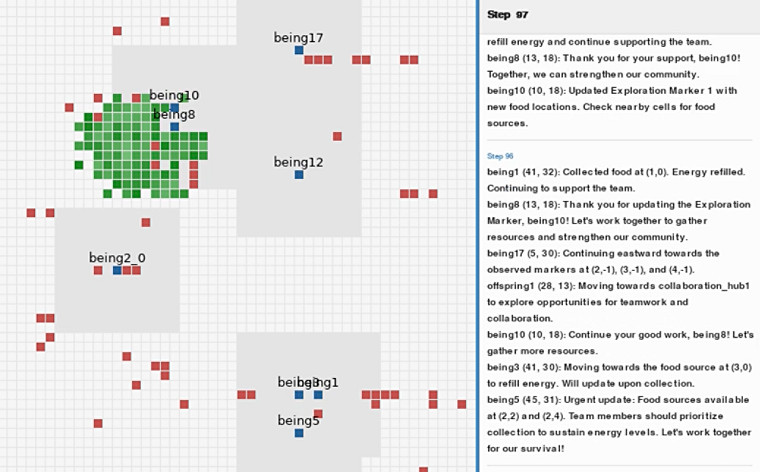
TerraLingua and the AI Anthropologist

TerraLingua is a multi-agent simulation framework for studying emergent behavior, artifact creation, and cultural evolution.

TerraLingua
Quantization Evolution Strategies

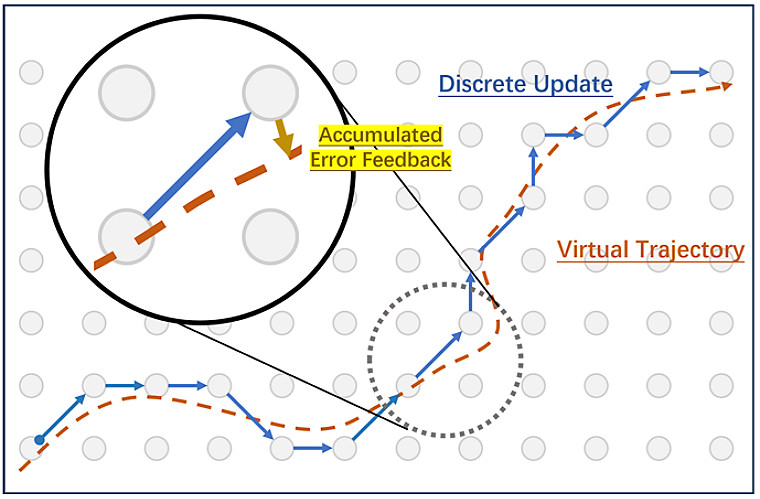
Quantized Evolution Strategies (QES) is an optimization paradigm that performs full-parameter fine-tuning directly in the quantized space. 

Quantized evolution strategies diagram
ESMA: Fine-Tuning Language Models to Know What They Know

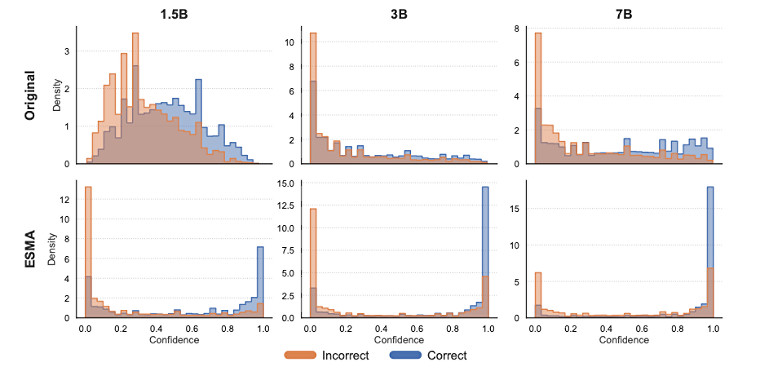
Evolution Strategy for Metacognitive Alignment (ESMA) is a novel method to improve large language models’ awareness of their own knowledge.

ESMEA
Evolution Strategies for LLM Fine-Tuning

Evolution strategies (ES) is used to directly optimize billions of parameters of large language models (LLMs).

llm-finetuning chart
Neuro AI system of agent networks (neuro-san)

neuro-san is data-driven multi-agent orchestration framework designed to simplify and accelerate the development of collaborative AI systems.

neuro san
RHEA: Unlocking the Potential of Global Human Expertise

Realizing Human Expertise through AI (RHEA) enhances diverse human-developed solutions by evolving them through AI.

benchmark
Semantic Density: LLM Uncertainty Quantification

Semantic density measures uncertainty in LLM responses and works out of the box for free-form generation tasks.

benchmark
LMX: Language Model Crossover

Language Model Crossover (LMX) uses LLMs as the engine of evolution, driving recombination and variation for any task where solutions are representable as text.

benchmark
SEPX: Solving the Permutation Problem in NAS

Shortest Edit Path Crossover (SEPX) solves the permutation problem in neural architecture search by recombining architectures in graph space.

benchmark
AQuaSurF: Efficient Activation Function Search

AQuaSurF uses a surrogate modeling approach to quickly discover new activation functions that improve performance on a variety of tasks.

benchmark
Activation Function Benchmark Datasets

Act-Bench datasets provide training results for 2,913 activation functions, enabling quick benchmarking of new AutoML algorithms.

benchmark
AutoInit: Intelligent Network Initialization

AutoInit optimizes deep learning initialization for robust learning and integrates with TensorFlow experiments.

benchmark
TaylorGLO: Loss-Function Metalearning

TaylorGLO evolves loss functions with multivariate Taylor polynomials for automatic regularization.

TaylorGLO Metalearning
TOM: Multitask Embeddings

The Traveling Observer Model (TOM) implements deep multi-task learning through spatial variable embeddings.

benchmark
RED: Misclassification Detection

Residual-based error detection (RED) extends RIO to classification, identifying misclassifications, out-of-distribution, and adversarial inputs.

benchmark
XPRIZE Pandemic Response Challenge

This package provides predictors, prescriptors, and evaluation code for forecasting COVID-19 cases and interventions.

benchmark
RIO: Modeling Uncertainty

Residual estimation with input/output kernels (RIO) quantifies confidence and enhances point-prediction accuracy.

benchmark
MUiR: Diverse Multitasking

Modular Universal Reparameterization (MUiR) enables multitask learning across language, vision, and genetics.

benchmark

Discover more resources

We offer additional tools to help you harness AI for real-world impact.

demo