

January 7, 2025
The Minds Behind the Neuroevolution Book: A Conversation with the Authors

The Minds Behind the Neuroevolution Book
In this fireside conversation, the authors reflect on how neuroevolution evolved into a unified field, what inspired their book, and where evolutionary approaches are taking the future of AI.
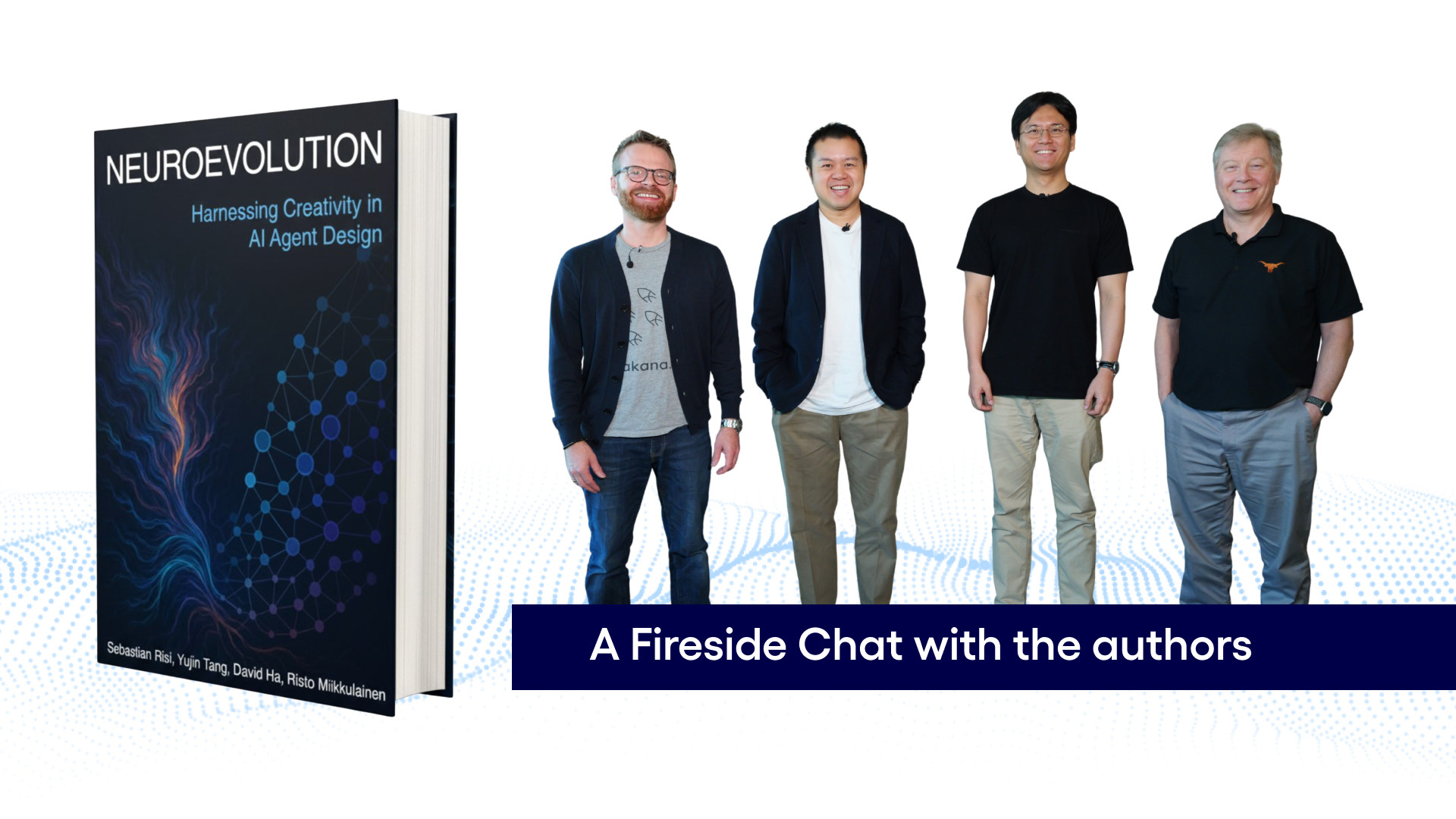
When Sebastian Risi, Yujin Tang, David Ha, and I first discussed writing a comprehensive book on neuroevolution four years ago, it was not obvious that it would become what it is today. The field was very active, but much of the knowledge lived in scattered papers, workshops, and conversations across academia and industry. What motivated us to take on the project was the sense that neuroevolution had matured into a coherent discipline with shared principles, practical methods, and increasingly impactful applications.
Neuroevolution has always offered a distinct perspective to AI. By evolving populations of neural networks rather than optimizing a single model, it supports exploration and discovery in ways that gradient-based approaches often cannot. It makes it possible to uncover strategies, structures, and behaviors that are difficult to design directly, which is becoming more important as AI systems grow in complexity and as we look for approaches that encourage creativity, transparency, and continual learning. These capabilities also extend to domains with broader societal impact, where the interactions of many agents shape policies, collective behavior, and long-term outcomes in ways that are challenging to design by hand.
As we finished the book, it became clear that one of the most valuable parts of the process was the collaboration itself. Each co-author brought a different perspective. Sebastian Risi contributed expertise in indirect encodings and diversity, and synergies with RL and artificial life. Yujin Tang brought experience in scaling evolutionary algorithms with compute, and synergies with generative AI . David Ha added clarity and motivation of the basic principles, and perspectives from world models. My own contributions focused on behavior and decision-making, metalearning, and synergies with biology. Together, these perspectives shaped not only the book, Neuroevolution: Harnessing Creativity in AI Agent Design, but also how we think about the future of this field.
A Fireside Chat on the Future of Neuroevolution
To share more of that collaboration, we recently recorded a fireside chat with the authors. It gave us a chance to discuss why neuroevolution is gaining momentum, how creativity arises in evolutionary systems, and where we see the most exciting opportunities, from generative AI and robotics to scientific discovery and large-scale evolutionary experiments. We also reflected on why this was the right moment to bring the field together in one place and what new directions are opening as evolutionary approaches scale with modern compute. I invite you to watch the conversation and explore the ideas behind it. It captures the energy and curiosity that drove us to write the book and highlights the questions that continue to push the field forward.
You can join the conversation and explore the book, its demos, and its resources at neuroevolutionbook.com. I hope it inspires you to experiment with these methods, contribute your own ideas, and take part in the growing community that is exploring what AI can become when it is free to evolve.

Risto Miikkulainen is VP of AI Research at Cognizant AI Lab and a Professor of Computer Science at the University of Texas at Austin.