

February 11, 2026
Bringing Multi-Agent AI to Capitol Hill: Reflections from AIIC Demo Day

Bringing Multi-Agent AI to Capitol Hill: Reflections from AIIC Demo Day
Demonstrating how responsible AI integration bridges innovation and enterprise adoption.
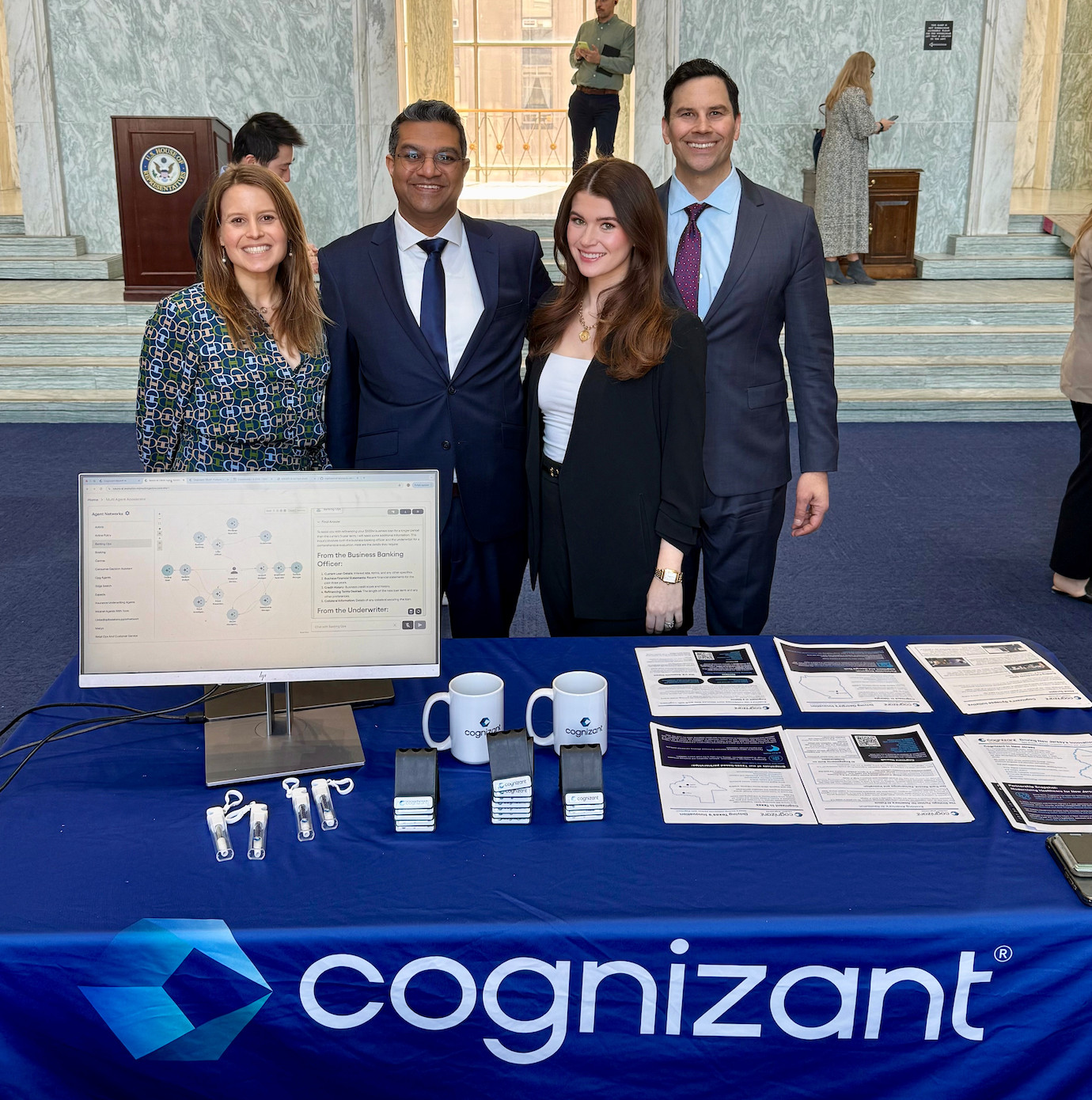
Earlier this week, Dr. Neel Savani, Cognizant's AI Assurance and Adoption Lead, showcased our Neuro® AI Multi-Agent Accelerator to policymakers, congressional staff and industry stakeholders on Capitol Hill, in Washington, D.C.
Dr. Savani’s presentation was part of the AI Integrators Council's (AIIC) Demo Day, an event convened for leading technology providers to share concrete examples of how AI is responsibly integrated across industries today. Cognizant is a member of the AIIC, which serves as the premier voice for companies operationalizing AI across sectors, bridging development and deployment through integration into systems, platforms and applications.
Demo Day provided an interactive forum for Cognizant and other companies to engage with policymakers and show responsible AI integration in practice. Cognizant’s demonstration builds on the significant momentum to craft responsible AI policy in Washington, D.C., an important driver for more clients to move from experimentation to enterprise-scale deployment of transparent and business-aligned systems this year.
Improving policy outcomes through meaningful engagement
Informed public policy is critical to realize the long-term promise of AI. As multi-agent systems become more sophisticated, dialogue between technologists and policymakers needs to be guided by real implementations. Demo Day provided Cognizant and other companies with the opportunity to hold substantive conversations about responsible AI systems, how they are governed and the potential policy measures required to accelerate adoption.
Dr. Savani focused his demonstration on how the Neuro® AI Multi-Agent Accelerator enables clients to build multi-agent systems that are designed to operate reliably at enterprise scale. Lawmakers and their staff learned how organizations can automate complex workflows and coordinate AI agents across distributed environments, with human oversight remaining central to decision-making. This firsthand context provided the type of meaningful insights that could structure future regulatory frameworks.
The integrator role in AI
Demo Day also marked the publication of the AIIC's white paper, which clarifies an increasingly important function in the AI ecosystem that’s often missed or misunderstood: the AI integrator.
Most organizations do not build foundation models from scratch, and they don't deploy AI in isolation. They rely on integrators, like Cognizant. We configure, customize and deliver AI solutions by bringing together foundation models, enterprise data and product features that work in operational settings. The AI ecosystem is more complex than just developer and deployer. Integrators occupy a critical, connective middle layer. We don't train underlying models, and we don't control client use. But we do the essential work of making AI systems enterprise-ready, helping clients implement them in ways that support compliance objectives and alignment with business needs.
This distinction matters for policy. When regulations fail to recognize integrators as distinct, it can create uncertainty about the appropriate allocation of compliance obligations. Setting these boundaries straight helps innovation move forward by keeping accountability where it belongs.
Shared responsibility across the value chain
The AIIC’s white paper outlines a framework for shared responsibility across the AI value chain.
- Developers are accountable for training data, model design and known limitations.
- Integrators handle customer data governance, system-level risk assessments and documentation on how components work together.
- Deployers own the use case, monitoring, human oversight and decisions about when and how AI gets applied in the real world.
No single actor can manage all risks alone. Effective AI governance depends on collaboration, transparency and each party owning the risks for which they're best positioned to control.
What comes next
The interest and enthusiasm generated by Dr. Savani’s demonstration, along with the AIIC’s other presenters, illustrated a key point: responsible AI adoption isn’t just about building better models, it’s also about building better systems—ones that policymakers, enterprises and key stakeholders alike can trust and understand, and that can support confident and responsible use. Cognizant is proud to contribute to these critical conversations and committed to helping our clients scale AI responsibly.