

February 17, 2026
AI for Inclusive Economic Progress: Reimagining the Public Services Stack

AI for Inclusive Economic Progress: Reimagining the Public Services Stack
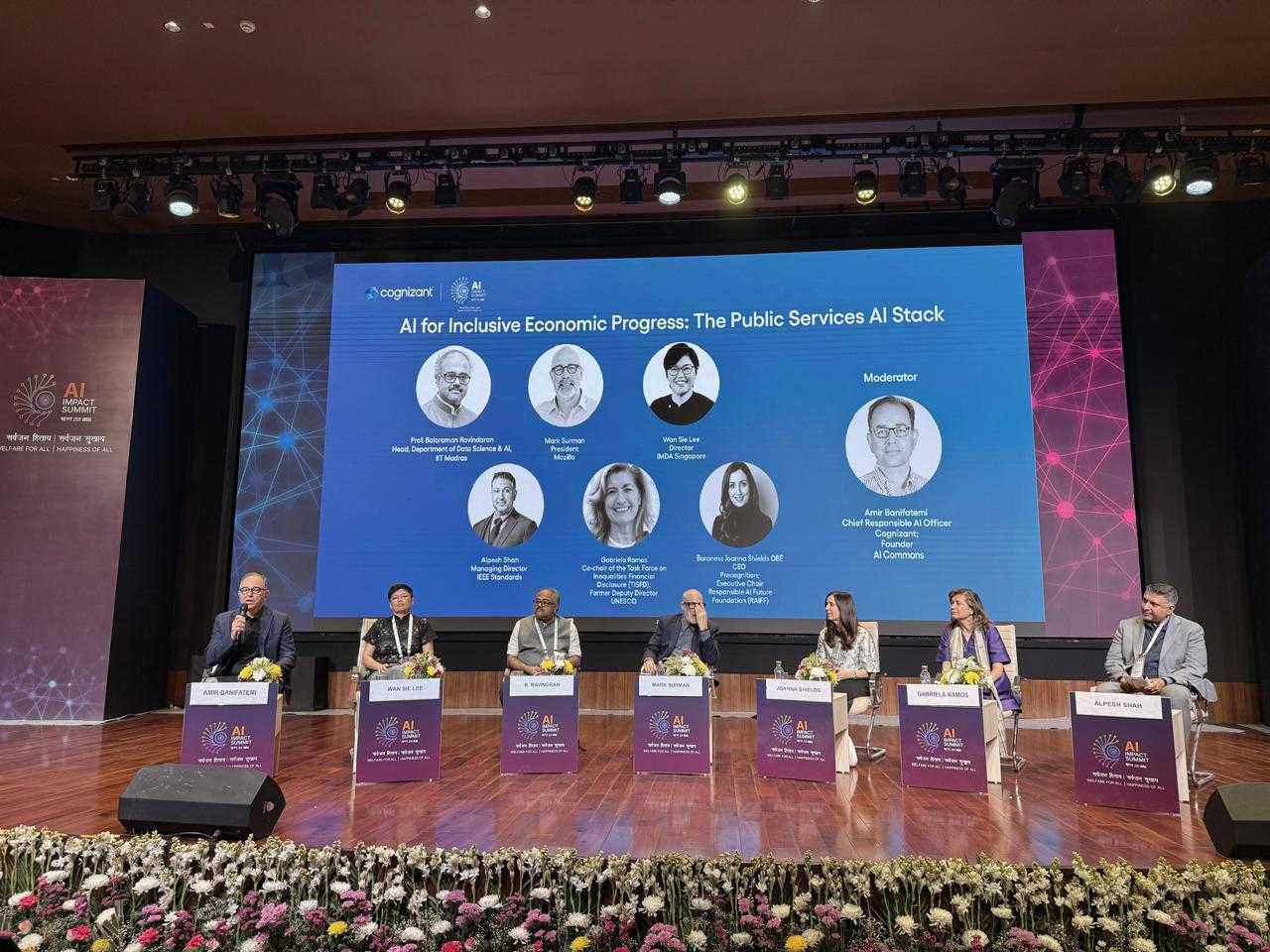
Reflections from the India AI Impact Summit 2026, featuring a panel discussion moderated by Chief Responsible AI Officer Amir Banifatemi, on building an inclusive Public Services AI Stack for equitable economic growth
Key Themes from the India AI Impact Summit
The conversation on “AI for Inclusive Economic Progress: The Public Services AI Stack” opened with a reminder that this moment did not emerge overnight. Nearly a decade ago, two parallel developments began to reshape the global conversation: the adoption of the United Nations Sustainable Development Goals in 2015, and the gradual movement of artificial intelligence from research labs into real-world deployment. Together, these currents gave rise to what many began calling “AI for Good.”
Over time, however, AI expanded rapidly, largely driven by productivity gains and commercialization. The pace of innovation was so swift that society has struggled to ask a fundamental question: beyond profits and efficiency, how does this technological acceleration genuinely benefit people?
That question framed the entire session.
One of the strongest points raised was that AI is not entering a neutral world. It is entering a world already shaped by inequality. Income inequality, opportunity gaps, uneven access to connectivity and education. These inequalities are not limited to the developing world. They exist everywhere. So when we talk about inclusive economic progress, we have to recognize that AI is being layered on top of systems that are already imbalanced.
Another reality is concentration. The production of foundational AI models is highly centralized. A small number of countries, and an even smaller number of organizations, are shaping the direction of this technology. Much of the Global South, and even parts of the Global North, are consumers rather than producers. That dynamic alone raises questions about representation. If models are designed elsewhere, in dominant languages and contexts, can they truly reflect the lived realities of diverse populations?
For countries like India, inclusive economic progress cannot begin at the model layer. It begins at the access layer. There remains a significant digital divide. Connectivity, device access, skills, these are still uneven. AI cannot be inclusive if people are not even connected.
Why the Public Services AI Stack Must Be Built for Access, Governance, and Digital Public Goods
The discussion then moved toward the idea of the “public services AI stack.” We often describe a stack in technical terms: infrastructure, data, models, applications. But in the public services context, that stack must be broader. It must include governance, standards, accountability, transparency, and sustainability. It must be built on digital public goods. And it must respect culture, sovereignty, and community priorities.
There was a powerful distinction made during the session: governments must not only govern AI, they must govern with AI.
That sounds subtle, but it changes everything. Governing AI means regulation and oversight. Governing with AI means using it responsibly to deliver services like healthcare, education, social protection, and citizen services, in ways that are more accessible and more responsive. But that requires serious investment. In connectivity. In skills. In adapting social protection systems for a workforce that will be touched, at speed, by AI.
The speed is important. Previous waves of automation targeted specific categories of jobs. This time, the transformation is broader. Nearly every profession is affected in some way. And the transition is happening fast.
Entrepreneurs were also called out directly. The capabilities of AI models have shifted dramatically in just the last few months. What was once expensive and complex can now be built faster and more affordably. Instead of viewing public services as slow or bureaucratic, the opportunity is to see them as an open innovation space. Education systems. Healthcare systems. Transportation networks. These are not niche markets. They are foundational systems that impact millions.
But innovation in public services cannot simply replicate commercial models. One speaker made a very clear point: if public money funds AI systems, those investments should create public goods.
Open source was highlighted not as ideology, but as practical infrastructure. We already know open-source ecosystems work. They power the internet. They accelerate industry. They reduce vendor lock-in. If we are investing billions in sovereign AI strategies and public service transformation, then building digital public goods, foundational layers that everyone can build upon, should be a default expectation.
India’s Digital Public Infrastructure is often cited in this context. Identity systems and payment interfaces have created digital rails at population scale. Recording transactions at granular levels has opened economic participation in ways that were not previously possible. When foundational layers are built as shared infrastructure, innovation multiplies on top of them.
Singapore offered a complementary perspective, focusing on individuals within public service. AI is already being used to assist in education, to help students with self-directed learning. Public servants use AI to summarize meetings, draft speeches, and build chatbots that respond to citizen queries more accurately. These are not futuristic experiments. They are daily productivity tools. And importantly, they create familiarity and agency.
That word, agency, came up more than once. Inclusive progress requires individuals to feel that they are participants in this transformation, not passive observers. That means digital literacy. Reskilling. Upskilling. Responsible usage. Human capital development is not an add-on to the AI stack. It is central to it.
If there was a consistent undercurrent throughout the discussion, it was this: inclusive economic progress will not happen automatically because AI becomes more powerful.
It requires intentional design.
It requires building infrastructure that lowers barriers rather than raises them. It requires standards that enable interoperability rather than reinforce lock-in. It requires distributed governance models that encourage participation. And it requires recognizing that technology alone does not create inclusion. Institutions and systems do.
The AI stack we need for public services is not just technical. It is institutional. It is social. It is human.
And perhaps the real benchmark for success will not be model size, parameter count, or inference speed. It will be whether individuals, across regions, across income levels, across generations, feel that they have a meaningful place in the AI-enabled economy that is unfolding.
That is a more difficult outcome to measure. But it is the one that ultimately defines progress.

Praveen Tanguturi turns complex data into simple, impactful outcomes and drives Data and AI strategy with a strong focus on business growth.

Amir Banifatemi leads the company's efforts to ensure its AI technologies, services, and capabilities meet the highest standards of safety, reliability, and responsible innovation.