

April 30, 2026
Multi-Agent Systems: Architecture, Applications & Real-World Impact

Multi-Agent Systems: Architecture, Applications & Real-World Impact
A deep dive into what multi-agent systems are, how they work, and real-world examples and applications.
Multi-agent systems are reshaping how AI takes action by distributing intelligence across many cooperating agents rather than depending on one model to solve everything. As each agent contributes its own skills and perspective, the system becomes more adaptive, more scalable, and more capable of navigating real-world complexity. In this blog, we explore what multi-agent systems are, how they work, and why they are quickly becoming a foundation for the next generation of AI.
If you’re tracking how multi-agent systems are evolving in the real world—from orchestration patterns to safety and governance—we share ongoing research notes and updates on our Substack.
Key Takeaways: Multi-Agent Systems
A multi-agent system is a collection of autonomous agents that perceive their environment, make decisions, and interact with one another.
Multi-agent systems offer advantages such as scalability, resilience, improved coordination, and deeper system-level problem solving.
Multi-agent systems depend on communication channels, cooperation strategies, alignment mechanisms, and clear role definitions in order to work effectively.
Modern multi-agent systems increasingly incorporate LLM-powered agents for reasoning, natural language interpretation, and tool use.
Designing a safe multi-agent system requires strong constraints, oversight layers, simulation testing, and consistent feedback loops.
Real-world applications span robotics, logistics, finance, cybersecurity, energy, healthcare, and generative AI workflows.
As organizations adopt AI for complex tasks, multi-agent systems will become central to distributed intelligence and adaptive decision making.
What Is a Multi-Agent System?
Inside a Multi-Agent System
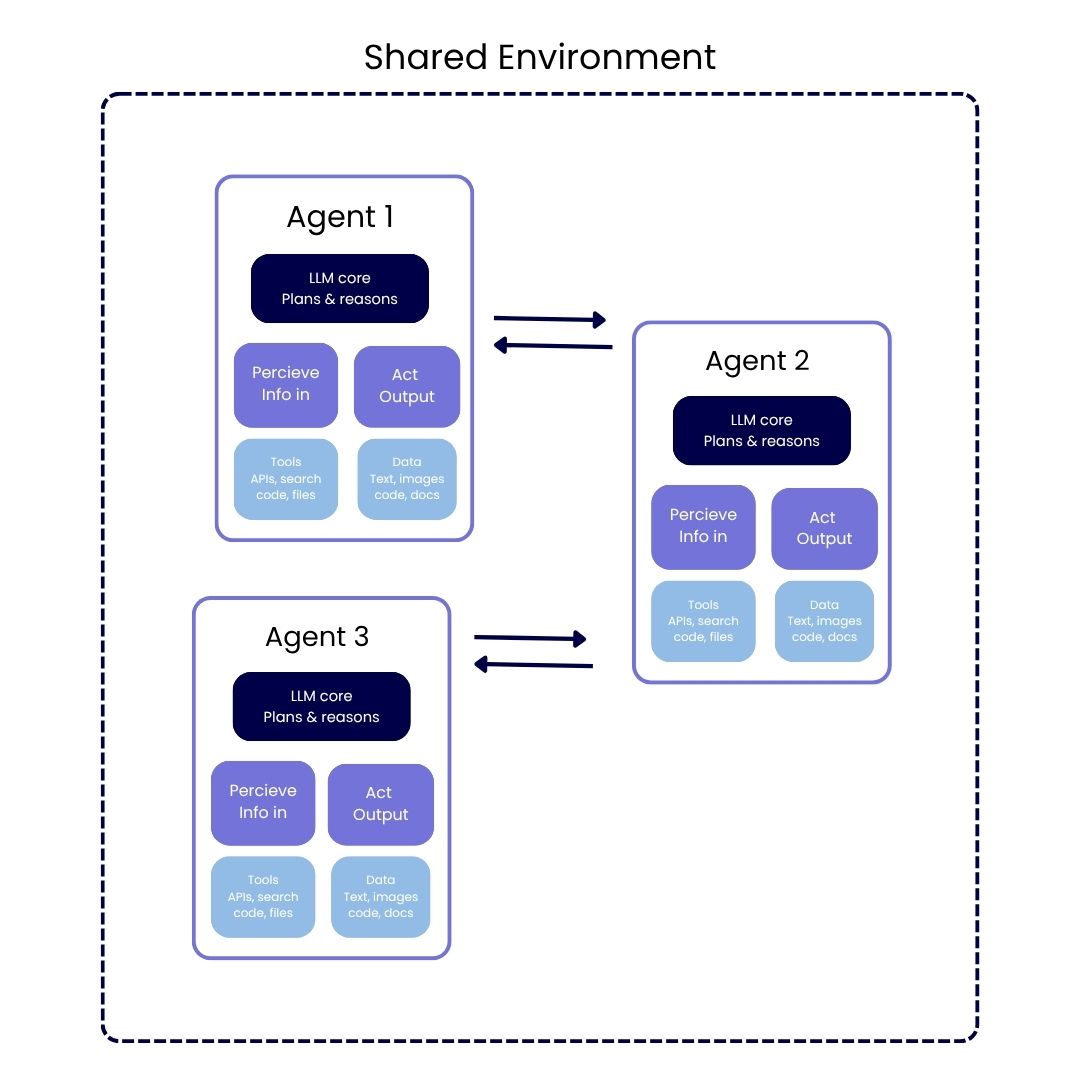
A multi-agent system is made up of multiple autonomous agents that operate in a shared environment. Each agent can perceive information, reason about what it observes, and take actions that move it toward a goal. In modern systems, these agents are often powered by large language models or other AI methods that give them the ability to plan tasks, use tools, or interpret unstructured data.
The strength of a multi-agent system comes from distributing decision-making rather than centralizing it. Each agent handles a part of the problem and collaborates with other agents that hold relevant expertise or resources. This structure allows multi-agent systems to manage challenges that are too large, too dynamic, or too interconnected for a single system to handle on its own.
Core Capabilities of Multi-Agent Systems
Multi-agent systems rely on several foundational capabilities that allow independent agents to function as an organized whole.
Autonomy
Each agent can perceive its environment, make decisions, and act without waiting for instructions from a central controller. This independence allows agents to respond quickly to changing conditions and play specialized roles within the system. Autonomy also enables multi-agent systems to scale, since new agents can contribute immediately without restructuring the entire workflow.
Decentralization
Decision-making is distributed across many agents rather than concentrated in one place. This reduces bottlenecks, improves resilience, and allows the system to operate effectively even when information is incomplete. Decentralization is especially valuable in environments that evolve quickly, where local decisions are often faster and more accurate than centrally managed ones.
Coordination
Coordination ensures that agents do not interfere with each other and that their actions support a shared outcome. This often comes from giving agents clear roles and responsibilities, goals, or boundaries so they understand how their behavior fits into the broader process. Good coordination prevents duplicated work and keeps the system moving in a consistent direction. It is what allows a multi-agent system to behave like an organized decision system rather than a collection of disconnected parts.
Communication
Agents share information they cannot gather on their own so they can stay aligned and make informed decisions. This may involve direct messaging, structured data exchange, or updates to a shared environment. Agents typically communicate only with the agents that hold relevant knowledge or responsibilities, which keeps the system efficient. Effective communication helps agents combine their perspectives into a cohesive understanding of the task.
Adaptability / Emergent behavior
Agents adjust to new information and conditions as they arise. When many adaptive agents interact, the system can exhibit emergent behaviors that were not explicitly programmed but improve performance. This adaptability makes multi-agent systems well-suited for dynamic environments where priorities and constraints shift frequently.
How Multi-Agent Systems Differ From Single-Agent Models
Scalability
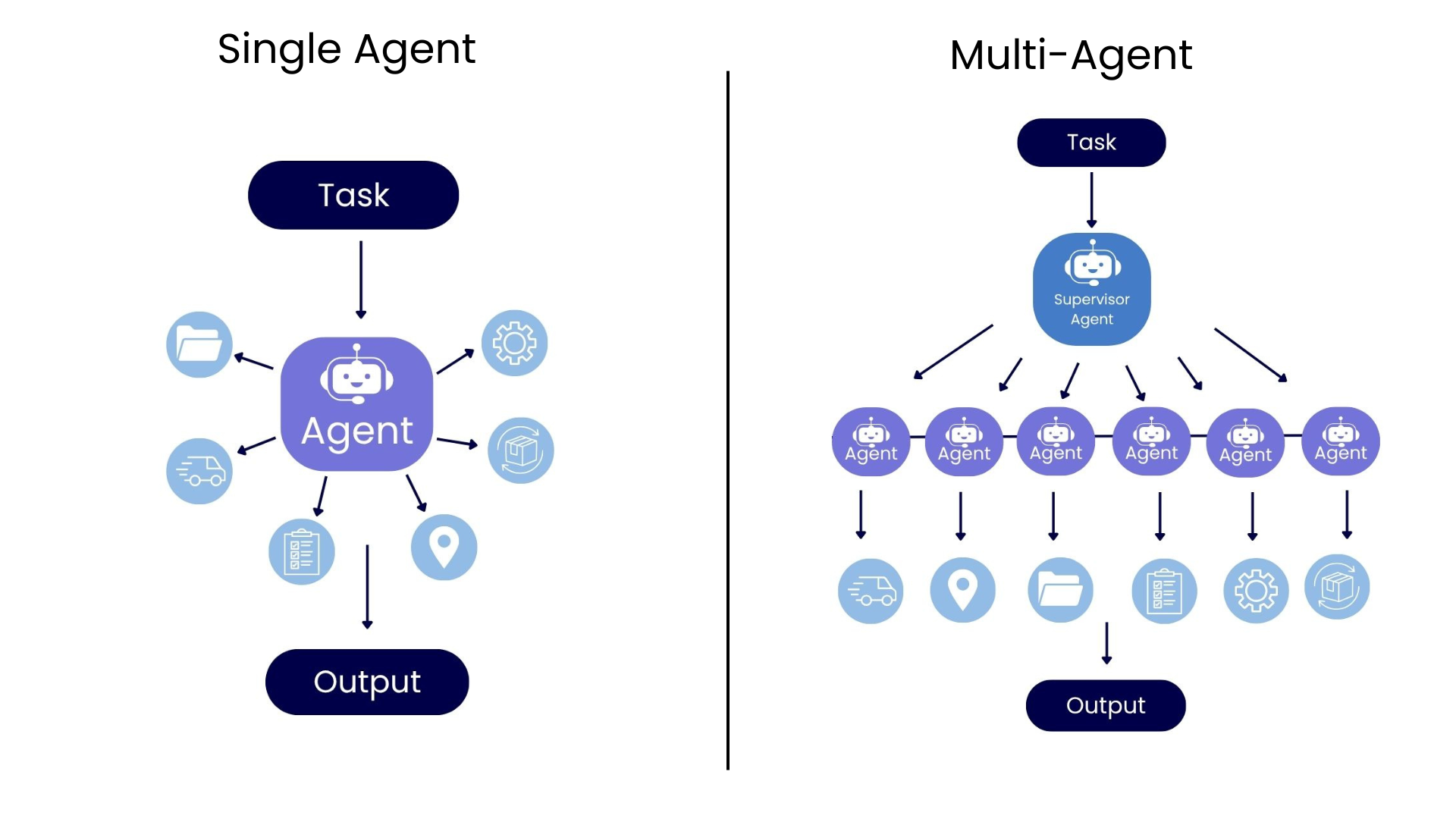
Single-agent systems often struggle when tasks grow in size or involve multiple domains. Multi-agent systems scale naturally because work is distributed across many agents, each handling a manageable part of the problem. This allows more agents to be added without redesigning the entire system.
Robustness
Multi-agent systems continue functioning even when individual agents fail. This resilience is built into the distributed structure, reducing single points of failure and improving reliability in mission-critical scenarios.
Parallel task execution
Agents can work simultaneously on different parts of a task, significantly improving speed and throughput. This parallelism makes multi-agent systems ideal for logistics, scheduling, or environments where many events occur at once.
Lower reliance on global knowledge
Single models often require full context to make accurate decisions. Multi-agent systems operate with partial, local information while still achieving collective goals. This reduces computation and allows faster responses.
How Multi-Agent Systems Work
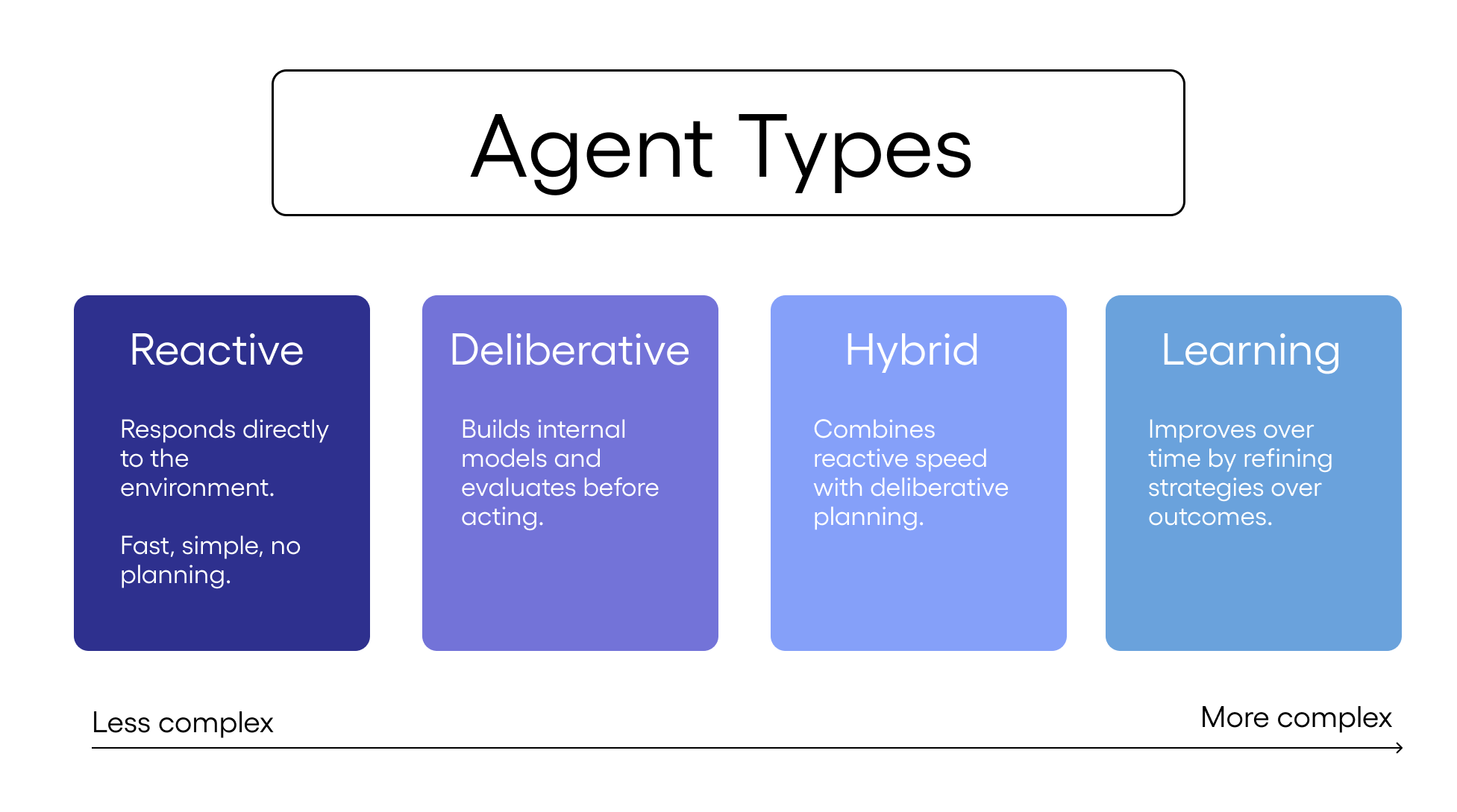
Multi-agent systems rely on many individual agents working together, but the way each agent operates can vary widely. Some respond instantly to changes, some plan ahead, and others learn over time. Understanding these agent types is a helpful foundation before exploring how they coordinate, communicate, and reason as a system.
Agent Types
Reactive agents
Reactive agents respond directly to changes in the environment. They are simple, fast, and effective for tasks that do not require long-term planning.
Deliberative agents
Deliberative agents build internal models, reason about goals, and evaluate different actions before choosing a path. They are useful for complex decision tasks.
Hybrid agents
Hybrid agents combine reactive speed with deliberative planning, making them versatile in dynamic environments.
Learning agents
Learning agents improve over time by incorporating new information or refining their strategies based on outcomes.
Multi-Agent Systems Architecture Overview
Once the agent types are defined, the next question is how they work together. Multi-agent systems architecture describes how decisions are distributed, how agents interact, and how the system organizes itself to complete tasks. These architectural choices determine how scalable, resilient, and adaptable the multi-agent system becomes, especially in environments where information changes quickly.
Centralized vs. distributed control
Centralized systems rely on a single orchestrator, while distributed systems allow agents to act independently. An example of a decentralized architecture is Adaptive Agent-Oriented Software Architecture (AAOSA), which enables agents to route queries intelligently without a central controller. This allows networks to self-organize, scale, and adapt in real time.
Environment modeling
The environment provides context, resources, and constraints that shape agent behavior.
Perception → Planning → Action loops
Agents observe, decide, and act continuously, refining decisions as new information appears.
Benefits of Multi-Agent Systems
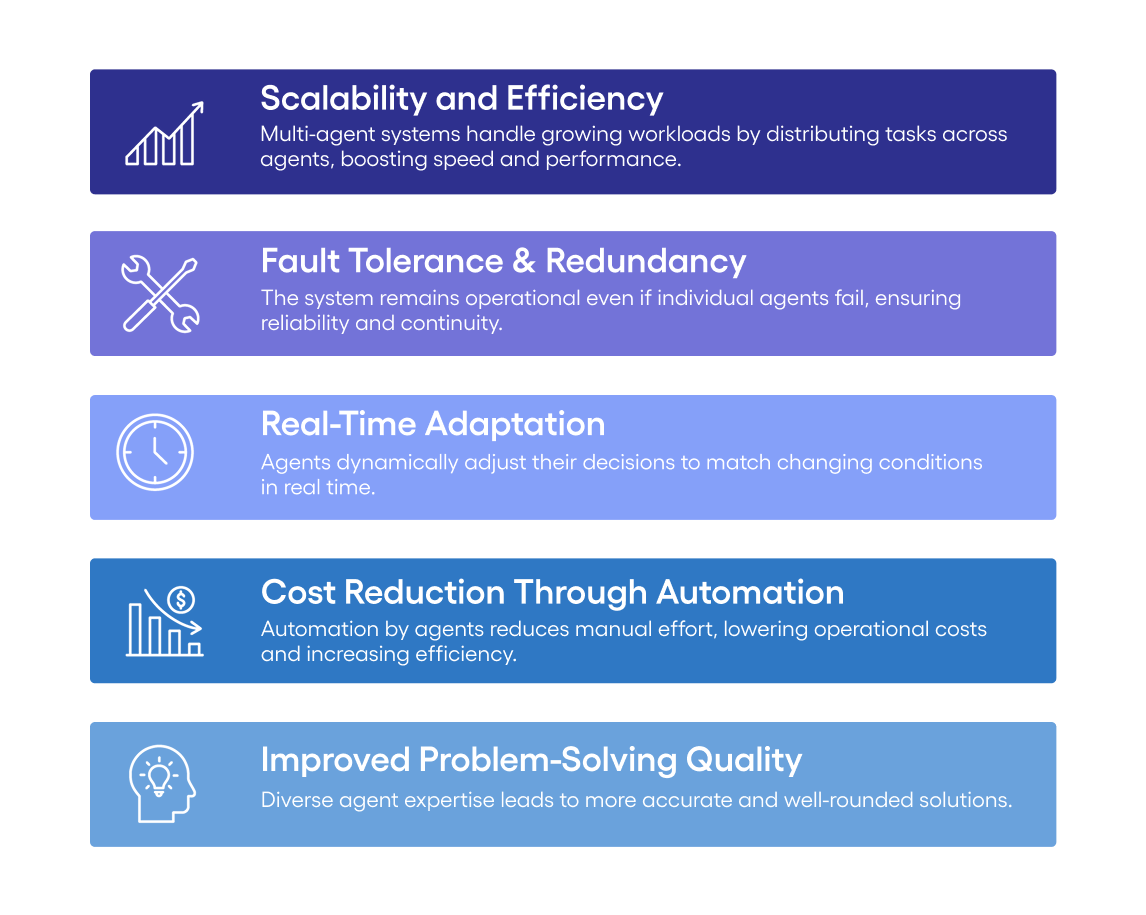
Scalability & Efficiency
Multi-agent systems scale easily as workloads increase because tasks can be divided among many agents. This modular design supports large systems without slowing performance. Distributed decision making also reduces bottlenecks and improves overall throughput.
Fault Tolerance & Redundancy
If one agent fails, others continue working, allowing the system to function without interruption. This resilience is essential for environments that require continuous uptime.
Real-Time Adaptation
Agents update their decisions as conditions change, allowing multi-agent systems to stay aligned with real-world dynamics. This adaptability is one of the reasons these systems perform well in unpredictable environments.
Cost Reduction Through Automation
Multi-agent systems automate complex or repetitive tasks that otherwise require manual coordination. As agents handle more of the workflow, operational costs decrease and efficiency increases.
Improved Problem-Solving Quality
Different agents contribute specialized knowledge or reasoning styles. Their combined insights lead to more complete and accurate solutions than a single model can produce.
Real-World Applications of Multi-Agent Systems
Multi-agent systems apply anywhere decisions need to be made across many moving parts. They work well in environments where information is distributed, conditions change quickly, and tasks benefit from multiple specialized roles. Let’s take a look at a few industries where multi-agent systems are already helping organizations operate with greater accuracy, adaptability, and scale.
Banking and Financial Services
Multi-agent systems can coordinate tasks across fraud detection, risk scoring, transaction monitoring, and customer servicing. Specialized agents share signals and escalate issues to improve detection accuracy and reduce response time. They also support market analysis and automated trading by distributing reasoning and strategy across multiple agents.
Insurance
Underwriting, claims review, fraud assessment, and customer communication often depend on distributed information. Multi-agent systems assign these responsibilities to dedicated agents that share context and resolve cases more efficiently. This improves decision consistency and reduces processing time.
Healthcare and Life Sciences
Healthcare environments require coordination across clinical, administrative, and operational systems. Multi-agent systems can assist with diagnostic support, patient flow management, and resource allocation by letting agents focus on specific tasks and combine their insights. In research settings, these systems help teams synthesize data, automate experiment planning, and surface relevant findings.
Retail
Inventory planning, pricing, logistics, and customer personalization all benefit from distributed decision making. Multi-agent systems coordinate these functions by assigning forecasting, replenishment, and routing responsibilities to different agents. The result is a more responsive supply chain and improved operational efficiency.
Cybersecurity
Cybersecurity environments change rapidly and require multiple, simultaneous lines of defense. Multi-agent systems allow specialized agents to monitor network behavior, detect anomalies, investigate alerts, and coordinate responses. Agents can share indicators of compromise, evaluate threat patterns, and isolate suspicious activity faster than centralized systems.
Manufacturing and Industrial Operations
Production lines involve many interdependent processes. Multi-agent systems can help schedule work, adjust production flows, detect anomalies, and coordinate material movement through specialized agents. This supports higher throughput and reduces downtime.
Multi-Agent System Design Considerations
Designing a multi-agent system requires careful planning around how agents perceive their environment, coordinate actions, and stay aligned with human goals. These considerations shape how well the system adapts, how safely it behaves, and how reliably it performs in real-world conditions.
Environment Modeling
Agents must understand the type of environment they operate in. Some settings are predictable (deterministic), while others involve uncertainty or incomplete information (stochastic). Environments may also be static or constantly changing. Knowing this upfront helps teams decide how much context agents need, how often they should reconsider their decisions, and how adaptable the system must be.
Safety & Alignment
Safety and alignment ensure that autonomous agents act in ways that support human goals. This includes setting clear boundaries, encouraging cooperative behavior, and adding oversight where needed. Constraint-based planning and well-defined objectives help agents stay on track, even as conditions change. These safeguards let teams benefit from autonomy while maintaining control and predictability.
Evaluation Metrics
The performance of a multi-agent system depends on how well the entire system functions, not just individual agents. Teams typically track decision quality, task efficiency, and cooperation effectiveness. Reward structures guide agent learning, while benchmarks help verify improvements over time. Strong evaluation keeps the system predictable and trustworthy as conditions evolve.
Ethical Considerations
As multi-agent systems take on more decision-making, ethical design becomes essential. Teams must watch for bias in data or decision patterns, provide enough transparency for users to understand how outcomes were reached, and maintain accountability so actions can be reviewed and corrected. These practices help distributed systems remain trustworthy as they scale.
Multi-Agent Systems vs. Agentic AI (and How They Intersect)
Multi-agent systems focus on collaboration. They bring together multiple specialized agents that share information, divide tasks, and work in parallel toward a larger goal. Each agent operates independently, but the system relies on coordination across many moving parts.
Agentic AI focuses on autonomy. An agentic system can understand a goal, plan the steps, call tools, and act with minimal human oversight. Instead of depending on a network of specialized agents, one agent can often manage an entire workflow on its own.
These two ideas intersect when LLM-powered agents are placed inside a multi-agent architecture. Multi-agent systems provide the structure for distributing work, while agentic AI gives each agent stronger reasoning and planning abilities. The result is a system where agents not only coordinate tasks, but also understand intent, adapt when conditions change, and collaborate more effectively.
Tools, Frameworks & Technologies
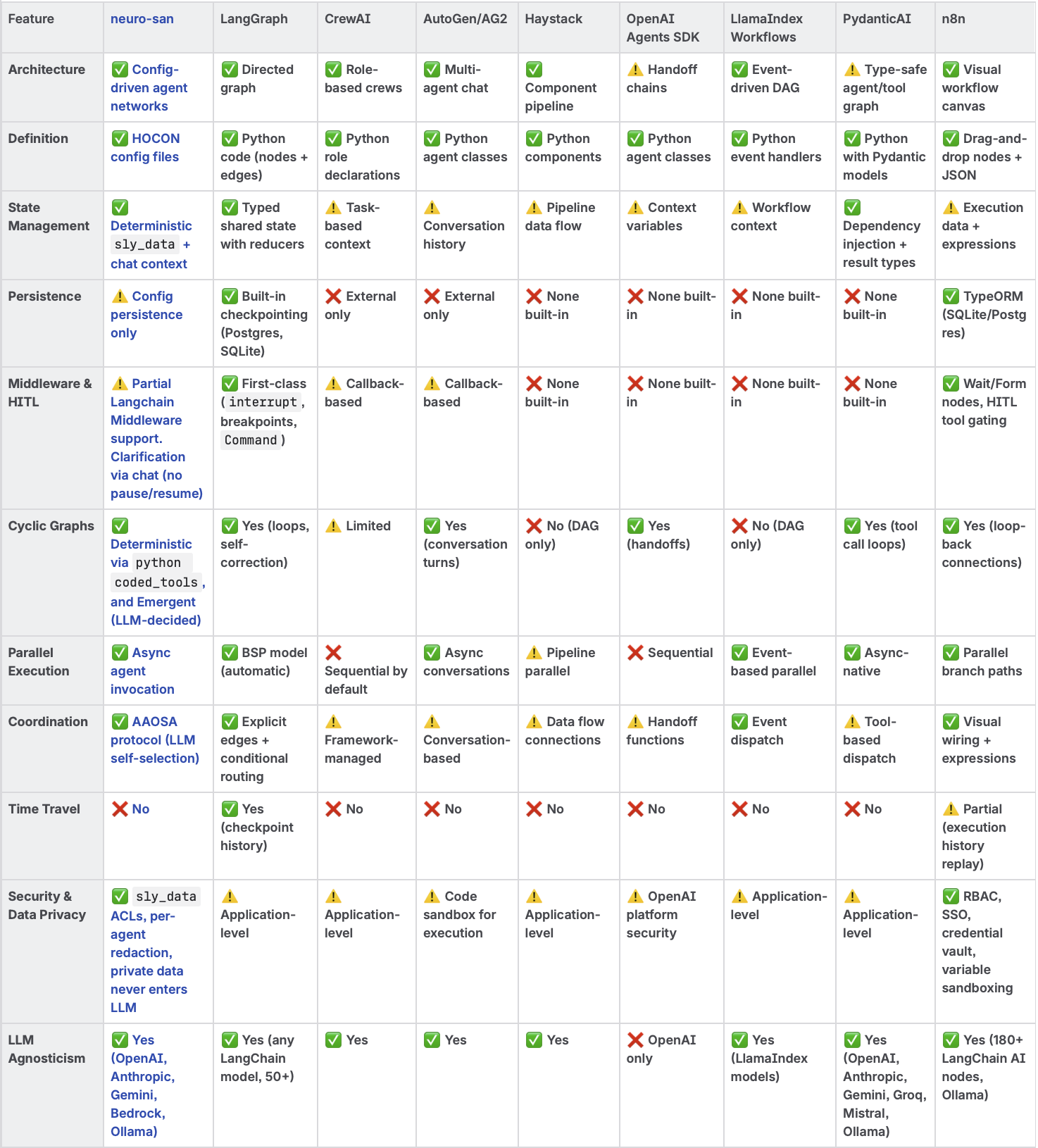
The multi-agent ecosystem is evolving quickly, and several open-source frameworks now support agent orchestration. Understanding this landscape helps teams compare architectural approaches and choose the right foundation for their needs. Below is a brief overview of widely adopted frameworks, followed by how Cognizant’s neuro-san builds on these ideas with stronger security, governance, and enterprise-ready orchestration.
Leading Multi-Agent Orchestration Frameworks
Microsoft AutoGen
AutoGen is an open-source framework for building AI agents that work together through structured message passing. It gives developers a flexible way to design multi-agent conversations, experiment with collaboration patterns, and observe how agents reason through tasks. AutoGen is often used in research and prototyping because it supports custom agent behaviors, tool integrations, and detailed debugging without forcing a rigid workflow structure.
CrewAI Multi-Agent Platform
CrewAI is a multi-agent platform designed to create teams of role-based AI agents that can work together on structured workflows. It focuses on orchestration patterns where agents take on well-defined responsibilities, passing tasks and intermediate outputs to one another to complete a larger objective. The framework is popular for workflow automation, content generation, and business process prototypes that benefit from clear role assignments and human-in-the-loop control.
Langchain LangGraph
LangGraph is an open source framework for building reliable, structured agent workflows using a graph-based architecture. It allows teams to define how an agent or group of agents should move through a process, maintain state, loop when necessary, and involve humans at specific checkpoints. Its emphasis on transparency and predictable execution makes it well-suited for production environments where oversight, debugging, and workflow control matter.
Benefits of Cognizant’s Multi-Agent Framework
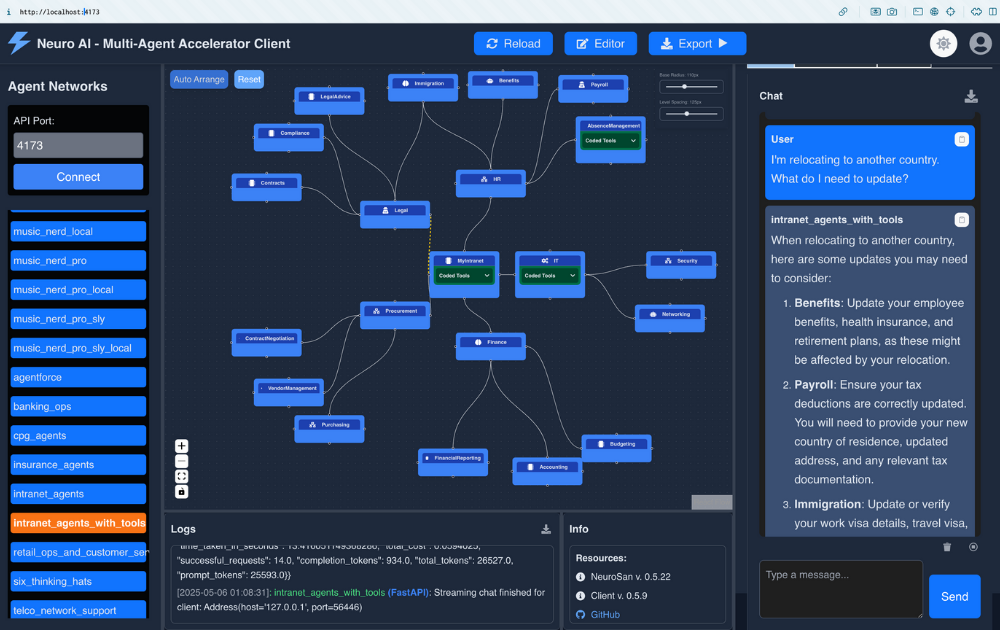
neuro-san is Cognizant’s data-driven multi-agent accelerator designed to make enterprise-scale agent orchestration easier, safer, and more adaptable. Instead of hardcoding workflows, teams define agent behavior through configuration files, allowing systems to evolve quickly as business needs change. Built for real-world complexity, neuro-san focuses on secure communication, flexible routing, and seamless integration with existing tools and APIs.
Key benefits include:
Data-driven orchestration: Agent networks are defined through configuration files rather than code, making it straightforward to build, modify, and extend multi-agent workflows without engineering overhead.
Dynamic routing with AAOSA: neuro-san enables agents to delegate tasks based on expertise and context, supporting decentralized collaboration that adapts as conditions change.
Secure data handling with sly_data: Sensitive information is kept out of LLM prompts through protected data channels, reducing both privacy risk and hallucination from unstructured context.
Interoperability with third-party agent networks: neuro-san connects seamlessly with Python tools, external APIs, and other agent ecosystems such as Agentforce and Agentspace, allowing teams to extend capabilities without rebuilding systems.
Transparent logging and observability: Built-in tracing and metrics provide a detailed view of agent interactions, tool usage, and system performance, simplifying debugging and governance.
How to Implement a Multi-Agent System
Step-by-Step Guide
Define the problem
Clarify the overall goal, the scope of the system, and the specific outcomes the multi-agent network needs to achieve.
Identify agent roles
Decide which tasks and responsibilities belong to which agents, ensuring each role has a clear purpose and set of capabilities.
Choose a communication model
Select how agents will exchange information, whether through direct messaging, shared memory, or environmental cues.
Design reward/coordination strategies
Establish the rules that guide cooperation, resolve conflicts, and keep agents aligned with system-level goals.
Select frameworks/tools
Pick orchestration frameworks, LLMs, and external tools that match the complexity, scale, and security needs of your environment.
Train, test, iterate
Validate how agents behave individually and as a group, then refine the system through repeated testing and optimization.
Integration With Existing Systems & APIs
Multi-agent systems rarely start from a blank slate. In most organizations, they need to plug into existing tools, databases, workflows, and APIs that already run the business. This means giving agents the right interfaces to pull data, trigger actions, and collaborate with the software ecosystem around them. The smoother the integration, the more useful the agents become. With the right connectors in place, agents can retrieve context, trigger workflows, and contribute to decision-making without disrupting existing infrastructure.
Common Pitfalls to Avoid
Many multi-agent system challenges come from unclear agent boundaries, overly complex communication patterns, or insufficient testing of edge cases. Systems can also become fragile when agents depend too heavily on shared resources or when coordination rules are left ambiguous. Teams can avoid these issues by starting with simple agent roles, validating communication flows early, and continuously monitoring for unexpected behaviors as the system scales.
Future of Multi-Agent Systems
The future of multi-agent systems is moving toward more reliable collaboration, stronger reasoning, and safer autonomy. As LLMs improve, agents will handle longer tasks, coordinate more naturally, and adapt to changing conditions with less manual intervention. At the same time, enterprises will rely on multi-agent system architectures to provide structure, oversight, and guardrails around increasingly capable agent behaviors. Research in long-horizon planning, real-time reasoning, and evolutionary methods will make agent teams more efficient and self-improving. Multi-agent systems are becoming a practical foundation for building scalable, interpretable AI systems that can operate across complex, distributed environments.
Frequently Asked Questions about Multi-Agent Systems
What is a multi-agent system in simple terms?
A multi-agent system is a group of autonomous AI agents that work together to solve a larger problem. Each agent handles a part of the task, and the system benefits from their combined intelligence and coordination.
How do multi-agent systems compare to simply using a single powerful LLM?
A single LLM handles tasks sequentially and requires full context, while a multi-agent system distributes work across specialized agents that can operate in parallel. This makes multi-agent systems more scalable, resilient, and better suited for complex workflows.
What should I look for when choosing a multi-agent system framework?
Look for easy orchestration, strong observability, secure data handling, interoperability with tools and APIs, and flexibility to adapt as workflows change. For enterprise use, governance and alignment features are essential.
Can multi-agent systems scale to enterprise-level workloads?
Yes. Multi-agent systems scale naturally because new agents can be added without redesigning the entire system. Distributed decision making allows them to handle large, variable, or fast-moving workloads.
How long does it take to implement a multi-agent system at the enterprise level?
Timelines vary, but a focused multi-agent systems pilot can be launched in weeks, while full-scale integration may take several months, depending on complexity, data availability, and governance requirements.
Are multi-agent systems safe?
They can be very safe when designed with constraints, oversight layers, testing, and alignment mechanisms. Proper governance ensures autonomy doesn’t compromise security or policy compliance.
What industries benefit most from multi-agent systems today?
Industries with distributed processes or high decision complexity — such as banking, insurance, healthcare, retail, manufacturing, logistics, and cybersecurity — see strong performance gains from multi-agent systems.
What skills are needed to build multi-agent systems?
Teams typically need experience in AI/ML, systems design, data engineering, and workflow automation. Increasingly, multi-agent systems frameworks reduce heavy engineering requirements through configuration-based orchestration.
How does Cognizant handle multi-agent system safety, governance, and compliance?
Cognizant’s neuro-san framework provides secure data channels, transparent observability, constraint-driven coordination, and configurable oversight layers. These controls ensure that multi-agent system behavior aligns with enterprise policies and regulatory requirements.
Conclusion
Multi-agent systems are quickly becoming one of the most practical ways to scale AI across complex, distributed environments. By combining specialized agents that collaborate, adapt, and reason together, multi-agent systems offer far more flexibility and resilience than any single model can provide. They help organizations react faster, make better decisions, and automate multi-step workflows that were previously too intricate for AI to manage end-to-end.
As LLM-powered agents continue to improve, multi-agent systems will evolve into even more capable networks – planning over longer horizons, coordinating in real time, and operating safely under strong governance frameworks. For enterprises looking to build AI systems that are scalable, transparent, and aligned with real-world needs, multi-agent architectures offer a powerful foundation for the future.