

April 13, 2026
What Are AI Agents? Definition, Examples & How They Work

What Are AI Agents? Definition, Examples & How They Work
A deep dive into what AI agents are, how they work, real-world examples, types of AI agents, and real world applications.

What Are AI Agents?
AI agents are semi-autonomous software systems that perceive their environment, make decisions, and take actions to achieve specific goals. Unlike traditional AI models that only generate outputs, AI agents can plan, reason, and execute tasks independently and often interact with tools, data sources, or other systems. This represents a shift from passive AI, which responds only when prompted to active AI that can initiate and carry out complex workflows on its own..
Key Takeaways
AI agents are autonomous systems that can perceive, reason, and act to achieve goals, moving beyond passive AI to active execution
They operate in a continuous loop (perceive → reason → act → learn), enabling them to handle complex, multi-step tasks in dynamic environments
Different types of agent such as reactive agents or learning agents vary in complexity, planning ability, and adaptability
Unlike AI models, agents can take actions, use tools, maintain memory, and perform multi-step reasoning autonomously
Businesses use AI agents to improve efficiency, enable real-time decision-making, and scale operations with 24/7 automation
While powerful, AI agents require strong governance, monitoring, and human oversight due to risks like hallucinations, security issues, and unintended actions
How Do AI Agents Work?
AI agents operate through a continuous loop often described as the perceive → reason → act → learn cycle. Rather than simply executing a single instruction, an AI agent continuously reassesses its environment, updates its understanding, and adjusts its actions accordingly. This iterative process is what allows agents to handle complex, multi-step tasks, even in fast-changing or unpredictable conditions.
Perception
Perception refers to the gathering and interpreting of data from the environment in which the agent operates. Input can come in many forms: APIs, databases, enterprise systems, or direct user interactions. This contextual awareness is essential. Without it, an agent has no basis for making informed decisions in the steps that follow.
Reasoning & Planning
Once an agent has formed an understanding of its environment, it moves to the reasoning and planning stage. This involves evaluating different possible actions and selecting the sequence most likely to achieve the desired outcome. Typically, this means breaking a larger task down into smaller, manageable steps and mapping out the order in which those steps should be completed. The agent also weighs potential trade-offs and consequences of each alternative before proceeding. This multi-step reasoning is what most clearly differentiates AI agents from simpler AI systems.
Action
The action stage is where the agent executes its selected plan. What that looks like depends on the system. In digital environments, agents may call APIs, update databases, trigger workflows, or integrate with enterprise software. In customer-facing scenarios, they may communicate with users, provide recommendations, or request additional input. Because actions are often final and consequential, this stage is typically paired with safeguards, validation checks, and monitoring systems to ensure each action is appropriate before it's carried out.
Types of AI Agents
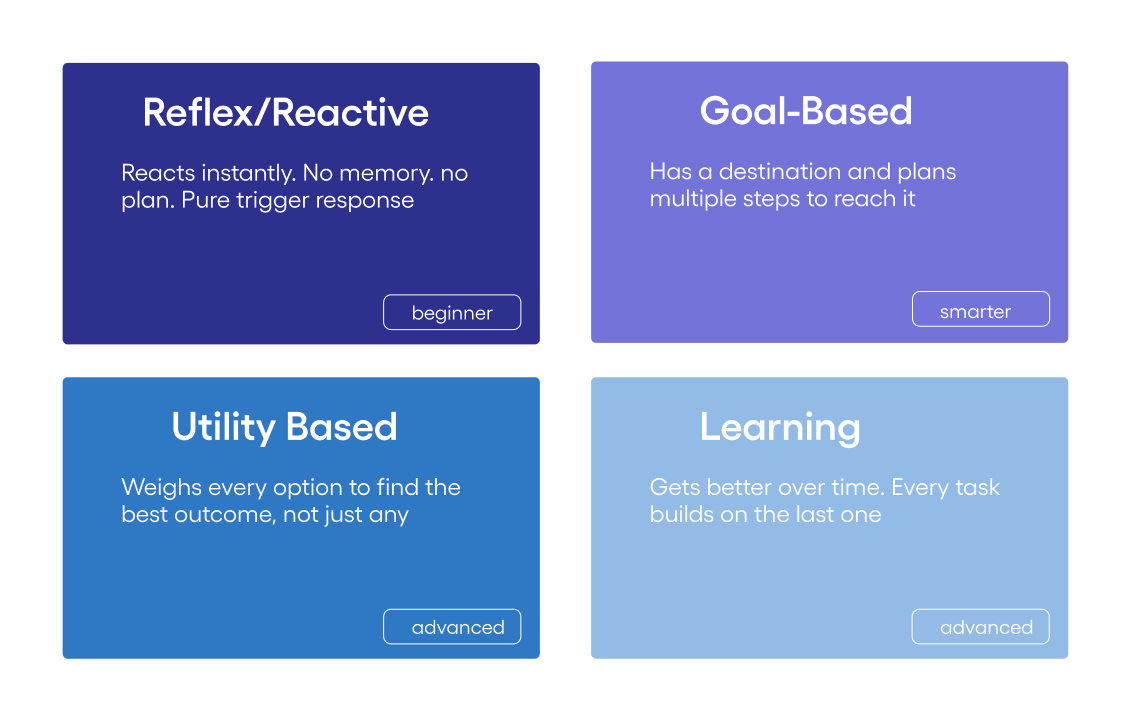
Reactive Agents
Reactive agents are the most straightforward type. They respond to environmental conditions in real time but don't retain memory or engage in long-term planning. A basic customer service chatbot that answers frequently asked questions is a good example. These agents work well for simple, predictable scenarios where speed matters more than complexity.
Goal-Based Agents
Goal-based agents take things a step further by incorporating specific objectives into their decision-making. Rather than simply reacting to inputs, they evaluate possible actions based on how well each one moves them toward a defined goal. Navigation systems and scheduling tools are common use cases where reaching a specific outcome is the primary priority.
Utility-Based Agents
Utility-based agents extend goal-based reasoning by adding the concept of optimization. Rather than just achieving a goal, these agents aim to achieve it in the best possible way. They assign a value or "utility" to different outcomes and evaluate trade-offs between competing factors, choosing the option that yields the highest overall benefit. This makes them well-suited for complex environments where multiple priorities must be balanced simultaneously.
Learning Agents
Learning agents are capable of improving their performance over time by incorporating feedback and adapting to new data. They typically include components for observation, decision-making, and self-evaluation, along with a learning mechanism that continuously updates their internal models. This makes them particularly valuable in environments where conditions change frequently or where predefined rules can't cover every scenario.
AI Models vs AI Agents: What’s the Difference?
AI Model | AI Agent |
Generates output (images, text) | Takes actions in a specific environment |
Typically stateless | Maintains context and memory |
One step response | Multi-step reasoning and planning |
Passive | Autonomous and proactive |
Limited interaction with tools | Actively uses APIs, tools, and systems |
What Makes AI Agents “Autonomous”?
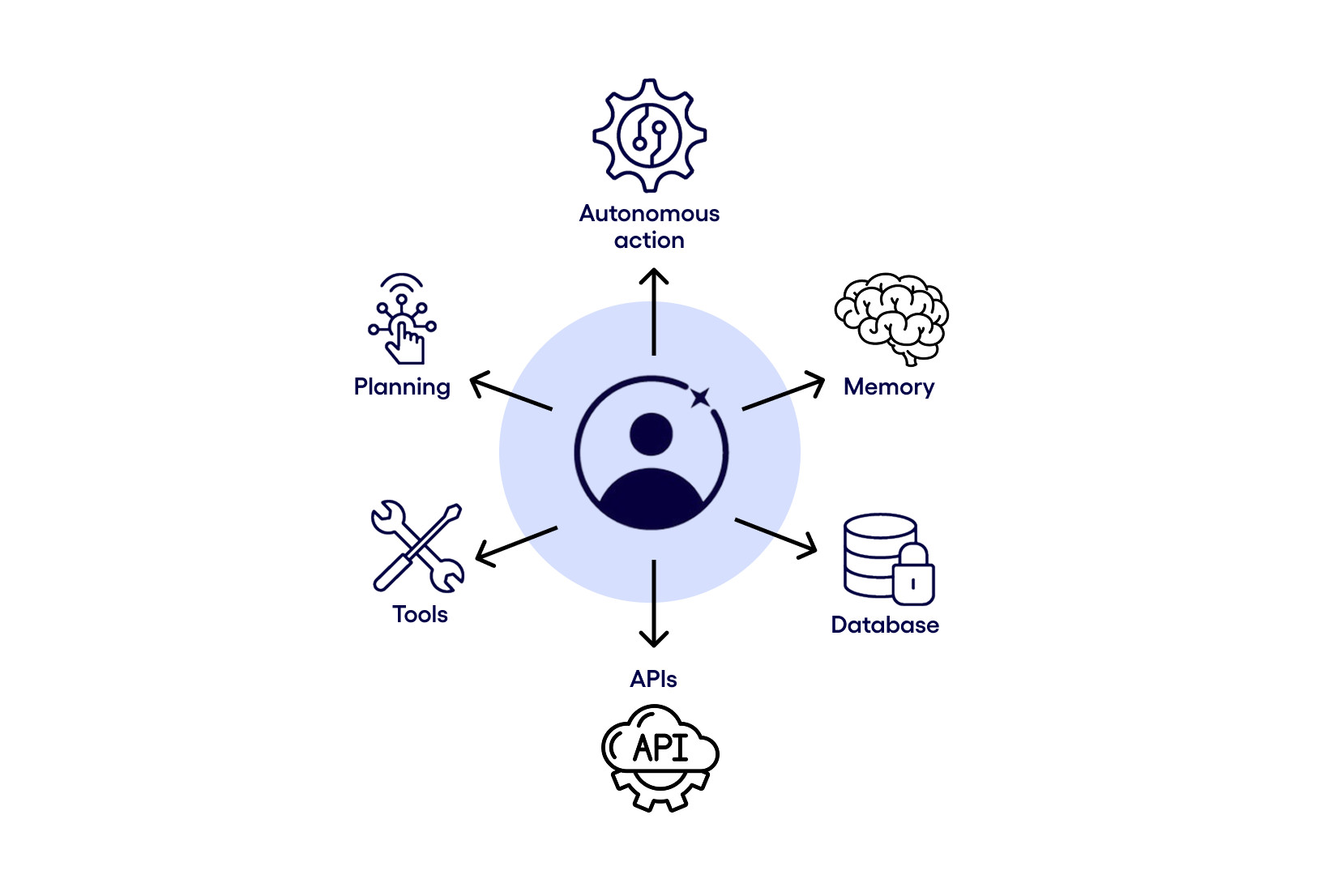
Autonomy in AI agents comes from their ability to operate independently while pursuing goals. This is enabled by several key capabilities:
Independent execution: The ability to act without continuous human prompting
Tool integration: Accessing and using external systems such as APIs, databases, and enterprise software
Memory: Retaining context across interactions so decisions build on prior information
Feedback loops: Adjusting behavior based on the outcomes of previous actions
Multi-step reasoning: Solving complex problems that require planning and iteration over time
Together, these capabilities allow agents to take on tasks that would otherwise require sustained human attention.
Benefits of AI Agents for Businesses
For businesses, AI agents offer a powerful way to move beyond traditional automation and toward intelligent, adaptive systems.
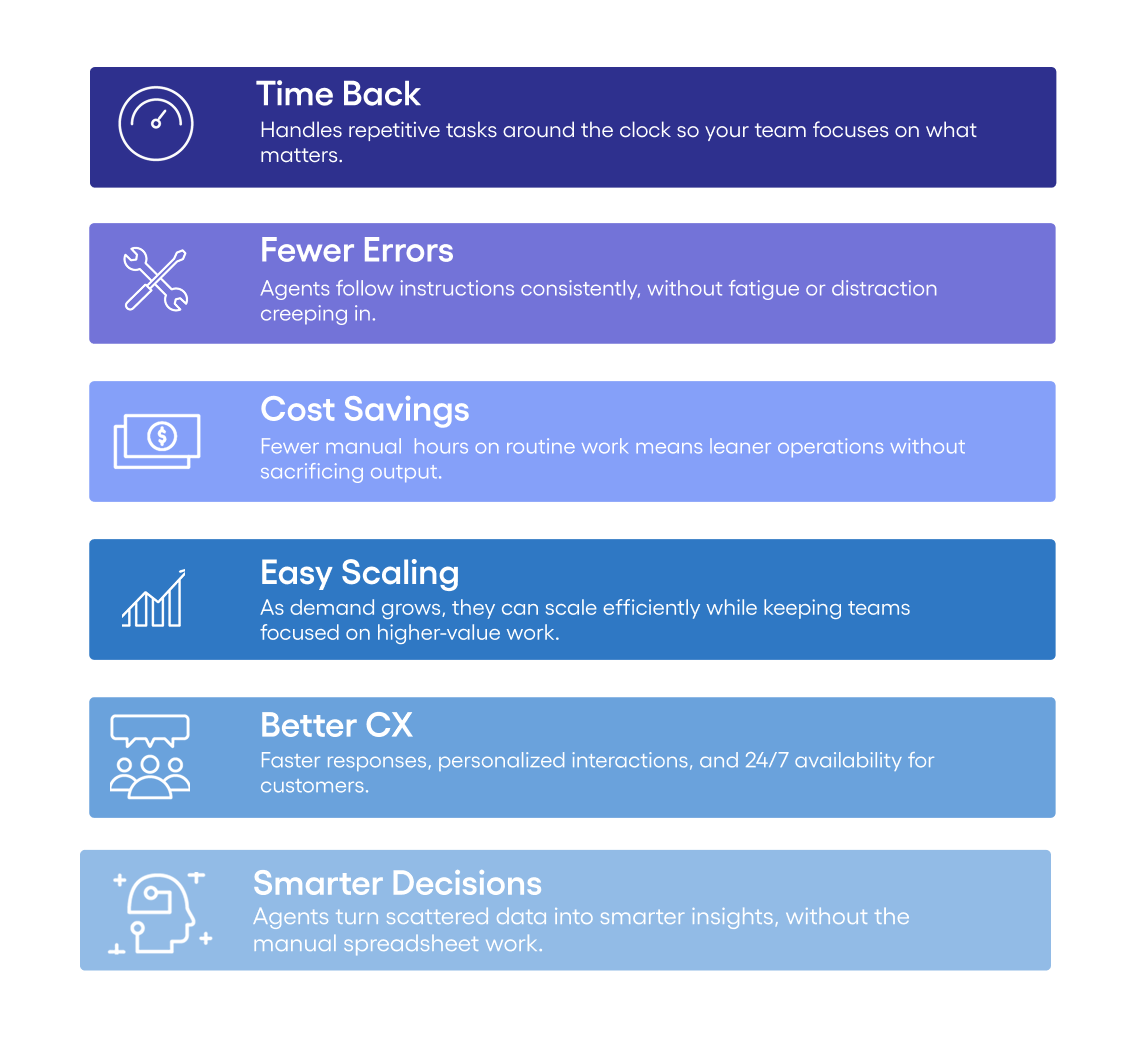
One of the most immediate benefits is increased operational efficiency. By automating both routine and complex workflows, agents reduce the need for manual intervention and free up human resources for tasks that genuinely require human judgment and creativity.
AI agents also enable faster decision-making. By analyzing data and acting in real time, they are particularly valuable in fast-moving environments like logistics, finance, or customer support where delays can have real consequences.
Another significant advantage is continuous, around-the-clock operation. Unlike human workers, AI agents don't experience fatigue. They can function 24/7 with consistent performance, making them ideal for monitoring systems, customer support queues, and time-sensitive operations.
Finally, agents provide scalable automation. As workloads grow, agents can handle increased demand without a proportional rise in operational costs, allowing organizations to scale efficiently without simply adding headcount.
Real-World Applications of AI Agents
Banking and Financial Services
Agents are widely used in banking and financial services to monitor transactions, detect fraud, and take action, such as flagging risks or triggering verification processes. They also support credit decision-making and can analyze real-time market data to generate insights and assist with portfolio management.
Insurance
AI agents help streamline claims processing by reviewing submissions, validating policy coverage, detecting potential fraud, and routing or approving claims. For simpler cases, they can initiate faster reimbursements, meaningfully improving both efficiency and the customer experience.
Healthcare and Life Sciences
In healthcare, AI agents are used to support diagnostics, automate administrative tasks like coding and scheduling, and accelerate research by analyzing large datasets. They can identify patterns across complex data and assist in drug discovery and the management of clinical trials.
Retail
Retail organizations use AI agents to manage inventory, pricing, logistics, and personalization at scale. They can continuously forecast demand, adjust pricing in real time, coordinate supply chain activity, and deliver tailored product recommendations to individual customers.
Cybersecurity
AI agents monitor systems continuously, detect threats, and respond in real time, often faster than any human team could. They also perform proactive threat hunting and simulate attacks to identify vulnerabilities before bad actors can exploit them.
Manufacturing and Industrial Operations
In manufacturing, AI agents optimize logistics, monitor for disruptions, and automate workflows such as order fulfillment. The result is improved efficiency, reduced operational costs, and more reliable day-to-day performance.
Customer Support
AI agents are well-suited for handling complex customer queries end-to-end. By understanding a customer's intent, pulling from internal knowledge bases and tools, and resolving issues without escalation in many cases, they can deliver high-quality support around the clock.
Risks and Limitations of AI Agents
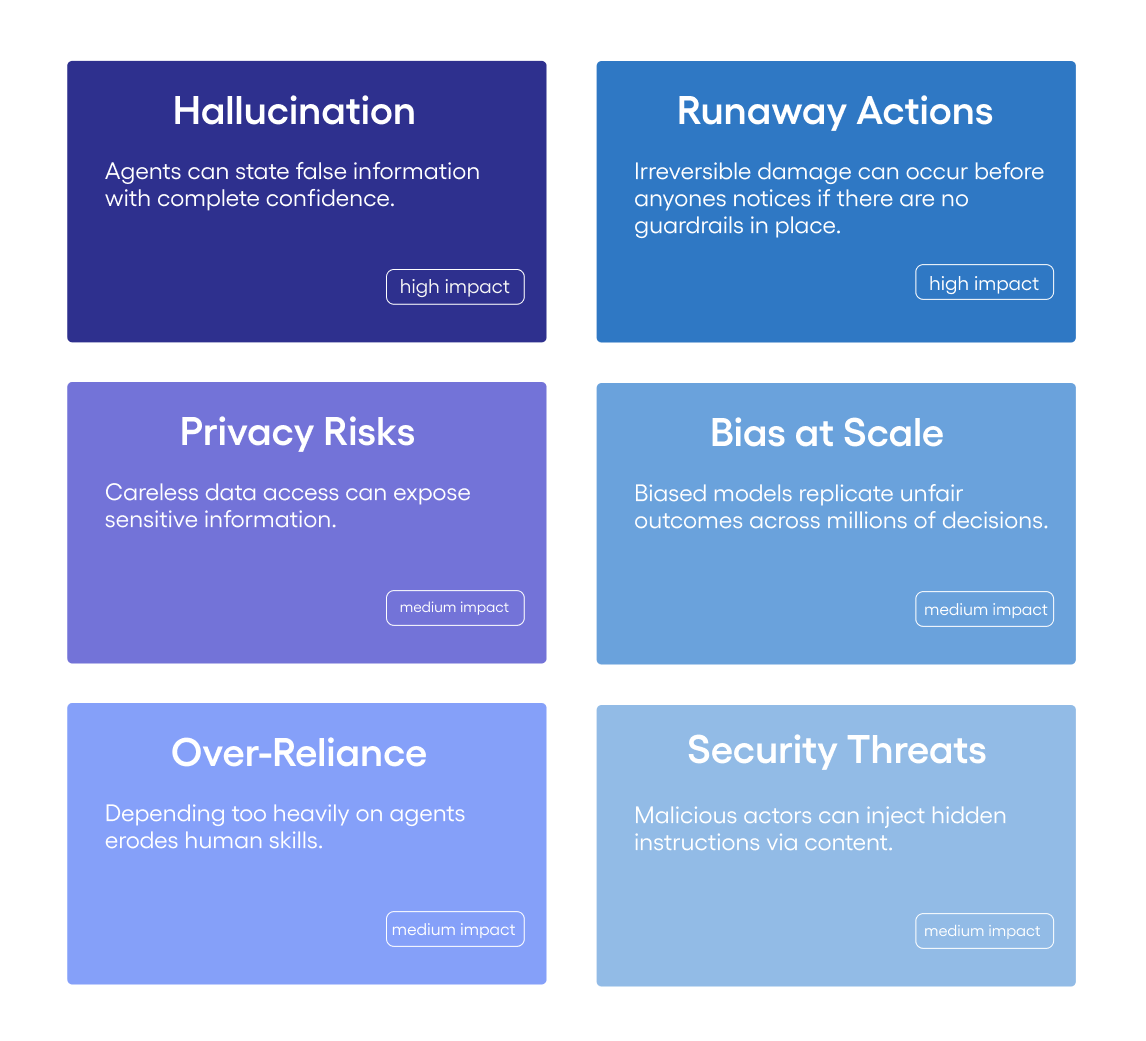
While AI agents introduce significant opportunities to optimize workflows, they also come with challenges that must be carefully managed. One of the primary concerns is reliability. AI agents can sometimes produce false or misleading information, a phenomenon known as hallucinations, which can lead to flawed decisions downstream. Closely related is the risk of unintended actions: because agents operate autonomously, errors in reasoning or planning can result in actions that stray from the intended goal in ways that are difficult to reverse.
Security is another critical concern, particularly when agents have access to sensitive systems, databases, or APIs. Without proper controls, there is real risk of information being exposed or misused. Robust monitoring is essential whenever agents are granted access to high-value systems.
Finally, governance and compliance present ongoing challenges. Organizations must ensure that AI agents operate within legal and ethical boundaries which is a task made more difficult by the complexity and occasional opacity of the systems involved.
Human Oversight and Safety in Agentic AI
Deploying AI agents responsibly requires structured approaches to oversight and safety. Several strategies have emerged as best practices:
Human-in-the-loop processes involve humans reviewing agent actions and approving critical decisions before they are carried out , particularly useful in high-stakes scenarios where errors are costly.
Real-time monitoring dashboards provide ongoing visibility into agent behavior, making it easier to spot anomalies and intervene when necessary.
Guardrails define the scope of an agent's responsibilities and limit what it can access or do. These may take the form of rules, policies, or technical constraints embedded directly into the system.
Intervention mechanisms (such as automatic shutdown triggers if unauthorized actions are detected) provide an additional layer of protection.
Ultimately, the goal is to strike the right balance between autonomy and control: allowing agents to operate efficiently while maintaining the accountability and transparency that responsible deployment requires.
The Future of AI Agents
The development of AI agents is still in its relatively early stages, but the trajectory is clear. As these systems continue to mature, they are expected to become more capable, more collaborative, and more deeply integrated into both digital and physical environments.
One emerging trend is multi-agent collaboration, where multiple specialized agents work together to tackle complex workflows, forming an ecosystem of intelligent systems that divide labor and share information to achieve outcomes no single agent could manage alone.
Another significant development is the integration of AI agents with robotics, enabling them to move beyond software environments and operate in the physical world. The implications span industries from manufacturing and logistics to healthcare and beyond.
At the same time, growing attention on regulation and governance reflects a broader recognition that as AI agents become more capable, the frameworks guiding their use must keep pace. Policymakers and organizations alike are working to ensure that agentic AI is deployed safely, ethically, and transparently.
Frequently Asked Questions About AI Agents
Are AI agents the same as chatbots?
No. Chatbots are typically designed for conversational interactions, answering questions or guiding users through a scripted flow. AI agents go much further: they are capable of planning, decision-making, and executing multi-step tasks across tools and systems. Think of a chatbot as a respondent and an AI agent as a doer.
How are AI agents different from LLMs?
Traditional large language models (LLMs) generate output like text, images, or other content in response to a specific prompt. AI agents, by contrast, are connected to tools and real software systems, allowing them to retrieve information, call APIs, store data in memory, and use all of that to decide what to do next and actually execute it. The key difference is that agents don't just respond, they act.
Can AI agents operate without human supervision?
While AI agents can operate without human supervision ,the most practical and responsible implementations include some level of human oversight to ensure safety, accuracy, and alignment with intended goals.
What benchmarks are used to evaluate AI agents?
Evaluation of AI agents typically focuses on task success rates, efficiency, decision quality, and robustness in dynamic or uncertain environments. The right benchmarks depend heavily on the specific use case.
What industries use AI agents?
AI agents are used across a wide range of industries, including finance, healthcare, logistics, cybersecurity, retail, insurance, and manufacturing with enterprise adoption growing rapidly across sectors.
Which business tasks are best suited to AI agents right now?
Tasks that are repetitive, high volume, rule-based, or research-heavy are best places to use agents: customer support triage, data entry and extraction, report generation, lead research, contract review, scheduling, and compliance monitoring. Tasks that require deep human relationships, ethical judgment, or genuine creativity are better kept with humans for now
What are the risks of fully autonomous systems?
Fully autonomous systems with no human oversight carry risks including incorrect decision-making, loss of control, potential exposure of sensitive information, and broader accountability and transparency challenges.
Are AI agents safe for high-stakes environments?
They can be but it requires a strong governance framework, well-defined guardrails, rigorous testing, and effective real-time monitoring. The higher the stakes, the more robust those safeguards need to be.

Deepak is a data scientist that specializes in machine learning, applied statistics, and data-driven applications such as multi-agent systems.