

March 31, 2026
neuro-san Adds Model Context Protocol (MCP) Integration for AI Agents

neuro-san Adds Model Context Protocol (MCP) Integration for AI Agents
A practical look at how neuro-san’s MCP integration enables AI agents to seamlessly connect with tools like GitHub, DeepWiki, and Google Maps, reducing integration overhead and unlocking scalable multi-agent workflows.
As enterprises scale AI beyond isolated use cases, a critical bottleneck emerges: integration complexity. Agents may be intelligent, but without access to the right tools, data, and systems, their impact remains limited. Every new integration adds friction, increases maintenance overhead, and slows down deployment.
In practice, most teams end up building one-off connectors for every system an agent needs to touch. These integrations are often inconsistent, hard to reuse, and tightly coupled to specific workflows. As systems grow, this creates a patchwork of tooling that is difficult to manage and even harder to scale, especially in multi-agent environments where different agents depend on different services.
We're excited to announce a major enhancement to neuro-san: native support for the Model Context Protocol (MCP). MCP provides a standard way for agents to connect to external systems, so teams do not have to build custom integrations for every tool they want to use.
With MCP, neuro-san moves toward a more consistent integration model. Tools and services can be connected through a shared interface and defined directly within the agent network, rather than stitched together through custom code. This makes integrations easier to manage, easier to reuse, and easier to extend as new systems are introduced. It also allows multi-agent workflows to scale more cleanly, since each agent can access the tools it needs without adding more integration overhead.
What Is MCP?
The Model Context Protocol is a standard for connecting AI systems to external tools and data sources. Instead of writing custom code for each integration, developers can rely on a shared interface that works across services. Your agents can now tap into wikis, GitHub repositories, databases, and business tools all through the same simple interface.
With this update, neuro-san agents can:
Access knowledge bases like DeepWiki for real-time information retrieval
Interact with GitHub to read issues, pull requests, and code
Connect to project management tools, databases, and internal systems
Use services like Google Maps for location and geospatial data
Leverage any MCP-compatible service through a standardized interface
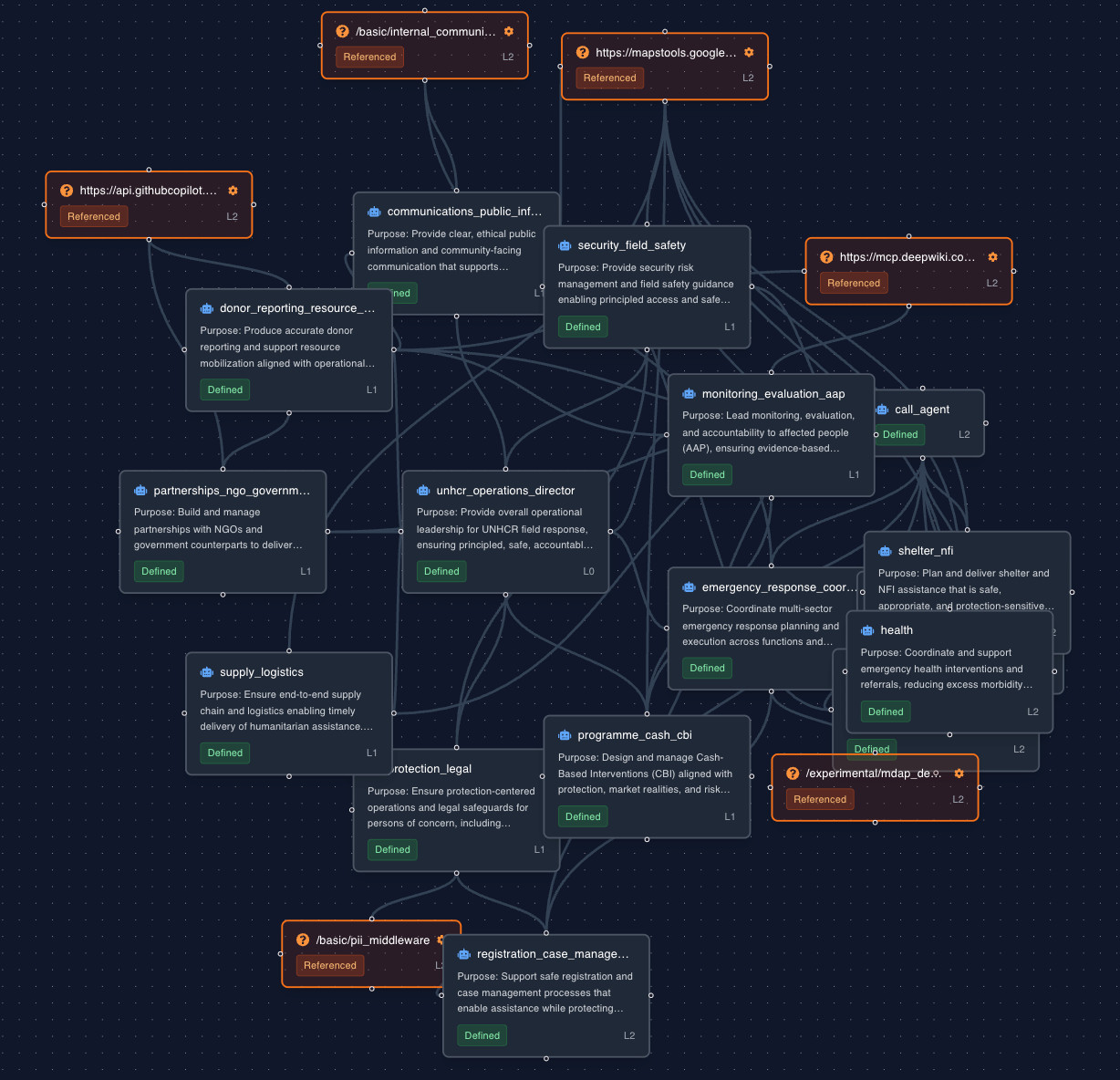
This is particularly useful in multi-agent systems. Different agents often need access to different tools. Without a standard like MCP, those integrations tend to be inconsistent and difficult to maintain. MCP keeps those interactions structured and predictable, which becomes more important as systems grow in size and complexity.
Easy Setup, Powerful Results
Adding MCP tools in neuro-san does not require heavy setup. Tools can be included as part of the agent configuration, alongside other components like coded tools or APIs. This keeps everything in one place and reduces the need for scattered integration logic. You can give your agents access to entire tool suites or selectively choose specific capabilities depending on the use case.
Authentication is handled securely and flexibly. Your agents can connect to public services, authenticated APIs, and private internal systems with the same ease. This makes MCP usable not just for demos, but for systems that need to operate within real enterprise constraints.
See It in Action: GitHub Integration
Let’s explore how neuro-san can be integrated with GitHub.
With MCP, you can build an agent system that interacts directly with your repositories. One agent can handle user queries, while others specialize in retrieving and processing data from GitHub.
The system can:
Check open issues and identify trends
Review pull requests and summarize changes
Answer questions about the codebase
Combine repository data with internal documentation
What changes here is not just access to GitHub, but how that access is structured. Each agent has a clear role, and the integration is defined as part of the system rather than embedded in prompts or scripts.
This makes the system easier to extend. You can add another agent for a different tool, or connect additional data sources, without rewriting the entire workflow.
Real-World Use Cases
The combination of neuro-san's multi-agent architecture and MCP integration opens up powerful possibilities:
DevOps Automation: Create agent networks that monitor GitHub issues, automatically triage bugs, and update project boards based on code analysis and testing results.
Knowledge Management: Build intelligent assistants that search internal wikis, documentation systems, and knowledge bases to answer employee questions and surface relevant information.
Business Process Automation: Develop agents that coordinate across multiple business systems, CRMs, and databases to automate complex workflows and data synchronization tasks.
Research and Analysis: Deploy agent networks that gather data from multiple sources, cross-reference information, and generate comprehensive research reports with citations.
Why This Matters
Before MCP support, connecting agents to external services meant building custom integrations for each tool. This was time-consuming, hard to maintain, and limited what agents could do. MCP changes that by standardizing how integrations work.
Instead of rebuilding the same patterns repeatedly:
Tools become reusable components
Integrations are easier to reason about
Systems can evolve without accumulating as much technical debt
There is also a longer-term benefit. As more tools adopt MCP, the number of available integrations grows without additional engineering effort. When a new service supports MCP, it can be added to an existing system with minimal changes.
This shifts the focus from integration work to actual system design and use case development.
MCP support makes neuro-san more useful in real environments where systems need to interact with other systems. As adoption grows, more tools and platforms will expose MCP interfaces. That increases what agents can do without increasing integration effort. Instead of building new connectors each time, teams can focus on designing better agent systems. This also changes how agent networks evolve. You can start with a small set of integrations and expand over time, adding new tools as needed without restructuring the entire system.
If you are already building multi-agent workflows, MCP reduces a major source of friction. If you are just getting started, it gives you a cleaner path to production without accumulating integration complexity early on.
Ready to get started? Check out our documentation and examples at: github.com/cognizant-ai-lab/neuro-san

Noravee specializes in machine learning, NLP, and analytical modeling, with a background in condensed matter physics