

April 28, 2026
Cognizant Neuro® AI Multi-Agent Accelerator Wins Global AI Award for Best AI Product or Service

Cognizant Neuro® AI Multi-Agent Accelerator Wins Global AI Award for Best AI Product or Service
Recognized by the Global AI Award 2026, Cognizant’s Neuro® AI Multi-Agent Accelerator is enabling enterprises to operationalize AI at scale through adaptive, multi-agent workflows.
There is a growing gap between how AI is demonstrated and how it is actually used inside enterprises.
On one side, AI shows up as something impressive but contained. A model writes, summarizes, answers, or generates. On the other side, real work continues to move through fragmented systems, handoffs, and dependencies that do not map cleanly to a single prompt or response. The challenge is not that AI lacks capability. It is that most implementations still treat it as a tool rather than a system.
Bridging that gap requires more than incremental improvements. It requires systems that can organize work across multiple steps, adapt as tasks evolve, and handle the kind of dependencies that exist in real environments. That shift is starting to take shape in practice. Systems built around coordinated agents rather than single models are beginning to show what it looks like when AI is embedded into workflows instead of layered on top.
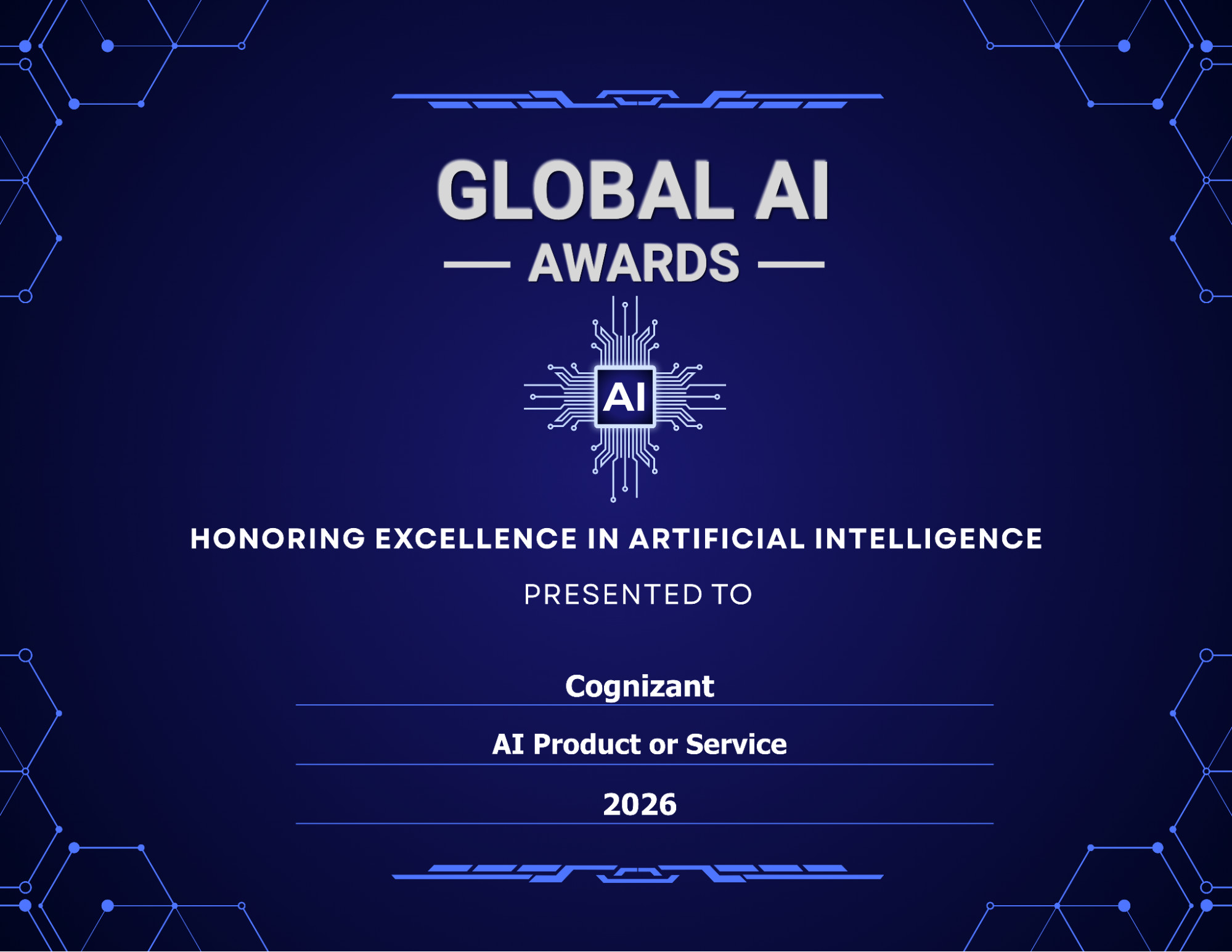
We are excited to share that Cognizant has won a Global AI Award 2026 in the Best AI Product or Service category for the Neuro® AI Multi-Agent Accelerator – recognized for its innovative multi-agent design, real-world impact, and its ability to make enterprise AI scalable, responsible, and easier to use. The recognition reflects this broader movement toward AI systems that can coordinate work across processes, rather than simply respond to individual tasks.
Building Agentic Systems That Can Coordinate Work, Not Just Complete Tasks
What changes when AI is structured as a system is not just scale, but how it behaves.
The Neuro® AI Multi-Agent Accelerator is an open-source multi-agent orchestration framework that allows organizations to design, deploy, and scale networks of collaborating AI agents to automate complex workflows and support decision-making.
At its core, it is built around agents that take on different roles and work together to complete tasks. Instead of sending everything through a single model, work is interpreted and distributed across agents based on context and capability. This becomes important in workflows that are not linear. Tasks often need to be revisited, broken down, or routed differently depending on the situation. A coordinated system can adapt to that in a way that fixed pipelines cannot.
Underneath this is a distributed architecture based on adaptive agent communication (AAOSA), where agents determine how to delegate and coordinate work without relying on a central controller. This allows the system to remain flexible as workflows evolve, rather than being constrained by predefined logic.
How these systems are built is a separate but equally important shift. Instead of defining everything upfront, teams shape agent behavior over time, starting with vibe coding using the Agent Network Designer, which can generate agent workflows from a high-level description and then refine them through iteration.
Testing becomes essential in this process. Because multi-agent systems can behave differently across runs, the platform includes a framework to simulate workflows repeatedly, measure consistency, and identify where behavior needs adjustment before deployment.
To support this in real environments, the platform also brings together a set of capabilities that make these systems usable beyond experimentation:
Sly_Data for secure handling of sensitive information between agents
Traceability and transparency, with detailed logs and interaction tracking
Flexible integration with enterprise systems, APIs, and external agent frameworks such as Agentforce, Agentspace, and CrewAI
Extensible, cloud-agnostic deployment across models and environments
These elements are what allow multi-agent systems to move from interesting prototypes to something that can be relied on in practice.
Case Study: Agentifying The Cognizant Intranet Across 350,000 Employees
The difference between an idea and a working system becomes much clearer when it is applied in a large environment.
At Cognizant, this meant rethinking how our own internal systems operate. The intranet supports more than 350,000 employees, but like most enterprise environments, it is fragmented across hundreds of applications, tools, and service layers. Completing even simple tasks often required navigating multiple systems, with workflows breaking across boundaries.
Using the Neuro® AI Multi-Agent Accelerator, we set out to agentify the intranet, turning disconnected systems into a coordinated network of agents that could manage tasks end to end.
The result is the OneCognizant (1C) platform. Instead of interacting with separate tools, employees now engage with a system that routes requests, orchestrates actions across applications, and handles the underlying complexity through coordinated agent workflows. Tasks that previously required multiple steps and touchpoints are now handled as part of a more continuous flow.
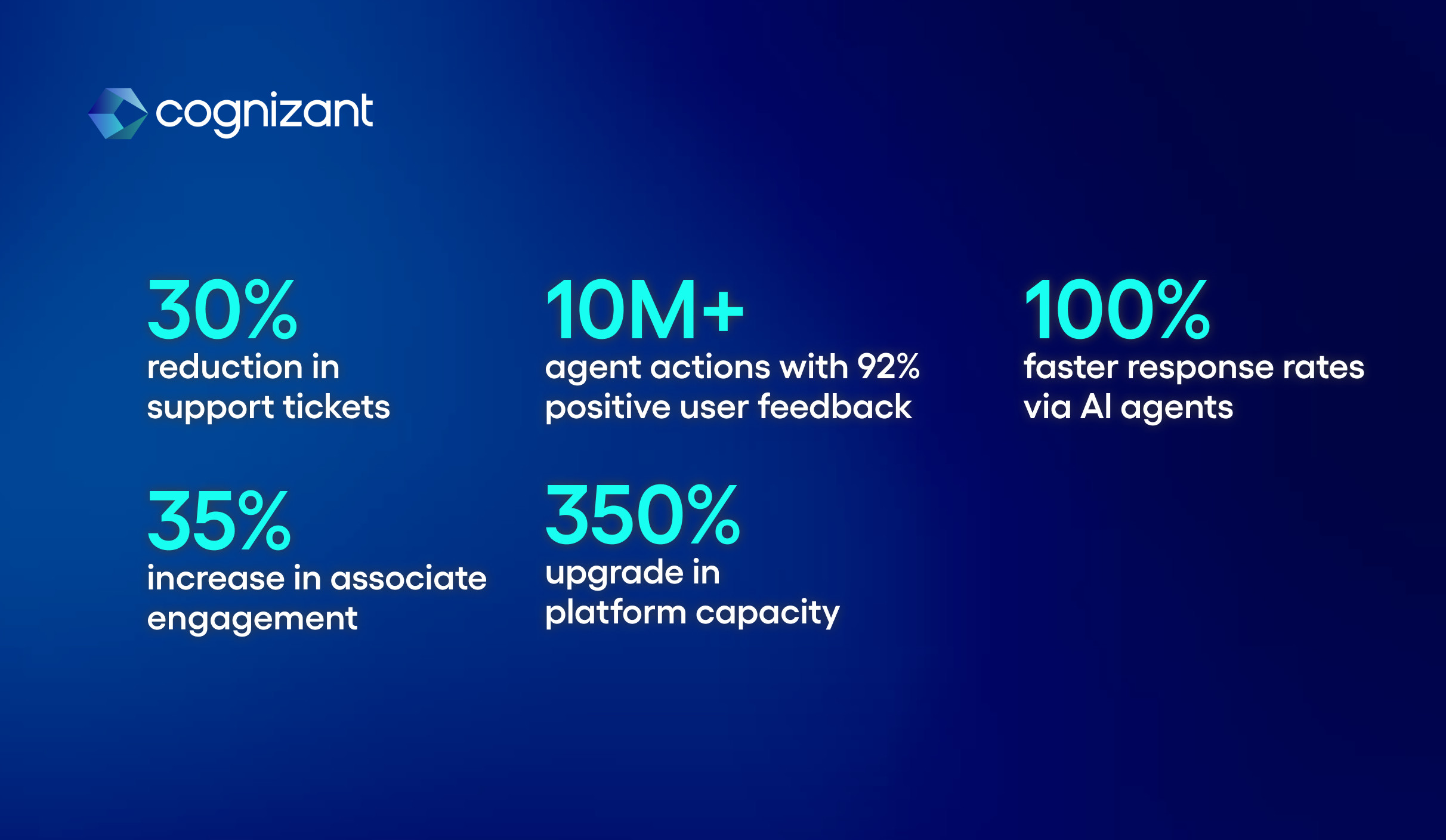
Within five months, the impact was measurable. Support tickets reduced by 30% and employee engagement increased by 35 percent as interactions became faster and more consistent. The platform has already supported millions of agent-driven actions, which is where reliability and system behavior start to matter in a very practical way.
At that scale, the question is no longer whether the approach works in theory. It becomes about how well it performs under real conditions, where complexity, volume, and variability are part of everyday use.
Why Open Source Matters For Enterprise Multi-Agent AI
As these systems become more integrated into enterprise environments, flexibility becomes difficult to separate from design.
The Neuro® AI Multi-Agent Accelerator is available under an Apache 2.0 open-source license, which allows organizations to adapt and extend it based on their own needs. This matters because multi-agent systems do not operate in isolation. They sit alongside existing tools, data sources, and model providers, all of which evolve over time.
An open approach makes it easier to connect these pieces and adjust as requirements change. It also gives teams more control over how systems are built and governed, rather than locking them into a fixed structure.
There is also a broader effect. When more teams can work with the same underlying framework, patterns start to emerge around how agent systems are designed, tested, and scaled. That shared learning tends to move the space forward faster than isolated implementations.
What This Recognition Signals For The Future Of Enterprise AI
This recognition reflects a shift in how organizations are approaching AI. The focus is moving away from individual capabilities and toward how those capabilities come together within real workflows.
Multi-agent systems are one way of addressing that challenge. They introduce new complexity, but they also offer a structure that is closer to how work actually happens across teams, systems, and decisions. What matters now is how these systems evolve in practice. Reliability, observability, and the ability to adapt over time are becoming just as important as capability itself. This is where most of the work is happening, and where the gap between experimentation and production is being closed.
At Cognizant, that work is ongoing. The Neuro® AI Multi-Agent Accelerator continues to evolve through real deployments, testing, and iteration, both within our own environments and with clients. The goal is not just to build more advanced systems, but to make them usable, dependable, and adaptable in the contexts where they are actually needed.
This recognition is a milestone, but it is also a signal of where the work is going next.