

August 18, 2026
What Is LLM Fine-Tuning?

What Is LLM Fine-Tuning?
A practical guide to LLM fine-tuning, how it works, when to use it and what businesses need to know.
A general-purpose language model can write competent prose, hold a conversation and answer a wide range of questions. What it often can't do out of the box is draft a claims summary the way a specific insurer expects, respond to customers in a company's exact voice, or apply a niche set of internal rules the same way every time. LLM fine-tuning is how businesses close that gap. It's one of the more practical levers available for turning a broad, general model into one that reliably does the specific job a business needs done.
LLM fine-tuning explained
Fine-tuning takes an existing large language model and continues training it on a narrower, curated dataset so it gets better at a particular task, industry, tone or workflow. Instead of starting from zero, teams build on a model that already understands grammar, reasoning and general world knowledge, and steer that understanding toward something more specific.
That distinction is the whole point. Building a large language model from scratch takes enormous datasets, specialized infrastructure and months of compute time, which puts it out of reach for most organizations. Fine-tuning skips that cost. It keeps the model's broad capabilities intact while sharpening its performance on whatever the business actually needs, whether that's a particular writing style, a company's internal terminology, or a repeatable task the model needs to handle more consistently than a generic model ever could.
How does LLM fine-tuning work?
The process looks fairly similar across industries and use cases, even though the specific tools and techniques vary.
It starts with a pre-trained model, selected because its existing capabilities already line up reasonably well with the target task. Then comes the part that takes the most time and matters the most: preparing the data. Teams collect examples that reflect what the model will actually encounter in production, clean out errors and inconsistencies, and format everything so the model can learn from it properly. Sloppy data at this stage tends to show up as sloppy output later, so it's worth the extra time.
Once the data is ready, the model trains on examples of the output it should be producing, and its internal parameters shift so its responses move closer to those patterns, whether that means a certain tone, a specific structure, or more accurate answers within a specialized domain. Most fine-tuning methods make that shift through gradients, which are essentially signals that tell the model how to adjust each of its internal parameters to get closer to the desired output. Those signals are calculated through backpropagation, a process that works backward through the model to figure out which adjustments will most improve performance, the same basic mechanism used during the model's original pretraining, just pointed at a smaller, more targeted dataset. From there, teams test the model against examples it hasn't seen before to check whether performance actually improved, measuring it against the original base model and against whatever benchmark matters most for the business case.
Deployment isn't the finish line. Production inputs shift over time, and a model's behavior can drift from what it was trained for, so teams need to keep monitoring performance after launch and be ready to retrain as new patterns show up.
Common types of LLM fine-tuning
Different fine-tuning approaches solve different problems, and picking the right one starts with understanding what each is actually good at.
Supervised fine-tuning
Supervised fine-tuning is the most common entry point. It trains a model on labeled examples, typically pairs of an input and the correct or preferred output, so the model learns to reproduce that mapping. It works well when a business already has a clear sense of what a good response looks like and enough representative examples to teach the model that pattern.
Instruction fine-tuning
Instruction fine-tuning trains a model to follow prompts and complete tasks reliably, rather than simply continuing a piece of text. It's largely responsible for the conversational, task-oriented behavior found in modern chat-based models, and it matters most in applications where a model needs to interpret varied instructions and respond appropriately to each one.
Preference tuning
Preference tuning takes a different route entirely. Instead of teaching a model one correct answer, it trains on human feedback about which of several candidate responses is better, gradually nudging the model toward the kind of response people actually prefer. This was traditionally done through reinforcement learning, a training approach where a model's output is scored, or rewarded, based on how well it matches what people preferred, and the model is then adjusted to earn a higher score next time. Algorithms like PPO are what carry out that adjustment. Direct Preference Optimization (DPO) has since become the more common way to put preference tuning into practice, since it learns directly from those preference comparisons without the added complexity of training a separate model to generate reward scores or running a full reinforcement learning loop. This approach is especially useful for improving tone, helpfulness and judgment in situations where there isn't one single right answer.
PEFT
Any of these three approaches can also be run more efficiently through parameter-efficient fine-tuning (PEFT), a separate dimension that's less about what the model is learning and more about how much of it gets updated. Methods like LoRA (Low-Rank Adaptation) and QLoRA freeze most of the base model's weights and train only a small set of added parameters, which cuts the compute and memory needed for training by a wide margin while still delivering most of the performance gains of updating the full model. This is a big part of why fine-tuning has become accessible to far more teams than it used to be, and it's often the more practical starting point before considering a full fine-tune.
Type | How it trains the model | Best suited for |
Supervised fine-tuning | Labeled input-output pairs | Tasks with a clear, correct answer, like classification or structured extraction |
Instruction fine-tuning | Instruction-response examples | Following varied prompts and completing tasks as instructed |
Preference tuning (i.e., DPO) | Human comparisons between candidate responses | Tone, helpfulness and judgment calls without a single correct answer |
PEFT (e.g., LoRA, QLoRA) | Trains a small set of added parameters instead of the full model | Reducing compute and cost across any of the types above |
LLM fine-tuning with Evolution Strategies
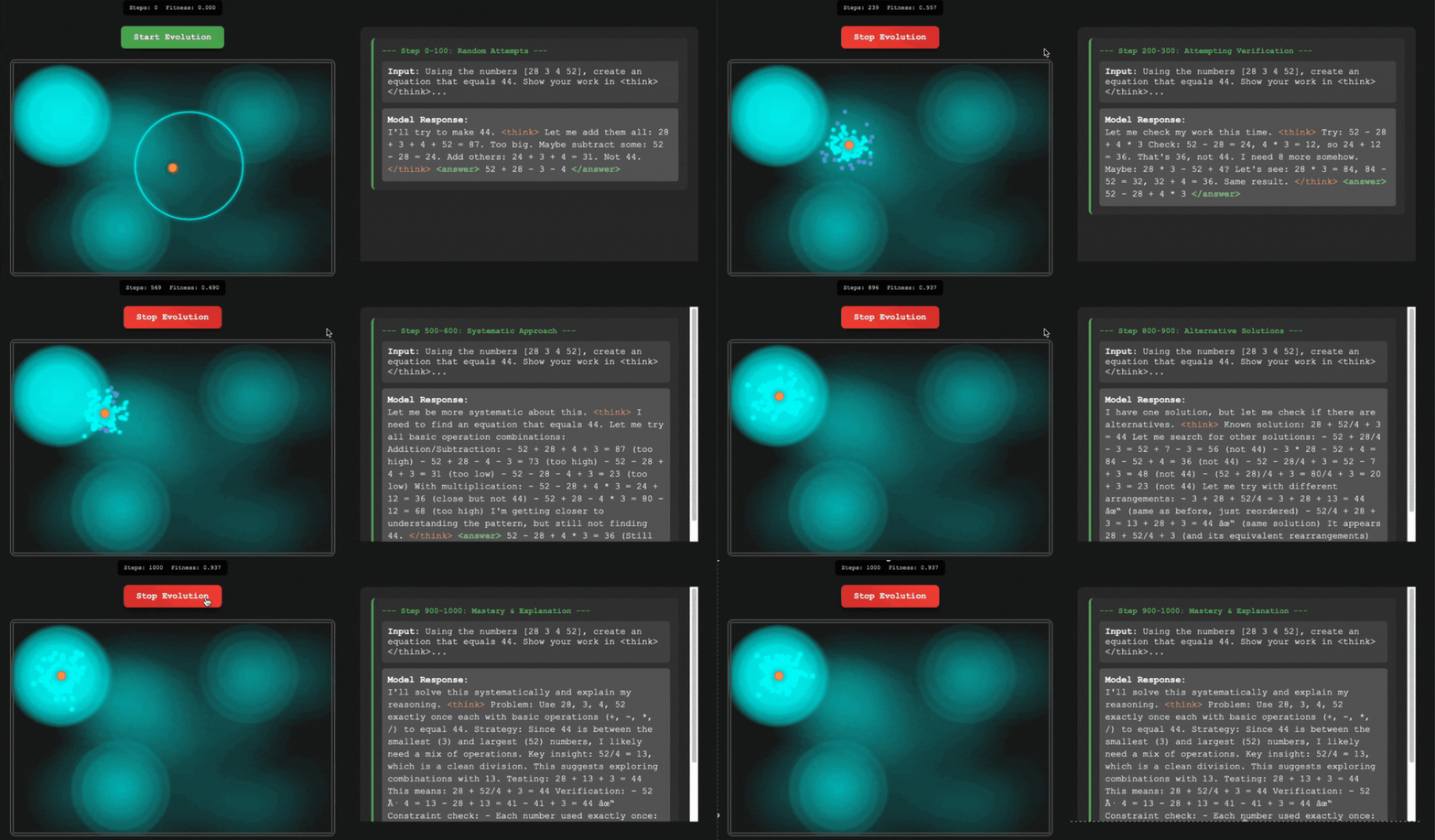
Reinforcement learning isn't limited to preference tuning. It's also the dominant approach for a broader style of fine-tuning where a model is scored on how well its output achieves a goal, and adjusted to earn a better score over time, using algorithms like PPO and GRPO. Like supervised fine-tuning and DPO, these methods still rely on gradients and backpropagation to make those updates, just applied to a reward score instead of a labeled example or a preference comparison. Evolution Strategies (ES) break from that pattern entirely. Instead of calculating gradients at all, ES fine-tunes a model by sampling small, random tweaks, known as perturbations, across its parameters, evaluating how each perturbed version performs, and aggregating the results into an update that moves the model toward stronger performance. No gradients, no backpropagation, and considerably less of the training instability that reinforcement learning can introduce.
Our team’s research on evolution strategies found that ES offers real advantages over reinforcement learning: stronger sample efficiency, more stable results across training runs, less sensitivity to hyperparameter choices, and a lower tendency toward reward hacking, where a model learns to game its reward signal instead of genuinely improving at the task. Those properties make ES particularly well suited to long, multi-step reasoning tasks and sparse reward settings, exactly the conditions where reinforcement learning tends to struggle.
That first result raised several more questions, and our follow-up research has been working through them since. We've since pushed ES into harder, more structured reasoning tasks like math problems and logic puzzles, used it to help models judge their own confidence more accurately, adapted it to fine-tune models directly inside quantized, low-precision environments, and worked out a theoretical explanation for why it scales so well across billions of parameters without gradients. Together, this work is turning ES from a single strong result into a broader foundation for post-training.
LLM fine-tuning vs. RAG
Fine-tuning and retrieval-augmented generation (RAG) get compared constantly, but they're not really competing for the same job. They solve different problems, and in most production systems today, they end up working side by side.
Fine-tuning changes how the model behaves. It adjusts the model's parameters so its tone, format, reasoning patterns and task performance are durably different, with no extra context needed at the time of the request. RAG doesn't touch the model at all. It retrieves relevant information from an external source, such as a document repository or knowledge base, and feeds that information to the model as context right before it responds.
That difference is what determines which one fits a given problem. RAG works best when the information a model needs changes often, since the underlying knowledge source can be updated without retraining anything. Fine-tuning works best when what matters is tone, format, task behavior or specialized patterns that need to hold steady no matter what information happens to be available at the moment. Put simply: RAG gives a model better context, and fine-tuning gives it better behavior.
Fine-tuning | RAG | |
What it changes | The model's parameters and behavior | The context available to the model at inference time |
Best for | Tone, format, task performance, specialized reasoning patterns | Information that changes frequently or needs to stay current |
Updating knowledge | Requires retraining | Update the knowledge source, no retraining needed |
Common risk | Overfitting or forgetting prior capabilities | Retrieval quality limits answer quality |
Most mature deployments end up combining both: a fine-tuned model to lock in tone and structure, paired with RAG to keep the facts it draws on current.
When should businesses use LLM fine-tuning?
Fine-tuning earns its place once prompt engineering stops being enough on its own. Well-written prompts and a handful of in-context examples get most teams surprisingly far, and it's usually worth trying that route first since it's faster and cheaper to iterate on. But once a task needs consistent format, tone or performance across a high volume of requests, and prompting alone can't hold that consistency, fine-tuning becomes the more dependable path.
Typical use cases: customer service responses that need to match a brand voice every single time, document review workflows that apply the same evaluation criteria across thousands of documents, classification tasks that need accuracy to hold steady at scale, coding support that follows an organization's internal conventions and APIs, and other industry-specific workflows where specialized language or reasoning is central to getting the task right.
None of this works without good data. Fine-tuning is only as strong as the training set behind it, and without a clean, representative dataset that actually reflects the task at hand, no amount of training technique will produce the consistent improvement a business is looking for.
What are the benefits of LLM fine-tuning?
Applied to the right use case with the right data, fine-tuning delivers a handful of concrete advantages over relying on a general-purpose model alone.
Better task performance: a fine-tuned model consistently outperforms a general-purpose model on the narrow task it was trained for.
More consistent outputs: less variability than relying on prompting alone, with more predictable results across similar requests.
Stronger domain understanding: the model picks up specialized terminology, conventions and reasoning patterns specific to an industry or function.
Better tone or brand alignment: responses consistently reflect a company's voice instead of defaulting to generic phrasing.
Less reliance on long prompts: the desired behavior is built into the model itself, so fewer lengthy instructions are needed at inference time.
Better support for specialized business use cases: from legal document review to customer service to code generation, the model is shaped around the actual demands of a workflow rather than approximated through prompting.
What are the challenges of LLM fine-tuning?
Fine-tuning is a powerful tool, but it comes with real tradeoffs worth planning for before committing to a project.
Poor training data can hurt results: a model is only as good as what it learns from, and noisy or unrepresentative data can actively degrade performance.
The model can become too narrow if overtrained: training too aggressively on a narrow dataset risks catastrophic forgetting, where a model loses some of the general capabilities it started with. Recent research suggests this forgetting is often more of a temporary drift than permanent damage, and that it can be substantially reduced with the right training safeguards rather than accepted as an unavoidable cost of fine-tuning.
Fine-tuning takes time, cost and technical expertise: even with efficient methods, it's a more involved undertaking than prompt engineering and needs the right skills and infrastructure behind it.
Sensitive data needs careful handling: training data often includes proprietary or regulated information, which means real governance throughout the process, not an afterthought.
The model still needs testing, governance and monitoring after launch: training doesn't end the work. Ongoing evaluation is what confirms the model actually behaves as intended once it's live.
Fine-tuning won't fix missing or outdated information: if the real problem is that a model lacks access to current facts, no amount of fine-tuning solves that. RAG is the better tool for that particular job.
Best practices for LLM fine-tuning
Getting fine-tuning right starts well before training begins, and it doesn't stop once a model is in production.
Start with a specific business problem, not the technology. Fine-tuning should answer a well-defined performance gap, not serve as a default step in every AI project. From there, decide whether fine-tuning, RAG or prompt engineering actually fits the problem, since each solves something different and picking the wrong one wastes time and budget.
Use training data that's accurate, relevant and secure. Data quality shapes the outcome more than almost any other decision in the process. Define success metrics before training starts, so there's a clear, objective way to judge whether the fine-tuned model is actually an improvement over the baseline, and test it against real-world scenarios rather than leaning on benchmark scores alone.
Build in governance, monitoring and human review to catch what automated evaluation misses, especially anywhere an off-tone or incorrect output could affect a customer or create compliance exposure. And plan to keep updating the model as business needs shift. Fine-tuning works best as an ongoing practice, not a one-time project, because the tasks and expectations a business cares about rarely stay fixed for long.
Making LLM fine-tuning work for your business
Fine-tuning can turn a capable general-purpose model into one that is much better suited to a specific task, workflow or business environment. But the value isn't in fine-tuning for its own sake. It comes from knowing what needs to improve, choosing the right approach and training against data that reflects the work the model will actually do.
For some use cases, better prompting or RAG will be enough. For others, fine-tuning can deliver the consistency, specialization and performance a general model can't reliably provide on its own. Increasingly, techniques like parameter-efficient fine-tuning and Evolution Strategies are expanding the ways organizations can get there.