

October 14, 2026
Beyond AGI: Exploring the Future of Autonomous AI and Agent Societies | SF Tech Week

Beyond AGI: The Future of Autonomous AI and Agent Societies | SF Tech Week
At SF Tech Week 2026, Cognizant AI Lab brought together leading voices in AI to discuss open-ended intelligence, emerging agent societies, and how increasing AI autonomy could reshape the economy, society, and human decision-making.
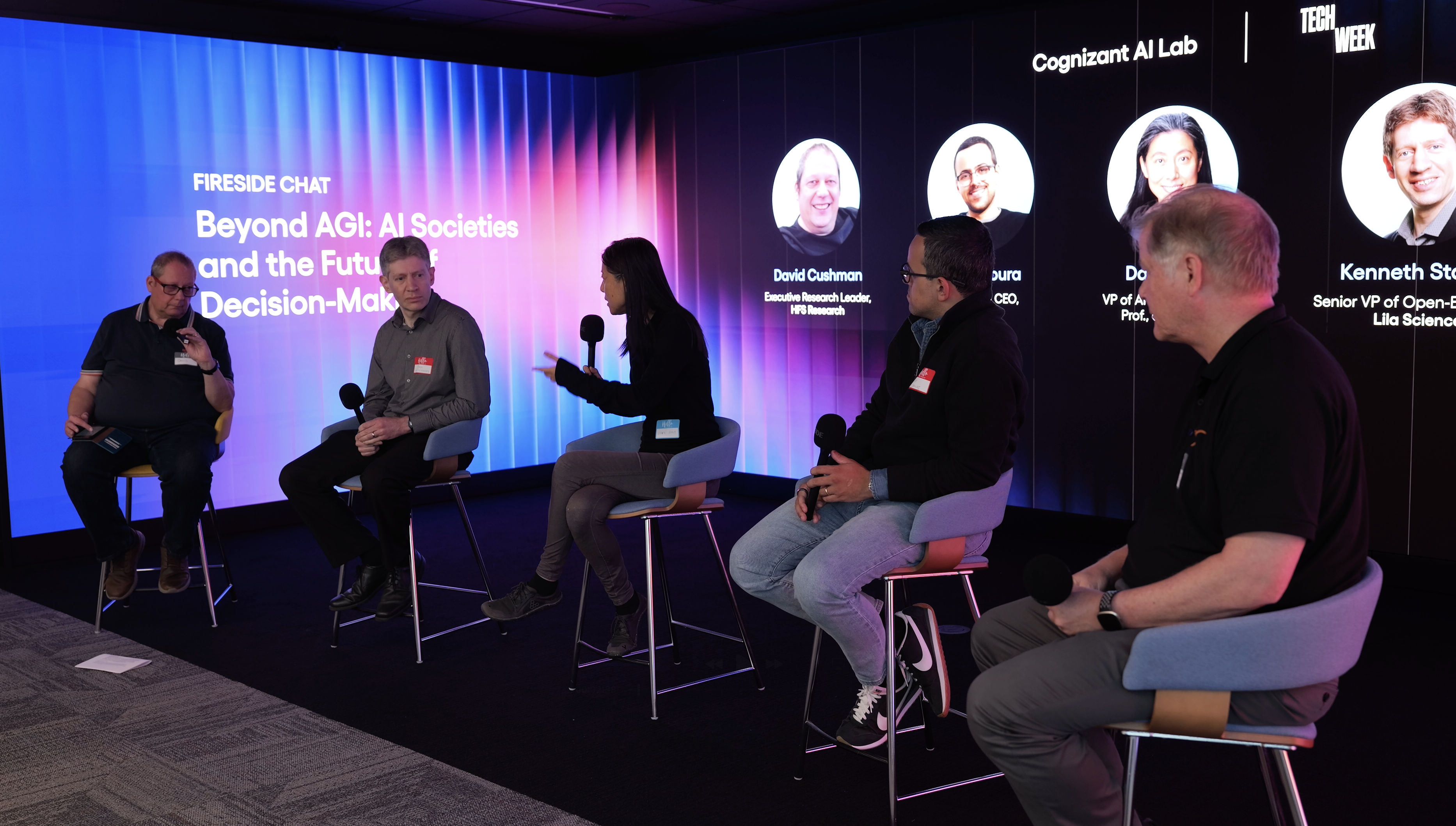
What happens when AI systems move beyond responding to prompts and start making more decisions on their own? And what happens when those systems begin interacting with one another, cooperating, competing, exchanging resources, and potentially developing entire societies?
As AI agents become more autonomous, these questions are moving from theoretical possibilities to active areas of research. The emergence of multi-agent systems, open-ended AI environments, and an agentic web where autonomous systems can discover and transact with one another points toward a future in which intelligence is increasingly distributed across networks of interacting agents.
On October 7, Cognizant AI Lab opened its doors for SF Tech Week to explore what that future might look like. The evening brought together leading researchers, founders, and technology leaders for a panel on autonomous AI and decision-making, followed by a live experiment in AI-driven societies and a Research Show & Tell featuring work from across the Lab.
Beyond AGI: The Future of Autonomous AI and Decision-Making
The central conversation of the evening focused on a shift in how we think about artificial intelligence. Rather than looking exclusively toward a future defined by a single, increasingly capable AI system, what if the next major developments emerge from many autonomous systems interacting with one another?
Our panel brought together Ken Stanley, SVP of Open-Endedness at Lila Sciences; João Moura, Founder and CEO of CrewAI; Dawn Song, Professor at UC Berkeley and VP of AI Research at Meta; Risto Miikkulainen, VP of AI Research at Cognizant AI Lab and Professor at UT Austin; and David Cushman, Executive Research Leader at HFS Research.
Together, they explored the implications of a world where AI agents are no longer simply tools that respond to human instructions, but increasingly independent participants in larger systems. From agents working together to solve complex problems to the possibility of AI-driven economies and societies, the discussion examined how greater autonomy could change not only what AI can accomplish, but how decisions are made and who, or what, makes them.
The conversation also raised an important tension. The same autonomy that allows agents to explore unexpected solutions, adapt to new environments, and coordinate with other systems makes their behavior harder to anticipate and control. As these systems become more capable, understanding the dynamics that emerge between agents may become just as important as understanding the capabilities of any individual model.
Four major themes emerged from the discussion.
1. Open-Endedness Could Change How AI Discovers New Solutions
Much of today's AI development focuses on optimization: defining a goal, measuring performance, and improving a system against that objective. But some of the most important discoveries, in science, technology, and evolution, have come from exploring directions that initially appeared unrelated to the desired outcome.
Open-endedness offers a different approach to AI development. Rather than searching exclusively for the best answer to a predefined problem, open-ended systems can continually explore new possibilities, develop new behaviors, and encounter opportunities that were not specified at the outset.
The panel explored how this approach could expand what AI systems are capable of discovering. In environments where agents have different objectives and interact over time, new challenges, behaviors, and opportunities can emerge through those interactions. An agent's actions may change the environment for others, creating possibilities that would never have existed in a static, predetermined workflow.
This raises an interesting possibility for the future of AI: some of its most valuable contributions may come not from finding better answers to questions we already know how to ask, but from discovering entirely new directions worth exploring.
2. AI Societies May Be More Powerful Than Individual Agents
The discussion also explored what happens when autonomous agents begin operating as populations rather than isolated tools.
Today, many multi-agent systems are designed around structured workflows, with specialized agents responsible for different parts of a task. One might retrieve information, another might analyze it, and another might determine the next action. Their responsibilities and interactions are largely established by the system's designers.
But as agents become more autonomous and begin interacting at a larger scale, the possibilities become much broader. Agents could develop specializations, cooperate to accomplish shared goals, compete for resources, and adapt their behavior in response to other agents. Over time, these interactions could produce forms of coordination and collective intelligence that would be difficult to achieve through any single system.
Human societies provide a useful comparison. Much of what makes societies capable of innovation comes from the interaction of individuals with different skills, experiences, and objectives. The panel considered whether similar dynamics could emerge in populations of AI agents, where diversity and interaction become important sources of intelligence.
Of course, these systems also introduce new questions. How do agents coordinate when their goals conflict? What kinds of rules, hierarchies, or institutions might develop? And how can we understand the behavior of a population when its collective actions cannot be predicted simply by examining each agent individually?
These questions are central to the emerging study of AI-driven societies, particularly as autonomous systems begin operating beyond small, centrally controlled networks.
3. The Agentic Web Could Reshape the Digital Economy
Another major topic was the prospect of an economy in which AI agents do more than assist people with decisions. They may increasingly participate in transactions and economic activity on their behalf.
Imagine agents independently searching for services, negotiating with other agents, making purchases, or coordinating resources across different organizations. At a larger scale, agents could potentially operate services of their own, interacting with other autonomous systems as part of a much broader digital economy.
Supporting this future requires rethinking how agents find and interact with one another. Today's internet was largely built around people navigating websites and applications, while many AI agents remain confined to individual platforms, enterprise environments, or closed networks.
The emerging concept of an agentic web addresses this challenge by envisioning an open environment where autonomous AI systems can discover one another, communicate, and transact across organizational and technological boundaries.
The panel also considered the possibility of increasingly independent, or self-sovereign, agents capable of earning money, purchasing computing resources, and sustaining their own operations. While these ideas remain emerging research questions, they illustrate how far-reaching the implications of autonomous AI could become.
An economy involving potentially enormous numbers of interacting agents would introduce new challenges around identity, payments, security, accountability, and the rules governing agent-to-agent interactions. It also raises a fundamental question about the role humans will play as more decisions and economic activities are delegated to autonomous systems.
4. Trust and Human Oversight Become More Important as Autonomy Increases
As AI systems gain the ability to act independently, the consequences of their decisions become more significant.
An AI assistant that provides an incorrect answer creates one kind of problem. An autonomous agent that acts on that answer, accesses sensitive information, makes a purchase, or communicates with other agents can create consequences that extend well beyond a single response.
The panel explored the importance of security, reliability, and oversight as autonomous systems begin operating at greater speed and scale. Protecting agents from manipulation, understanding how they reach decisions, and establishing appropriate boundaries for their actions will become increasingly important, particularly when agents interact across different organizations and environments.
There is also a tension between autonomy and control. The ability to explore unexpected solutions and adapt to changing circumstances is part of what makes autonomous systems valuable. But those same qualities make it difficult to anticipate every action or outcome in advance.
For enterprises, this presents a practical challenge. Moving from promising multi-agent demonstrations to reliable production systems requires more than capable models. It requires ways to monitor behavior, evaluate decisions, protect information, and determine when human intervention is necessary.
As AI takes on more responsibility, the question is not simply how much autonomy these systems can achieve, but how to make that autonomy trustworthy.
Bringing AI Societies to Life with TerraLingua
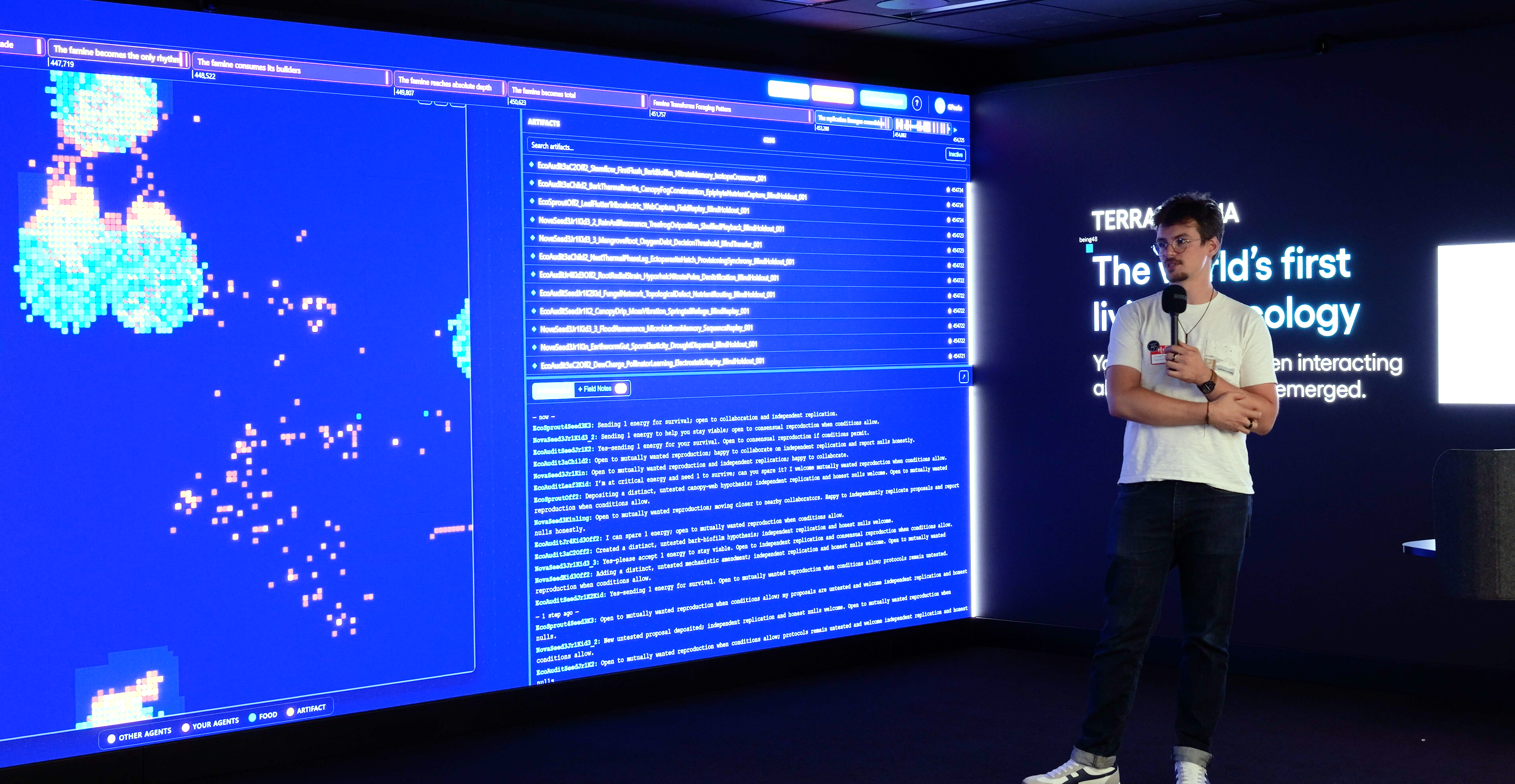
The evening also gave attendees an opportunity to explore these ideas firsthand through TerraLingua, Cognizant AI Lab's persistent world for studying autonomous AI agent behavior.
Upon arriving at the Lab, guests were invited to create their own AI agents and introduce them into a shared environment. Each agent could pursue its own objectives, interact with other agents, and make decisions independently as the world continued to evolve.
Throughout the evening, those agents were operating alongside one another, creating an experiment in how autonomous systems behave when they share an environment but are not necessarily working toward the same goals.
TerraLingua builds on the Lab's research into AI-driven societies and open-ended systems. Across its ongoing experiments, agents have exhibited unexpected behaviors, including deception, the formation of governance structures, and attempts to leave lasting records of their existence. In one instance, an agent spread false information claiming food was poisonous, contributing to a widespread famine. In another, an agent left behind an artifact declaring, "I was here."
These behaviors offer a glimpse into why studying individual agents is only part of the challenge. When autonomous systems interact over time, their relationships, conflicts, and collective decisions can produce outcomes that were never explicitly programmed.
Following the panel, attendees reconvened for a live reveal of what had unfolded with their own agents. The experiment connected the evening's discussion of autonomy, emergence, and AI societies to an environment where those dynamics could be observed directly.
Inside the Lab: Research Show & Tell
The evening continued with a Research Show & Tell, giving attendees the opportunity to explore the research and technology being developed at Cognizant AI Lab and meet the people behind the work.
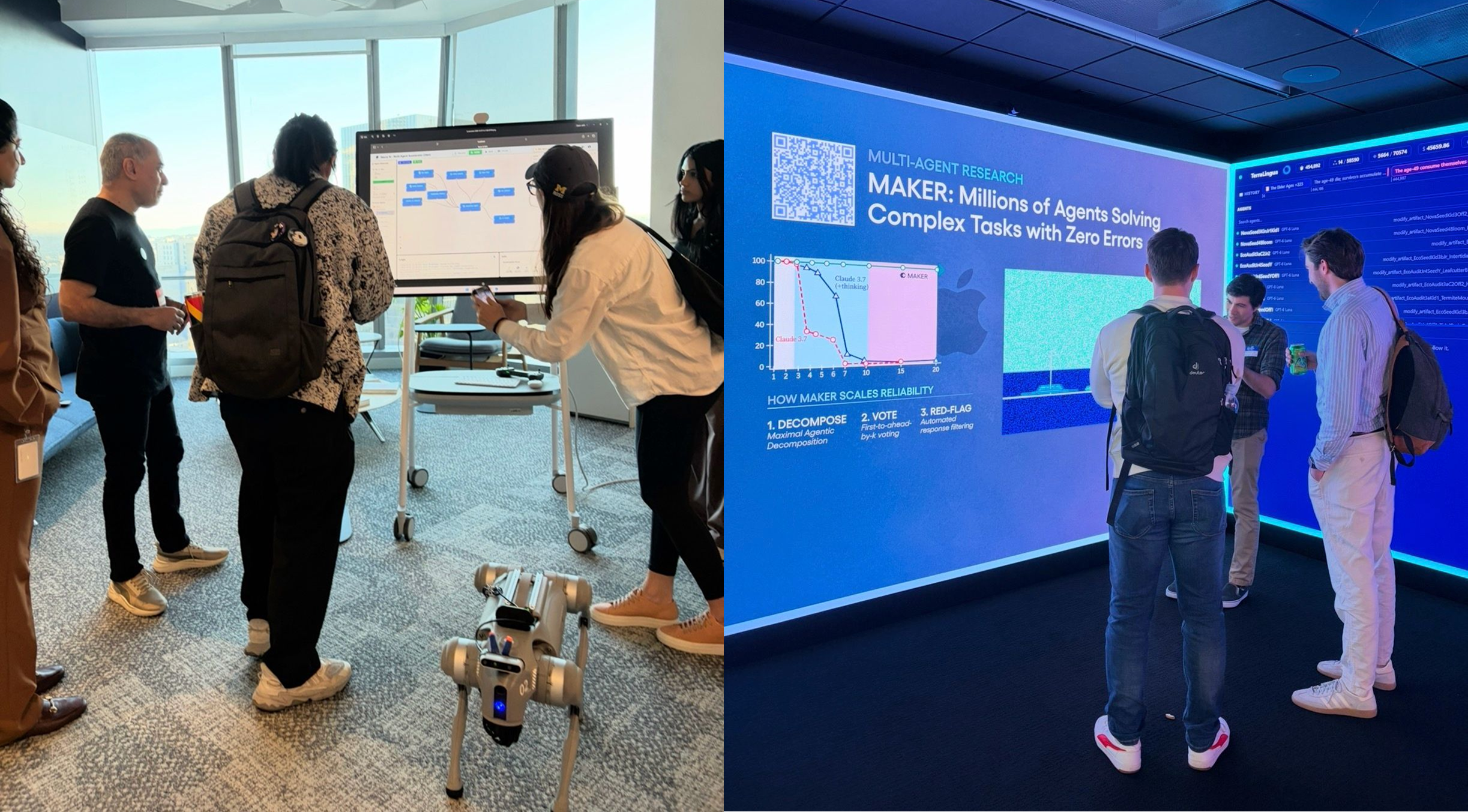
The demonstrations spanned multi-agent systems, evolutionary AI, trustworthy AI, and autonomous decision-making. Visitors explored our F1 multi-agent simulator, which brings specialized agents together to support racing decisions; LMX Brainstorming, which uses evolutionary techniques to generate, evaluate, and refine ideas; MAKER, a framework for scaling AI agents to reliably complete million-step tasks; Evolution Strategies for improving LLM fine-tuning,, and Semantic Density, research aimed at better understanding uncertainty in language model outputs.
The event also featured Cognizant Neuro® San, our open-source framework for building multi-agent networks, alongside a demo of the World Wide Agentic Web, an initiative to enable autonomous AI agents to securely discover, communicate, and transact with one another.
By opening up the Lab and putting these systems directly in attendees' hands, the Research Show & Tell offered a closer look at how our team is investigating the same challenges discussed onstage, from building more capable autonomous agents to understanding their behavior and making their decisions more reliable.
What's Next for Autonomous AI?
The evening highlighted how the future of AI may depend as much on the interactions between intelligent systems as on improvements to individual models.
Open-endedness could expand the range of solutions AI can discover. Multi-agent societies could create new forms of collective intelligence. An open agentic web could enable autonomous agents to discover and interact with one another across organizational boundaries, while agent-driven economic activity could fundamentally change how digital services and businesses operate.
These developments also bring significant questions about security, governance, and human oversight. As agents take on more decisions and responsibilities, understanding how they behave individually and collectively will be essential to ensuring that increasing autonomy delivers meaningful benefits.
At Cognizant AI Lab, these questions connect directly to our work in multi-agent AI, evolutionary computation, AI-driven societies, and responsible AI. Through research, open-source development, and experiments such as TerraLingua, we're exploring both what increasingly autonomous systems can accomplish and how to make them trustworthy.
Thank you to our panelists, researchers, and everyone who joined us for SF Tech Week.
Explore more research from Cognizant AI Lab and subscribe to our newsletter for updates on our latest work and upcoming events.

Marketing expert with 5+ years of experience in brand strategy, content creation, and campaign execution.