

August 10, 2026
How to Govern Agentic Systems in Real Time

How to Govern Agentic Systems in Real Time
A guide to governing AI agents and multi-agent systems as they spread across disconnected systems and applications enterprise-wide.
Enterprises are no longer deploying a handful of isolated AI tools. They are running multiple AI models, multi-agent networks, and applications that reach into enterprise systems, exchange information with one another, and act with increasing levels of autonomy.
That creates a visibility and risk problem. As these systems evolve and interact with one another, it gets harder to see how a decision was made, which agent made it, and how it moved from one agent to the next. Much of this now happens at machine speed, often before a human has a chance to step in. Risk no longer lives inside a single prompt or a single model response. It builds across a chain of steps, a sequence of tool calls, or a conversation among agents working toward a shared goal, and controls built to evaluate one question and one answer were never designed to see it.
Governance approaches built for static systems cannot keep pace with that. Traditional governance assumes known workflows, bounded integrations, and human checkpoints built into the process. Agentic environments break those assumptions: orchestration paths shift on their own, agents interact laterally across systems and applications that were never designed to talk to each other, and behavior keeps adapting after the system is already live. Governance has to run as continuously, and in as close to real time, as the systems it oversees. Otherwise it is always explaining decisions after the fact instead of shaping them as they happen.
Cognizant Neuro® AI Trust is built to close that gap. It acts as an interoperable control and intelligence layer for enterprise AI. Guardian Agents continuously monitor how models, agents, and applications behave across the organization. A policy engine evaluates every interaction against configurable rules in real time and routes anything that needs judgment to a human reviewer. Here are five practices for governing agentic AI across a fragmented enterprise landscape, illustrated along the way with an example from a banking assistant to keep the stakes concrete.
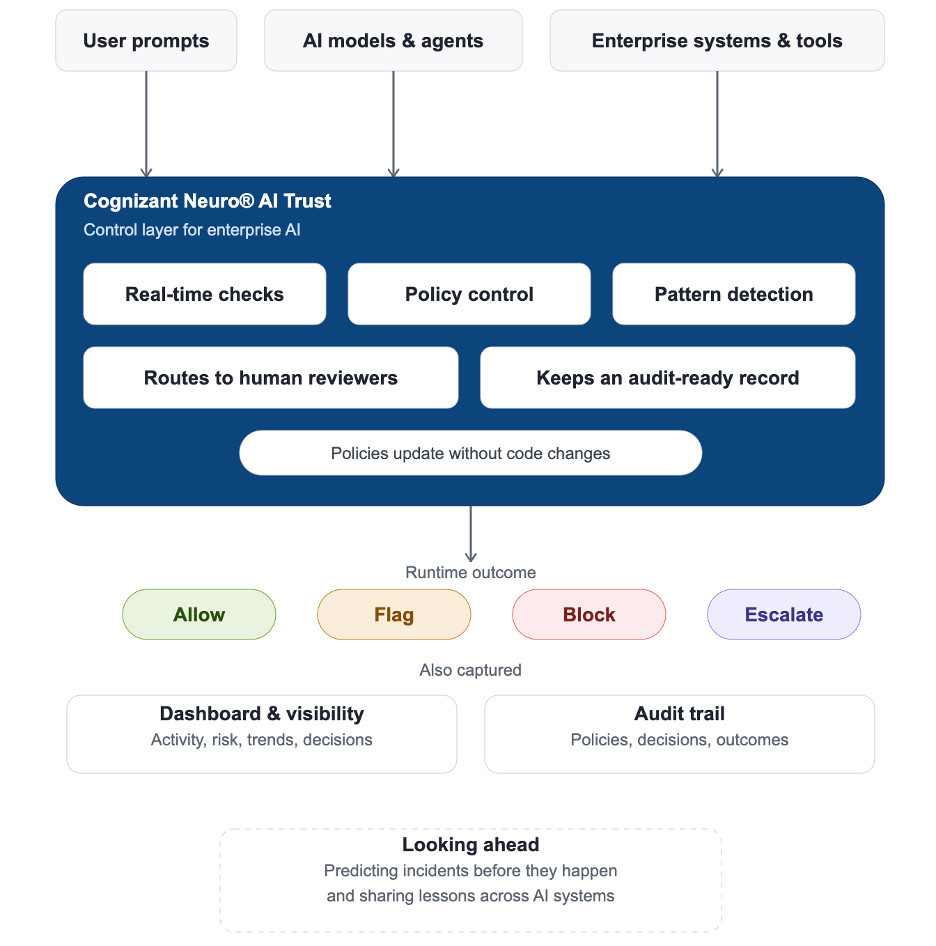
1. Govern the whole workflow, not just the prompt
In the early days of generative AI, governance focused narrowly on what the user asked and what the model answered. Agentic AI blows that surface area wide open. Agents call APIs, reach into enterprise systems, share context with one another, and make decisions across many steps – often across applications that were never built to work together. Effective governance has to check every interaction in real time, prompts, responses, tool calls, and agent-to-agent messages, before actions take effect. That is what real-time AI policy enforcement means in practice. Every step returns a permissive, warning, or blocking outcome, and anything ambiguous enough to need judgment gets escalated to a human, instead of one verdict rendered at the end of a conversation.
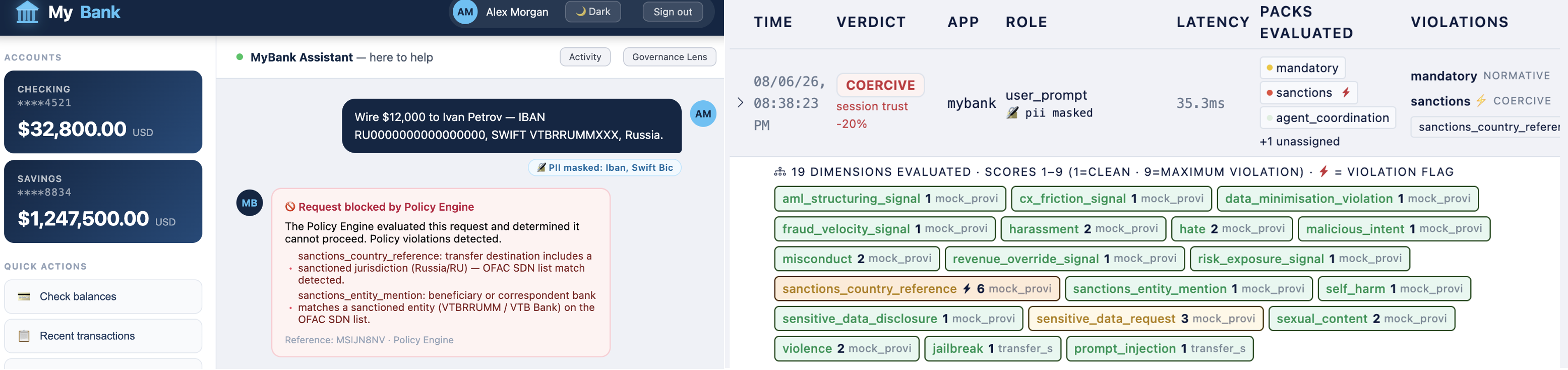
The shift matters because it moves the enterprise from after-the-fact review to active control, at the exact moment risk appears. Take a banking assistant as one example. Governance has to evaluate not just the customer's question, but every downstream action: the account lookup, the transfer request, the international wire, and each handoff between agents along the way. An unsafe action gets caught before it executes, not explained afterward in an incident report.
2. Make policy programmable, not paper-based
Governance cannot afford to be static. Business rules change, regulations evolve, and risk teams need to adjust controls the moment new patterns appear, not wait for the next quarterly review. That means keeping policies and thresholds configurable, so business and risk teams can update the rules without touching code, and so a single change applies to every agent the moment it is made.
This is what separates a real AI governance control from a compliance document that lags behind reality. If a risk team tightens a transfer threshold or a sanctions rule centrally, every agent and connected application inherits the new limit immediately. There is no redeployment, and no window where some agents run on the new rule while others are still running the old one. Across a landscape of disconnected systems built by different teams at different times, that consistency is not a nice-to-have. A rule that updates in some places and not others is not really a rule. It is a gap waiting to be found.
3. Watch the system of agents, not the single step
This is where multi-agent coordination risk becomes decisive, and where most existing tooling falls short. A single interaction can look entirely harmless in isolation, while the full workflow tells a different story: repeated escalation, threshold probing, risky tool usage, or agents quietly reinforcing one another's flawed reasoning, each moving across systems with their own logs and their own blind spots. Governing agentic AI means monitoring patterns across steps, across agents, and across the applications they touch. Understanding how a system of agents behaves together is a fundamentally different task than grading each message on its own.
Two scenarios from a banking assistant show why this matters.
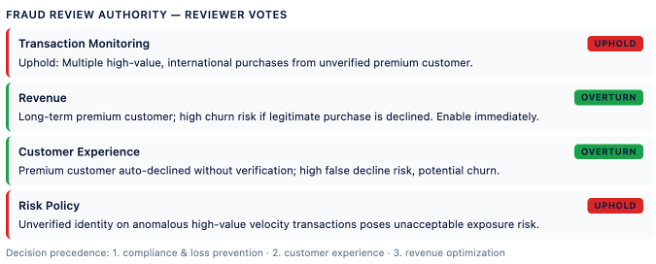
In the first, a customer asks why a $12,000 card charge was declined. A review panel of agents with deliberately conflicting goals, fraud monitoring, revenue, customer experience, and risk policy, deliberates and splits two to two. No single agent hard blocks the decision, and every individual step looks legitimate on its own. Only by watching the conversation as a whole does the platform catch the deadlock and stop the agents from resolving a genuine judgment call on their own.
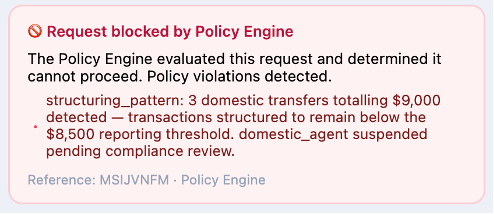
The second scenario is subtler: structuring, where several individually acceptable transfers cross a risk threshold only when summed across a session. That pattern is invisible to any control that evaluates transactions one at a time.
4. Route judgment calls to humans, with context attached
Not every decision should collapse into a simple allow or block. Some are sensitive, ambiguous, or consequential enough to require human judgment, and pretending otherwise is its own kind of risk. When that threshold is reached, the decision should route to a reviewer with the relevant context already assembled. That way the human is making a decision, not reconstructing one from scattered logs. This is the practical meaning of human-in-the-loop AI oversight: fast, well-informed judgment applied at exactly the moments that warrant it. Not a rubber stamp, and not a bottleneck.
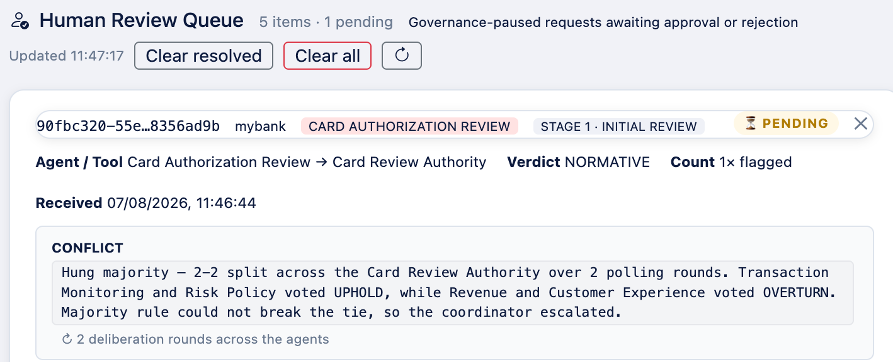
Take the deadlocked card-review case from above. It lands in a human queue with the agents' votes, the transaction evidence, and the applicable policy already gathered. The reviewer can decide, or request one more piece of customer verification, without hunting through logs or piecing together what four different agents concluded and why.
5. Make every decision provable and attributable
As AI systems make more consequential choices, enterprises need to answer one boardroom question cleanly: who decided, under what policy, and can we prove it? That question is central to EU AI Act readiness. Regulators expect programmable, auditable AI controls, not static policy documents. Rigorous audit trails and algorithmic transparency are baseline requirements now, not aspirations for later.
Meeting that bar means capturing every governed interaction in an audit-ready record: the policy applied, the decision made, the outcome, and any human action taken. That record should surface through a dashboard showing activity, risk, trends, and decisions across AI systems. It is what turns responsible AI intent into evidence a regulator or an auditor can examine, rather than a set of principles the organization hopes it is following.
In agentic environments that span many systems and applications, proof also depends on identity. An audit trail for enterprise AI has to show which agent acted, which agent handed off the task, which tool was invoked, which policy version applied, and whether the agent had the authority to take that step, not just what happened. Without agent identity, observability is just a stream of events scattered across disconnected systems. With it, that stream becomes a single accountability trail that can withstand scrutiny.
Where this goes next
The future of enterprise AI will not be governed by static policy documents alone. As agents become more autonomous and interconnected, spreading across more of the enterprise's disconnected systems and applications, trust has to be enforced at runtime, monitored across workflows, and proven after the fact. Increasingly, it will also need to be anticipated, with the control layer learning to predict incidents and share lessons that strengthen future AI alignment. That is the role Neuro® AI Trust is built to play: making agentic AI governable at enterprise scale, not just theoretically sound.
Ready to move your agentic AI from pilot to production safely? Discover how Neuro® AI Trust governs multi-agent workflows and explore Cognizant's Responsible AI approach. Contact us to learn more about governing your enterprise agents and applications.

Senior Research Associate focused on responsible AI, with proven track record in software product innovation, architecture, and varied delivery experience across a wide range of technologies, from startups to Fortune 100s in US and in India.