

Open Agentic Web Challenge | $13K Prizes - Enter by January 11
How AI Agents Can Negotiate and Transact on the Open Agentic Web

November 19, 2026
How AI Agents Can Negotiate and Transact on the Open Agentic Web
As the Open Agentic Web Challenge launches, a new demonstration shows how AI agents can negotiate prices and reach agreements through a shared arbitration mechanism.
One of the more interesting challenges in building the worldwide agentic web is figuring out how independently developed AI agents can conduct transactions with one another. Allowing agents to discover services and exchange information is relatively straightforward. Allowing them to negotiate prices, agree on terms, and make financial commitments on behalf of people and businesses is considerably more complicated.
I explored one approach to this problem in my earlier work on a deterministic Arbiter for agentic transactions. An Arbiter is an intermediary that applies predefined rules to negotiations between different parties. In our implementation, it is deterministic code rather than another LLM, allowing agents to negotiate without giving them unrestricted authority over binding financial decisions. The Arbiter evaluates the parties' requirements and determines whether an agreement is possible.
We've now extended this approach to the worldwide agentic web reference implementation, demonstrating how a personal AI agent can negotiate with an agent representing a business. Using Cailville as a demonstration environment, we bring together agentic websites, a private steward acting on behalf of a consumer and a shared Arbiter that handles the negotiation.
This is one example of the infrastructure that could support transactions across the agentic web. With the launch of the Open Agentic Web Challenge, we're inviting developers to explore these problems and build their own solutions.
The mechanics of agent-to-agent negotiation
Consider a consumer asking their personal agent to book a hotel. The agent could contact several providers, compare available rooms and identify options that meet the consumer's preferences and budget. Each hotel might have its own agent, developed using a different framework and operating independently of the consumer's agent.
Finding and comparing those options is one thing. Negotiating a binding price is another. The consumer has a maximum amount they are willing to spend, while the hotel has a minimum price it is prepared to accept. Neither party necessarily wants to disclose those limits to the other.
Leaving the negotiation entirely to LLM-based agents introduces problems. An agent might reveal information it should keep private, agree to an unfavorable price or make concessions that exceed its authority. LLMs can be capable at communicating and coordinating tasks, but they are not well suited to independently enforcing financial constraints.
In the Arbiter approach, agents remain responsible for discovering providers and coordinating interactions, while deterministic code handles the binding parts of a transaction. As described in my earlier work, the buyer establishes a transaction mandate, the seller submits a sealed bid, and the Arbiter determines whether an agreement is possible under those constraints. A separate consumer-controlled approval is required before settlement proceeds.
The goal is to preserve the flexibility of AI agents while introducing predictable rules for transactions that carry financial consequences.
Inside the Arbiter demo
To illustrate how this approach could work on the agentic web, we've incorporated a commerce Arbiter into Cailville, where businesses are represented by agentic websites that can communicate with visitors and other agents.
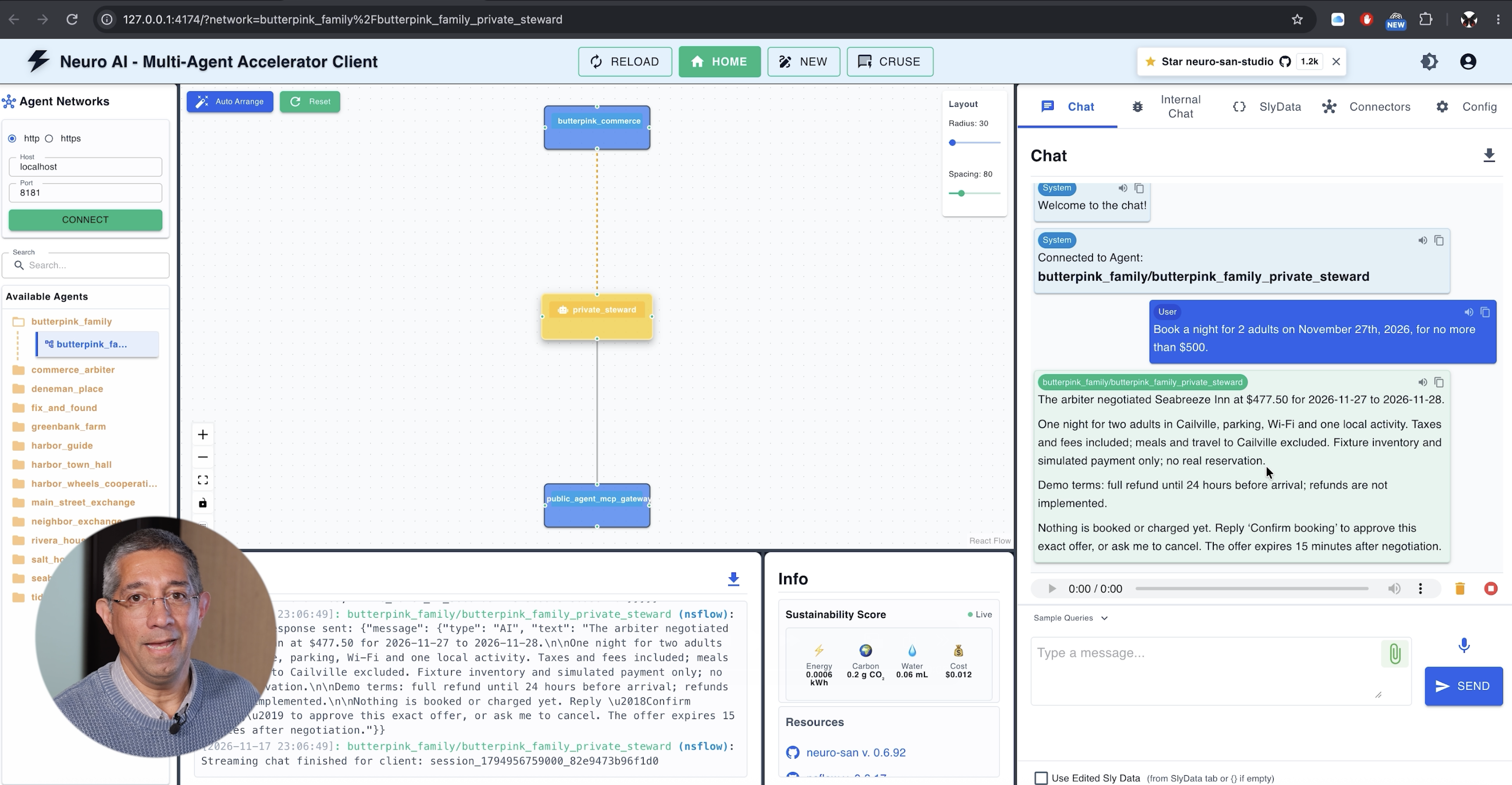
In the demo, a user interacts with the Seabreeze Inn, a hotel represented by its own AI agent. Rather than simply asking about room availability and accepting the listed price, the user can work through a private steward, a personal agent that communicates with other agents on their behalf.
The steward, accessed through Neuro San, can communicate with the hotel agent and use the Arbiter to negotiate a booking. The user specifies the desired dates, number of guests and maximum price they are willing to pay. The Arbiter then evaluates whether an agreement is possible under those conditions.
The demo explores both successful and unsuccessful negotiations. In the first example, the Arbiter determines that an agreement is possible. In the second, the user requests different dates at a lower maximum price, and the Arbiter determines that the hotel cannot accommodate the offer.
The important distinction is that the agents do not determine these outcomes themselves. They can communicate, coordinate and initiate negotiations, but the Arbiter applies the transaction rules independently of their conversations.
The implementation also restricts repeated negotiations for identical booking conditions, preventing an agent from repeatedly changing its offer to probe the seller's private pricing limits.
The hotel booking is a relatively simple example, but it illustrates how a consumer's agent can interact with a business agent through a shared transaction mechanism without either LLM controlling the binding outcome.
The underlying Arbiter is implemented in Python, and developers can examine the source code to understand how the negotiation mechanism works and explore possible extensions.
Enabling transactions across the agentic web
The hotel example is only one possible application. The same general approach could be used in retail, travel, procurement and other commercial interactions where agents represent parties with different objectives.
A consumer agent could consult several businesses, compare their offers and negotiate according to the consumer's requirements. A procurement agent could evaluate suppliers operating on different systems, while a retailer's agent could respond to requests from personal agents developed by different providers.
The Arbiter can also support negotiations involving multiple parties. Developers can try the open-source Agent Commerce demo, where an agent representing a consumer negotiates with multiple retailers through a shared arbitration mechanism.
This becomes particularly relevant as agents begin interacting across organizational boundaries. Businesses should not need to integrate separately with every personal assistant, and consumers should not be restricted to the services supported by a particular AI platform.
These examples demonstrate how the Arbiter can support negotiations between agents representing different parties, from individual hotel bookings to transactions involving multiple retailers. As more businesses make their services accessible to AI agents, mechanisms like this could help turn agent-to-agent interactions into commercial agreements across the open web.
Building an open foundation for agentic commerce
For agentic commerce to work across the web, agents developed by different organizations need to be able to discover one another, communicate, and conduct transactions without depending on a single proprietary platform. A consumer's personal agent should be able to negotiate with businesses using different AI models and frameworks, just as people today can access websites operated by different organizations.
The Arbiter demonstrates one way to handle the negotiation component of these interactions. By separating agent communication from binding transaction logic, it provides a mechanism for agents to negotiate under defined constraints without trusting an LLM to enforce financial commitments. However, a functioning agent economy will require additional infrastructure for identity, authorization, security and accountability, as well as ways to establish trust between parties that may have no prior relationship.
There is no reason to assume that one arbitration mechanism will work for every transaction. Different commercial arrangements may require different approaches, and some may not need an intermediary at all. The important question is how these mechanisms can work across independently developed systems, allowing agents to transact without being confined to a particular platform.
Join the Open Agentic Web Challenge
On November 12, we launched the Open Agentic Web Challenge at Web Summit in Lisbon, inviting developers and researchers around the world to help build an open, interoperable web of AI agents, with $13,000 in prizes up for grabs.
The challenge encourages participants to build interconnected agentic websites and contribute technologies that enable agents to discover, communicate and collaborate across platforms. It also provides an opportunity to explore the infrastructure needed for transactions, identity, authorization and governance.
I'm particularly interested in seeing how developers approach agent-to-agent commerce. The Arbiter is one possible starting point. Participants could experiment with negotiation mechanisms that account for more than price, ways to protect transaction information or approaches that allow agents to reach agreements involving multiple conditions and participants.
The Arbiter is a minimum viable implementation, not a complete solution for agentic commerce. There is considerable room to improve it, explore alternatives and determine which mechanisms are most useful for different types of transactions.
The web evolved because developers could build on common technologies and make their work accessible to others. I think the agentic web should develop in much the same way.
The Arbiter is one contribution to that effort. I'm looking forward to seeing what others build.
Explore the Open Agentic Web Challenge and submit your project.

Babak Hodjat is the Chief AI Officer at Cognizant and former co-founder & CEO of Sentient. He is responsible for the technology behind the world’s largest distributed AI system.