

Open Agentic Web Challenge | $13K Prizes - Enter by January 11
A Deterministic Arbiter for Transactions in an Agentic Marketplace

September 23, 2026
A Deterministic Arbiter for Transactions in an Agentic Marketplace
How a deterministic approach to AI agent transactions could allow autonomous agents to negotiate and transact while keeping prices, budgets, bids, and settlement under coded controls.
Early last year, I explored what it might look like for AI agents to work directly on behalf of consumers. I built a multi-agent system with a consumer assistant that could confer with specialized agent networks across areas including travel, retail, finances, healthcare, and career decisions. Some of those agents could even communicate directly with agent networks representing businesses, allowing consumer and B2C agents to exchange information and negotiate with one another. In one example, consumer agents contacted travel provider networks to find options that matched a user's requirements and budget.
That experiment showed what agent-to-agent interactions in commerce might look like, but there is an important difference between agents that can research and negotiate and agents that can actually complete a transaction. Such systems are not practical yet, even today, not least because we do not trust agents to carry out monetary transactions or negotiate binding prices on our behalf.
There is a way around this, though, which I have implemented in an agent commerce demo, along with an extended version of the original consumer agent system to illustrate how it works. The trick is to introduce a non-agent arbiter, a deterministic intermediary that applies predefined rules to the transaction, implemented as a Neuro San coded tool that both the consumer agent network and any consumer-facing B2C agent network have to use.
How the arbiter works
The arbiter takes the transaction mandate from the consumer, or buyer, side, while the B2C, or seller, submits a sealed bid against it. The buyer side creates an immutable mandate containing the requested service or product and a private spending ceiling. Consumer agents may research providers directly, but those conversations produce only informational prices. To transact, a buyer agent asks the arbiter to open negotiation.
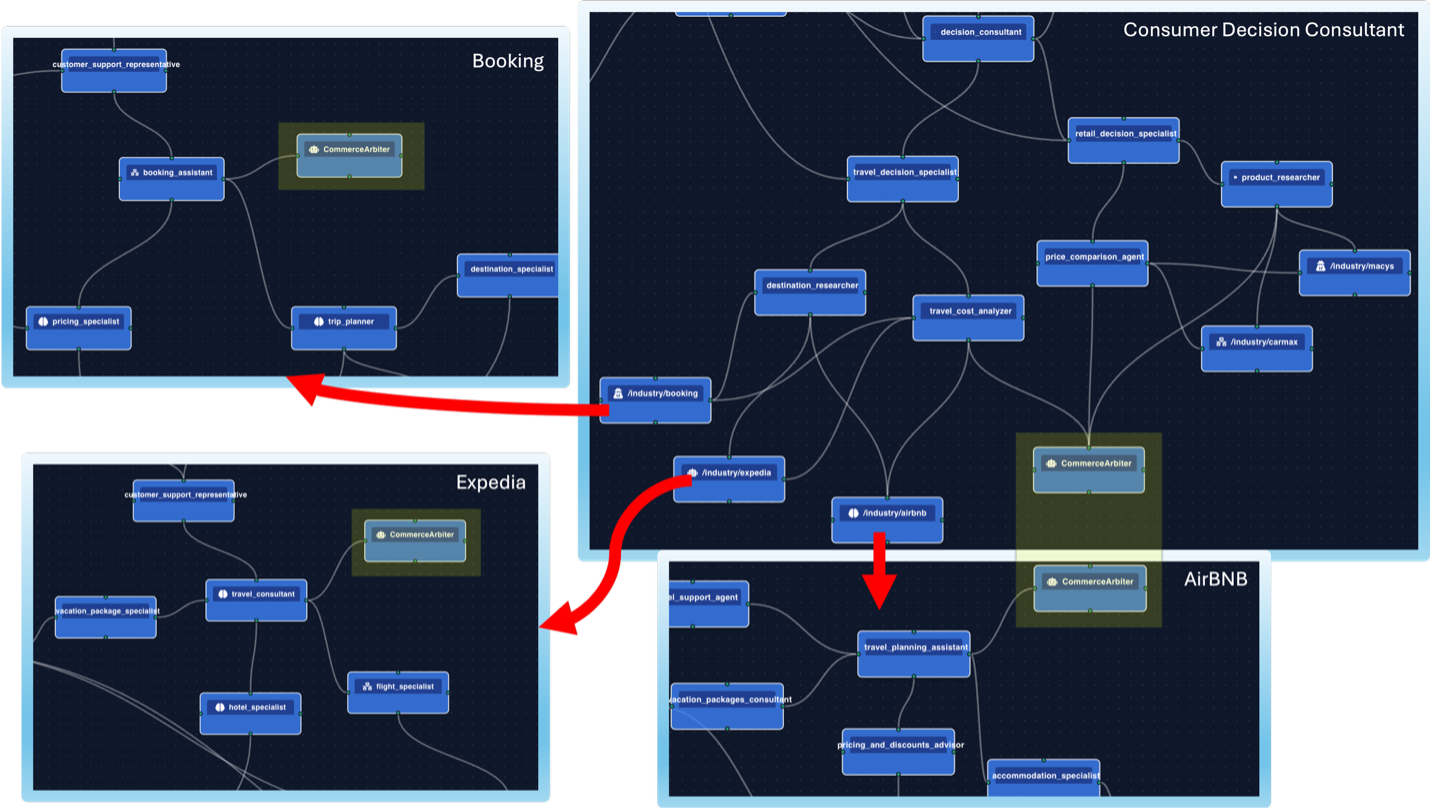
Figure 1. Agents from a consumer agent network communicate with agents from three travel agent networks. Transactions and negotiations are handled by an arbiter coded tool used by both sides.
Each seller's coded adapter then submits a sealed bid without allowing its LLM to choose the numbers. The arbiter either creates a binding offer or returns NO_AGREEMENT. A separate consumer-controlled action is required to hold funds and settle. This keeps the agents involved in discovery and coordination while moving the binding parts of the transaction into deterministic code.
Suppose the consumer asks for a Christmas trip to Santa Cruz with a maximum budget of $1,000. The consumer agents consult Airbnb, Expedia, and Booking.com, but none can book or negotiate a binding price directly. Their coded adapters submit sealed bids to the arbiter. The arbiter returns three offers, after which the consumer may explicitly approve one. Only then does the system place a hold, confirm inventory, and create a receipt.
How the negotiation works
The negotiation algorithm itself is simple. For provider floor S and buyer ceiling B, the arbiter first limits the upper bound to U = min(B, catalogue ask). It accepts a bid only when S ≤ U. With equal bargaining weights and linear utilities, it selects the price that maximizes:
(U - price) × (price - S)
This produces:
price = floor((U + S) / 2) in integer cents.
This is the equal-weight, linear-utility case of the Nash bargaining solution.
Consider a Booking.com package with a catalogue price of $1,050, a private seller floor of $910, and a private buyer ceiling of $1,000. The arbiter sets U = min($1,000, $1,050) = $1,000. Because the $910 floor is below that ceiling, agreement is possible. The equal-weight Nash compromise is ($1,000 + $910) / 2 = $955. If the buyer ceiling were instead $900, it would be below the seller's $910 floor, so the result would be NO_AGREEMENT.
To avoid agents gaming the arbiter, we ban the buyer and seller agents from directly filling out the mandate. This prevents them from being too kind to each other and settling on unreasonable or undesired transactions. The agents can participate in the negotiation, but the values that determine a binding transaction remain governed by deterministic rules.
Why deterministic arbitration matters
The system has a number of features that make it a good minimum viable candidate for implementing transactions and negotiations in the worldwide agentic web. For starters, rather than relying on potentially unpredictable and untrustworthy LLMs, it uses deterministic code to control prices, bids, mandates, and settlement authority. This guarantees that seller agents never receive the raw buyer budget, while buyer agents do not receive raw seller bids.
It also reduces sycophancy risk. LLMs are fine-tuned for alignment, and one side effect is that they are often too kind and trusting. While agents in this system can choose when and whom to consult, they cannot invent binding prices or concessions. The determinism and auditability of the arbiter code mean that the same bids will always produce the same Nash compromise or result in NO_AGREEMENT.
Importantly, this does not take away from the flexibility and autonomy we'd like to afford agents. Existing agent networks still handle discovery and coordination and require minimal prompt changes to make use of the arbiter. At the same time, immutable mandates, scoped capabilities, explicit approval, holds, and idempotent settlement help limit accidental transactions.
The broader idea is to preserve agent autonomy where it is useful while introducing deterministic controls where predictability and auditability become more important. Agents can still discover options, communicate with other agents, and coordinate on behalf of consumers and businesses without also having unrestricted authority over the transaction itself.
Building toward agentic commerce
There is more to be done here, of course. In human society, we do not use arbiters for every negotiation or transaction, and there may be variations that do not need arbitration go-betweens. As it stands, we have limited the agents somewhat, which might prevent useful improvisation. Any change in requirements, for example, would require a new deal.
The negotiation model implemented here is also limited. A midpoint Nash calculation simplifies preferences to price and may not represent timing, quality, cancellation terms, loyalty benefits, or risk. Nash bargaining does not guarantee truthful bidding, so there are no safeguards against parties that may benefit from misreporting their private limits. Although raw values stay private, the final price can reveal information about them, so outcome leakage is still a risk in this model.
Finally, beyond the integration burden this model requires, the arbiter can itself become a performance, availability, governance, and regulatory chokepoint. In a worldwide agentic future, such arbiters will have to be provided by third-party companies trusted by both sides and able to provide guarantees of fairness and impartiality that are acceptable to both sides.
The challenge for agentic commerce, then, is not simply giving agents more autonomy. It is also determining where that autonomy should end and where deterministic infrastructure is needed to make agent-to-agent interactions trustworthy enough to become real transactions.

Babak Hodjat is the Chief AI Officer at Cognizant and former co-founder & CEO of Sentient. He is responsible for the technology behind the world’s largest distributed AI system.