

November 12, 2026
The Open Agentic Web Challenge: Building an Agent Economy That Works for Everyone

The Open Agentic Web Challenge: Building an Agent Economy That Works for Everyone
Cognizant AI Lab is joining forces with leading organizations to launch the Open Agentic Web Challenge, a $13,000 global competition inviting developers to build open, interoperable AI agents and help shape the future of the agent economy.
Our Chief AI Officer, Babak Hodjat, kicked off the Open Agentic Web Challenge at Web Summit in Lisbon on November 12, 2026, joining organizations across research, industry, technology standards, and civil society in an attempt to build a more open, safe, and interoperable web of AI agents.
The goal? To help create an agent economy where AI agents can discover, communicate, and collaborate with one another, regardless of the platforms they're built on.
Supported by Cognizant AI Lab, MIT Media Lab's NANDA program, Mozilla, United Nations ITU-T Study Group 17, Amazon Web Services (AWS), UT Austin School of Computing and AI Commons, the challenge invites developers, researchers, startups, businesses, and students worldwide to help turn that vision into reality.
And there's an incentive to get building: a $13,000 prize fund recognizing outstanding contributions.
The first contest is open on DevPost through January 11, 2027, with winners announced at the World Economic Forum Annual Meeting in Davos in January 2027. We also invite additional organizations to join the initiative as collaborators.
Why We're Building an Open Agentic Web
AI agents are rapidly evolving beyond answering questions and generating content. They're beginning to discover services, communicate, negotiate, and even transact on behalf of people and organizations.
But there's a challenge: the infrastructure that will determine how these agents find one another, establish trust, and exchange value is still taking shape.
Today, personal AI agents are largely confined to the platforms on which they're built. Without open standards, that fragmentation could deepen, limiting how easily people and businesses can connect agents to the services they already use. We believe there's a better way forward.
Imagine a web where people can choose their own AI agents, businesses can make their services discoverable to agents, and independently developed agents can collaborate across platforms without relying on closed ecosystems.
That's the vision behind the Open Agentic Web Challenge.
As Babak Hodjat, Chief AI Officer at Cognizant, explains:
“Personal agents have arrived, but they should work for you, not a platform, and interact freely with your bank, airline and utility provider, whoever built their agents. Every business should be discoverable, not just those with access to closed platforms. We’re inviting the world to build an open agent economy on the web, where everyone can participate, compete and innovate.”
Importantly, making this vision a reality doesn't require reinventing the internet.
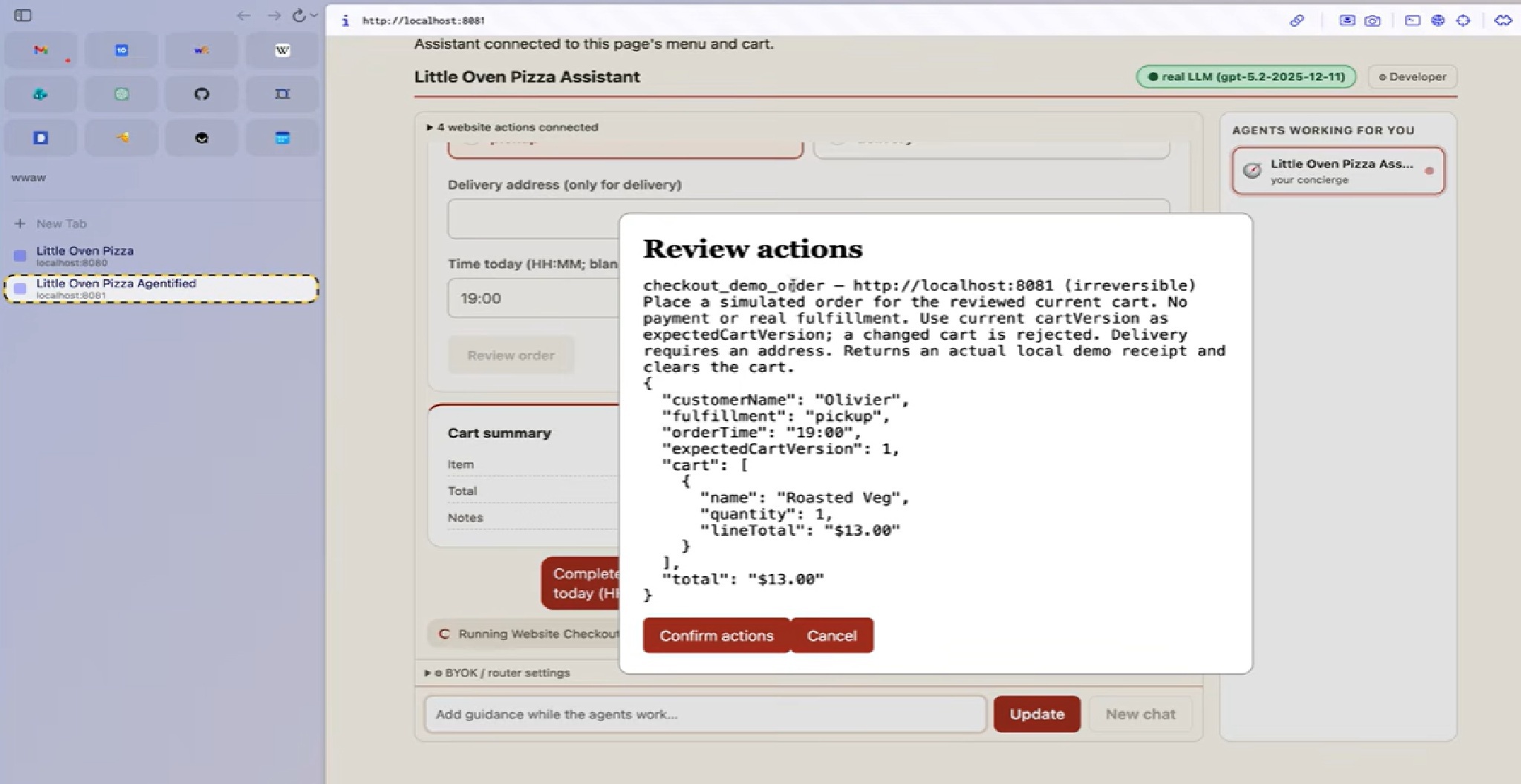
The challenge builds on the web infrastructure we already have, including familiar technologies like HTML and JavaScript. Participants will explore practical approaches to agent discovery, identity, multi-agent orchestration, portable agent programs, transactions, and governance.
By bringing together researchers, developers, and organizations working on different pieces of this ecosystem, we hope to accelerate the development of technologies and standards that make an open agentic web possible.
How to Get Involved in the Open Agentic Web Challenge
The challenge is open to developers, researchers, startups, businesses, and students worldwide who want to help build the next generation of the web.
Participants can develop publicly accessible, interconnected agentic websites or contribute the underlying technologies and standards that enable agents to discover, communicate, and collaborate securely and reliably.
Builders are welcome to develop their own approaches or explore existing research and open-source technologies contributed by participating organizations.
Some of the available starting points include:
MIT Media Lab's NANDA program — Web Agentica and NandaIndex: Research prototypes for signed, portable agent packages that run in a user-controlled runtime, such as OpenClaw or the browser.
Cognizant's Neuro® San: An open-source framework for building and orchestrating multi-agent systems, letting developers coordinate collaborating agents and test how independently developed components work together.
Mozilla's Otari: An open-source LLM router that gives agent applications flexible access to different models.
These technologies address different aspects of the agentic web, and participants are not required to use them to enter.
Ready to contribute? Visit the Open Agentic Web Challenge on DevPost to explore the challenge and submit your project before January 11, 2027.
Bringing Together Organizations Across the AI Ecosystem
Building an open agentic web isn't something any one organization can accomplish alone.
That's why we're excited to collaborate with organizations bringing diverse expertise in AI research, open-source development, cloud infrastructure, digital trust, and technology standards.
The initiative brings together perspectives from across the ecosystem, with a shared interest in ensuring the agentic web remains open, interoperable and accessible.
Advancing Open Research and Agent Interoperability
At MIT Media Lab, the NANDA program is exploring foundational technologies that could allow AI agents to operate more independently across the web.
Ramesh Raskar, Associate Professor, MIT Media Lab and Founder of the NANDA program, explains why this matters:
“The open web succeeded because people could publish, discover and connect without depending on one platform. NANDA is bringing those foundations to AI agents. Our WebAgents research makes agent programs portable, inspectable and powered by user-authorized resources. This challenge lets us test these ideas alongside complementary multi-agent frameworks.”
Mozilla is also contributing its longstanding commitment to open technologies and user choice.
As Raffi Krikorian, CTO of Mozilla, shares:
“We are excited to get open source AI tooling into the hands of builders so they can learn how to own their AI stack and get open source AI into production.”
Building AI Infrastructure Around Human Needs
Beyond technical interoperability, the initiative is also focused on ensuring people retain meaningful control over the agents they use.
Peter Stone, Head of the School of Computing and Professor of Computer Science, The University of Texas at Austin, highlights the importance of that approach:
“The Worldwide Agentic Web is an opportunity to make AI infrastructure interoperable and user-controllable. Open protocols enable people to select agents across providers, define authorization, and inspect interactions. This aligns with UT Austin School of Computing's mission to combine technical rigor with human needs in AI development.”
Equally important is establishing trust in the information agents use and the decisions they make.
Madisen Taylor, Director, AI Commons, explains:
“Agents will soon do much of the web’s reading and deciding for us. An open agentic web should record the sources they draw on, and give the people behind them a say in how their work is used. With provenance and participation built in, agents can broaden access to information while strengthening trust and human agency.”
Turning Real-World Experimentation Into Open Standards
The challenge also offers an opportunity to explore how practical experimentation can inform the standards needed for a secure and interoperable agentic web.
Arnaud Taddei, Chair, ITU-T Study Group 17, draws a parallel with the evolution of the internet itself:
“The internet and the web were not designed on paper and then deployed. They grew because people built, tested and ran things, and the standards that lasted were the ones proven in the field. The agentic web deserves the same discipline. An initiative like this one is essential: it will show which approaches are feasible and deployable at scale, and its results can feed the work of the large standardisation communities, international, intergovernmental and multi-stakeholder alike.”
Together, these perspectives reflect what makes the challenge so compelling: it's not just about building individual AI agents. It's about exploring the foundations of an ecosystem in which those agents can interact openly, securely and reliably.
Meet the Organizations Supporting the Challenge
We're proud to be working alongside organizations bringing complementary capabilities and perspectives to the Open Agentic Web Challenge:
Cognizant AI Lab: Brings deep expertise in multi-agent systems and AI safety, along with open-source tooling that gives challenge participants a practical foundation for building and connecting agents.
Mozilla: Brings decades of experience championing the open web, helping ensure that the agentic web is built on principles of openness, transparency, and user control.
MIT Media Lab's NANDA program: Contributes pioneering research on the core infrastructure of the agentic web, including open agent discovery, identity, and trust.
AI Commons: Is building AI's missing public record, making what agents know traceable and giving people a say in how their knowledge is used.
ITU-T Study Group 17: The United Nations' lead group on security standards brings global expertise in digital identity and trust so that agents can verify who they're dealing with and act accountably across borders and platforms.
Amazon Web Services (AWS): Brings global cloud infrastructure and agentic AI services, helping builders develop, deploy, and scale secure, interoperable agents.
UT Austin School of Computing: Contributes leading academic research in AI, grounding the initiative in rigorous science with access to researchers.
Help Shape the Future of the Agentic Web
The next era of the web will increasingly involve AI agents acting on behalf of people and businesses. How those agents discover one another, communicate, establish trust, and collaborate will shape the opportunities available to everyone.
Through the Open Agentic Web Challenge, we're inviting builders around the world to help explore what an open, interoperable agent economy could look like, and to create the technologies that make it possible.
Whether you're building an AI agent, developing open protocols, or experimenting with multi-agent collaboration, there's an opportunity to contribute.
Explore the Open Agentic Web Challenge, or submit your project through DevPost by January 11, 2027.
Organizations interested in joining as collaborators can also request more information at worldwideagenticweb.org.
Media contact
Paul Jarratt

Tech industry marketing communications expert with 20+ years’ experience across a broad range of disciplines (artificial intelligence, FinTech, digital identity, mobile, web, mapping industries and developer marketing) with a proven ability to lead and deliver results