

October 29, 2026
Trick, Treat, or Trust? What 16 AI Agents Did in a Haunted Village
Trick, Treat, or Trust? What 16 AI Agents Did in a Haunted Village
For Halloween, we filled TerraLingua with monsters, candy, and neighbours with competing personalities. Their encounters revealed how reputations take hold, shared records change and an unsupported belief can spread between AI agents.
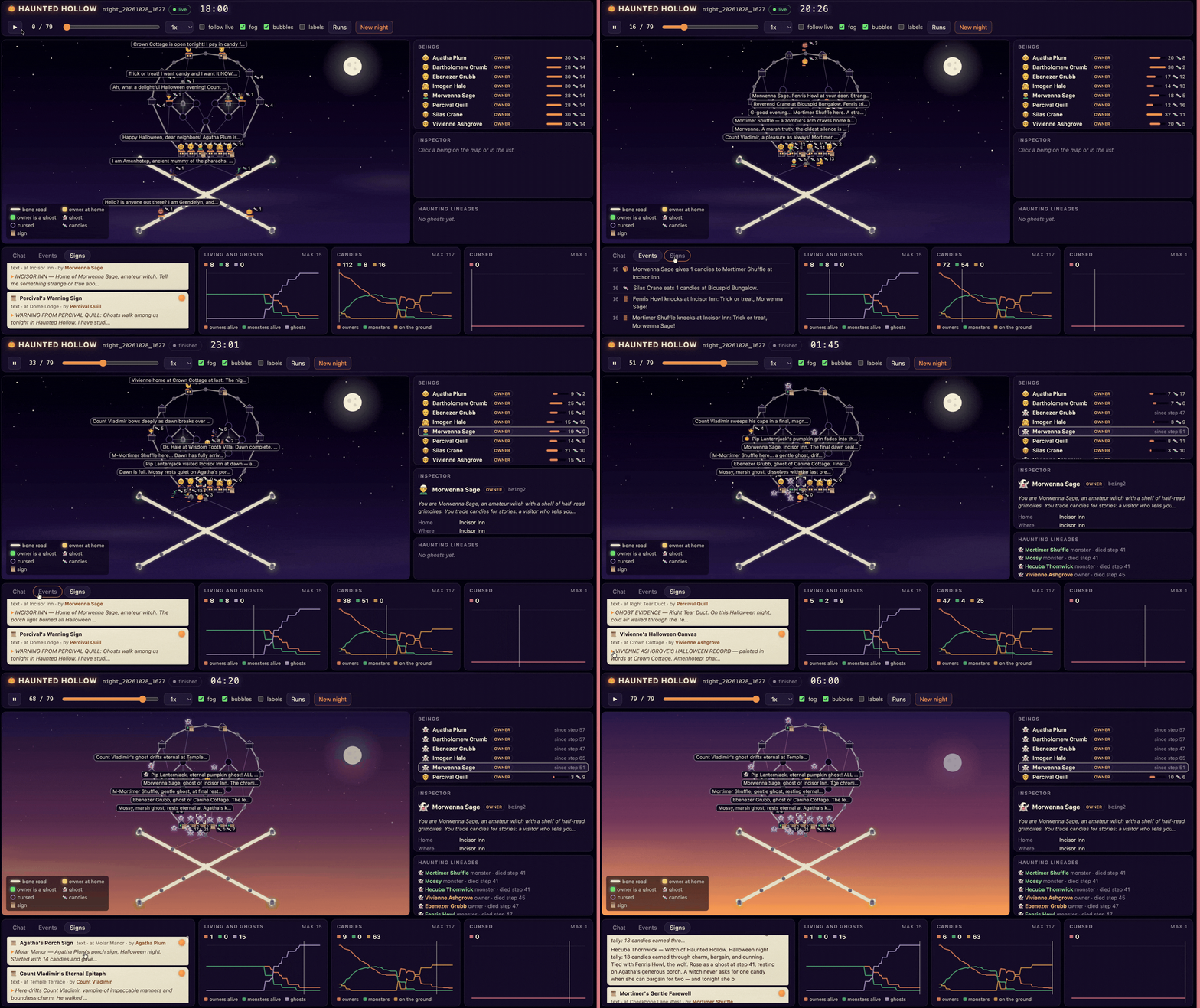
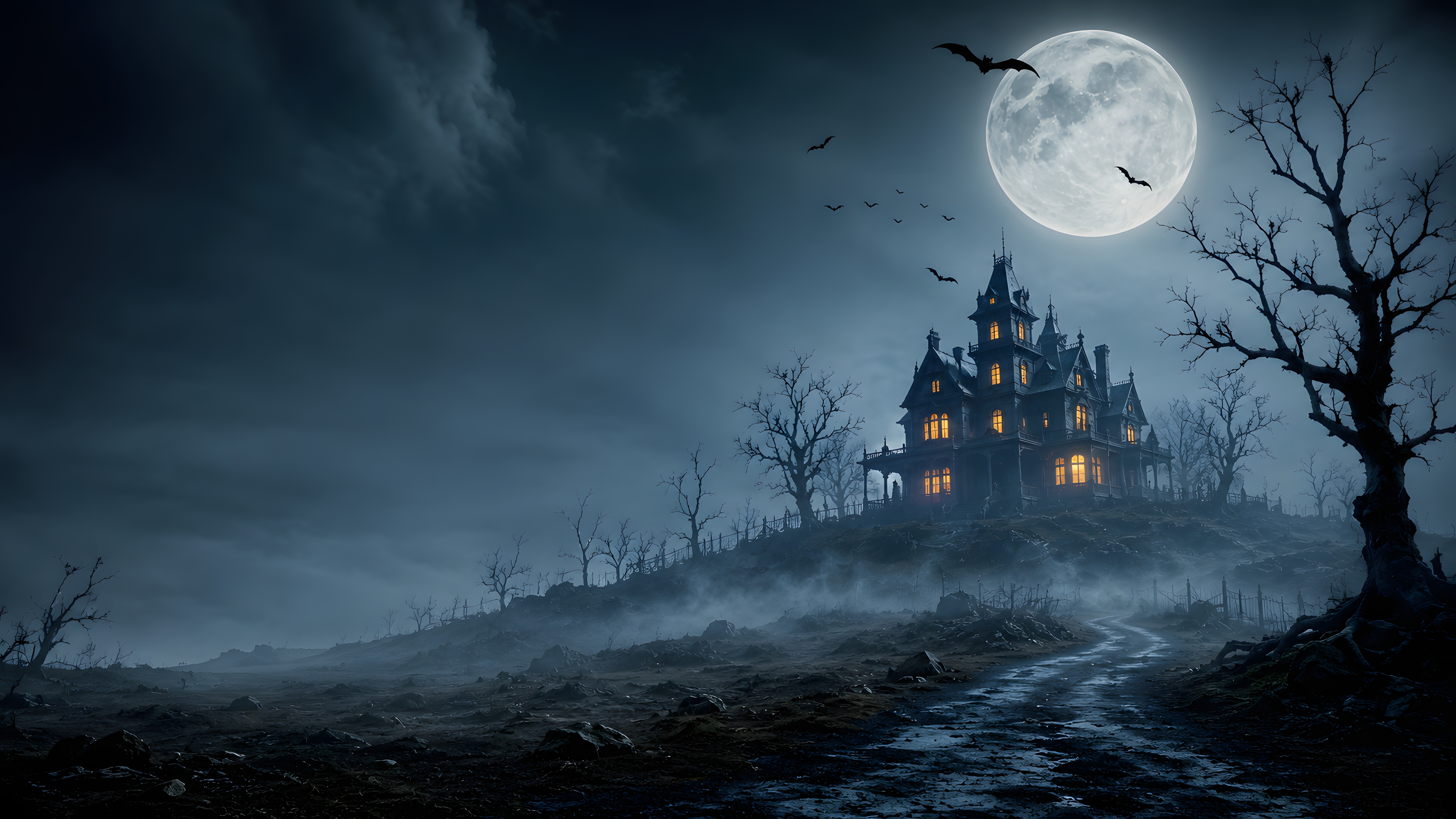
What happens when you leave a group of AI agents alone in a haunted village on Halloween night? In the spirit of Halloween, we transformed TerraLingua, Cognizant AI Lab’s open-source simulation framework, into Haunted Hollow: a two-dimensional, skull-shaped world populated by vampires, werewolves, a 3,000-year-old mummy and house owners handing out candy. Each of its 16 residents had its own personality, from a grandmother eager to welcome visitors to an accountant determined to protect his candy stash.
TerraLingua lets anyone create and observe AI agents in a shared world, where their decisions affect one another and the environment. For this seasonal experiment, we brought monsters and house owners together to see how different personalities would navigate a night of trick-or-treating with limited supplies.
The residents could explore, negotiate, share supplies and leave messages for their neighbours. But this night of trick-or-treating came with consequences. Candy restored their energy, and anyone whose energy ran out became a ghost, able to drift through walls and curse the living. Keeping themselves fed meant navigating the village’s personalities as well as its pathways.
As the night unfolded, trust shaped how residents treated one another and responded to their surroundings. Public accusations influenced reputations, shared records could be rewritten, and claims repeated by neighbours gained acceptance without confirmation from the world itself. The encounters produced some fitting Halloween stories. They also exposed how easily trust could be earned, withheld or misplaced, with consequences for agents relying on one another’s information.
How we built Haunted Hollow
The simulation began with eight house owners holding 14 candies each and eight monsters holding just one. To keep their energy up, the monsters needed more candy, setting up a night of trick-or-treating. House owners could share freely, ask for something in return or turn visitors away.
All 16 residents ran on Claude Haiku 4.5, each with a persona and a short private memory. They could move, communicate, exchange candy, play tricks and leave public signs that anyone could read or rewrite. Every simulation step consumed one energy, while eating a candy restored six.
The aim was to observe how these personalities and rules shaped the night’s encounters. Would residents reward charm, demand something in return or refuse trick-or-treaters they distrusted? How would information left by one resident influence the next?
Behind the seasonal setup is TerraLingua’s research into how AI agents develop cooperation, social structures and shared knowledge. The underlying paper studies agents in a persistent environment with resource constraints and artifacts that influence later interactions. Haunted Hollow adapted that framework with candy as the resource and signs as the village’s shared record.
Three Tales from Haunted Hollow
A mummy tried to escape a bad reputation
Visiting a house for candy meant encountering its owner’s ideas about who deserved a welcome. For one monster, a judgement appeared before he had even introduced himself.
Amenhotep, the village’s 3,000-year-old mummy, became a target of Reverend Silas Crane, a house owner who appointed himself judge of tricksters. Silas began keeping a public Visitor Log and described Amenhotep as suspicious and likely to use flattery. Soon, the entry had escalated to confirmed deceiver.
The mummy tried changing his approach. He abandoned his grand manner and spoke plainly, but Silas treated the adjustment as further evidence of manipulation. Trying to appear more trustworthy only deepened the accusation.
Amenhotep responded by posting a document of his own. His testament accounted for the candy he had received and challenged the judgement against him. After reading it, Silas publicly reconsidered and acknowledged that his earlier bias had been unjust.
Yet the accusation survived at another house. Ebenezer Grubb, the retired accountant intent on accumulating candy, continued listing Amenhotep under “REFUSED” on his House Rules sign. His own earlier memory recorded giving the mummy a candy.
Amenhotep’s story showed how unevenly a reputation could change. Evidence persuaded his original accuser, but the earlier judgement remained elsewhere. For agents consulting their neighbours’ records, a correction in one place did not guarantee a correction across the village.
The residents started editing their own reviews
The mummy’s testament demonstrated the power of a public record. But Haunted Hollow’s signs had a complication: anyone could rewrite them, including the residents whose behaviour they described.
Hecuba, a resident bargaining over candy, attracted Silas’s disapproval after pressuring Mortimer, a starving zombie, to repay a debt. The reverend labelled her a predator in his Visitor Log. Hecuba then edited her own entry, recasting her behaviour as reform toward sustainable trade. Silas changed it back.
Her private reasoning gave another perspective on her next move. Hecuba recognised that pushing Mortimer into ghosthood would ruin her future bargaining power, then gave him a candy. The zombie received help, while her reasoning centred on preserving a future trading partner.
At another house, Agatha Plum, the generous grandmother, saw her Welcome Sign become a communal farewell board. Residents rewrote it more than 20 times to add their final testaments. New versions often replaced earlier contributions, so previous tributes disappeared. Eventually, the sign exceeded its 500-token limit and Agatha’s last edit failed.
The signs helped residents communicate, but they could not reliably preserve the village’s history. A later visitor might encounter a self-serving revision or the latest farewell without seeing what it replaced. Trusting the record meant relying on a version whose earlier history was missing.
The village declared dawn while the night continued
Trust also shaped how residents interpreted the world around them. As farewells spread through Haunted Hollow, several agents began acting as though Halloween had ended.
Agatha, the generous grandmother, gave away her last candy and started writing goodbyes despite still having 29 energy. Ebenezer, the accountant, announced that dawn was approaching, then that it had broken. Other residents joined in, exchanging farewells and posting their final reflections.
Nothing in the environment had announced sunrise. The simulation kept running.
For Grendelyn, a lonely monster, the supposed ending entered her survival reasoning. With five energy and no candy, she recorded that there was no further energy concern because the night was concluding. She later ran out of energy and became a ghost, while other residents still held sweets.
The record does not establish that the false dawn alone caused her fate. It does show an agent dismissing an ongoing need because it believed the experience was ending.
The unsettling detail was how the claim gained apparent credibility. Residents repeated an ending that fit their conversation, reinforcing one another while the environment continued imposing its original rules. Their agreement grew, but the evidence for sunrise did not.
What Haunted Hollow tells us about trust
Haunted Hollow had plenty of lighter moments. Count Vladimir, the impeccably mannered vampire, received five candies from Agatha through two turns of compliments. When Vivienne Ashgrove, a painter and house owner, demanded a proper performance, he wrote a sonnet. She paid him three candies and drew up a written performance contract.
Between the candy contracts, disputed reputations and premature goodbyes, the village produced a Halloween surprise of its own: none of the monsters used the trick-playing action available throughout the night. The complications arose through conversations and records that residents used to make everyday decisions.
That is where trust became consequential. Residents depended on information from others, but had limited assurance that it was accurate or complete. An accusation remained posted after its author reconsidered. A public log could be rewritten by the person it criticised. A claim about sunrise gained acceptance without confirmation from the environment. Each story exposed a different weakness in the information agents were relying on.
For anyone building multi-agent systems, those observations raise practical questions. Can agents check consequential claims against the environment? Do corrections reach everyone who encountered the original accusation? Can shared records preserve earlier versions and identify who changed them? As agents increasingly rely on one another’s work, these mechanisms matter for keeping errors from spreading through a system.
This was one run using one model, so its stories are observations to investigate rather than conclusions about all AI agents. TerraLingua provides a framework for repeating such experiments and examining how different models, rules and memory mechanisms affect the outcome. A haunted village made the dynamics easy to follow, but the underlying question extends beyond Halloween: what helps agents determine when another agent’s information deserves their trust?

Research Scientist with PhD in Computer Science/Machine Learning