

July 23, 2026
GECCO 2026 Best Paper Award: Advancing Whole-Brain Modeling with Evolutionary AI

GECCO 2026 Best Paper: Hierarchy-Informed Optimization for Whole-Brain Models
Recognized with the GECCO 2026 Best Paper Award, the research demonstrates how guiding evolutionary optimization with the brain's natural functional hierarchy produces more robust and behaviorally meaningful whole-brain models.
Some of the most advanced models of the human brain still struggle with a fundamental problem. They can accurately reproduce data from one individual, but often fail to generalize across people or predict real-world behavior.
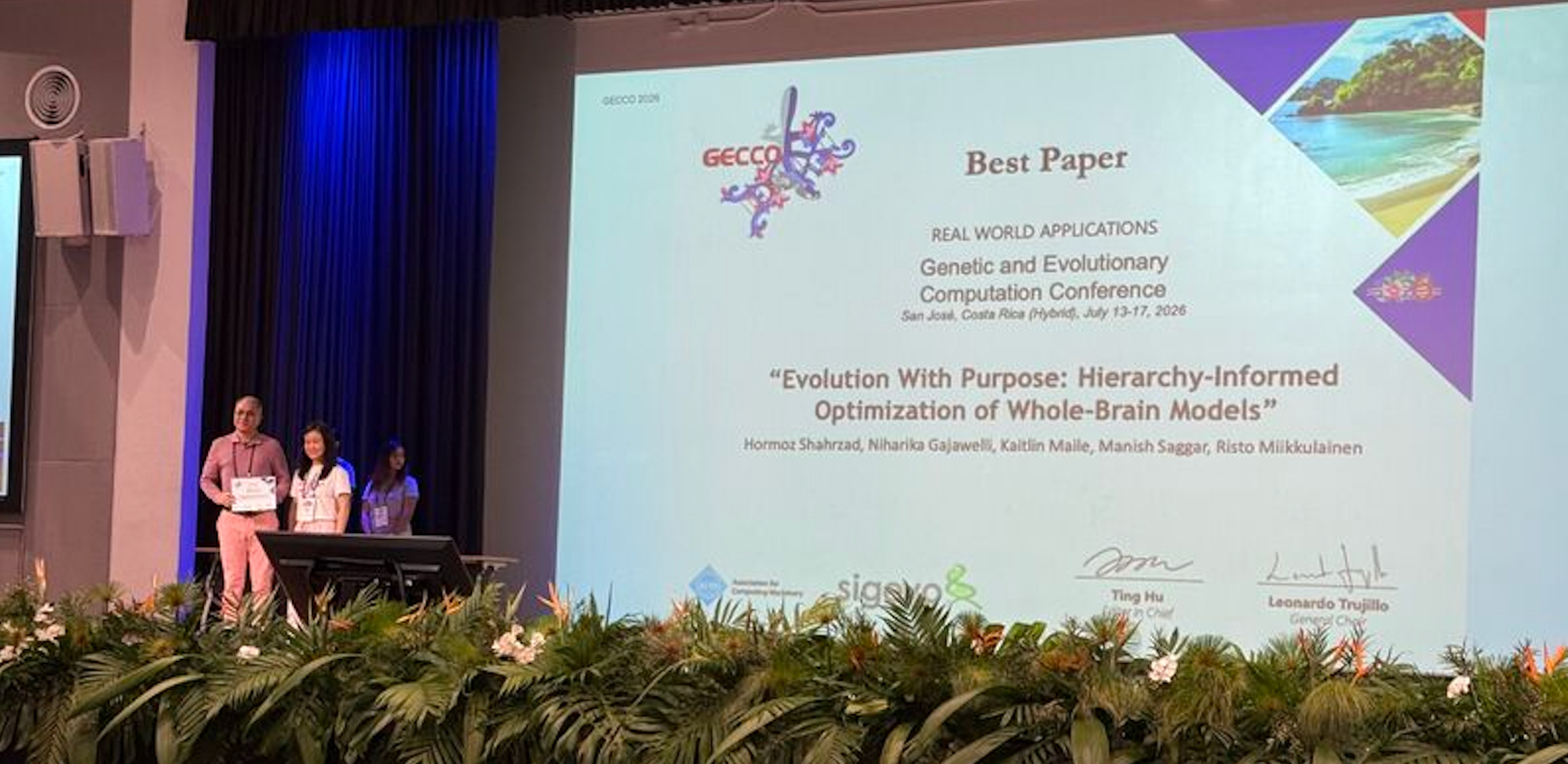
We are proud to share that our paper, Evolution With Purpose: Hierarchy-Informed Optimization of Whole-Brain Models, has received the Best Paper Award in the Real World Applications track at the 2026 Genetic and Evolutionary Computation Conference (GECCO). Led by Cognizant AI Lab researchers Hormoz Shahrzad and Risto Miikkulainen, in collaboration with Brain Dynamics Lab at Stanford University led by Manish Saggar, the research introduces Hierarchy-Informed Curriculum Optimization (HICO), a new evolutionary optimization method that addresses this challenge by guiding optimization according to the brain's own functional organization.
The result is whole-brain models that are more stable, generalize more effectively across individuals, and produce behaviorally meaningful predictions. The award recognizes the research's contribution to applying evolutionary computation to a significant real-world challenge in computational neuroscience.
From Fitting Data to Understanding the Brain
Whole-brain models are designed to simulate how activity emerges across interconnected brain regions, giving researchers a powerful tool to study cognition, behavior, and neurological disease. As these models become increasingly sophisticated, they also become more difficult to optimize. The large number of interacting parameters creates a complex search problem where many different solutions can appear equally successful.
Traditional optimization methods can often find parameter settings that closely match brain activity from an individual subject. However, those same models frequently fail when applied across different people or when used to predict meaningful behavioral outcomes. In other words, they fit the data well without necessarily capturing the underlying principles that govern how the brain works.
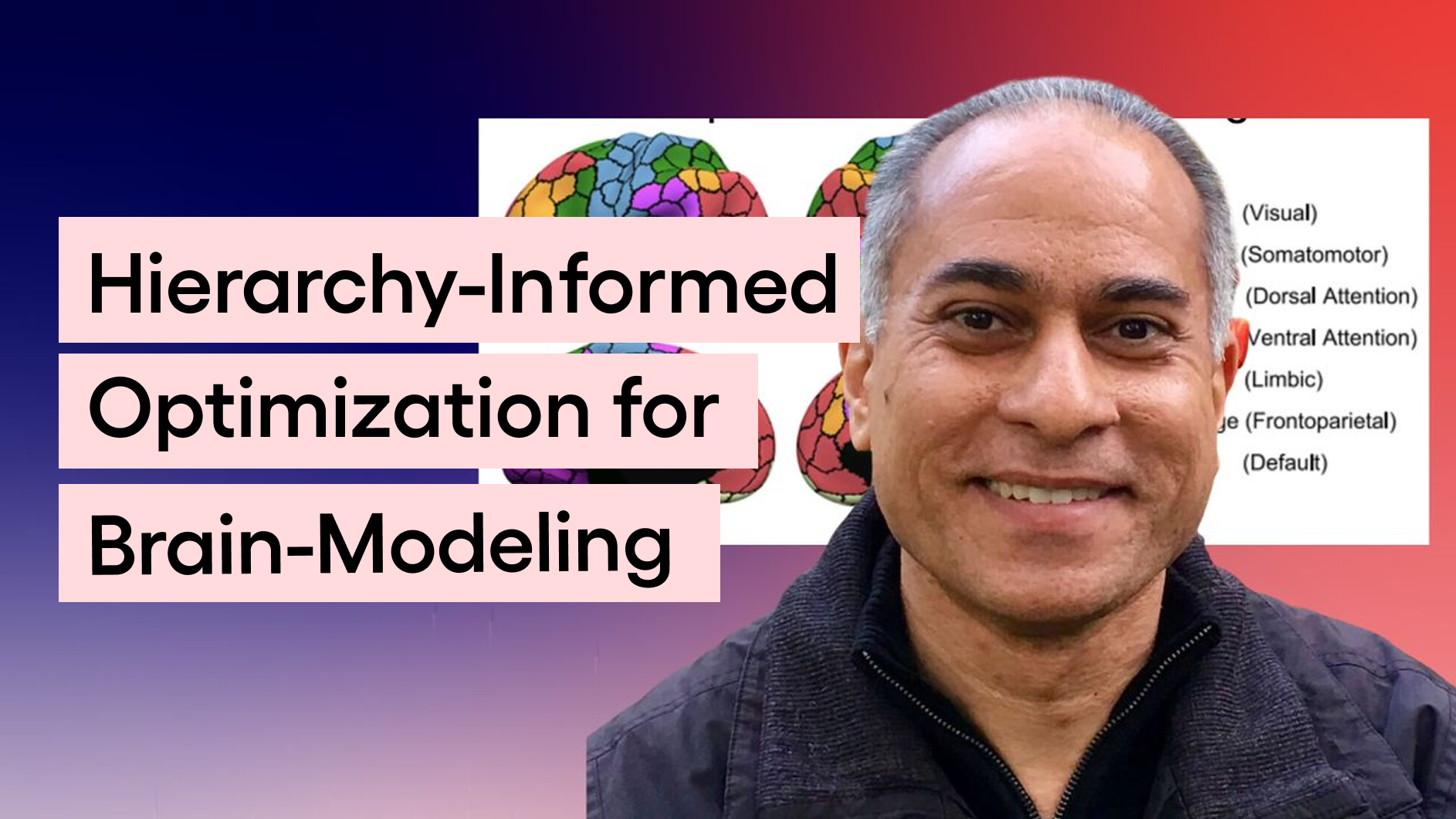
HICO takes a different approach. Rather than treating optimization as an unconstrained search, it guides the learning process using the brain's natural functional hierarchy. Parameters are introduced progressively, allowing the model to build a stable foundation before learning increasingly specialized brain dynamics. This structured optimization produces models that are more robust, generalize across subjects, and better capture the relationship between brain activity and behavior.
The Research Journey
The idea for HICO began with a practical challenge: optimizing whole-brain models is extraordinarily difficult. Each model contains roughly 140 interacting parameters, there are no tractable gradients to guide optimization, and every evaluation is computationally expensive. While distributed evolutionary algorithms helped accelerate the search, they did not solve the underlying problem. The search was faster, but it still lacked direction.
That led the team to rethink the problem itself. Instead of asking how to search more efficiently, they asked whether the search process should reflect the way the brain is organized. The brain follows a natural hierarchy, from sensory and motor regions through to higher-order cognitive systems. What if optimization followed that same progression?
That idea became Hierarchy-Informed Curriculum Optimization (HICO). Rather than optimizing every parameter simultaneously, HICO unlocks parameters progressively, following the brain's own functional hierarchy as a curriculum. The result was more than a faster optimization strategy. By introducing structure into the search, the team found models that generalized across individuals and produced more meaningful behavioral predictions.
Why This Research Matters
The implications of this work extend beyond whole-brain modeling.
Many real-world AI systems face the same challenge as computational neuroscience: they involve high-dimensional, nonlinear search spaces where unconstrained optimization can produce solutions that appear successful during training but fail to generalize in practice. HICO demonstrates that incorporating domain knowledge into the optimization process can fundamentally change that outcome. By structuring how the search unfolds, evolutionary algorithms can discover solutions that are not only more accurate, but also more stable, more generalizable, and more meaningful.
That broader idea is one reason this work was recognized by GECCO. The conference's Real World Applications track highlights novel applications of evolutionary computation that address genuine scientific and engineering challenges. Receiving the Best Paper Award reflects the significance of applying evolutionary AI to improve whole-brain modeling and demonstrates how research at the intersection of AI and neuroscience can advance both fields.
We are honored to receive this recognition and grateful to the GECCO community for acknowledging this work. It reflects the research being conducted at Cognizant AI Lab to develop AI systems that solve complex real-world problems through advances in evolutionary computation. We look forward to continuing this research by extending HICO to larger datasets, clinical populations, and other complex optimization challenges where structured evolutionary search can improve both performance and scientific understanding.

Hormoz specializes in evolutionary AI and explainable decision-making systems, focusing on scalable optimization techniques and multi-agent problem-solving frameworks.