Skip to main content Skip to footer

Module 3 Overview:

You have learned what agents are, the different types they come in, and how multi-agent systems coordinate to tackle complex problems. Now it is time to step back and look at the bigger picture.

Agentic AI is the term that describes all of this together. It is not a specific product or a framework. It is a paradigm: a way of building and deploying AI systems that are goal-directed, capable of planning, and able to take action with meaningful autonomy. Understanding what agentic AI means, how it works, and how it relates to the other concepts in this course is important groundwork before you start designing systems of your own.

In this module, you’ll learn:

  • What agentic AI is and how to define it clearly
  • How agentic AI works, including the perception, planning, action, and evaluation loop
  • How agentic AI relates to generative AI, individual agents, and multi-agent systems
  • The core advantages agentic AI brings to organizations
  • The key challenges to be aware of when building and deploying agentic systems

By the end of this module you will have a clear and grounded understanding of what the agentic AI paradigm means and what it is capable of.

Estimated time length: 30 minutes
Lesson 1: Definition of Agentic AI

Learning objectives

By the end of this lesson you will be able to:

  • Define agentic AI and explain what 'agentic' means in this context
  • Describe the core characteristics that make a system agentic
  • Distinguish agentic AI from earlier AI paradigms

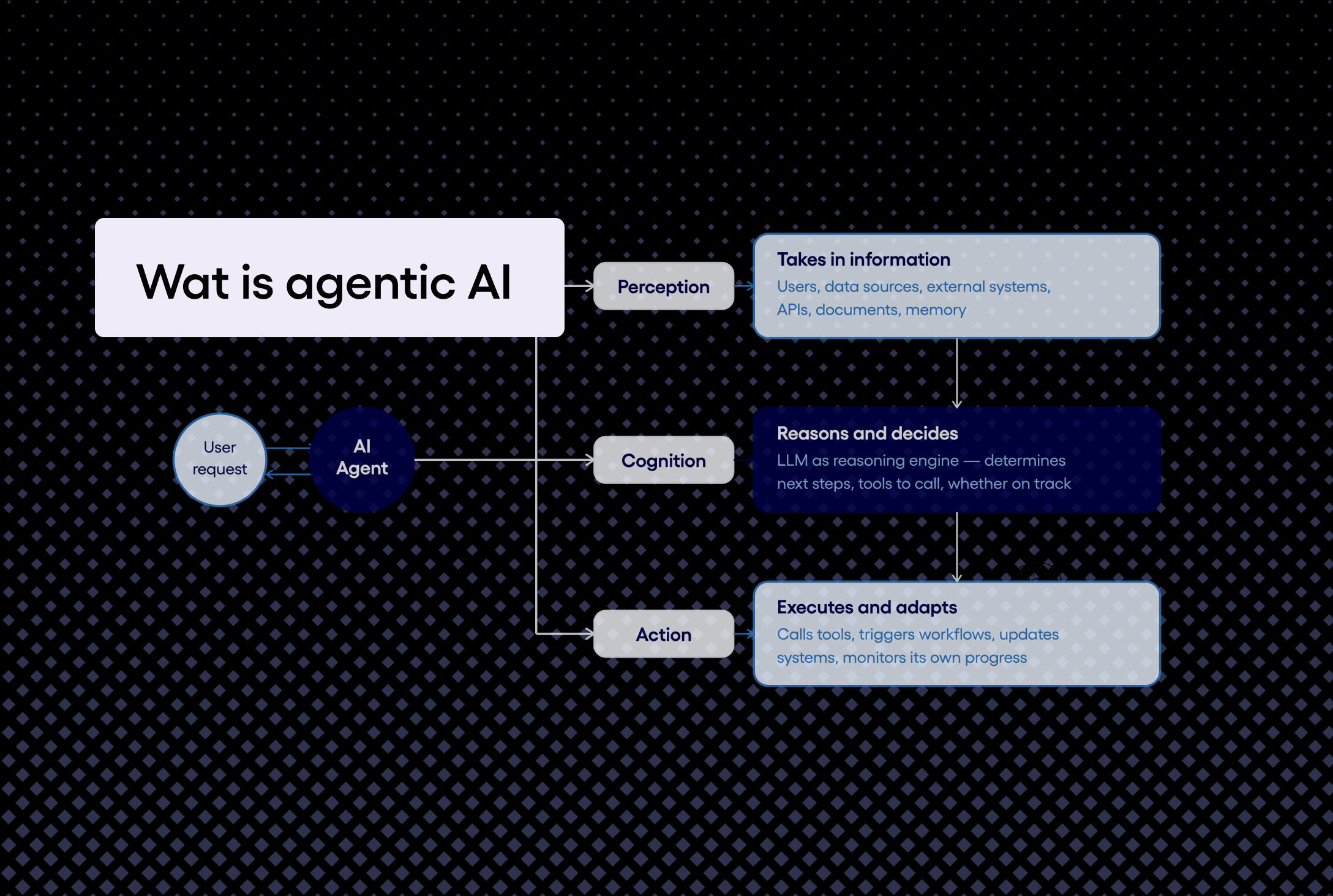
Agentic AI is an advanced form of artificial intelligence focused on autonomous decision-making and action. Traditional software follows predefined rules, and traditional models require prompting and step-by-step guidance. Agentic AI works differently: it is proactive, capable of performing complex tasks with minimal human oversight, and able to pursue goals across many steps without needing a person to initiate each one.

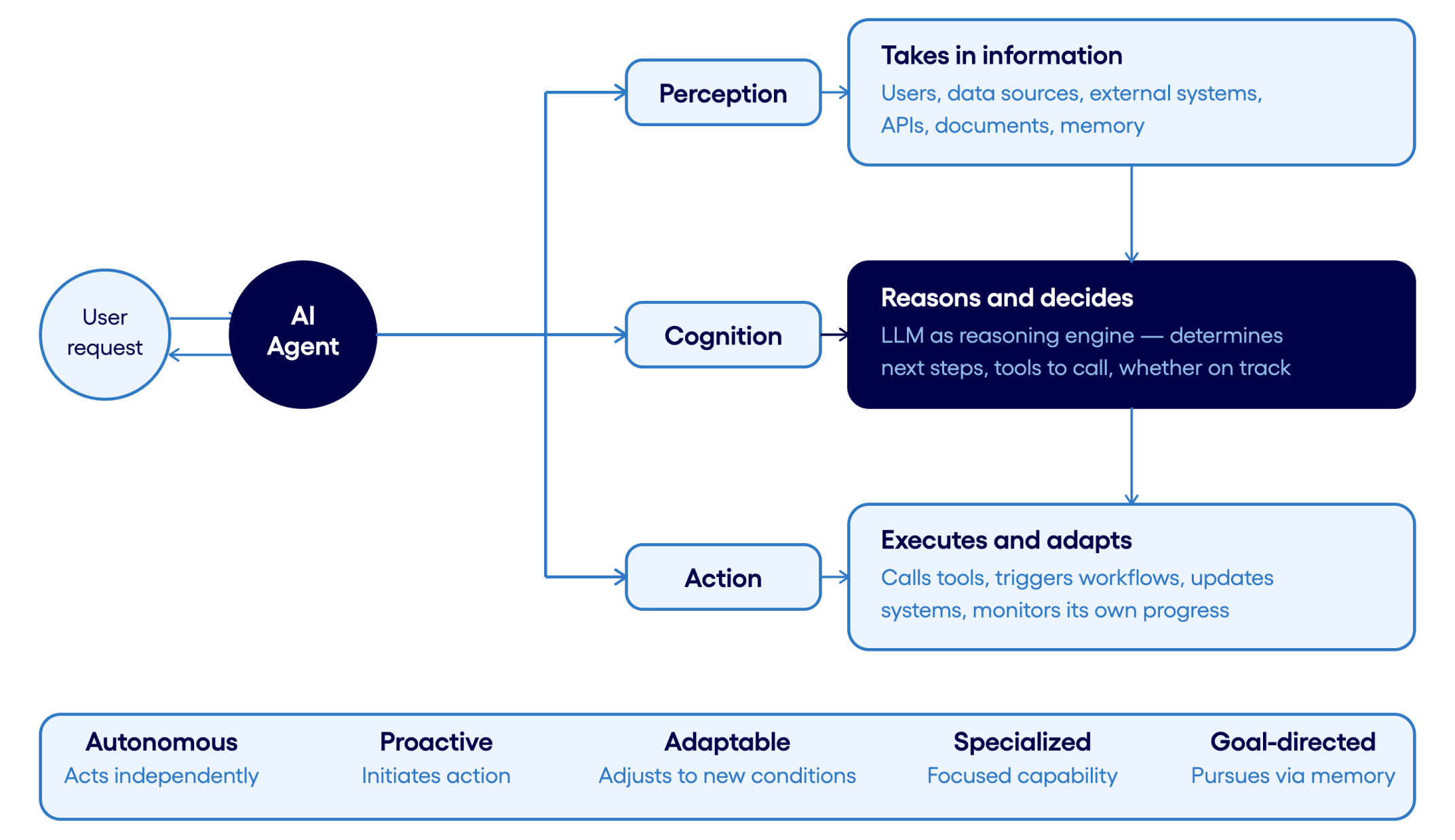
The word 'agentic' comes from 'agency', which in this context means the ability to act independently in pursuit of a goal. Rather than waiting to be asked, an agentic system can plan a sequence of steps, execute them using tools and external systems, monitor its own progress, and adjust when things do not go as expected. 

Blue diagram with agents

At the heart of most agentic AI systems is a large language model, used not just to generate responses but as a reasoning brain that determines what actions to take, which tools to call, and how to evaluate whether the work is on track. This is what separates agentic AI from generative AI: the LLM is no longer the endpoint. It is the engine.

Core Characteristics

Agentic AI systems share a set of defining characteristics. These are not just features. They are the properties that, taken together, make a system capable of acting autonomously toward a goal rather than just responding to prompts.

Key insight

The shift from generative AI to agentic AI is the shift from producing outputs to taking responsibility for outcomes. A generative model answers your question. An agentic system works toward your goal.

Up next: Now that you have a clear definition of agentic AI, the next lesson looks at how it actually works, step by step.

Lesson 2: How Agentic AI Works

Learning objectives

By the end of this lesson you will be able to:

  • Describe the perception, planning, action, and evaluation loop
  • Explain what happens at each stage and why each one matters
  • Understand how the loop enables a system to handle complex, multi-step problems

Knowing what agentic AI can do is one thing. Understanding how it does it gives you a much clearer picture of where these systems succeed, where they struggle, and how to design them well.

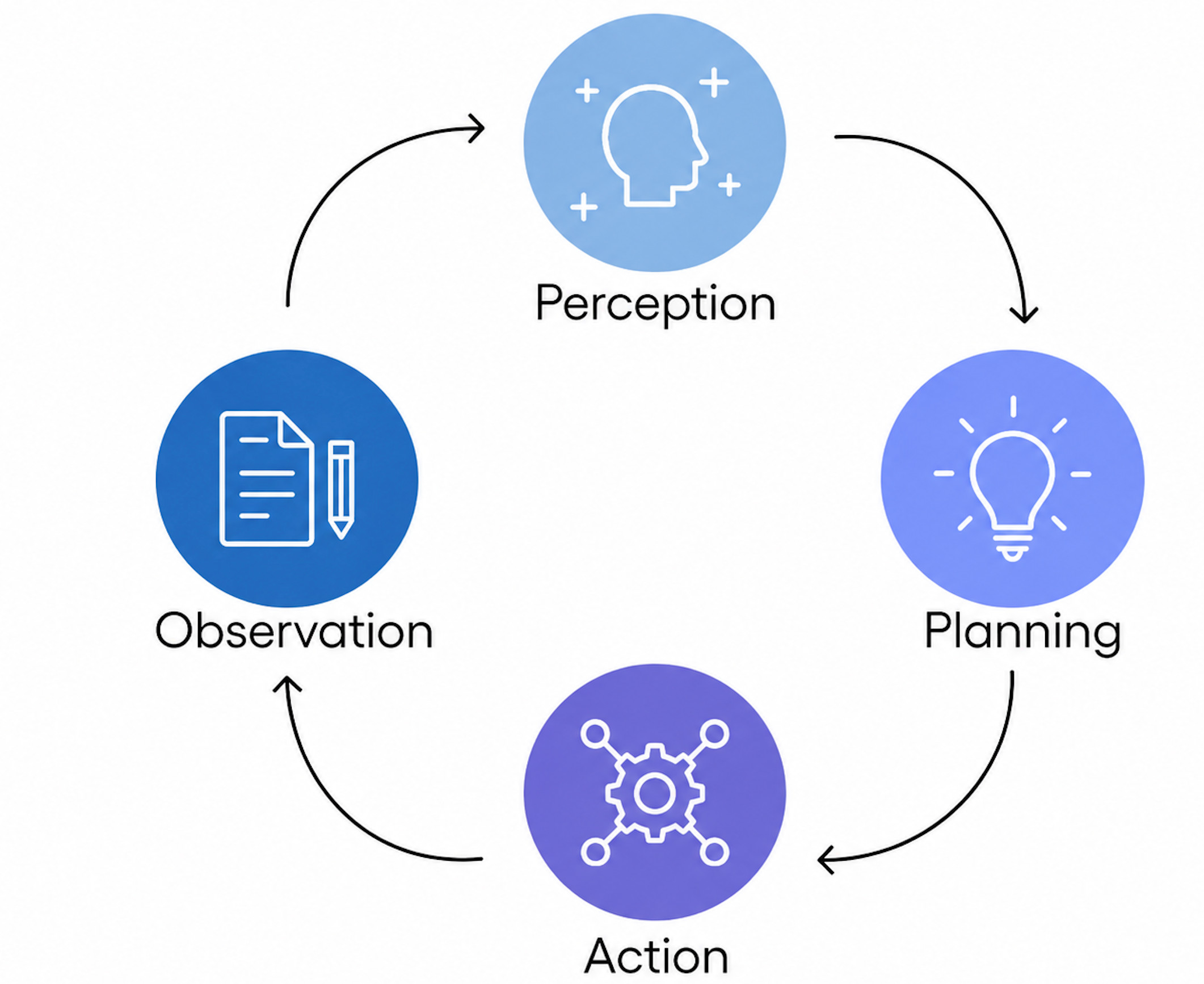
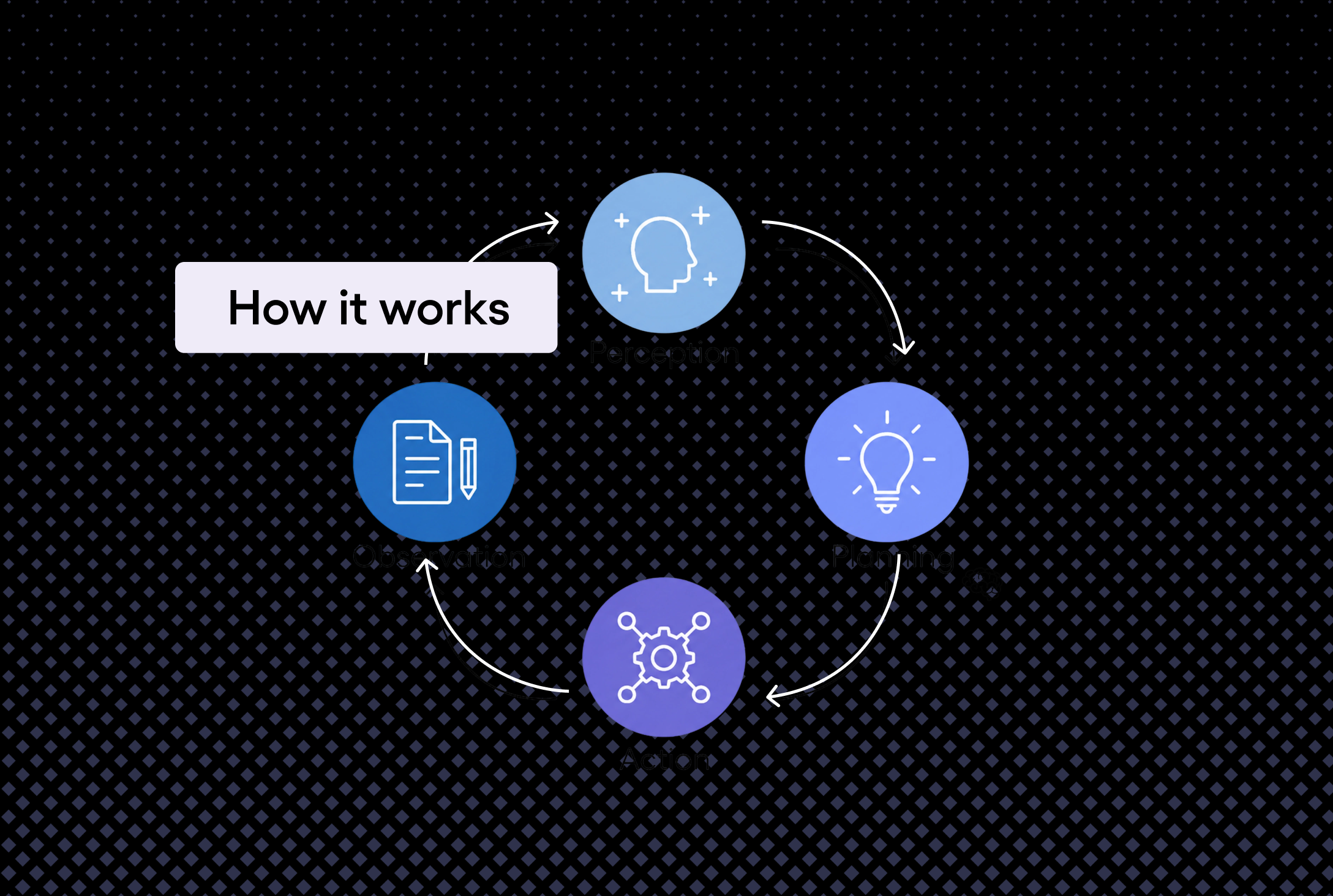
Agentic AI operates through a repeating four-stage loop: perception, planning, action, and evaluation. Each pass through the loop moves the system closer to the goal, and the loop continues until the task is complete or a human needs to step in. This cycle is what gives agentic systems their power. It is also where the complexity lives. Each stage has its own failure modes, and a weakness in any one of them affects everything that follows. Unlike a single-turn interaction where the stakes of any given response are relatively low, an agentic system is making decisions that compound on each other. Getting each stage right matters. Let's dive into what happens at each one.

Coordination

Perception

Every loop starts with the agent taking in information. This can include user input, data from APIs or databases, outputs from other agents, system logs, or any other relevant signal. Before the agent can make a decision, it needs to interpret and structure this input into something it can actually reason about.

In practice, this means parsing inputs, identifying what is relevant, filtering noise, and structuring data for the steps that follow. This stage is easy to underestimate. If the agent misreads the input or receives incomplete information, everything that follows is built on a flawed foundation. Poor perception leads to poor decisions, regardless of how good the reasoning layer is.

Planning

Once the agent has a clear picture of the current situation, it plans. Planning is where the agent determines what needs to happen and in what order. It breaks the problem into subtasks, weighs different approaches, considers constraints and uncertainties, and selects the sequence of actions most likely to achieve the goal.

In a single-agent system, the same model handles both planning and execution. In multi-agent systems, a dedicated orchestrator handles planning and delegates execution to specialized agents. Either way, the planning stage is what turns a high-level goal into a concrete sequence of steps the system can actually act on. Ambiguous goals produce poor plans, which is why the quality of the input to an agentic system matters so much.

Action

Action is where decisions become real. The agent executes the steps it planned, which may involve calling external tools and APIs, updating data, triggering workflows, generating content, or passing outputs to other agents. This is the stage where the work actually gets done.

The quality of the action stage depends heavily on how well the tools and integrations the agent relies on are designed. A well-structured tool interface makes agent actions predictable and reliable. A poorly designed one introduces errors and inconsistency that can cascade through the rest of the workflow. This is one of the reasons that good agentic system design pays close attention to how tools are defined and documented.

Evaluation and Observation

After each action, the agent reviews what happened. It checks whether the action moved it toward the goal, whether the output was correct and complete, and what, if anything, needs to change before the next step. Feedback can come from automated checks, comparison against expected outcomes, or human correction.

This stage is what separates systems that improve over time from systems that repeat the same mistakes indefinitely. It is also what makes agentic systems accountable: a well-designed evaluation layer creates a record of what the system did and why, which matters for debugging, auditing, and building trust in production environments.

Key insight

The loop is what makes agentic AI different from a single-turn model. One pass might not be enough to solve a complex problem. But a system that can perceive, plan, act, and evaluate repeatedly, adjusting its approach as it learns more, can handle a level of complexity that would otherwise require ongoing human coordination at every step.

Up next: Now that you understand how agentic AI works, the next lesson clarifies how it relates to the other concepts you have already encountered.

Lesson 3: Agentic AI vs Generative AI vs Agents vs Multi-Agent Systems

Learning objectives

By the end of this lesson you will be able to:

  • Distinguish between agentic AI, generative AI, individual agents, and multi-agent systems
  • Explain how these concepts relate to each other without conflating them
  • Use the right term for the right context with confidence

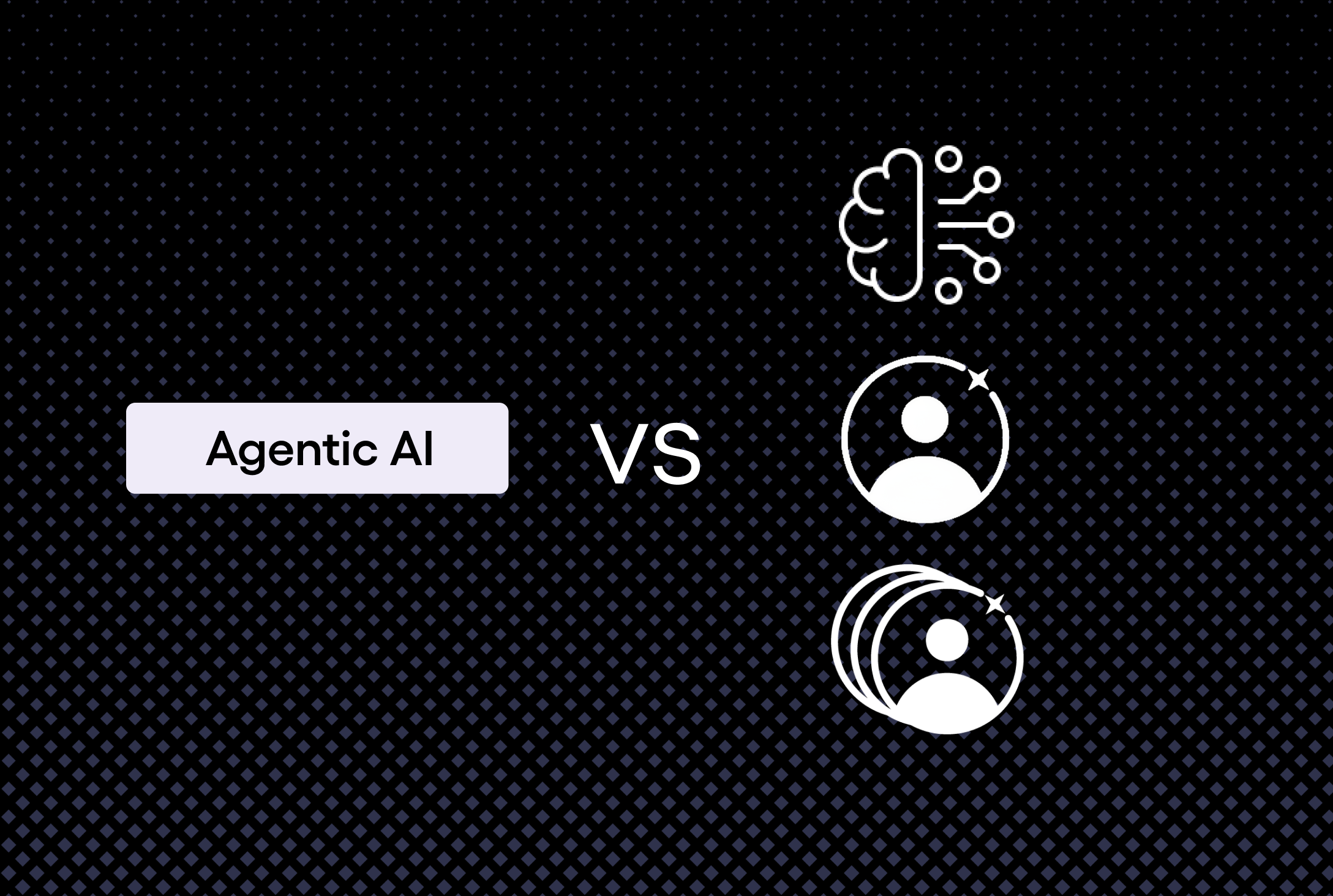
These terms come up constantly in conversations about AI, often used interchangeably. That creates real confusion, especially when you are trying to decide what to build, evaluate a vendor's claims, or explain a system to a stakeholder. They are related concepts, but they describe different things. Getting them straight is practically useful.

The clearest way to understand the relationship is to think of them as layers that build on each other, not as competing alternatives.

What is generative AI

Generative AI is AI that creates content in response to a prompt. It is built on large language models trained on large datasets, and it excels at producing text, images, code, summaries, and other outputs that are contextually relevant and fluent. You give it an input and it generates an output. That exchange is largely self-contained: each interaction starts fresh, and what happens after the model responds is entirely up to the person who received it.

Generative AI is a powerful tool for content creation, ideation, drafting, and analysis. What it does not do is act on its own. It waits to be prompted, produces an output, and stops.

→ Generative AI vs agentic AI

Agentic AI is a subset of generative AI, meaning it is built on the same underlying language model technology, but it goes significantly further. Rather than using the LLM to generate a response, agentic AI uses it as a brain to orchestrate and execute a series of actions through tools, in pursuit of a higher-level goal.

Generative AI could be used to create a marketing campaign. Agentic AI could then deploy that campaign, track its performance across channels, identify what is working and what is not, and automatically adjust the strategy based on results. In this way, agentic AI can use generative AI as one of its tools. The relationship is not either-or. It is sequential.

What is an AI agent

An AI agent is a single, autonomous unit designed to accomplish a specific task. Think of AI agents as individual tools in a toolbox. Each one is specialized and capable within its defined scope: one domain, one type of task, or one part of a larger workflow. An agent that retrieves documents before generating a response is an AI agent. An agent that monitors and routes support tickets is an AI agent.

→ AI agent vs agentic AI

AI agents are the building blocks of agentic AI. Agentic AI is the coordinated use of those building blocks to accomplish something larger. While an individual agent focuses on a specific task, agentic AI employs and orchestrates agents to handle complex, multi-step workflows and achieve broader objectives. The agent is a component. Agentic AI is the system.

What is a multi-agent system

A multi-agent system coordinates multiple individual agents to complete a broader workflow that no single agent could handle efficiently on its own. Each agent has a specialized role. An orchestrator distributes work, tracks progress, and ensures the outputs of one agent feed correctly into the next.

Multi-agent systems are a structural choice within the agentic AI paradigm. When the problem is too large, too complex, or too domain-specific for one agent, you distribute the work across several. This is how agentic capabilities scale to real enterprise problems.

→ Multi-agent system vs agentic AI

Multi-agent systems are an architectural pattern within the agentic AI paradigm, not a separate concept. Agentic AI can be implemented with a single agent or with many. Multi-agent architecture is the right structural choice when the problem requires parallelism, specialization across multiple domains, or scale that one agent cannot provide. It does not make a system more agentic. It makes it more capable.

Concept              

Definition

Primary focus

Use when...

Generative AI                   

AI that creates original content from prompts

Content creation and generation

When you need to produce, summarize, or draft

AI Agent

A single autonomous unit designed for a specific task

Individual task execution

When one bounded, repeatable task needs autonomy

Multi-Agent System

Multiple agents coordinating to complete a complex workflow

Collaboration and scale

When a problem is too large or diverse for one agent

Agentic AI

The paradigm of goal-directed, autonomous AI that acts rather than responds

Pursuing outcomes end-to-end

When you need AI to own a goal, not just answer a question


A useful shorthand

Agentic AI describes the behavior, goal-oriented action with autonomy. Single agents and multi-agent systems describe the structure, how many units are involved and how they coordinate. Generative AI describes the underlying capability that many of these systems are built on. They are complementary concepts, not competing definitions.

Quick check in: See if you can match the concept to the definition 

Up next: With the terminology clear, the next lesson looks at the concrete advantages agentic AI brings to organizations.

Lesson 4: Advantages of Agentic AI

Learning objectives

By the end of this lesson you will be able to:

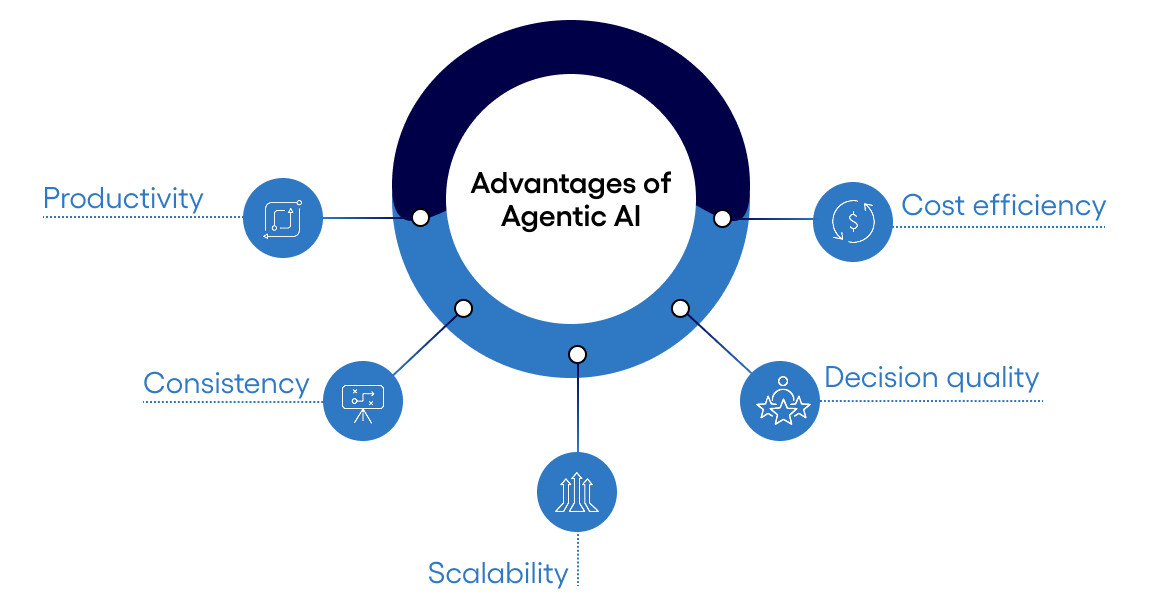
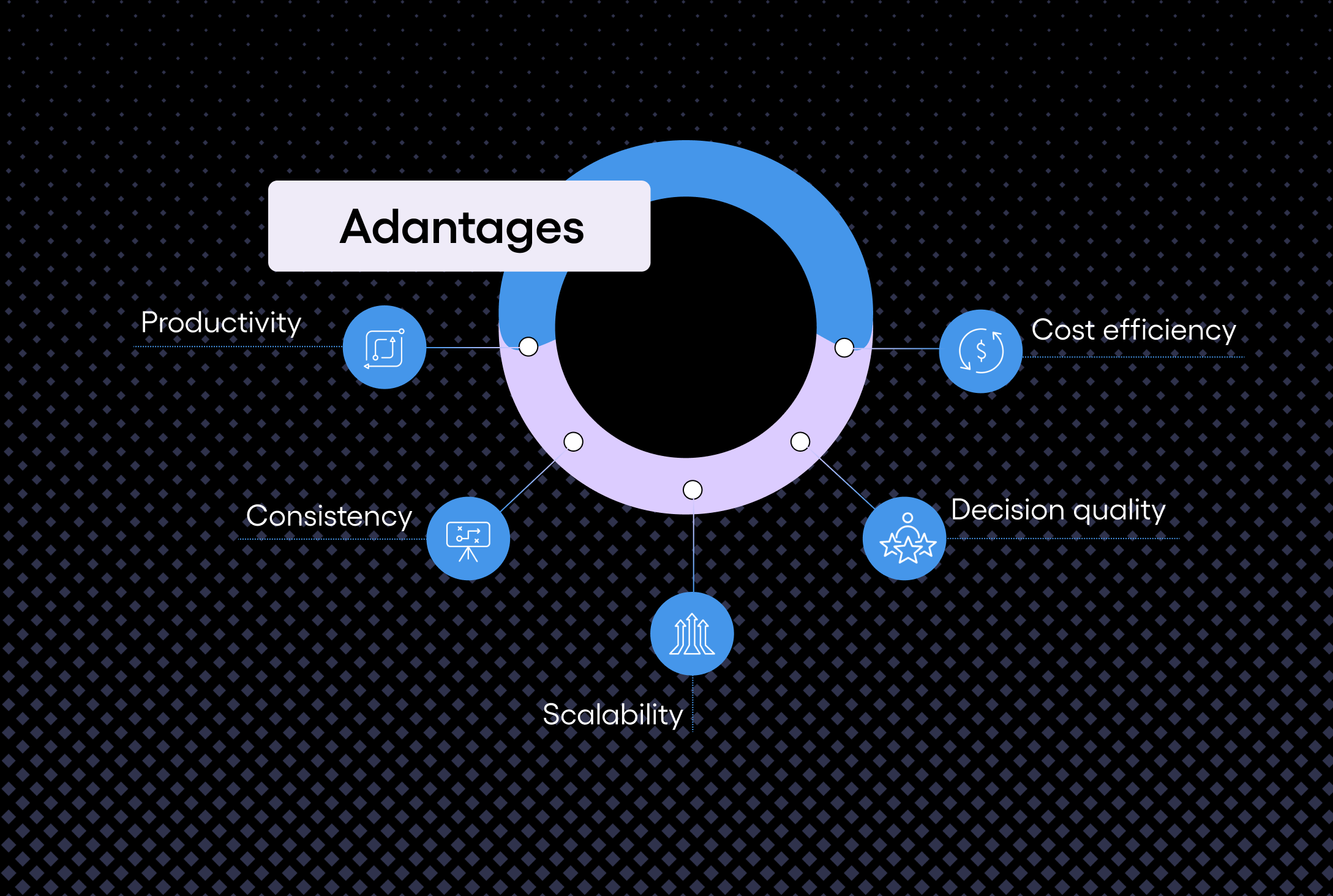
  • Describe the five main advantages of agentic AI
  • Explain why each advantage matters in an organizational context
  • Recognize the types of work where agentic AI creates the most value

Agentic AI is not valuable because it is technically impressive. It is valuable because it changes what is possible in practice. The advantages are real and measurable, but they show up most clearly in specific types of work. Understanding where each advantage applies helps you make better decisions about where to deploy agentic systems and what to expect from them.

    Advantages circle diagram

    Productivity

    Traditional AI assists. Agentic AI acts. Instead of generating a response that a person then has to act on, an agentic system handles the coordination itself. It takes initiative, executes multi-step workflows, and continues working without needing a human to move things from one step to the next.

    The productivity gain is most visible in workflows that currently involve a lot of manual handoffs: routing requests, gathering information from multiple systems, logging outcomes, and triggering follow-up actions. These are often the tasks that consume the most time without requiring the most judgment. When an agent takes ownership of that operational layer, the people involved can focus on the decisions that genuinely require their expertise.

    Consistency and error reduction

    Human-run processes introduce variability. Agentic systems, when designed with proper guardrails, apply the same logic and rules every time. Built-in validation, exception handling, and anomaly detection make outcomes more predictable and trustworthy.

    This advantage is most significant in high-volume, rule-dependent processes: compliance checks, data entry validation, transaction monitoring. In these contexts, the reliability of an agentic system is not just convenient. It is a meaningful improvement in quality.

    Scalability

    When a process is handled by an agent, scaling it does not require redesigning the workflow or growing headcount proportionally. You add capacity. Multi-agent architectures take this further: specialized agents can work in parallel, handling different parts of a workflow simultaneously and improving throughput without significant re-engineering.

    This is particularly valuable for organizations dealing with spiky or growing demand. An agentic system handling customer support or data processing can handle significantly more volume with far less marginal cost than a human team doing the same work.

    Decision quality

    Agentic systems can evaluate multiple options, weigh trade-offs, and adapt their approach as conditions change before committing to an action. For decisions that depend on gathering information from multiple sources and holding competing priorities in mind simultaneously, this iterative reasoning can produce better outcomes than approaches that commit upfront.

    The practical benefit shows up most in decisions where the right answer depends on context that changes frequently: pricing, routing, scheduling, and resource allocation are all areas where continuous evaluation can outperform both static rules and human reviewers working under time pressure.

    Cost efficiency

    By handling complex end-to-end tasks with minimal human oversight, agentic AI reduces administrative overhead and operating costs. The efficiency gains compound across any process where labor is currently spent on coordination, data gathering, or repetitive decision-making that follows predictable patterns.

    It is worth being realistic about this one. The cost savings are real, but they depend on getting the system design right. A poorly scoped agentic system that requires constant human correction is not cheaper than the process it replaced. The organizations seeing the most benefit are precise about what they are asking agents to do and rigorous about validating results before trusting them at scale.

    Benefit

    What it means in practice

    Productivity          

    Handles multi-step workflows with minimal supervision, freeing people for higher-value work

    Consistency                        

    Reduces errors through built-in validation, exception handling, and continuous reasoning

    Scalability

    Scales with demand through multi-agent architectures without manual redesign

    Decision quality        

    Evaluates multiple options and adapts to changing conditions before acting

    Cost efficiency

    Reduces administrative overhead by automating complex end-to-end processes                  

    Worth noting

    These advantages do not materialize automatically. Agentic systems that are poorly scoped, given ambiguous goals, or connected to unreliable tools will underperform. The organizations seeing the most benefit are the ones that are precise about what they are asking agents to do and rigorous about how they validate the results.

    Up next: The final lesson looks at the challenges of agentic AI, because understanding what can go wrong is just as important as understanding what these systems can do.

    Lesson 5: Challenges of Agentic AI

    Learning objectives

    By the end of this lesson you will be able to:

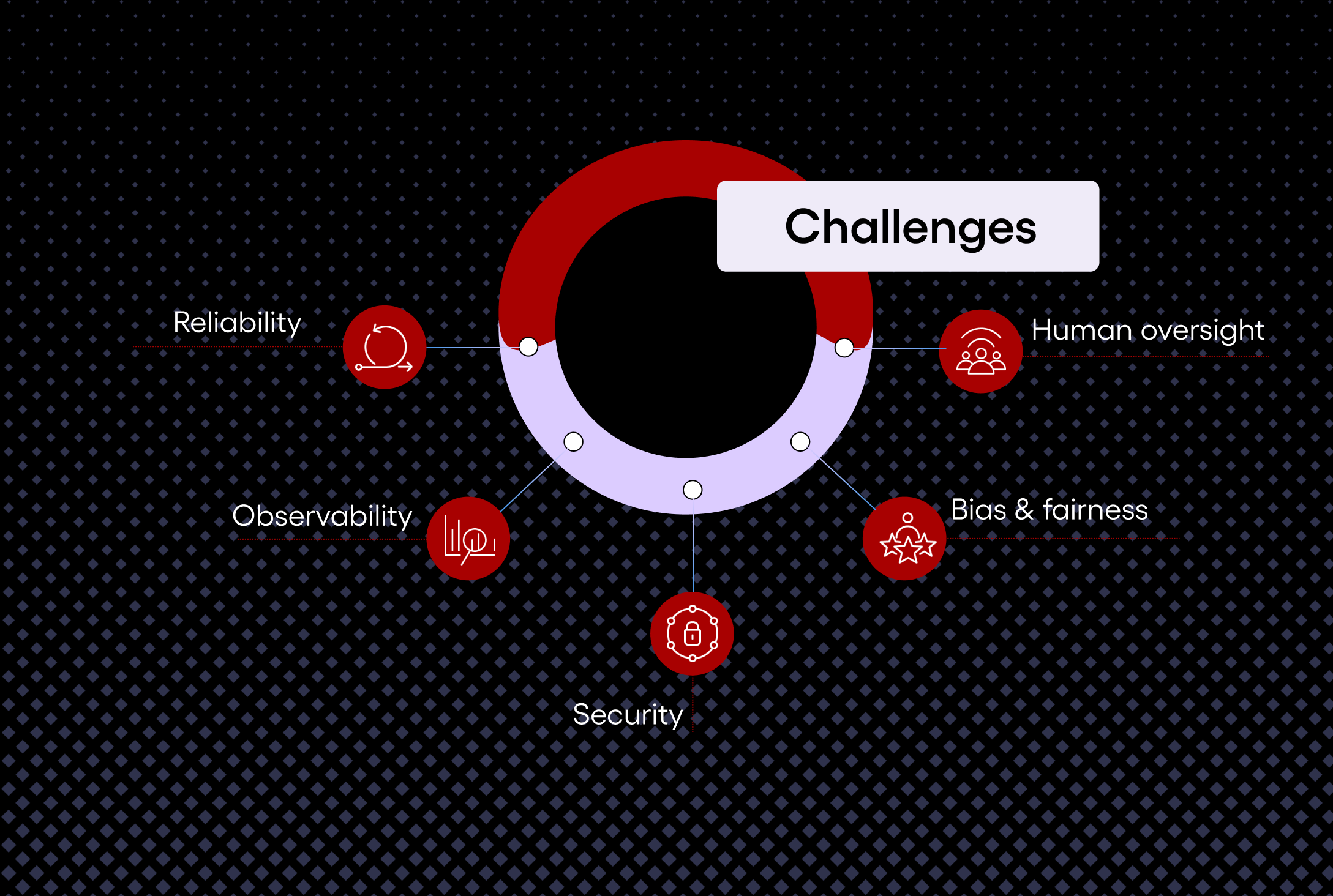
    • Identify the main challenges that come with building and deploying agentic systems
    • Explain why each challenge matters and where it tends to surface
    • Recognize the role of human oversight in responsible agentic deployment

    Agentic AI systems are more capable than earlier AI systems, and that increased capability comes with increased complexity. The challenges covered in this lesson are not reasons to avoid building agentic systems. They are things you need to understand before you deploy them in production. Every one of them is manageable with the right design choices. 

    Reliability and error propagation

    In a multi-step agentic workflow, an error at one stage can propagate through subsequent stages before anyone notices. A misinterpreted input leads to a flawed plan, which leads to incorrect actions, which produce outputs that look plausible but are wrong. The longer the chain, the harder it is to trace the error back to its source.

    This is why validation steps, exception handling, and structured logging are not optional extras. They are the foundation of reliability. Building in checkpoints where outputs are verified before moving to the next step is a critical design choice, especially in workflows where downstream agents depend on the accuracy of upstream results.

    Observability and monitoring

    When an agent operates autonomously across multiple tools and systems, it can be difficult to know what it actually did and why. Without proper observability, a system that appeared to complete a task successfully might have taken an unexpected path, one that would not hold up under scrutiny or repeat reliably.

    Observability means having detailed logs of every action an agent takes, every tool it calls, and every decision point it passes through. This is not just useful for debugging. It is necessary for accountability in regulated industries, essential for building trust with stakeholders, and the primary mechanism for improving system behavior over time.

    Security and data handling

    Agents that can access external systems, read and write data, and trigger workflows have significant reach into your infrastructure. If that reach is not carefully scoped, it creates real security risks. Agents can be manipulated through malicious inputs, prompt injection attacks that redirect their actions, or exploited integrations that expose sensitive data.

    Treat every agent like a new employee with significant system access: give them only the permissions they actually need, implement validation on inputs before they act, require additional approvals for sensitive or irreversible actions, and monitor their behavior continuously. Every integration point is a potential vulnerability and needs to be treated as such from the start.

    Bias and fairness

    Agents can inherit bias from their training data, from the tools they rely on, or from feedback loops that reinforce skewed patterns over time. In automated workflows, biased outputs can be applied at scale before anyone reviews them, which amplifies the impact of the underlying problem significantly compared to a human-run process with natural checkpoints.

    Proactive bias testing before deployment, human review for high-stakes decisions, and continuous monitoring of outcomes in production are the primary mitigations. Explainability, being able to trace why a particular decision was made, is also a key requirement for catching and correcting bias in live systems and for demonstrating compliance with regulations that increasingly require it.

    Human oversight and accountability

    Fully autonomous systems that operate without any human review are appropriate for a narrow set of low-stakes, well-bounded tasks. For anything consequential, some form of human oversight is important. Agents should have clearly defined operational boundaries and explicit escalation paths for situations they were not designed to handle.

    The question is not whether to include human oversight, but where to place it. Designing for appropriate human involvement, rather than treating it as a limitation to be eliminated, produces systems that are both more reliable and more trustworthy. The right escalation design also makes agents more useful in practice, because stakeholders are more willing to trust a system that knows when to ask for help.

    Key insight

    The challenges of agentic AI are manageable with the right design practices. Clear scope, strong observability, minimal permissions, bias testing, and thoughtful human oversight are not constraints on what agentic systems can do. They are what makes it responsible to give them the autonomy they need to be useful.

    Up next: Before moving to the next module, test your understanding with a quick quiz.

    Module wrap-up

    That's a wrap on Module 3: Agentic AI

    You now have a clear, grounded definition of agentic AI and the core characteristics, autonomous, proactive, adaptable, specialized, and goal-directed through memory, that set it apart from earlier AI paradigms. You walked through the perception, planning, action, and evaluation loop that agentic systems run on, and you can now confidently distinguish agentic AI from generative AI, individual agents, and multi-agent systems instead of using those terms interchangeably. You also covered the real advantages agentic AI brings to organizations, along with the challenges, reliability, observability, security, bias, and human oversight, that need to be designed for rather than discovered in production.

    At this point, you should be able to:

    • Define agentic AI and explain the core characteristics that make a system agentic
    • Describe the perception, planning, action, and evaluation loop and why each stage matters
    • Distinguish agentic AI from generative AI, individual agents, and multi-agent systems
    • Explain the five main advantages agentic AI creates for organizations
    • Identify the key challenges of building and deploying agentic systems responsibly

    Put it to the test

    Take the short quiz below to check your understanding before moving on. 

    Want to see agents in action?

    Everything you just learned comes to life in Neuro San, Cognizant AI Lab's open source framework for building and deploying multi-agent systems. If you want to explore how real agent networks are structured before diving into the next module, the repo is a great place to start.

    Next up:

    In the next module, you will dive deep on RAG and agentic RAG: what retrieval-augmented generation is, how agentic RAG improves on the standard approach, and when it is the right architectural choice.

    Continue Your Learning Journey

    What is RAG and Agentic RAG