Skip to main content Skip to footer

Module 1 Overview:

Welcome to the first module in the Agent Foundations learning track, where we'll be diving into the fundamentals of AI agents.

Before building or designing agent systems, it's important to understand what an agent is, how it works, and how it differs from other AI systems like chatbots or traditional automation.

In this module, you'll learn:

  • What defines an AI agent
  • How they differ from chatbots and automation
  • The key components that enable autonomy
  • Why agents are becoming important across industries
  • Common real-world use cases

By the end of this module, you should have a clear understanding of what AI agents are and the role they play in modern AI systems. And when you're done, you'll have a chance to check your understanding with a short quiz at the end.

Estimated time length: 35 minutes
Lesson 1: Definition of an AI Agent 

Learning objectives

By the end of this lesson you will be able to:

  • Define what an AI agent is and explain how it differs from traditional AI systems
  • Describe the perceive-decide-act loop and explain why it matters
  • Explain what it means for a system to be goal-driven rather than prompt-driven
  • Place agents in context alongside models, chatbots, and automation

How to define an AI Agent

The term "AI agent" is used in many different ways, and not all of them are consistent. Some definitions focus on autonomy, others emphasize tool usage or reasoning, and in many cases the term is applied to systems that are closer to chatbots or simple automation. Because of this, it is important to establish a clear and practical definition before going further.

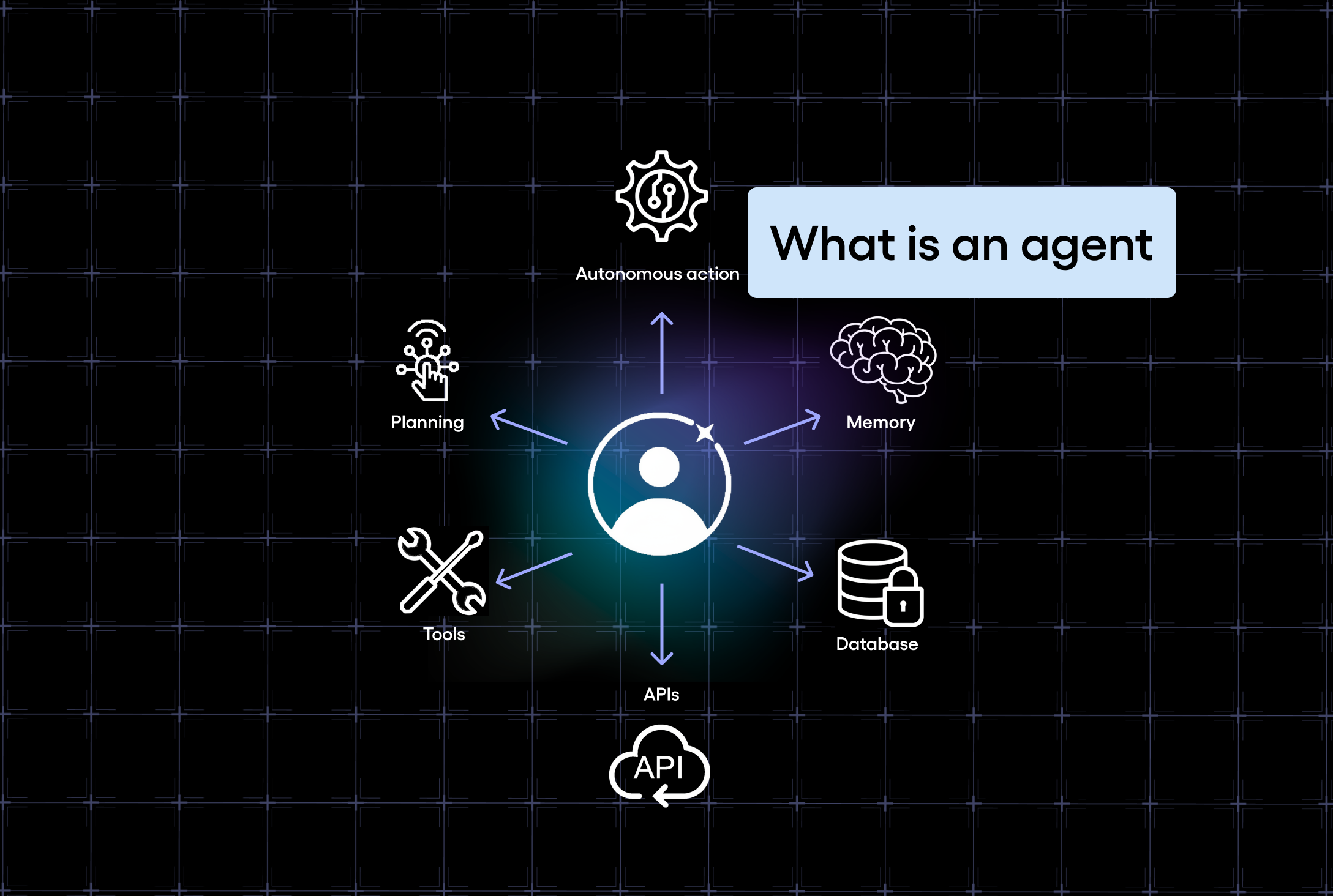
An AI agent is a software system that can understand its environment, make decisions, and take actions to achieve a goal. Unlike traditional AI models that generate outputs in response to a prompt, agents are designed to do more than respond. They are designed to act.

At a high level, what makes an agent different comes down to three core capabilities:

  • The ability to perceive its environment by taking in information from users, systems, or data sources
  • The ability to make decisions by reasoning through options and determining next steps
  • The ability to take action, including calling APIs, retrieving or updating data, triggering workflows, or interacting with other systems

Because of this, agents do not operate as one-time interactions. They work through tasks over time. A typical agent gathers information, determines the next step, takes action, and then repeats the process until the goal is reached. This allows agents to handle multi-step tasks that would normally require ongoing human involvement.

This is what makes agents different from traditional AI systems. A model might answer a question or generate content, but an agent is responsible for completing a task. That shift from generating outputs to executing actions is what defines agentic AI.

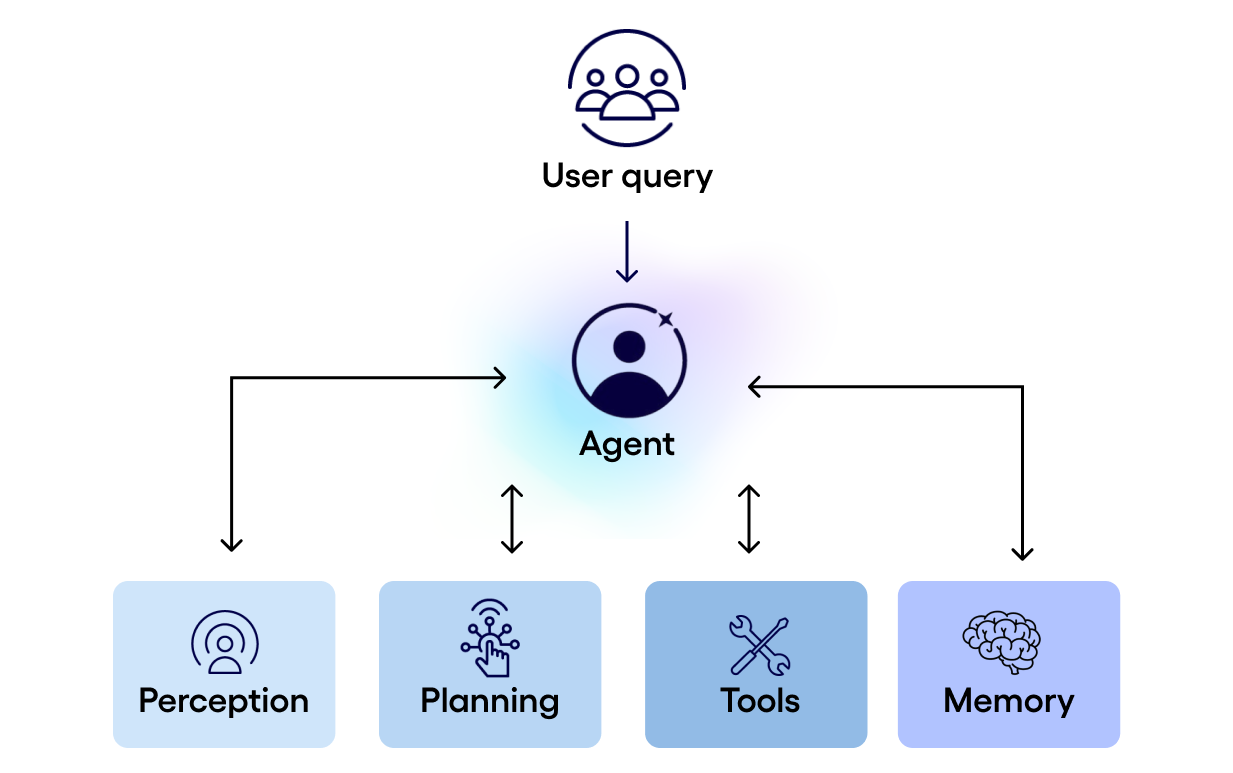
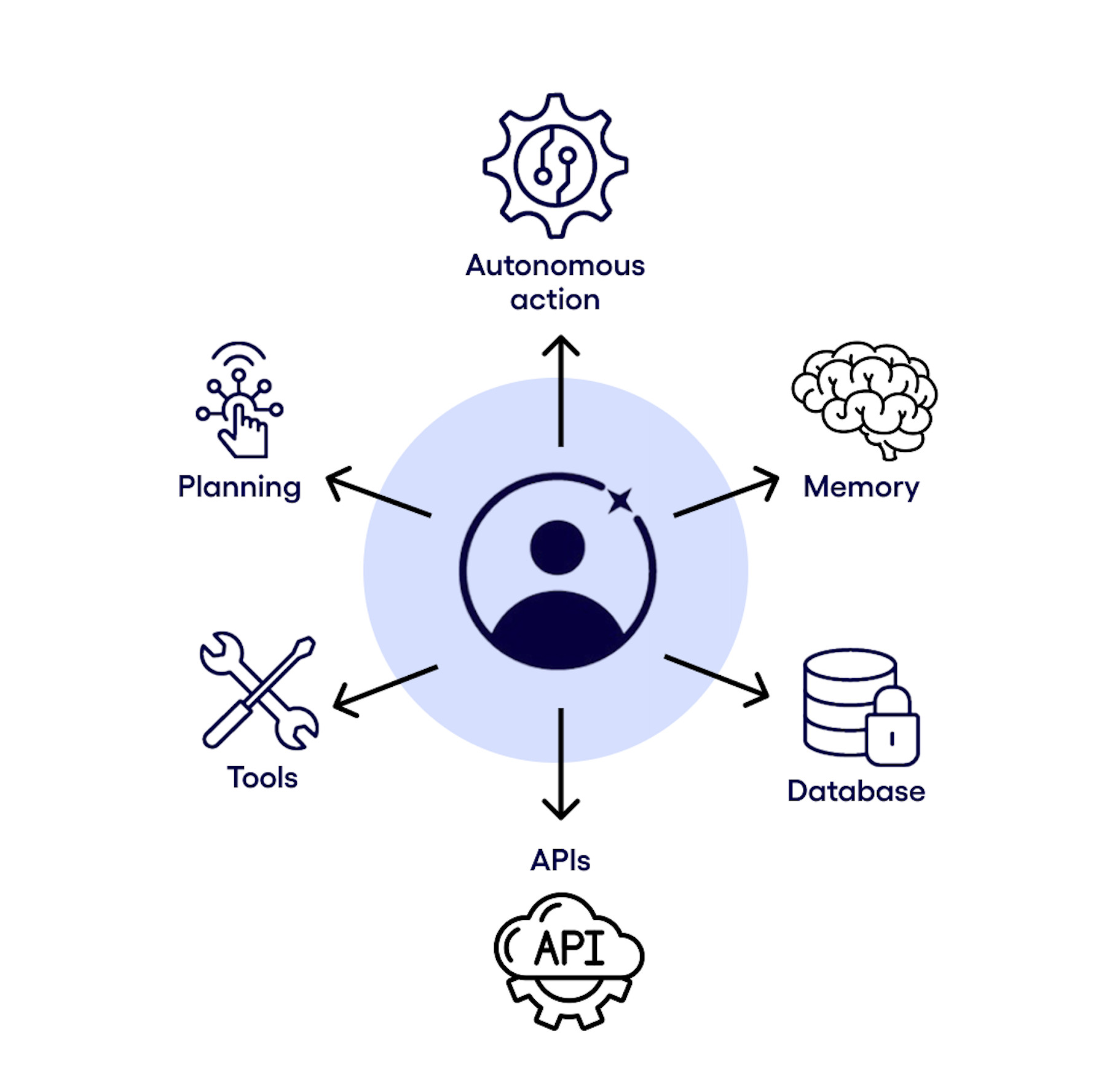
Agent diagram

What it means to be goal-driven

Most AI systems are prompt-driven. You give them input, they produce output, and the interaction ends. The system does not carry any sense of what should happen next. It simply responds and waits.

An agent works differently. It is given an objective and stays oriented toward that outcome until the work is done. It decides what steps to take, evaluates progress, and adjusts when something changes. The conversation or instruction is not the end of the process. It is the beginning of it.

This distinction matters practically. A prompt-driven model can tell you the steps needed to process a customer refund. A goal-driven agent will actually process it, check whether it went through, and flag any issues. Same task, fundamentally different modes of operation.

The perceive-decide-act loop

An agent does not complete a task in one step. It runs a continuous loop: perceive the environment, decide what to do next, take action, then perceive again. This cycle repeats until the goal is reached. It is what makes agents capable of handling work that is too complex or dynamic for a single response.

Part of the confusion around AI agents comes from the fact that this is still an emerging category. Different systems emphasize different capabilities, but most modern agents share a common foundation: they are goal-driven, capable of making decisions, and able to take action using tools and external systems.

This definition is important because everything that follows builds on it. Before comparing agents to other systems or exploring how they are used, you need a clear understanding of what an agent is designed to do. 

Up next: Now that you have a solid foundation for what an AI agent is, the next lesson will look at one of the most common points of confusion: how agents differ from chatbots, and why that distinction matters for how you build and deploy them.

Lesson 2: Agents vs Chatbots

Learning objectives

By the end of this lesson you will be able to:

  • Explain what a chatbot is and how it differs from an AI agent at the architectural level
  • Walk through a concrete example that illustrates the difference in practice
  • Use the comparison framework to decide when a chatbot is the right tool and when an agent is
  • Understand why many systems combine both, and how they work together

What is a chatbot?

Agents and chatbots can look similar on the surface. Both understand language. Both respond to users. But the way they work, and what they are built to do, are fundamentally different.  

A chatbot is built for conversation. It takes a user's input and generates a response, often based on predefined logic, prompts, or a knowledge base. Its goal is to provide information, guide a user, or complete a simple interaction. Even when powered by large language models, most chatbots remain focused on answering questions within a defined scope. Once the response is delivered, the interaction typically ends.

It is worth acknowledging that chatbots have become significantly more capable in recent years. Many now use large language models to understand nuanced questions and generate fluent, contextual replies. But improved language understanding alone does not make something an agent. A chatbot can sound sophisticated and still be doing nothing more than producing the next message in a thread.

The key question to ask is: after the response, does the system do anything? A chatbot's job is finished when it replies. An agent's job may just be getting started.

Key differences between an AI agent and a chatbot 

An AI agent is built to complete tasks. Instead of stopping at a response, it determines what needs to be done and takes steps to do it. That might involve calling APIs, retrieving data, updating systems, or coordinating multiple actions across tools. The response is not the end result. It is part of a larger process.

Another important difference is how each handles complexity. Chatbots are generally limited to short interactions. They may keep some context, but they are not designed to manage longer processes or evolving tasks. Agents are built for multi-step work. They can break down a problem, decide on a sequence of actions, execute those actions, and adjust as new information becomes available.

There is also a difference in autonomy. Chatbots depend on user input at each step. They respond when prompted. Agents can continue working toward a goal without constant input, only involving the user when needed.

A practical way to see the difference is to think about what happens after the response. With a chatbot, the conversation continues or ends. With an agent, the work continues regardless of whether the conversation does. The agent stays oriented toward its goal and keeps moving until it is done or until it determines it needs human input to proceed.

Feature                        

AI Agent

Chatbot

Primary Purpose

Complete tasks and achieve goals

Answer questions and hold conversations

Output

Actions and outcomes

Text-based responses

Interaction Style

Multi-step workflows

Single or short interactions

Use of Tools

Actively uses APIs, systems, and tools

Limited or no tool usage

Decision-Making

Dynamic, based on context and goals

Predefined or prompt-based

Autonomy

Can operate independently toward a goal

Requires user input at each step

Complexity

Handles multi-step, adaptive tasks

Handles simple or structured queries

Memory

Maintains context across steps

Limited or session-based context


When to use each

This is not about one being better than the other. It is about using the right tool for the job. Let's compare when to use an agent vs a chatbot.

A helpful way to summarize the difference is:

  • A chatbot focuses on conversation and responses

  • An AI agent focuses on actions and outcomes

n practice, many modern systems combine both. A user may interact through a conversational interface, but behind the scenes an agent is doing the actual work. Knowing the difference helps you design systems intentionally, rather than applying the wrong pattern to a problem.

Up next: Chatbots are one point of comparison. The next lesson looks at another: traditional automation. This one is a bit more nuanced, because agents and automation can look similar from the outside. The difference is in how decisions get made.

Lesson 3: Agents vs Automation

Learning objectives

By the end of this lesson you will be able to:

  • Define traditional automation and explain how it works
  • Identify the key differences between rule-based automation and agent-based systems
  • Explain where automation still wins, and where agents are the better fit
  • Describe how automation and agents can work together in the same workflow

Defining Traditional Automation

Traditional automation is based on predefined rules. A workflow is designed in advance with specific steps and conditions, and the system follows those instructions exactly. If a condition is met, a corresponding action is triggered. This works well for structured, predictable tasks where all possible scenarios can be mapped out ahead of time.

Think of an automated invoice approval workflow. If the amount is under a threshold, it gets approved. If it exceeds the threshold, it routes to a manager. Every path is known. Every decision is programmed. The system never has to figure anything out.

AI agents take a fundamentally different approach. Instead of following a fixed set of instructions, they are given a goal and determine how to achieve it. They evaluate options, decide what steps to take, and adjust their approach as conditions change. They are not following a map. They are navigating in real time.

Key differences between an AI agent and automation

This difference shows up most clearly in flexibility. Automation systems are rigid. If something changes or falls outside the predefined logic, the workflow can fail or require manual intervention. Agents are more adaptive. They can interpret new information, revise their plan, and continue working toward the goal even when the situation is not exactly as expected.

The way decisions are made is also different. In automation, decisions are explicitly programmed. Every possible path needs to be defined in advance. In agent systems, decisions are made dynamically based on the current context.

There is also a difference in how each handles the unexpected. Automation breaks at the edges of what it was designed for. An agent can reason through a situation it has not seen before and still make progress.


Traditional Automation

AI Agent

How decisions are made

Predefined rules, explicitly programmed

Dynamically, based on current context and goal

Flexibility

Rigid, fails outside defined parameters

Adaptive, can handle unexpected situations

Best suited for

Repetitive, structured, high-volume tasks

Multi-step, dynamic tasks requiring judgment

When conditions change

Workflow fails or requires manual fix

Agent re-evaluates and continues toward the goal

Human involvement

Required to update or fix broken workflows

Required to set goals and oversee boundaries

Examples

Invoice routing, scheduled syncs, email triggers

Research workflows, issue resolution, ops monitoring


Where automation still wins

It is also worth being honest about the tradeoffs. Agents are more flexible, but that flexibility comes with complexity. Designing, testing, and overseeing agents requires more careful thought than configuring a rule-based workflow.

For simple, stable, high-volume processes, traditional automation often remains the right tool. It is predictable, fast to build, and easy to audit. You know exactly what it will do in every situation because you defined every situation.

Agents add power where the work is too dynamic or judgment-dependent for rules to cover. But they are not a replacement for every workflow you already have.

Key insight

Automation and agents are not competitors. They are complements. Automation handles the parts of a workflow that are stable and well-defined. Agents handle the parts that require judgment, flexibility, or multi-step reasoning. The best systems use both.

How they work together in practice

In most real-world deployments, automation and agents co-exist in the same system. Automation handles the predictable, high-volume work. Agents step in where the work requires reasoning or adaptation.

Consider a procurement workflow. Automation handles standard purchase orders, routes approvals based on thresholds, and sends confirmation emails. An agent handles the exceptions: a vendor submits an unusual request, pricing does not match the contract, or a shipment is delayed and alternatives need to be evaluated. The automation runs the routine. The agent handles what the automation cannot.

This is the design pattern worth internalizing. Not 'should I use automation or agents?' but 'where in this workflow does each one belong?'

A simple way to remember the distinction:

  • Automation follows predefined instructions
  • AI agents determine what to do to achieve a goal

Up next: Now that you understand how agents differ from both chatbots and automation, the next lesson goes inside the agent itself. You will learn what the core components are that actually enable an agent to perceive, decide, and act, and why each one matters.

Lesson 4: Key Components of an AI Agent 

Learning objectives

By the end of this lesson you will be able to:

  • Name and describe the five core components of an AI agent
  • Explain what each component does and what breaks without it
  • Understand the different types of memory and when each applies
  • Describe how the components work together to enable autonomous operation

Knowing what an agent is and how it compares to chatbots and automation gets you most of the way there conceptually. But to actually build or evaluate agent systems, you need to understand what is happening inside. This lesson opens the hood. You will walk away knowing the five components that make an agent work, why they depend on each other, and what to watch for when any one of them is weak.

What an agent is made of

Agents are not powered by a single feature. The capability you see from the outside, the ability to take a goal and work toward it across multiple steps, is the result of several components operating together. Each one has a specific job. Each one is essential.

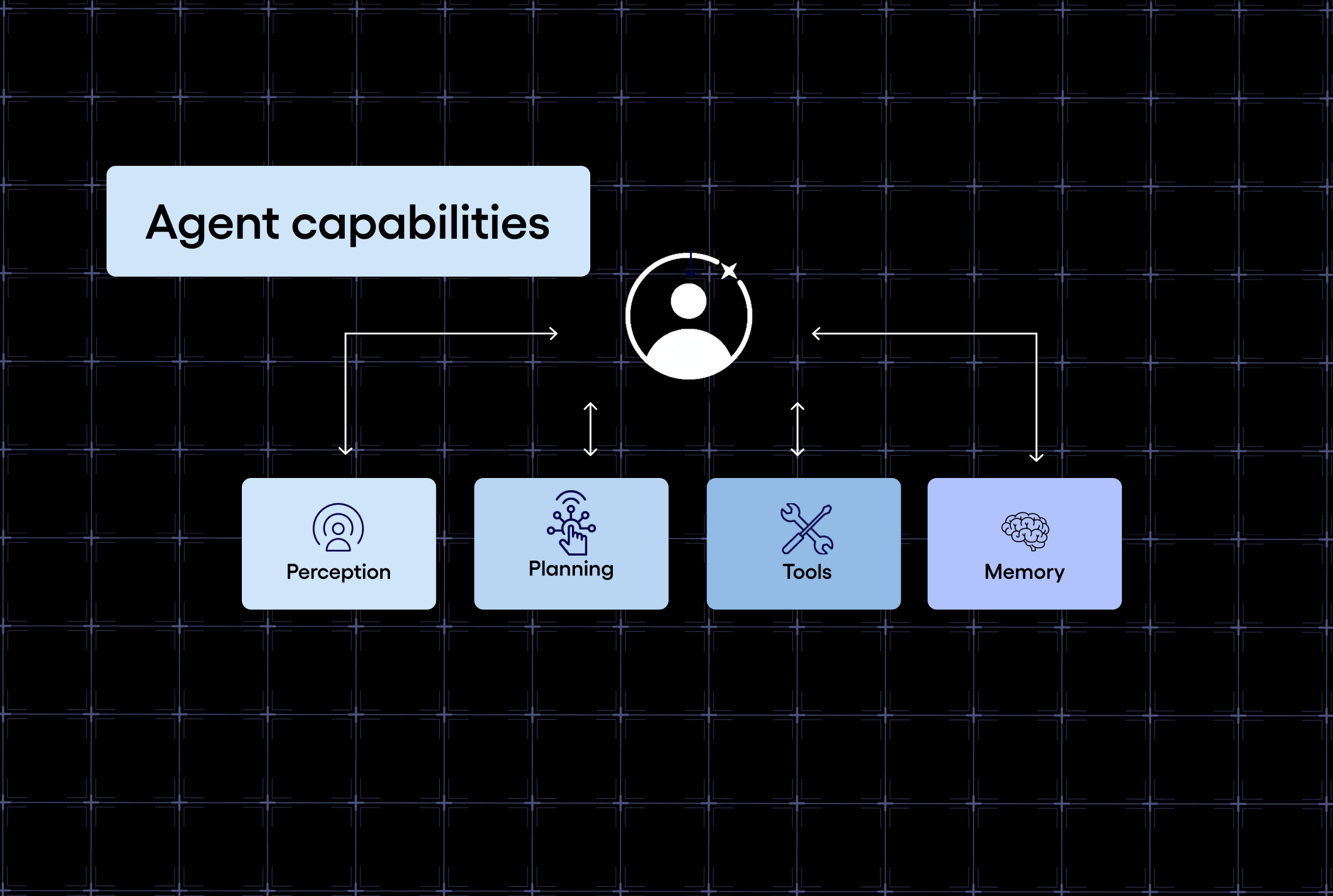
The 4 main components are:

Perception and input handling
Planning and reasoning
Tool use and external integrations
Memory and state management

Think of these less as layers and more as a loop. Perception feeds planning. Planning drives tool use. Memory holds the context together. When they work well together, the agent can handle complex, dynamic work independently. When one is missing or poorly designed, the whole system feels it.

Perception and input handling

Every agent starts by taking in information. That might be a user instruction, data pulled from an API, a document, a system log, or output from another agent. Before any decision can be made, the agent needs to interpret that information and structure it in a way the rest of the system can use.

This step involves parsing inputs, pulling out the relevant signals, filtering noise, and organizing data so downstream components can act on it. It sounds simple. It is not. If perception is weak, the agent is essentially making decisions in the dark. Good reasoning on top of bad inputs still produces bad outcomes.

The mental model that matters here: perception is not just about receiving data. It is about making sure the agent is working with the right information from the start.

Planning and reasoning

Planning is what turns a goal into something a system can actually execute, step by step.

In most agent systems, this is handled by a coordinating agent, often called an orchestrator or frontman agent. It takes the goal, figures out what needs to happen, and breaks the work into structured steps. It identifies what order things need to happen in, what depends on what, and when it needs to stop and gather more information before proceeding.

Here is what that looks like in practice. If the goal is to produce a competitive analysis report, the orchestrator might plan it as: identify the relevant competitors, retrieve data on each, analyze the patterns, generate the content, and validate the output before returning it. Each step is informed by the one before it.

Tool use and external integrations

An agent without tools can think, but it cannot act. It can describe what steps to take to update a record, but it cannot update the record. It can explain how to send an alert, but it cannot send it. The reasoning is there. The ability to actually do anything is not.

Tools are what close that gap. Through APIs, databases, and system integrations, agents can retrieve live data, write to records, trigger workflows, send messages, run calculations, and interact with external services. This is one of the most important distinctions from a standard language model. A model generates text. An agent with tools takes action in real systems.

How well those tools are defined matters as much as having them. Vague, overlapping, or poorly scoped tools lead to unpredictable behavior. Well-defined tools, with clear inputs, outputs, and boundaries, make agent behavior predictable and controllable.

Memory and state management

To complete multi-step tasks, agents need to maintain context across time.

Memory allows an agent to keep track of what has already happened, what information has been gathered, and what remains to be done. This is especially important in workflows that span multiple steps or involve multiple agents.

In practice, memory can include:

  • previous actions taken

  • intermediate outputs from earlier steps

  • relevant user inputs or system data

  • the current status of a task or workflow

  • plans and checklists

State management ensures that this information is structured and accessible as the system progresses. Without it, agents lose continuity and treat each step as a new problem, which leads to inconsistent or incomplete results.

In multi-agent systems, shared or structured memory becomes even more important. Different agents need access to the same context in order to stay aligned and avoid duplicating work.

Agent capabilities

When all five are well-designed and working together, you have a system that can take a goal, figure out how to achieve it, act on that plan, and adapt when things do not go as expected. That is what makes agents genuinely useful for complex, real-world work. 

Up next: You now understand what an agent is, how it differs from other systems, and what makes it work internally. The next lesson shifts focus to why this all matters, and what practical value agents create for organizations and teams.

Lesson 5: Why AI Agents Matter and Agent Benefits

Learning objectives

By the end of this lesson you will be able to:

  • Explain why agents represent a meaningful shift in how AI systems participate in work
  • Describe the five key benefits agents bring to organizations and teams
  • Articulate how agents change the way humans and AI divide responsibility
  • Recognize where agent-driven approaches create the most practical value

A different way of using AI

AI systems have been genuinely useful for years. You can use them to draft documents, summarize information, answer questions, and think through problems. But there is something most of those interactions have in common: after the AI responds, the next move is yours. You take the output, decide what to do with it, move it to the next step, and carry the work forward yourself. The AI assisted. You coordinated.

Agents change that relationship. Instead of producing a response that you then act on, an agent works toward an outcome you give it. It gathers the information it needs, makes decisions about how to proceed, takes action across systems, and returns something finished. The coordination does not sit with you anymore.

From a business perspective, this changes how systems get designed. Instead of building processes around rigid rules, organizations can build systems that are adaptive and goal-driven, where agents determine how to get work done within the boundaries you set. That shift has real consequences for what kinds of problems become tractable and how quickly teams can respond when conditions change.

Key insight

Earlier AI systems made individuals more capable. Agents make organizations more capable. When AI can take responsibility for an entire piece of work, the implications reach further than productivity. They touch how teams are structured, where human attention goes, and which problems are worth solving at scale.

The five benefits

This shift translates into five practical advantages that show up in how organizations operate day to day.

Efficiency is usually the first benefit teams notice, because it shows up quickly in workflows where people spend time moving between systems. Agents can manage that coordination end to end, and the time freed up adds up faster than most people expect.

Speed compounds the gain. Because agents act on information as soon as it arrives, they compress the gap between a trigger and a response. A fraud signal that used to sit in a review queue can be acted on in seconds. A customer issue that required handoffs across departments can be resolved without anyone waiting for anyone else.

Availability matters most in environments where timing has real consequences. Agents run without shifts or off-hours. For processes where a delayed response carries cost, whether financial, operational, or customer-facing, that continuity is genuinely valuable, not just convenient.

Scalability changes the conversation about capacity. When a process is agent-driven, handling significantly more volume does not mean rebuilding the workflow or hiring proportionally. You add agents. The infrastructure scales in a way that headcount alone cannot.

Adaptability is the hardest to quantify but often the most valuable in practice. Rule-based systems work until reality stops matching the scenarios anticipated at design time. Agents can reason through situations they have not seen before, adjust their approach, and keep moving toward the goal. In dynamic environments, that resilience matters.


Benefit

What it means in practice

Efficiency

Handles multi-step coordination without requiring manual effort across tools and teams

Speed

Acts on information in real time, removing delays from sequential handoffs and waiting on human input

Availability

Runs continuously, without shifts, queues, or off-hours

Scalability

Increased demand is met by adding agents, not by redesigning workflows or growing headcount

Adaptability

Adjusts based on context, making it easier to handle edge cases and changing conditions

A note on expectations

These benefits are real, but they are not automatic, and it is worth being direct about that.

An agent given a vague goal, poorly scoped tools, or no meaningful human oversight will not perform well. The gains described above depend on thoughtful design: clear objectives, well-defined integrations, and appropriate human involvement in the decisions that actually matter. The organizations getting the most value from agents are not necessarily the ones who moved fastest. They tend to be the ones who were clearest about what they were asking agents to do and where humans need to stay involved.

Up next: Now that you understand why agents matter and what value they create, the next lesson brings it to life with real-world examples across industries.

Lesson 6: Common Real-World Use Cases

Learning objectives

By the end of this lesson you will be able to:

  • Identify the industries and process types where agents create the most value
  • Recognize the common pattern that makes a task well-suited to an agent-based approach
  • Connect the capabilities covered in earlier lessons to real-world outcomes

Where agents are being used today

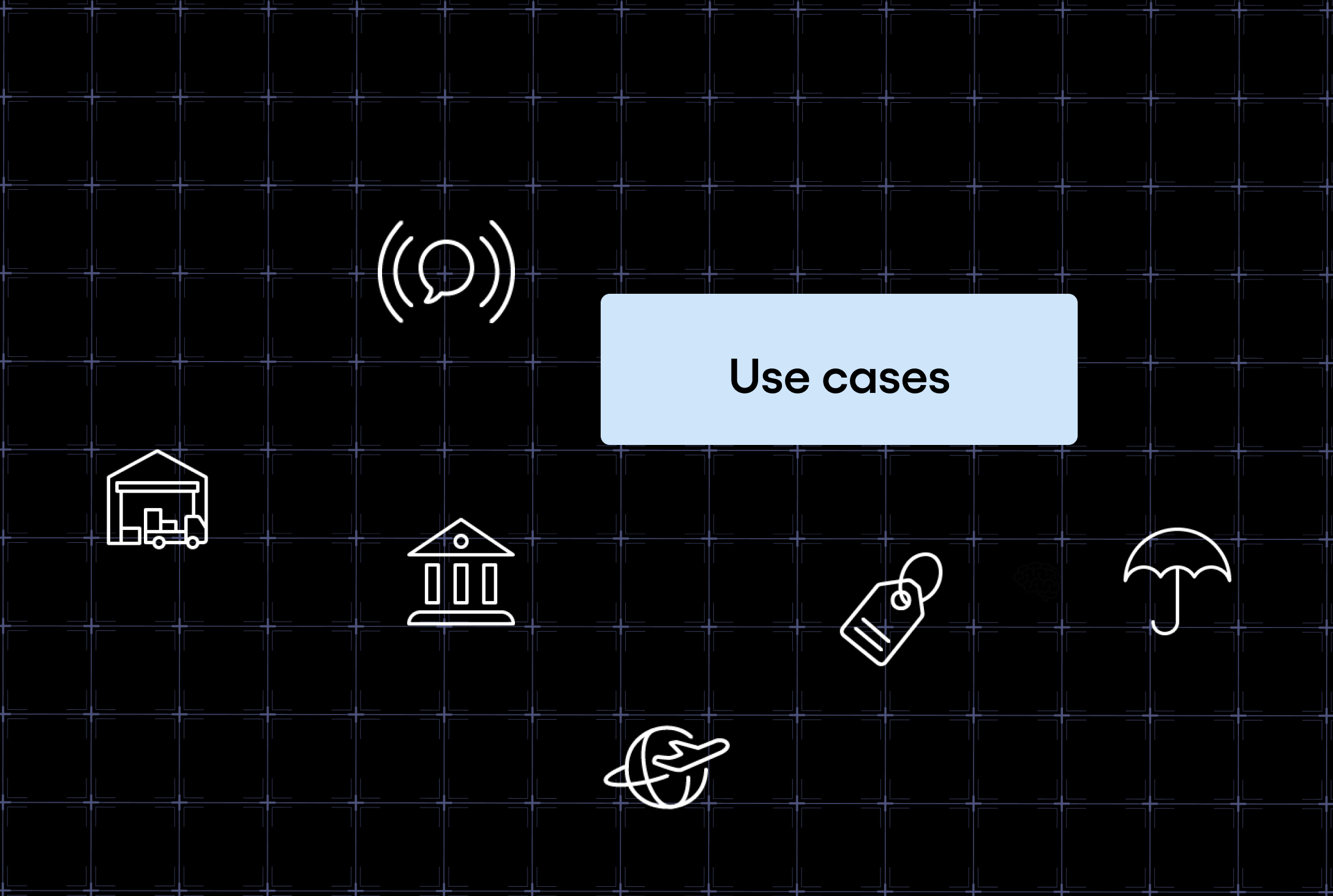
Agents are most useful in situations where work involves multiple steps, access to information, and decisions that depend on context. They are not needed for every task, but they are powerful when a process requires more than a simple response or a fixed workflow. What follows is a look at six industries where that combination of characteristics shows up consistently, and where agents are being used to close the gap between what a system can reason about and what it can actually do.

Customer support

Resolve issues end to end:retrieve, update, escalate

Customer suport icon
Finance

Monitor transactions,detect risk, flag anomalies

Finance
Insurance

Review claims, check policy,route and flag fraud

Insurance
Healthcare

Scheduling, coding,research support

Healthcare
Retail & logistics

Inventory, forecasting,supply chain coordination

Retail & logistics
Cybersecurity

Monitor, detect anomalies,trigger response workflows

Cybersecurity

Customer support

In customer support, agents can help resolve issues from start to finish. They can interpret a customer's request, search internal knowledge bases, retrieve account details, update records, trigger follow-up actions, and escalate when needed. This moves support from simple question-answering toward complete issue resolution, with faster response times and a more consistent experience across channels.

The case for agents in customer support comes down to how much of the work in a support interaction is not actually the conversation itself. It is looking things up, pulling account history, checking system status, logging the outcome. Agents can handle that operational layer end to end, while freeing human agents to focus on the cases that genuinely require empathy, judgment, or escalation authority.

Finance

In finance, agents can monitor transactions, detect unusual behavior, and trigger verification workflows. They can also gather financial data, summarize risk signals, and support decision-making in areas like credit review, fraud detection, and portfolio analysis.

Speed matters here in a way it does not in many other domains. Financial decisions are often time-sensitive, and the volume of data involved makes continuous human monitoring impractical. Agents can process high volumes of signals in real time, surface the ones that warrant human attention, and act on the ones where the decision criteria are well-defined, without slowing down to wait for a review queue to clear.

Insurance

In insurance, agents can support claims processing by reviewing submissions, checking policy details, identifying missing information, routing cases, and flagging potential fraud. For simpler claims, they can help accelerate the process while keeping human review available for higher-risk decisions.

Claims processing is one of the clearest fits for an agent-based approach because the work is both high-volume and variable. A large insurer might receive thousands of claims a day, most of which follow predictable patterns but enough of which are unusual to make rigid automation unreliable. Agents can handle the routine cases quickly and escalate the complex ones with context already assembled, so the human reviewers who receive them are not starting from scratch.

Healthcare and life sciences

In healthcare and life sciences, agents can assist with administrative workflows, scheduling, coding, research support, and data analysis. They can help organize information across systems, identify patterns, and support teams working with large volumes of complex data.

The appeal in healthcare is partly about administrative burden. A significant portion of clinical and operational staff time goes toward tasks like documentation, prior authorization, and scheduling that are necessary but not where expertise is best spent. Agents can take on a meaningful share of that work. In research and life sciences contexts, they can also support literature review, data preparation, and hypothesis exploration, helping teams move through large bodies of information more efficiently without sacrificing rigor.

Retail and logistics

In retail and logistics, agents can support inventory planning, demand forecasting, pricing adjustments, and supply chain coordination. These are areas where conditions change frequently and decisions often depend on multiple data sources.

The challenge in retail and logistics is that the environment is rarely stable. Demand shifts, suppliers have disruptions, and pricing conditions change faster than manual processes can track. An agent that can monitor inventory levels, identify a supply disruption before it becomes a stockout, and trigger a reorder or rerouting workflow is closing a loop that would otherwise require constant human attention across multiple dashboards and systems.

Cybersecurity

In cybersecurity, agents can continuously monitor systems, detect anomalies, investigate suspicious activity, and trigger response workflows. Security risks often require fast action and sustained visibility across a large and constantly changing attack surface.

This is one of the use cases where the availability benefit from Lesson 5 is most concrete. A threat does not wait for business hours. An agent can identify anomalous behavior at any hour, begin the investigation process, and escalate with context already assembled, so the analyst who picks it up is reviewing findings rather than starting a search. That combination of speed and continuity is difficult to replicate with human-only teams at scale.

Key insight

These use cases show why agents are not just another interface for AI. They are a way to connect reasoning, action, and business processes in a more dynamic way. The value is not in what agents know. It is in what they can do with it.

The pattern behind all of it

Across every one of these industries, the tasks where agents create the most value share a recognizable shape. The work involves multiple steps. Conditions change. Different systems need to be accessed or updated. Decisions depend on context that has to be gathered in real time. And speed or continuity matters.

  • Multiple steps that currently require manual coordination across tools or teams
  • Changing information where the inputs are not static and the right answer depends on what is true right now
  •  Access to tools and data across systems that do not naturally connect
  •  Context-dependent decisions where the right action depends on the specifics of the situation
  • Speed or continuity where delayed responses carry real cost

If a process has most of these characteristics and still relies on manual coordination, it is worth asking seriously whether an agent-based approach would change what is possible.

Up next: Before moving to the next module, test your understanding with a quick quiz.

Module wrap-up

That's a wrap on Module 1: Intro to AI Agents.

You've covered a lot of ground! You started with a clear definition of an AI agent and how it differs from traditional AI systems. You then explored the difference between agents, chatbots, and automation, which helps clarify when an agent-based approach is actually the right call.

You also dug into what makes agents actually work: the core components that enable them to operate with autonomy, including perception, planning, tool use, memory, and feedback. And you saw why agents matter for organizations and where they are already being applied across industries.

At this point, you should be able to:

  • Define what an AI agent is and how it differs from other AI systems
  • Explain when to reach for an agent versus a chatbot or automation
  • Describe the components that enable an agent to operate autonomously
  • Articulate why agents matter and where they create practical value

Put it to the test

Take the short quiz below to check your understanding before moving on. You will need 4 out of 6 to pass, and you can retake it as many times as you need.

Want to see agents in action?

Everything you just learned comes to life in Neuro San, Cognizant AI Lab's open source framework for building and deploying multi-agent systems. If you want to explore how real agent networks are structured before diving into the next module, the repo is a great place to start.

Next up:

In the next module, you'll expand your understanding by learning about multi-agent systems: what they are, how they function, and the key differences between multi-agent systems and individual AI agents.

Continue Your Learning Journey

What are Multi-Agent Systems