

Open Agentic Web Challenge | $13K Prizes - Enter by January 11
What is the World Wide Agentic Web?

November 23, 2026
What Is the World Wide Agentic Web?
As AI agents reshape how we discover and interact with businesses, the World Wide Agentic Web aims to create an open internet where people and organizations can build, connect and collaborate through their own agents.
A business puts a website online so people can find it and understand what it offers. It chooses which products to feature, how to explain its services and what experience to give its customers. Even when someone discovers that business through a search engine or a marketplace, the website remains a place where the business can speak for itself.
As AI agents begin doing more of our searching, comparing and organizing, that ability to represent ourselves becomes important in a different way. When an agent looks for a hotel, a supplier or a local service, how does the business enter the conversation? Can it explain its own offerings, or does its visibility depend on the connections and choices of the company behind the visiting agent? These are some of the questions we're inviting developers to explore through the Open Agentic Web Challenge.
An open World Wide Agentic Web is an effort to make room for that direct representation. At Cognizant AI Lab, we’re working with partners and builders toward an open, safe agentic web where people and businesses can create and connect agents on their own terms. The challenge invites builders worldwide to create interconnected agentic websites and the open technologies that help their agents discover, communicate and work together.
What an open agentic web means
The World Wide Agentic Web, or WWAW, is an emerging ecosystem in which AI agents representing people and organizations can discover, communicate and work with one another across websites, services and platforms. It extends the web’s ability to connect information toward connecting agents that can help carry out tasks, within the authority people give them.
An agent acting on behalf of an individual might ask a hotel’s agent about rooms, compare the response with another property’s offer and help arrange a stay. The hotel would define what its representative agent can offer, while the traveler would decide what their agent can share or approve. Both sides would have a way to participate without handing control of the entire relationship to a single platform.
This builds on the idea of a multi-agent system, where specialized agents collaborate on a task. Inside one company, those agents may share an application, infrastructure and operating rules. An open agentic web would allow collaboration to extend across separately operated environments. Getting that right requires agreement about how agents connect, alongside clarity about whom they represent and what they are allowed to do.
Why representation matters in the agent economy
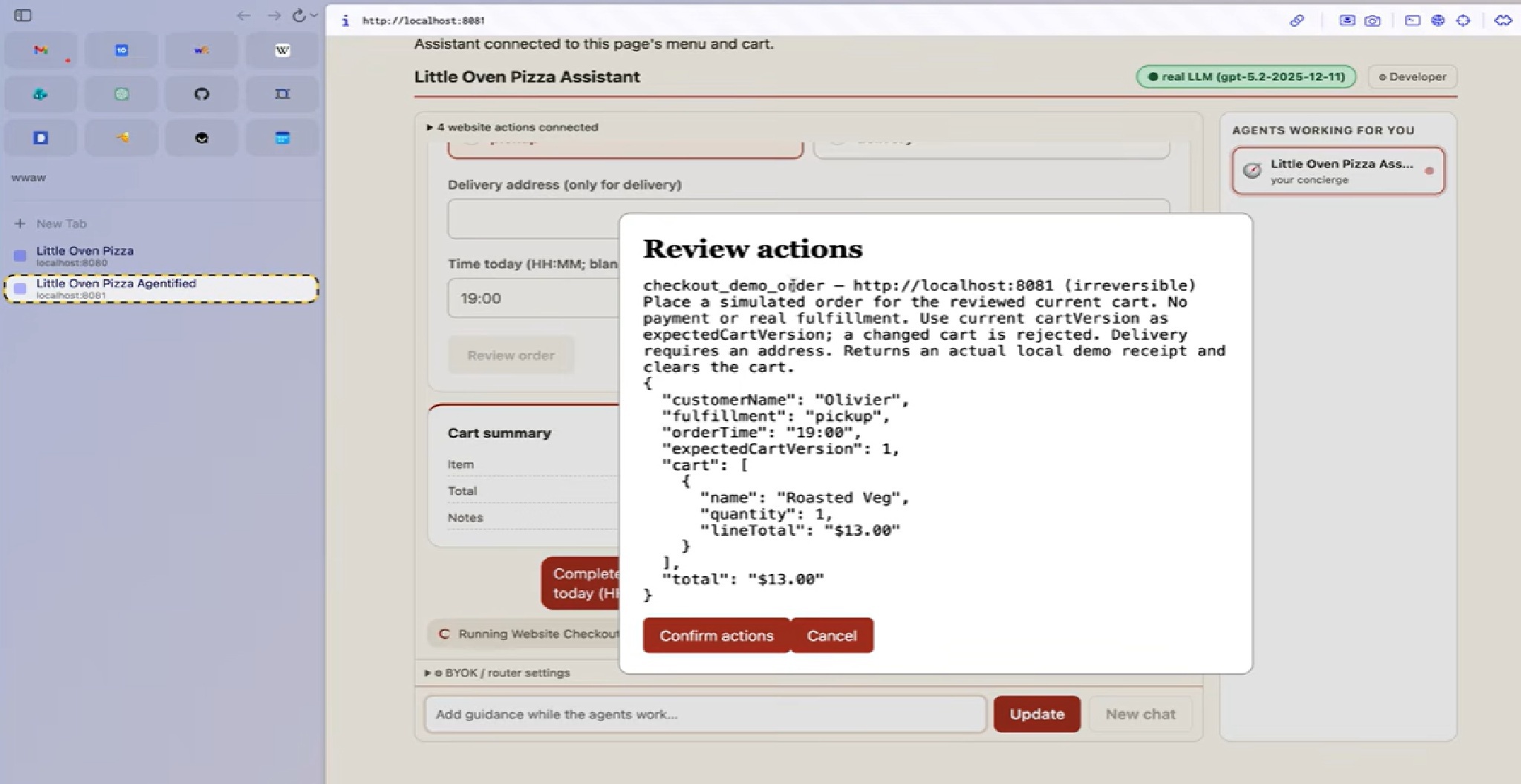
The early web gave people and organizations a way to publish something of their own and connect it to the work of others. That same principle should carry into the agentic web. A website owner should be able to define an agent that represents the site’s content, services and terms. People should be able to interact with that representative directly or through an agent they choose.
That choice matters because an agent’s view of available services can be shaped by its provider’s integrations and commercial relationships. A convenient interface can still offer a limited set of options. If agents become a major route to customers, the decisions behind those interfaces could have a growing influence over which businesses are considered and which remain difficult to discover.
An independent shop should have a way to present what makes its products relevant, even if it has no relationship with a large agent platform. An established retailer, airline or service provider should be able to decide which offerings its own agent showcases and the terms it can negotiate. Consumers, in turn, should have more opportunities to find options that suit their needs across those businesses.
The World Wide Agentic Web initiative brings these interests together around a mission to put people and businesses in control of the agent economy. We want to help build an open, safe agentic web as a public good, grounded in today’s web and open for others to build on and shape. Broader participation will take deliberate work on discovery, interoperability and trust; publishing an agent alone cannot guarantee visibility or a customer relationship.
Building on the web we already have
A useful starting point is the infrastructure people already use to publish websites. HTML, JavaScript, browsers and web hosting offer a familiar foundation for developers. Rather than asking every organization to join a new proprietary environment, the initiative explores how a website can gain an agentic extension that its owner defines and others can interact with.
The challenge’s minimum viable specification gives builders a concrete approach to test. A site publishes a portable description of its agent network, and a browser runtime loads and runs that description. With the user’s approval, the runtime can load another site’s published agent network into the caller’s browser. The site provides the agent’s published behavior, while the runtime supplies the environment in which it operates.
That separation creates possibilities for how participation is funded. A site could provide model access, or a user could authorize a supported model configuration and pay for the inference involved. In the latter arrangement, a small business would not necessarily have to fund every visitor’s agent conversation. Hosting, integration and security still carry costs, but the business has another option beyond operating a fully hosted agent service for every interaction.
Public representation and private operations can also remain separate. A business may publish an agent that explains its products while keeping customer records, confidential instructions and internal systems behind authenticated services. An interaction with a public-facing representative should reveal only what the business and customer have authorized. The browser-based approach is an early implementation direction within a much wider ecosystem that is still developing.
What this could change for businesses and customers
Consider someone planning a weekend away. Their agent could discover a small guesthouse, ask about a room that meets their needs and explore transport options through another site’s agent. The guesthouse could explain its own cancellation terms and offer a package it wants to promote. The traveler would still decide whether to proceed, with an agent helping coordinate the conversation.
For a larger business, the same principle could support consistency across different customer interfaces. An airline’s representative could describe the fares, conditions and services the airline chooses to make available, whether a customer approaches through a personal agent or another compatible experience. The business would retain a role in explaining its offers as the ways people discover and compare them evolve.
Within an enterprise, the opportunity could extend to relationships with suppliers and business partners. A procurement agent might request proposals from several supplier agents, compare delivery constraints and refer a recommendation to an employee for approval. A logistics agent might exchange authorized shipment updates with a carrier’s representative and flag a disruption before it affects a receiving team’s plans.
These are examples of what broader connectivity could enable. Each depends on reliable information, compatible interfaces and appropriate permissions. Their value would come from helping people coordinate across services while keeping the authority to share information, spend money or make commitments with the people and organizations responsible for those decisions.
Connections need trust as well as reach
Finding an agent is only the beginning of a useful interaction. A description should make clear which services it offers and the conditions under which they are available. The requesting system also needs to establish whom the agent represents. A supplier’s claim that it can meet a deadline deserves a different level of scrutiny from a general description of its product range, particularly when another business will act on the answer.
Identity and permission are closely related, but they answer different questions. Confirming that an agent represents a customer does not establish that it can approve a purchase of any size. A person might authorize comparisons while reserving payment approval, or allow an agent to share delivery preferences without disclosing other account information. Those limits need to survive as a task passes between participants.
Shared interfaces can help make the exchanges more consistent. Model Context Protocol (MCP) connects AI applications with tools and data sources, while Agent2Agent (A2A) supports communication between agents. They address complementary parts of interoperability. The systems using them still need to decide which requests are authorized and how to validate the information returned.
Reliability also has to be tested across the whole interaction. A mistaken answer can influence later decisions, repeated delegation can waste time and model calls, and an incomplete handoff can leave two participants with different understandings of what happened. Records of actions, clear failure handling and ways to stop or escalate a task are part of making collaboration dependable.
Openness should make these questions easier to examine and improve together. Builders need opportunities to test unfamiliar counterparts, inspect failures and share what they learn. That practical work can help establish which approaches are useful and where stronger protections are needed before an experiment becomes a consequential business workflow.
Turning the vision into working technology
We launched the Open Agentic Web Challenge at Web Summit in Lisbon on November 12, 2026, to invite that experimentation. The challenge brings together Cognizant AI Lab, MIT Media Lab’s NANDA program, Mozilla, United Nations ITU-T Study Group 17, AWS, UT Austin School of Computing, and AI Commons. Each contributes a different perspective on the research, infrastructure, security and participation needed for a more open agent economy.
For builders, the invitation is to create working agentic websites and explore the components that make them useful. A project could give an existing site an agentic representative, make it easier for agents to find relevant services or test how independently built components work together. Discovery, identity, negotiation, transactions and governance all raise practical questions that can be explored through a working application.
The challenge provides a shared specification so those experiments have a common point of reference. Its emphasis on open-source contributions gives the community a chance to inspect the work, learn from it and build on useful ideas. A developer improving how one site connects to another can contribute something that matters beyond that individual demonstration.
Open technologies builders can start with
Participants can draw on contributing technologies that address different parts of the problem. Cognizant Neuro® San is our open-source framework for building and orchestrating networks of specialized agents. Its natural-language Agent Network Designer helps create agents, define their roles and connect them into a network. Developers can then test and refine how those agents collaborate, using their preferred models and connected tools.
MIT Media Lab’s NANDA program offers research on making agents portable and discoverable. WebAgentica proposes separating how agents are created, published and executed, so a published agent can run with user-selected resources and permissions. NANDA Index addresses discovery, helping resolve an identifier to where an organization’s agent information can be found. These contributions explore how agents could be available beyond the environment in which they were first created.
Mozilla AI’s Otari addresses access to the models powering agent applications. Its open-source gateway provides a common interface to different model providers, with visibility into usage and costs and controls for spending limits. It can be hosted by Mozilla AI or run on an organization’s own infrastructure, giving builders options for how they manage model access.
These are starting points for experimentation, and participants can develop their own approaches while meeting the challenge specification. Bringing different components into working projects will help reveal where they fit together and where additional engineering is needed. That is valuable evidence for a community trying to build interoperable systems.
Help shape an agent economy that works for everyone
The first challenge runs through January 11, 2027, with a $13,000 package of cash prizes and Mozilla Otari credits recognizing outstanding contributions. Winners are scheduled to be announced at Davos in January 2027. Eligible developers, researchers, startups, businesses and students can join the challenge on Devpost and explore the specification and resources as they develop their projects.
There is a role for organizations that want to support the work as well. Technology, research, mentorship and access to technical communities can help builders take an idea further. Partners can contribute prizes or help host future events, extending the opportunities to experiment and collaborate. The initiative’s hub brings together ways to get involved, resources and community updates.
The choices made as the agentic web develops will influence how people find businesses and how businesses connect with customers and one another. We want those relationships to remain something people and organizations can shape for themselves. We invite builders to join the Open Agentic Web Challenge and create the sites, agents and open components that help people and businesses connect on their own terms.