

September 17, 2026
Building More Reliable Multi-Agent Systems with Semantic Uncertainty

Building More Reliable Multi-Agent Systems with Semantic Uncertainty
New research from University of Texas at Austin, AT&T, and Cognizant AI Lab shows how semantic uncertainty can help multi-agent systems detect unreliable intermediate reasoning and intervene before errors propagate through an agent network.
Multi-agent systems are increasingly capable of tackling complex tasks by dividing work among specialized agents, calling tools, exchanging information, and coordinating reasoning across multiple steps. But this added complexity creates a fundamental reliability challenge. An agent can hallucinate a fact, reason inconsistently, misinterpret a task, or produce an unreliable intermediate answer.
In a multi-agent system, that error does not necessarily remain isolated. One agent’s response can become a false premise that other agents accept, build upon, and use to make subsequent decisions. An incorrect fact retrieved early in a workflow could shape the analysis that follows, influence which tool another agent calls, and ultimately affect the system’s final answer or action. By then, the original failure may be difficult to identify because each later step can appear reasonable based on the flawed information it received.
Recent research suggests that greater AI capability alone is not solving this problem. Princeton University’s AI Agent Reliability research evaluates 15 agents across multiple dimensions of reliability and finds that, despite significant improvements in accuracy over the past two years, there has been barely any improvement in reliability – even among newer models. Another 2026 study, AgentHallu, examined hundreds of agent trajectories across seven agent frameworks and five domains to determine how well models could trace hallucinations back to the step where they originated. Even the best-performing model correctly localized the responsible step only 41.1% of the time, falling to 11.6% for tool-use hallucinations.
Together, these findings highlight a challenge that final-answer accuracy alone cannot capture. A multi-agent system also needs a way to recognize when an intermediate response may be unreliable and act before other agents begin building on it. Without that capability, an error can continue moving through the network even when the final stages of reasoning appear coherent.
Our latest paper, Semantic Uncertainty-Guided Orchestration in Hierarchical Multi-Agent Systems, explores how a system might do exactly that. Researchers from The University of Texas at Austin, AT&T, and Cognizant AI Lab introduce HASSUM – Hierarchical Agent System with Semantic Uncertainty Metrics, a framework that turns semantic uncertainty from a measure of an agent’s response into a signal that actively guides orchestration.
When an intermediate response appears uncertain, HASSUM can prompt the system to pause before passing it forward and determine whether to reprompt the agent, consult another specialist, or continue deliberating.
The work marks an important transition from measuring uncertainty in individual LLM outputs to using it to help multi-agent systems intervene before a questionable response becomes the basis for everything that follows.
From measuring uncertainty to acting on it
This research builds on our earlier work called Semantic Density, which addressed a fundamental challenge with large language models: how can we tell how confident an LLM is in the answer it produces? LLMs can generate responses that sound equally convincing even when their underlying certainty varies significantly.
Semantic Density helps quantify that uncertainty by generating multiple responses to the same prompt and measuring how closely their meanings cluster in semantic space. When responses converge around a similar meaning, density is higher. When they diverge, density falls, signaling that the answer may warrant greater scrutiny. We later made this process visible through an interactive Semantic Density demo.
HASSUM takes the next step by turning semantic uncertainty into an orchestration signal. When one agent’s output becomes another agent’s input, the system can use that signal to decide whether the response should move forward or receive additional scrutiny first. The research therefore moves Semantic Density from a method for understanding when an LLM may be uncertain to a mechanism that can help a multi-agent system decide what to do about it.
How HASSUM helps multi-agent systems respond to uncertainty
HASSUM is designed around a straightforward idea: before a multi-agent system accepts an agent’s response and continues its reasoning, it should have a way to assess how reliable that response appears to be. If confidence is high, the workflow can continue. If uncertainty is high, the system can intervene.
To test this approach, the researchers implemented HASSUM on top of HASHIRU, a hierarchical multi-agent system. HASHIRU uses a central orchestrator, called the CEO agent, to coordinate a group of specialized worker agents. The CEO determines how to approach a query, divides it into subtasks when necessary, delegates work to the appropriate agents or tools, and combines their responses into a final answer.
HASSUM adds an uncertainty checkpoint to that process. Before the CEO accepts a worker’s response, the system generates four additional samples and evaluates them using two complementary measures: semantic density and semantic entropy.
Semantic density assesses how tightly the responses cluster in semantic space, helping identify vagueness or imprecision. Semantic entropy assesses whether the responses agree on the same underlying meaning or reach competing conclusions. Together, the metrics provide two different views of whether an agent’s response is stable enough to move forward.
The system then uses those signals to make an orchestration decision. In the experiments, responses that met both confidence thresholds were accepted. If either metric indicated uncertainty, the CEO could revise the prompt, delegate the task to a different worker, consult multiple workers, or continue deliberating before reevaluating the response.
In other words, HASSUM creates a feedback loop: delegate, evaluate, intervene when needed, and reevaluate before moving forward. It does not retrain or modify the underlying language models. Instead, it changes the orchestration around them, giving the multi-agent system a way to decide when an intermediate answer deserves additional scrutiny.
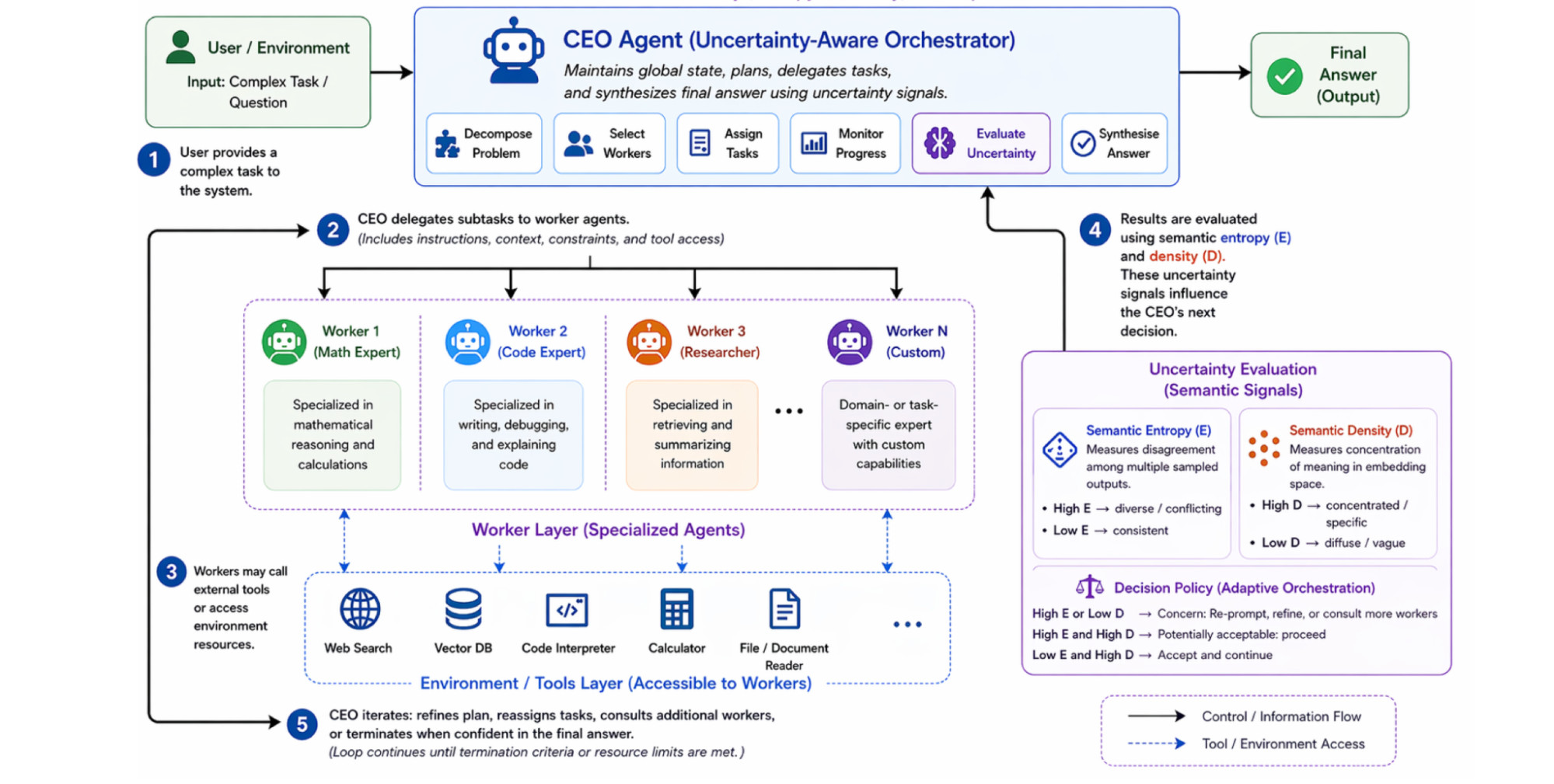
Figure 1. HASSUM system overview. The CEO agent delegates tasks to specialized workers and evaluates responses using semantic density and semantic entropy. Responses that meet both uncertainty thresholds are accepted, while those that do not can trigger reprompting, worker reassignment, or multi-agent collaboration before being evaluated again.
What the results show
The researchers evaluated HASSUM on subsets of StrategyQA, TruthfulQA, and JailbreakBench, three benchmarks selected for their susceptibility to ambiguity and hallucination. Across all three, uncertainty-aware orchestration improved accuracy. StrategyQA increased from 70% to 78%, TruthfulQA from 19% to 41%, and JailbreakBench from 25% to 61%. On the latter two benchmarks, HASSUM more than doubled the baseline accuracy.
The largest gains occurred where agents frequently produced vague, hedged, or unstable responses. Instead of simply applying more reasoning to every task, HASSUM used uncertainty to identify which intermediate responses warranted further scrutiny and direct additional effort toward them.
The results also showed that semantic density and semantic entropy work best together. On StrategyQA, combining both metrics achieved 78% accuracy, compared with 66% for density alone, 64% for entropy alone, and 70% with neither. Semantic density helps identify imprecision, while semantic entropy detects cases in which responses reach competing conclusions. Together, they capture different forms of uncertainty that either metric may miss on its own.
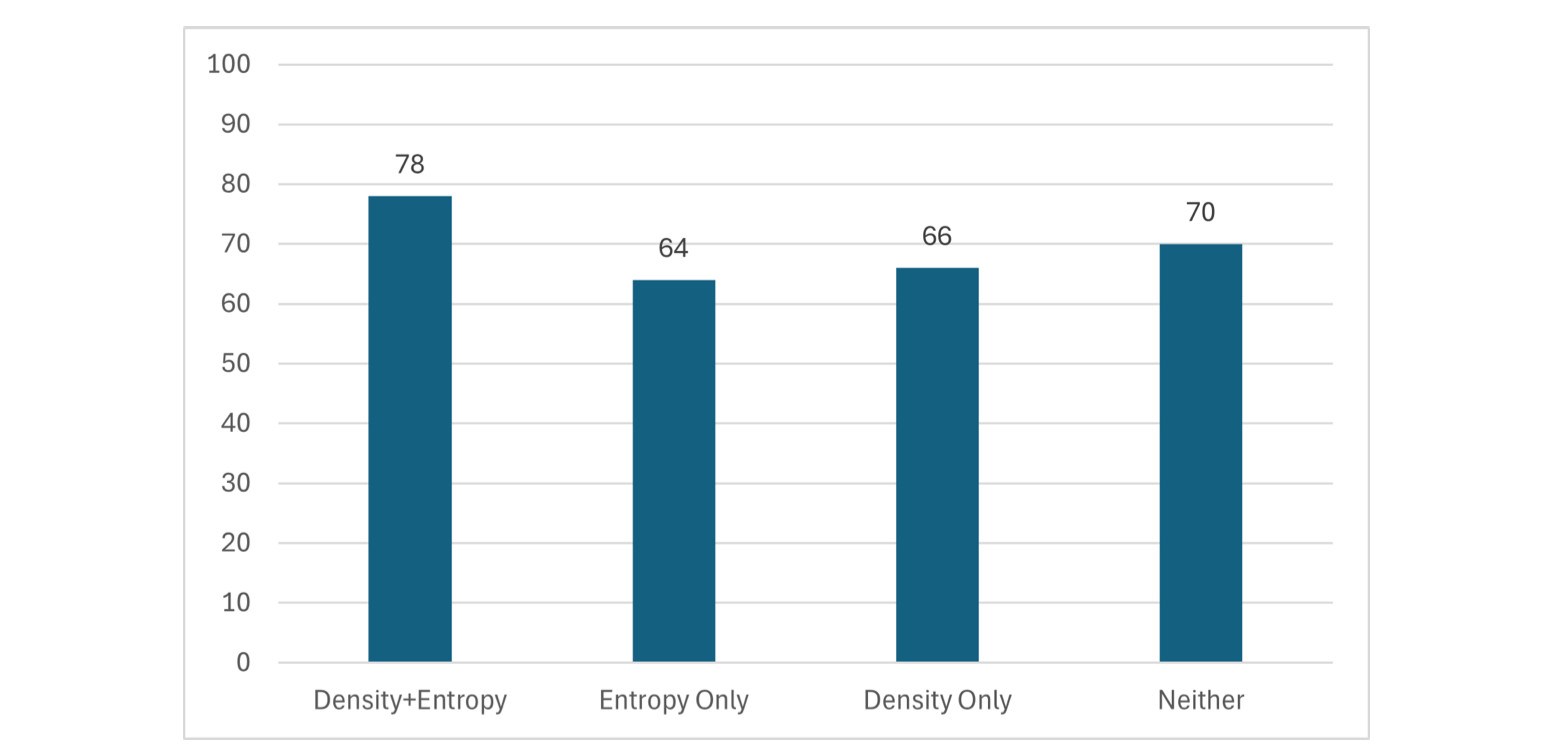
Figure 2. Accuracy across semantic uncertainty ablations on StrategyQA. Combining semantic density and semantic entropy achieved the highest accuracy, outperforming either metric alone and orchestration without uncertainty metrics.
A StrategyQA execution trace shows how this can change an outcome. After a worker incorrectly identified the founder of the University of Pittsburgh, low semantic density scores prompted the CEO to continue reasoning and consult another agent rather than accepting the response. The system ultimately corrected the premise and reached the right answer. Without the uncertainty metrics, the original error was accepted and carried into the final response.
When uncertainty-aware intervention helps, and when it does not
The broader evaluation also revealed an important limitation: uncertainty is not the same as incorrectness. HASSUM was most effective when failures resulted from ambiguity, imprecision, or competing interpretations. It was less effective when an agent lacked necessary facts, retrieved the wrong evidence, made a computational mistake, or followed an incorrect reasoning path with confidence.
This helps explain the mixed results across six additional benchmarks. HASSUM improved IFBench from 47% to 55% and produced little change on several other tasks, but performance declined on the multi-hop question-answering benchmarks MuSiQue and HotpotQA. In those cases, additional reasoning often returned to the same incorrect evidence or reasoning path instead of resolving the error.
The research therefore establishes an important boundary condition: uncertainty is necessary but not sufficient for recoverability. Recognizing that a response warrants scrutiny is only the first step. The system must also choose an intervention suited to the failure, whether that means consulting another agent, retrieving new evidence, invoking a tool, applying another form of verification, or escalating to a human.
Why this matters for real-world multi-agent systems
As multi-agent systems take on longer and more autonomous workflows, an unreliable intermediate response can affect more than the final wording of an answer. It can shape which information the system retrieves, which agent receives a task, which tool is called, or which action is taken next. The more agents and decisions involved, the more opportunities there are for an early mistake to influence the rest of the workflow.
HASSUM points toward a different approach to reliability. Rather than waiting until the end of a workflow to evaluate the outcome, the system can use uncertainty while the work is still underway. This creates an opportunity to direct additional reasoning and verification toward the parts of a workflow that appear least reliable, before their outputs influence other agents.
The research also shows that uncertainty alone cannot solve every failure. Reliable multi-agent systems will need to pair detection with the right response, whether that means consulting another agent, retrieving new evidence, invoking a tool, applying a deterministic check, or escalating to a human. The broader value of HASSUM is that it gives the orchestration layer a signal for deciding when those interventions may be necessary.
Applying Semantic Uncertainty to agent networks in Neuro San
The experiments in this paper apply HASSUM within HASHIRU, a hierarchical multi-agent framework used to test how semantic uncertainty can guide orchestration decisions. The next step is to explore how this approach could be applied within Cognizant Neuro® San, our open-source framework for building and orchestrating networks of specialized AI agents.
Neuro San agents can delegate tasks to specialized peers and connect with different LLMs, tools, and APIs. Incorporating Semantic Density and complementary uncertainty signals could add another dimension to those decisions: not only which agent should handle a task, but how much confidence the network should place in the response that comes back.
An uncertainty-aware Neuro San network could determine whether an intermediate response should move forward, be reconsidered by the original agent, be routed to another specialist, or be checked against an external tool or source. Because a Neuro San network can combine different agents, models, and capabilities, the response to uncertainty would not have to be limited to asking the same model the same question again. The network could introduce a different source of evidence or reasoning path based on the type of scrutiny required.
Applying this research to Neuro San could help make uncertainty part of the network’s orchestration logic, allowing it to determine when to trust, when to verify, and where to direct additional reasoning. This could help prevent uncertain intermediate outputs from quietly becoming inputs to downstream agents while focusing additional computation on the parts of a workflow that need it most.
Building multi-agent systems that know when to intervene
As multi-agent systems move toward longer-running and more autonomous workflows, reliability cannot depend solely on making each individual model more capable. The interactions between agents, the information they exchange, and the orchestration decisions governing those interactions become part of the reliability problem as well.
HASSUM demonstrates a practical step forward. By placing semantic density and semantic entropy inside the orchestration loop, a multi-agent system can identify certain forms of unreliable intermediate reasoning and respond before committing to them. At the same time, the research makes clear that detection alone is not enough. The value of uncertainty depends on whether the system can choose an effective way to recover.
More reliable multi-agent systems will need orchestration mechanisms that can recognize when reasoning deserves further scrutiny, determine which intervention is appropriate, and prevent uncertain decisions from becoming the foundation for everything that follows.
Read the full research: Semantic Uncertainty-Guided Orchestration in Hierarchical Multi-Agent Systems
Explore the related work: Semantic Density | Semantic Density Demo | Cognizant Neuro® San

Risto Miikkulainen is VP of AI Research at Cognizant AI Lab and a Professor of Computer Science at the University of Texas at Austin.