

August 6, 2026
A Self-Improving AI Agent Just Broke a Math Record That Stood Since 2011

A Self-Improving AI Agent Just Broke a Math Record That Stood Since 2011
An AI coding agent, built on Claude, was set loose to write and rewrite its own optimization solver with little human guidance beyond a benchmark to test against. In the process, it broke a math record that had gone unchallenged since 2011, and generated an answer that anyone can independently verify in seconds.
One of the open questions hanging over the current wave of AI agents is whether they can actually produce something new, or whether they are simply very good at repackaging things that already exist somewhere in their training data. It is a difficult question to settle in most real-world settings, because most real-world outputs, a report, a piece of code, a strategy memo, do not come with a way to prove they are correct. This case is different, and that is what makes it worth a closer look.
The task itself sits inside a corner of mathematics called circle packing: given a square and a fixed number of circles, arrange the circles so none overlap or cross the boundary, and make the combined size of all their radii as large as possible. It sounds narrow, and it is, but that narrowness turns out to be exactly what makes it a useful way to test an AI agent, for reasons worth walking through below.
Against that backdrop, a Cognizant AI Lab experiment led by Principal Research Scientist Jason Liang produced a result worth explaining in full. An AI coding agent built on Anthropic's Claude was given a benchmark to test against and told to write and rewrite its own solver, with no algorithm handed to it and no person guiding its approach. Working through repeated cycles of trial, testing, and revision, it arrived at a new arrangement of 27 circles that broke a record which had gone unchallenged for more than a decade. The arrangement is not a guess dressed up to look convincing. It is a set of coordinates that a separate, independently written program can check and confirm as valid in a fraction of a second, which means the claim does not rest on trusting the AI that produced it.
That alone would be a good story. What makes it a more useful one is what the team found when they looked at how much it cost to get there, and at what point in the process the winning idea actually showed up. The answer reshapes a common assumption about where AI capability comes from, and where it is worth spending more to get it.
What Circle Packing Is, and Why It Has Become an AI Benchmark
The rules are simple to state in full. Take a square, fit a fixed number of circles inside it of any size, make sure none overlap and none extend past the edge, and maximize the total of all their radii. There is no ambiguity in this and no partial credit: an arrangement either satisfies every constraint or it does not, and a proposed total either beats the current best or it does not.
That rigidity is exactly why circle packing has become a useful benchmark for AI systems that write their own code. Someone has to keep score, and for circle packing that role belongs to Packomania, a reference site maintained for decades by Dr. Eckard Specht that tracks the best arrangement anyone has ever submitted for every number of circles, the way a record book tracks the fastest verified time in a given event. Beating an entry on that table means beating the best arrangement anyone has ever submitted, not just the ones a particular research team happened to know about. That is what has made Packomania a public benchmark for AI systems that write their own code, used as a showcase by Google DeepMind's AlphaEvolve and Sakana AI's ShinkaEvolve.
The Record: A Small Numerical Gain With an Outsized Amount of Context Behind It
For the 27-circle case, our AI agent found an arrangement with a sum of radii of 2.685978684198. The previous record was 2.685350025228, set by D. W. Cantrell on the sci.math forum. The improvement, 0.000628658970, is about 0.023 percent.
That margin is easy to dismiss until you consider how long it had gone unmoved. The previous record had stood since 2011 and had not been bettered since. Packomania has now accepted the new arrangement as the listed record, crediting Jason Liang, and noted its "remarkable D1 symmetry," meaning the arrangement is a mirror image of itself across a diagonal. Comparing the two side by side shows exactly where the gain came from: where the old arrangement used two matched circles straddling that diagonal, the new one replaces them with a single larger circle placed directly on it.
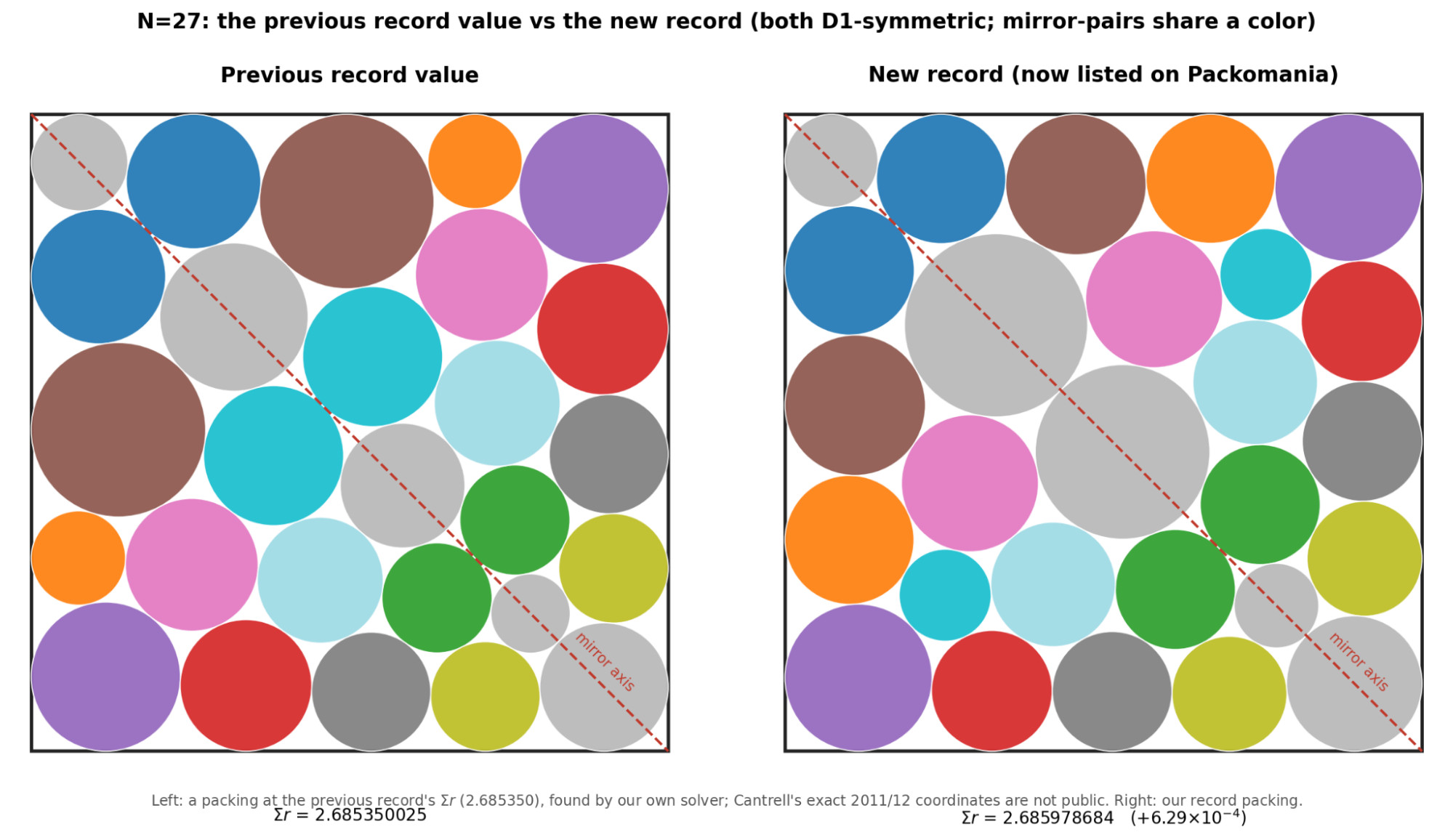
Figure 1: The old world record and the new 27 lap record, shown side by side. The old arrangement appears on the left and the new one on the right, with the mirror axis marked as a dashed line and mirror-image pairs sharing a color; the gain comes from replacing two matched circles that straddled the axis with a single larger circle placed directly on it.
It's worth being precise about the scope of this result. The agent improved a long-standing classical entry, not one of the more recent AI-generated arrangements. On the 26-circle problem, the size that AlphaEvolve made famous, the agent matches the best known value but does not surpass it. This is one specific, independently verified result, not a claim that the agent now outperforms every existing method across the board.
How the Agent Did It: No Person Wrote the Solver
No one wrote the underlying algorithm. The agent worked in short, repeated cycles: modify the solver, test it against a fixed benchmark, record what happened, save the result, and start again. Its version history effectively became its memory of what had and had not worked. The team ran six of these improvement loops in parallel as a controlled experiment, and the record-breaking arrangement came from the most exploratory of the six, the one given permission to rewrite its own improvement process rather than only its solver.
The method the agent converged on is worth explaining because it differs from the approach used by other AI systems on this same problem. The agent identified that if the positions of the circle centers are fixed first, then calculating the largest radii that will still fit becomes a problem that can be solved exactly rather than approximated. So the solver searches only over center positions, tests many random starting layouts, keeps the best result, and finishes with a rescaling step that guarantees every reported answer is strictly valid rather than merely close. The team confirmed the agent had not reproduced a published implementation. It had reconstructed this approach independently from what it already knew.
Across the full range of the number of circles tested, the solver matched the existing world record exactly for lower numbers, beat it for the 27-circle case, and fell short on the larger numbers. That shortfall might reflect the limited computing time allotted to the solver and not a limitation of the underlying method.
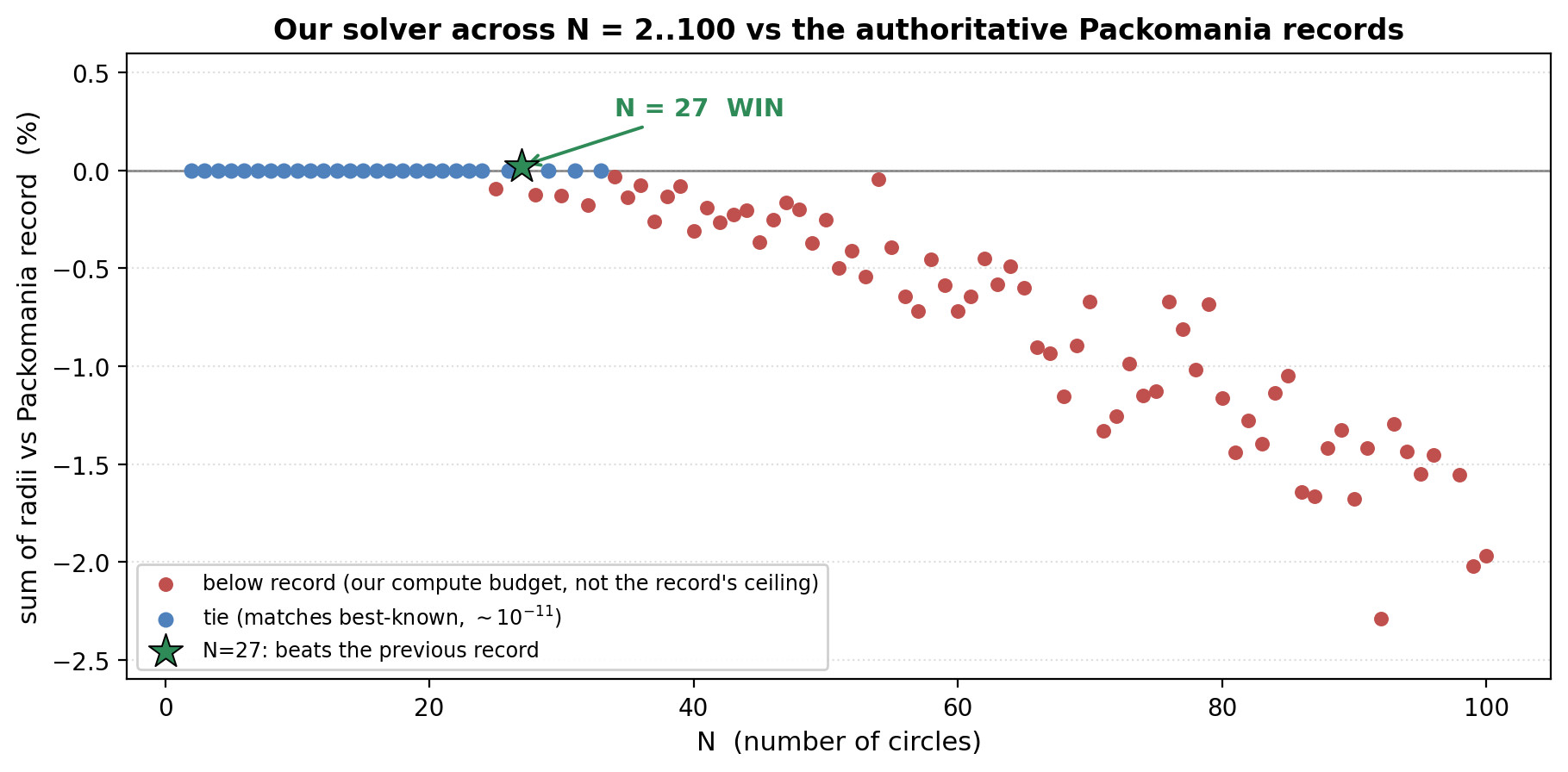
Figure 2: How the solver performed at every number tested. Each dot represents a particular number of circles: blue dots mark numbers where the solver matches the existing world record exactly, the green star marks the 27-circle problem where it broke the record, and the red dots on large numbers show where it fell short, a possible result of limited computing time rather than a limit of the method. Note: results shown here are inherently noisy due to starting seed; some seeds will allow solver to match the record, others will not.
The Finding the Team Did Not Expect
Because the search process involves randomness, a single run of any solver version reveals very little on its own. So the team tested every version the agent produced across its full history of self-improvement, running each one fifty times from different starting layouts, to determine which versions could reach the record-beating arrangement at all.
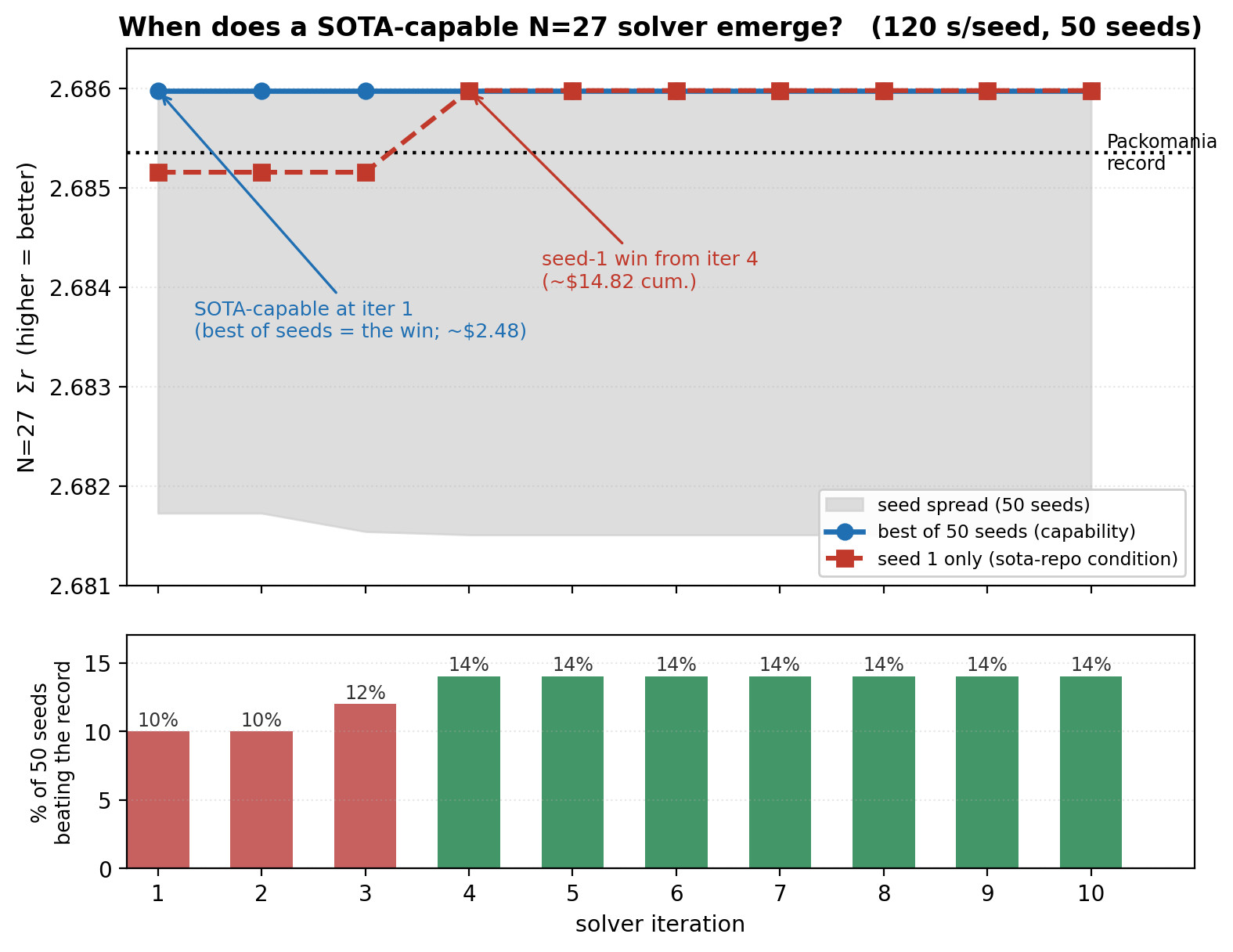
Figure 3: When the record-beating ability first appeared, and what it cost to get there. The very first solver iteration, costing about $2.48, could already reach the record-beating arrangement; roughly $12 of additional self-improvement after that point didn't raise the ceiling, but it did raise the success rate per attempt from 10 percent to 14 percent.
The result ran counter to expectation. The very first iteration, which cost about two dollars and forty-eight cents to produce, could already reach the record-beating arrangement. Roughly twelve additional dollars of self-improvement after that point did not raise the ceiling at all. What it improved instead was consistency. The success rate per attempt rose from 10 percent to 14 percent.
That distinction matters. The underlying capability came from the model itself, and it appeared early and at low cost. The self-improvement loop's contribution was not a new ability. It was turning a promising first attempt into something reliable.
Why This Matters to Industry, Beyond a Single Math Benchmark
Most AI agents today retrieve, summarize, or recombine information that already exists somewhere in their training data or context. This is a small, fully checkable instance of an agent producing something that was not already available as an answer. That distinction carries three practical implications.
First, a great deal of real optimization work shares the same underlying shape as circle packing: maximize a value subject to hard constraints that cannot be relaxed. Delivery routing, chip and circuit board layout, warehouse slotting, and staff or machine scheduling all fit this pattern. An agent capable of independently assembling a strong custom solver for problems shaped this way has an immediate and practical application.
Second, the result is verifiable, which is the detail that should carry the most weight for anyone evaluating AI-generated claims. The winning arrangement is simply a list of coordinates, and a separate checking program that shares no code with the solver confirms its validity in a fraction of a second. In a field where AI claims are often difficult to audit, being able to say "here is the answer, and here is an independent check that confirms it" is what makes a result safe to act on.
Third, the cost data points to a specific conclusion for anyone deciding where to invest. If genuine capability tends to arrive early and cheaply, and additional spend primarily buys reliability rather than new ability, then the more valuable investment is in the scaffolding that makes a model's first good idea dependable and reusable, rather than in progressively larger amounts of undirected search.
Where the Solver Still Falls Short
The solver is not uniformly strong, and that is worth stating plainly. On large boards, it trails the current records by up to about 2.3 percent, and at 97 circles, a single run failed to return a valid arrangement at all. Each of the six experimental runs represents a single trial, so differences between them should be read as suggestive rather than statistically conclusive. Because the search relies on randomness, repeating it does not guarantee rediscovering this specific result, although the saved arrangement itself remains valid permanently now that it has been found.
The solver, an independent checker, and every result from this experiment are openly available in the circle-packing-sota repository on GitHub, for anyone who wants to verify the result directly or build on the method.
The Follow-Up Run, and 21 Records at Once
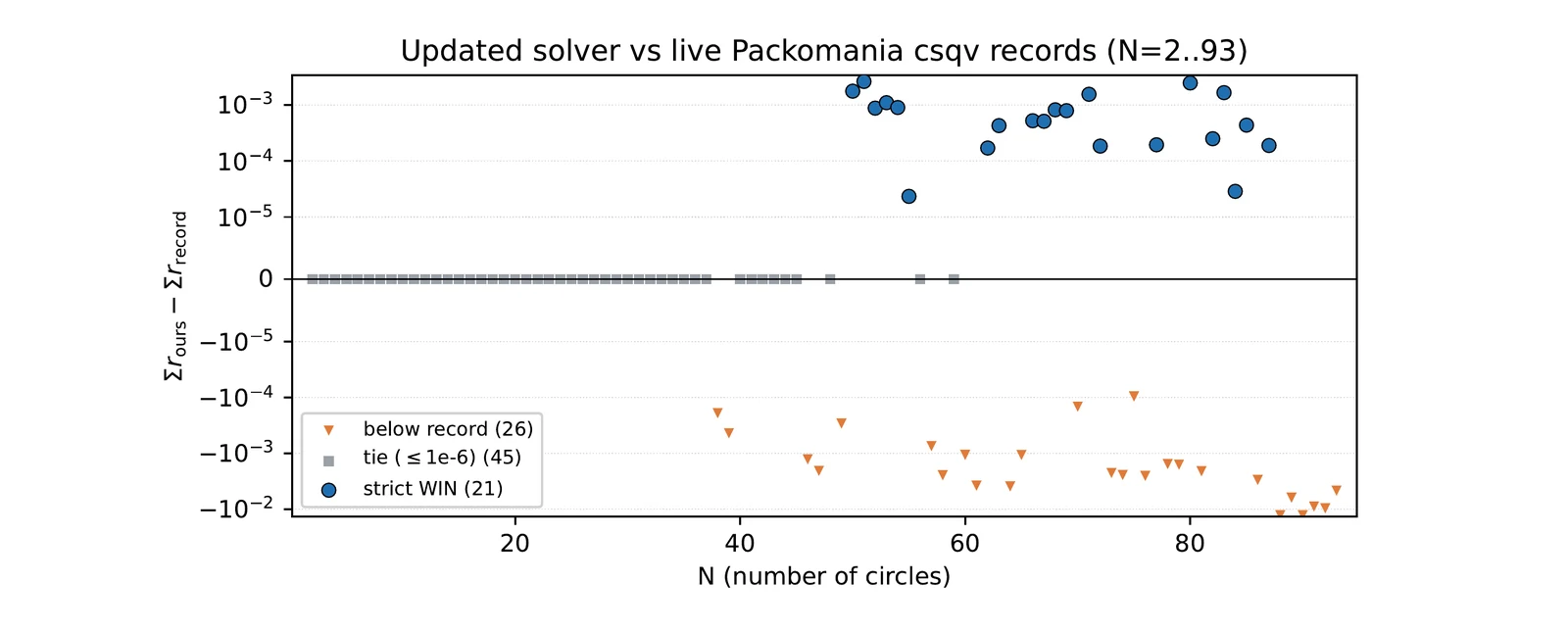
Figure 4: Our updated solver compared against live Packomania records for N = 2 to 93. The vertical axis is the sum of radii our solver achieved minus the published record, plotted on a symmetric log scale so that both tiny and large differences stay visible. Blue points above the line are the 21 strict wins, gray squares are the 45 ties, and orange triangles below the line are the 26 sizes where the published record still stands. Small N is essentially solved territory, which is why the left side of the chart is a flat row of ties, and the interesting behavior only starts once N passes roughly 37.
The 27-circle result was the beginning. The self-improvement loop was run again a few days later and discovered an updated solver adapted for larger values of N. It was then used to sweep every packing size from 2 to 93 circles under increased time budgets, and it beat 21 of Packomania's live records at once (N = 50 to 55, 62, 63, 66 to 69, 71, 72, 77, 80, 82 to 85, and 87), by margins ranging from 2.3e-5 to 2.6e-3.
The core algorithm is again a past idea from the literature. If you fix the circle centers, the best radii are the exact solution to a linear program, which is Eppstein's formulation, so the solver searches only over centers and every configuration it scores is feasible by construction. Three other established pieces do the rest. No technique in the pipeline is new, and the loop's contribution was integrating and combining them in a novel way into a working solver, unaided.
Most of the 21 wins are against recent entries, and the table of records is updated quickly, so a win means "above the best published value" and never "optimal." The 27-circle result is already listed on Packomania, and our new solver ties the value it set. None of this changes the central claim; it widens it. A self-improving loop, given only a benchmark and no algorithm, wrote its own solver and produced 21 independently verifiable results that beat existing records.
What makes this worth reporting is not the size of any single margin, but that the loop moved from one result to a general solver on its own, and that the entire sweep can be re-run and checked by anyone. The solver, an independent checker, and every result from this blog post are openly available in the circle-packing-sota repository on GitHub, for anyone who wants to verify the results directly or build on the method.
Records like these change hands often, and some of the 21 will not survive long. That is fine, and in a sense it is the point. The durable result is the process: a system that reads a benchmark, assembles a method from what is already known, and improves on the state of the art without a human deciding which techniques to combine. We will keep pointing that loop at harder problems and reporting what it finds, including the cases where it comes up short.

Research scientist who specializes in research of LLMs, neuroevolution, evolutionary algorithms, and applications of neural networks