

October 28, 2026
The Agentic Web Needs Both a Phone Book and Builder Tools

The Agentic Web Needs Both a Phone Book and Builder Tools
As the agentic web takes shape, NandaIndex and Neuro San are tackling two essential challenges: making AI agents discoverable and making it easier to build, deploy, and connect them.
The early web had one simple rule. If you had a link, you could reach the page. Agents don’t work that way yet.
An agent built inside a company lives in that company’s catalog. An agent on a platform lives in that platform’s registry. Others are found through DNS records or gateways, and many can’t be found at all. These systems are not always connected. The NandaIndex paper describes these separate systems as “discovery islands.”
With the prospect of a large emergent economy where billions or trillions of agents work on our behalf, not having agents discoverable could be costly. Version 0.1 of NandaIndex is now available, introducing a federated resolution architecture designed to act as a common switchboard for AI agents.
NandaIndex takes a stable agent ID and points to wherever that agent is listed, whether that’s a company catalog, a DNS record, a platform registry or a national directory. It uses formats that already exist and adds no new protocol. The systems people already use stay in place.
It also keeps an agent’s ID separate from where the agent runs and where its details are stored. You can move hosts or change providers, and people can still reach your agent at the same address. We’re really encouraged by this step, as it builds on the open source tools we have been creating to enable people to build the first agent networks for the world wide agentic web.
Building something worth finding
This is where Cognizant Neuro® San comes in. It’s our open-source framework for building teams of agents that work together – you can vibe an agent network, auto-generate test cases, recursively self-improve your network then deploy it at scale, building-in trust and safety along the way. NandaIndex helps you find an agent. Neuro San helps you build one worth finding.
Why use Neuro San to create agent networks for NandaIndex?
Your agents can move. In Neuro San you describe your agents in a simple config file instead of hard-coding them. The same setup can run on a laptop, in the cloud or on a hosted service. That fits NandaIndex well, because your ID stays the same wherever your agents run.
You don’t need to be a developer. You can describe the agents you want in plain language and Neuro San builds them.
It works with what’s already out there. Neuro San works with any major LLM and supports open protocols like MCP and A2A. NandaIndex takes the same approach to discovery.
Trust is built in. Neuro San keeps sensitive data away from the LLM and shares it only with the agents and tools that need it.
Missing a feature? Fork it. Because Neuro San is offered under Apache 2.0 it’s easy to fork and clone the repo to add the features you need.
Put together, it’s simple. Build your agents in Neuro San, run them wherever you like, describe them in a standard format and register them with NandaIndex. Your agent is now one step closer to having an address on the agentic web.
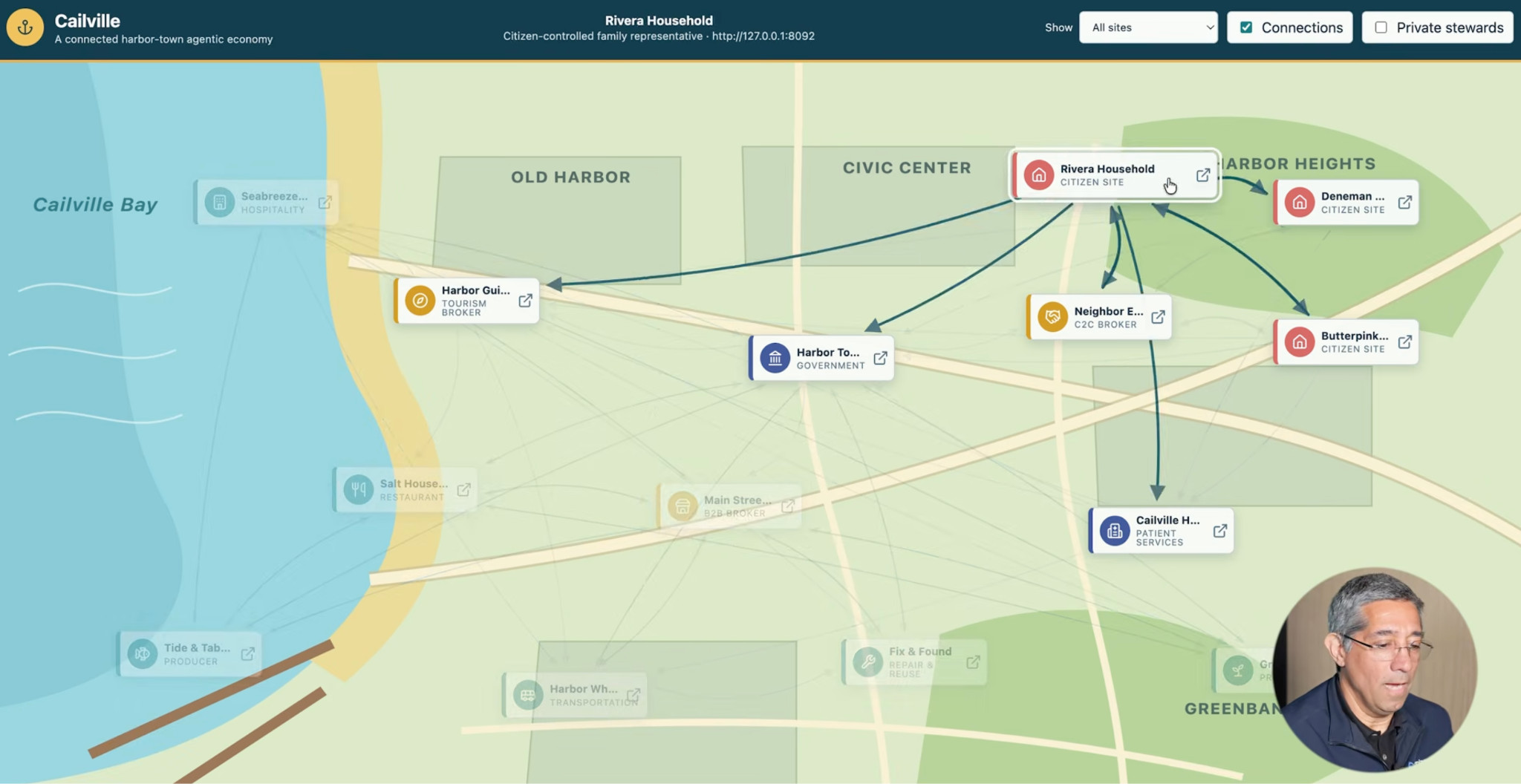
Here’s what that might look like in practice. In this short demo, I built a series of agent networks in Neuro San, deployed them, and registered them so they could be discoverable.
What’s still open
NandaIndex is an early version of what an agent switchboard might look like, and the team is open about what’s unsolved. How do you safely link an email-based ID to a domain? How does one index trust what another tells it? How should the different layers hand off to each other?
These are the right questions. The people building and running real agents will find out where the answers hold and where they break, so they should help shape them.
Join us
The first web pages were simple. They mattered because they came first and set the patterns everyone followed. The agentic web is at that stage now.
If you build agents, try Neuro San and register what you make. If you work on discovery, identity or trust, join the NandaIndex conversation. Together we can turn discovery islands into a connected web.

Babak Hodjat is the Chief AI Officer at Cognizant and former co-founder & CEO of Sentient. He is responsible for the technology behind the world’s largest distributed AI system.