
Why legacy modernization is now a security question
<p><br> <span class="small">September 09, 2026</span></p>
<h2><b><span class="h6">Legacy systems were not designed to fend off threats moving at AI speed. This puts modernization on the same page as the cyber resilience agenda.</span></b></h2>
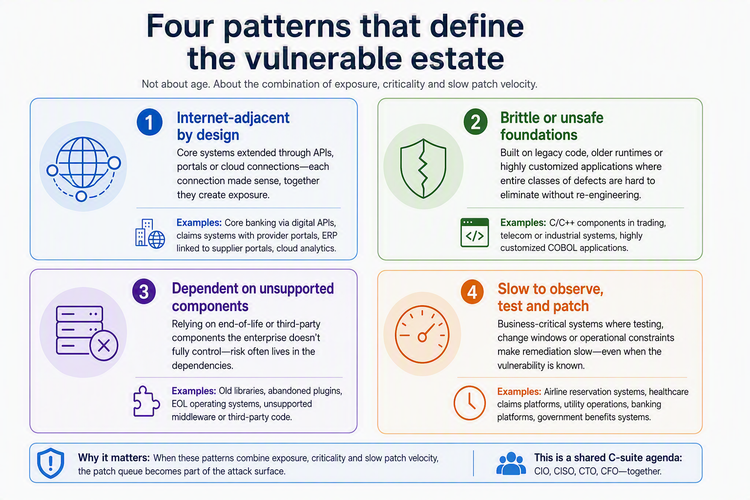
<p>Legacy modernization has reached an important inflection point. For years, modernization has been discussed as a productivity, agility and cloud economics agenda. Frontier AI has changed that. By accelerating the speed at which vulnerabilities are discovered, it has forced legacy systems out of the IT roadmap and into an enterprise security posture, where they now belong.</p> <p>This shift is playing out in the open. With each new generation of frontier models, we see capabilities emerge that make vulnerability discovery and exploitation faster and more automated. This is followed by reports of jailbreaks, disclosed incidents and policy intervention as governments and model providers weigh how tightly to control access.</p> <p>While the specifics may change every cycle, the direction does not. Each round pushes the ceiling on what a motivated actor—human or machine—can find and exploit at scale. The trend line has been consistent enough that no single incident is really the story anymore. The pattern is the story, and it belongs in the boardroom now, not on the security team's status report.</p> <h3><span class="h4" style="font-weight: normal;">A Y2K moment, minus the date</span></h3> <p><a href="https://www.cognizant.com/us/en/insights/insights-blog/frontier-ai-exposes-enterprise-architecture-flaws" target="_blank">We have described this before</a> as a Y2K-like moment, and the comparison holds in one sense: Every organization has to take a serious look at the systems it depends on. But with Y2K, we knew the date and the failure mode, and there was a coordinated global response. This time, there is no fixed deadline, no single remediation playbook and no guarantee that defenders will see the exposure before adversaries do.</p> <p>A bank, an airline, an insurer, a healthcare payer or a government agency may be running systems that have operated reliably for decades. The issue is not that those systems are old. It’s that AI can now understand, probe and stress-test them at a speed that changes the underlying risk equation. Reliability over time does not equal defensibility in an AI-enabled threat environment.</p> <h3><span class="h4" style="font-weight: normal;">Machine-speed offense; calendar-speed defense</span></h3> <p>While vulnerability discovery and exploit development are accelerating, patching, testing and business sign-off are still moving at enterprise speed, and enterprise speed has not caught up to the moment.</p> <p>AI can help security teams discover more, but the real constraint is whether the enterprise can triage, test and deploy a fix quickly enough to matter. When it cannot, the patch queue itself becomes part of the attack surface.</p> <p>A healthcare claims platform may carry a known exposure, but patching it could disrupt provider payments. An airline scheduling system may need weeks of regression testing because downtime is not an option. A utility operations platform may need to be tested against physical infrastructure and safety requirements before a single change goes live. In each case, the business impact of patching slows remediation more than the technical fix itself.</p>
#
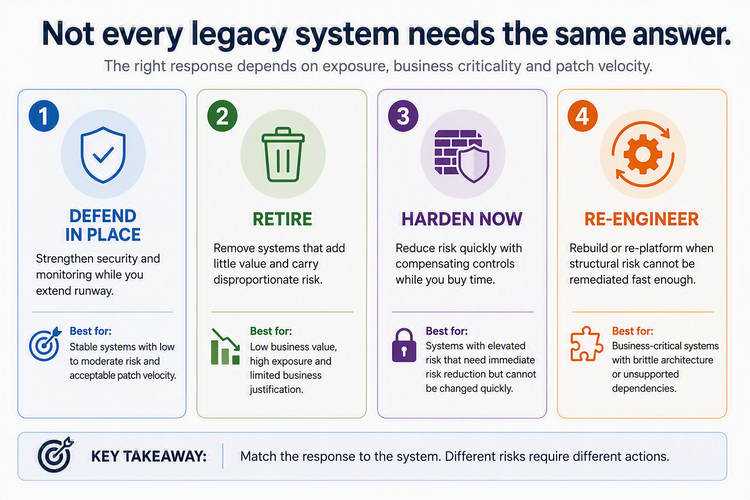
<h3><br> <span class="h4" style="font-weight: normal;">A shared responsibility across the C-suite</span></h3> <p>When we talk about legacy risk, we are not talking about abstract systems sitting in a data center. We are talking about the platforms that process payments, adjudicate claims, schedule flights, manage utilities, move goods, administer benefits and connect suppliers. Most of them were never designed for today's level of connectivity. They were extended over time, through APIs, portals, partner access, cloud reporting, mobile interfaces and third-party integrations. Each connection made sense on its own. Together, they create a very different exposure profile than the one the original architects had in mind.</p> <p>This is where the conversation has to change at the leadership level. The CIO may own modernization. The CISO may own cyber resilience. The CTO may own architecture and engineering standards. The CFO may own capital allocation and risk trade-offs. The exposure does not sit neatly in one function.</p> <p>Behind many security exposures is an architectural condition: unsupported platforms, fragmented identity, limited observability, hard-coded access, unmaintained libraries, applications that cannot be patched without breaking the business they support. The vulnerability is the symptom. The architecture is often the condition that allowed it to it persist.</p> <p>In banking, this becomes a joint CIO-CISO-CTO-CFO discussion about defending a core existing platform versus re-platforming. In healthcare, it becomes a decision about whether claims modernization gets funded as an efficiency program, a resilience program or both. In utilities, it requires IT, OT, cyber and operations leaders to agree on what can be segmented and what must be re-engineered. Modernization funding is becoming a shared risk, resilience and growth decision across the C-suite, not a line item that any one function owns alone.</p> <h3><span class="h4" style="font-weight: normal;">Triage, not blanket transformation</span></h3> <p>Not every legacy system needs the same answer. As the infographic below details, some systems can be defended in place, and some should be retired. Some need hardening now, and others need to be re-engineered.</p>
#
<p><br> The right response depends on exposure, business criticality and a serious assessment of whether the enterprise can realistically keep pace with remediation on that system as it stands today.</p> <h3><span style="font-weight: normal;" class="h4">Where to start: Map the estate, then test it like an attacker</span></h3> <p>The first move does not have to be a transformation program. Often it is simpler: Build a map showing which systems matter most, where they connect, what they depend on, who owns them, how quickly they can be patched and the blast radius if something goes wrong.</p> <p>Then, test that map adversarially. Ask the questions a machine-speed attacker would ask: Which systems would become attractive first, given their combination of connectivity, privilege, dependency and slow response? For some enterprises, the priority may be the legacy workflow connecting customer channels, identity, supplier data and core transaction processing. For others, it may be a third-party integration carrying privileged access. For still others, it may be the business-critical system the team cannot patch fast enough without disrupting operations. The highest-risk system is usually the one where those factors overlap, not the one that looks biggest on an asset inventory.</p> <h3><span style="font-weight: normal;" class="h4">Modernization is how enterprises become defensible</span></h3> <p>Hardening in place buys time, and time matters. But for systems where the patch cadence will never catch up, hardening alone does not change the underlying structural position. Modernization does.</p> <p>That is the mandate in front of every enterprise now. Legacy modernization is no longer a separate agenda from cyber resilience. It is how an organization becomes defensible in an AI-enabled threat environment, and getting there is a conversation the CIO, CISO, CTO and CFO need to have together, not as four separate initiatives that happen to touch the same systems.</p> <p>The starting point is the same for any enterprise: Know what you are running, know what it connects to, and know how an AI-enabled attacker would rank it. Everything else follows from that map.</p> <p><i>As an AI Builder, Cognizant is putting the same intelligence, engineering discipline and governance we have built into work like Neuro® AI Trust to work on the defense side of this equation, helping clients understand, secure and modernize their estates faster than traditional programs allow.</i></p>

<p>Vishal leads Cognizant’s global cybersecurity strategy, strengthens threat protection capabilities and advances digital trust across client enterprises. Under his leadership, Cognizant is scaling its cybersecurity offerings to meet the evolving needs of global organisations, with a focus on resilience, regulatory alignment and secure digital transformation.</p>

<p>Rajesh leads the company’s software engineering group and operational model globally, in addition to overseeing the company’s presence in India. Guiding strategic direction across the company’s digital engineering, application development and management, and quality engineering and assurance teams—along with operational strategy, processes, workforce sourcing and delivery excellence—he defines how engineering capability is built, scaled and delivered to clients worldwide.</p>