
Beyond the agent harness: What enterprise AI needs to become reliable
<p><br>
<span class="small">September 18, 2026</span></p>
<h2><span class="h6">A harness, including context engineering, gets an agent deployed. Four capabilities beyond it decide whether it can be trusted in production.</span></h2>
<p>Enterprise AI is converging on a shared story: The model is a commodity, and the real work is in building the agent harness, meaning the orchestration, tool access, memory, governance and context engineering that turn a raw model into something usable inside the business. That story is right as far as it goes.</p>
<p>But there's a danger in treating the harness as the finish line. While a harness makes an agent safe and deployable, it cannot make it reliable across runs, correct on complex tasks, economical at scale and better next quarter than today.</p>
<p>The evidence is mounting that an additional chapter of the story—which speaks to four essential capabilities outside the harness—is often missing from enterprise conversations today.</p>
<h3><span class="h4">AI reliability: the right metric to track</span></h3>
<p>Part of why this gap goes unnoticed is that the industry has been measuring the wrong thing. The field has spent its energy calculating the average accuracy of AI models, which has climbed impressively. But accuracy is the demo, and reliability is the product. </p>
<p>Princeton’s Arvind Narayanan calls the constraint the capability-reliability gap. Measuring 14 models across 18 months of progress, <a rel="noopener noreferrer" href="https://www.normaltech.ai/p/new-paper-towards-a-science-of-ai" target="_blank">his team found</a> that rapid capability gains produced only modest reliability gains: On one customer-service benchmark, reliability improved at one-seventh the rate of accuracy.</p>
<p>This matters because reliability compounds downward. A 10-step workflow where each step is 95% reliable is roughly 60% reliable end-to-end. Every step a harness adds to make an agent capable is another step where reliability can decline, which is why more orchestration alone does not produce a more dependable system.</p>
<h3><span class="h4">What real-world benchmarks tell us about reliability </span></h3>
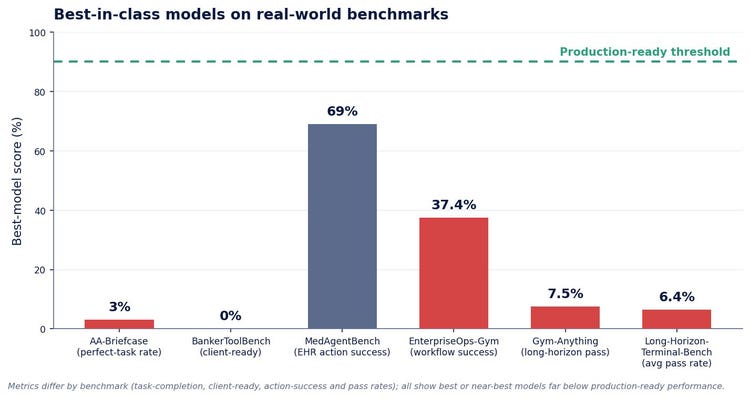
<p>A new generation of benchmarks came out this year that reflect real work because the agents are given tools, environments and full context. For example:</p>
#
<ul>
<li><b>AA-Briefcase</b> (Artificial Analysis) asked a model to act as a consultant for six weeks: Synthesize tens of thousands of messages, build a financial model, brief a board. Anthropic Claude Fable 5 satisfied every task criterion just 3% of the time, and on 31 of 91 tasks, no model cleared 50%, even though the benchmark ran inside a working harness.<br>
<br>
</li>
<li><b>BankerToolBench</b> (Handshake AI, built with 502 investment bankers) scored multi-file deliverables against expert rubrics averaging 150 criteria. The best model managed 58.1% and produced zero client-ready outputs.<br>
<br>
</li>
<li><b>MedAgentBench</b> (Stanford) used agents that received 100 real patient profiles and 700,000+ clinical data points, then had to act inside an EHR. Models that ace medical licensing exams reached under 70% and did markedly worse on actions than on lookups. Grounding was not the problem; reliably doing was.<br>
<br>
</li>
<li><b>EnterpriseOps-Gym</b> (ServiceNow) dropped an agent into a sandbox of 164 database tables and 512 tools. The top model hit 37.4%, and the binding constraint was planning, not tool use: Handing agents a human-authored plan lifted performance by 14 to 35 points.<br>
<br>
</li>
<li><b>Gym-Anything</b> (Carnegie Mellon) spans 12,000+ tasks across every major US occupation group. The best model averaged just over 50 out of 100, falling to 7.5% on long-horizon tasks. Its behavioral finding is the most useful result in the literature: Failed agents spent 78% of their steps stuck in retry loops, and the single strongest predictor of success was whether the agent paused to verify its own work, present in 91% of wins versus 70% of losses.</li>
</ul>
<p>Two more recent studies, from Alibaba and Tencent, echo the pattern. Alibaba's MerchantBench ran a year-long e-commerce simulation on 98,843 real product records; the best agent ended the year with just 27.3% of the net worth a human operator built. Tencent's Long-Horizon-Terminal-Bench found a 6.4% average pass rate across 17 frontier models, with 79% of failed runs simply timing out mid-task—the same kind of failure Gym-Anything documented. </p>
<p>The common thread is that the context was not withheld. What agents lacked was reliable long-horizon reasoning, planning and error recovery, the things a harness surrounds but cannot supply. Part of the answer is architectural: decomposing work across specialized agents rather than overloading one. But structure alone does not make a system reliable, and that is what the capabilities below provide.</p>
<h3><span class="h4">Four capabilities beyond the agent harness</span></h3>
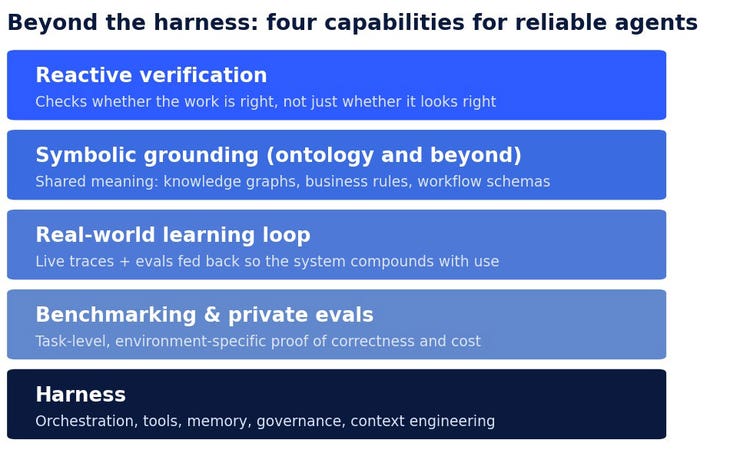
<p>The harness is the execution layer. It controls how an agent acts, and it remains necessary as the foundation to build on. The four capabilities that follow are the layers of measurement, meaning and improvement that the harness cannot supply on its own. </p>
<p>One theme runs through all of them: As the benchmarking evidence above shows, the harness is a variable to select and tune on evidence, not a fixed default.</p>
#
<p><b>1. Real-world benchmarking and private evals.</b> Most organizations cannot move an agent to production because they have no defensible way to prove its output is correct. “AI isn’t delivering ROI” usually means “we can’t measure whether it works.” </p>
<p>The answer is task-level evals against your own environment: rubrics of 100 or more atomic pass/fail criteria per task, paired with gold-standard deliverables from domain experts. Across a vertical, that corpus becomes the moat, capturing conventions and failure modes no public leaderboard contains. </p>
<p>Benchmarking also shows the harness itself is a variable worth measuring. Databricks, testing on its own multi-million-line codebase, found that running the same model through two different harnesses changed cost-per-task by more than 2x at identical quality. The harness you pick can double your bill, and without private benchmarking, one will never see it. This is why “meta-harness” tools that switch and compose harnesses are emerging.</p>
<p><b>2. A real-world learning loop. </b>Most deployed agents are static. They ship, then they sit, improving only when someone manually retrains them. The compounding advantage comes from a closed loop that turns live execution, workflow traces and evals back into improvement.</p>
<p>There is now hard evidence this is a distinct regime: ByteDance-Seed and Tsinghua both found a measurable scaling regime for real-world learning, separate from the familiar pre-training scaling laws. Gym-Anything showed the payoff concretely: a distilled 2-billion-parameter model trained on real trajectories beat a base model twice its size. </p>
<p>This is what Microsoft CEO Satya Nadella means when he uses the term "hill-climbing machine" on company-owned evals. The tenth engagement’s evaluation corpus is far richer than the first, and the gap widens every cycle, because the inputs are your workflows, your experts and your time.</p>
<p><b>3. Ontology and the broader case for symbolic grounding. </b>Many failures are less about calling a tool wrong and more about the agent not understanding what the enterprise means. Symbolic grounding means giving a probabilistic model an explicit structure to reason against, whether a knowledge graph, formal business rules or a workflow schema. </p>
<p>The richest form is an ontology. a machine-readable map of a domain’s concepts, relationships and rules, typically held in a knowledge graph. It supplies grounding (the agent queries the graph instead of guessing), disambiguation (“premium” means different things in insurance and banking), governance (rules the agent must obey even when the model disagrees) and audit-ready explainability. </p>
<p>Concepts like building thin agents on a smarter substrate are now emerging, resting on three pillars: a business ontology (concepts in the language employees use), a technical ontology (metadata for every data asset, so agents find the right source automatically) and execution traces (runtime signals that feed the learning loop). Ontology sits beneath the harness as its semantic substrate. The harness controls execution, the ontology supplies meaning, and enterprise agents need both.</p>
<p>A growing neurosymbolic movement goes further still, moving trust-critical reasoning out of the model and into deterministic engines; ontology-based grounding is the pragmatic entry point on that same path.</p>
<p><b>4. Reactive verification.</b> Every capability above depends on the ability to grade whether work is correct, and doing that at scale means automating the grading. Most teams use a text-only LLM judge, which can only tell whether output looks right. It cannot open the spreadsheet to check the formulas, confirm a cited policy exists or verify a system change happened. An agent can report that a compliance check ran when it never did, and a judge reading the summary will never catch it. </p>
<p>Reactive verification fixes this on three principles: It runs inside the agent’s environment (opening real artifacts, querying real systems), it decides at inference time what evidence to inspect rather than following a fixed script, and it carries swappable domain guidance so one architecture serves any vertical. </p>
<p>The payoff is that architecture beats model: A reactive verifier on a small, cheap model beats a text-only judge on a large one. Gym-Anything’s environment-grounded verifier agreed with human judges 93.3% of the time versus 43.3% for a naive checker, and caught agents fabricating results and bypassing interfaces entirely.</p>
<h3><span class="h4">Moving toward reliable enterprise AI</span></h3>
<p>Foundation models improve every quarter, and every competitor rents the same ones on the same terms. The moat is the measurement, meaning, learning and verification built around them, none of which appears on a model card. So, the decisive question is shifting from “which model do you use?” toward “how do you prove this works, and can you show me the evidence?”</p>
<p> A strong harness, context engineering included, was the right place to start. But measuring agents against their own work, grounding agents in meaning, closing the learning loop and verifying whether the work is actually right turns agentic AI from a cost center into a durable, appreciating asset. </p>

Nikhil is an AI Strategist and AI GTM Partnerships Lead at Cognizant, shaping AI offerings and co-sell initiatives with frontier partners. A Claude Certified Architect, he works at the intersection of strategy, go-to-market, and solutioning, turning agentic AI into differentiated propositions, compelling narratives and measurable business outcomes across industries.