
How to resolve digital channel conflict in the agentic era
<p><br>
<span class="small">October 22, 2026</span></p>
<h2><span class="h6">Agentic commerce and paid social are not competing channels. Judging both with the same attribution model can lead to costly media mistakes. Here's how brands can assess each channel based on its actual role.</span></h2>
<p>One of the key questions chief digital officers and chief marketing officers ask today is how they can get real-time feedback to optimize paid social spend between TikTok, Instagram and other social media platforms.</p>
<p>The implicit assumption is that the one with the better cost-per-result should receive more budget. While that’s a reasonable framework for a direct-response campaign, it becomes a liability the moment an agentic commerce layer enters the customer journey. </p>
<p>Platform-reported conversions may not tell the full story: Paid social can create awareness and consideration, while an AI assistant or brand agent captures the eventual transaction. Brands, therefore, need a two-layer measurement model, one that evaluates paid social for incremental demand creation and agentic commerce for intent conversion, customer value and relationship growth.</p>
<p>Here’s an example of why. A consumer sees a brand's TikTok content but doesn’t click. A few days later, a need arises, like a specific product for a health condition. When they query an AI assistant, the brand appears in the response, and they make a purchase on the brand's direct-to-consumer (DTC) platform. The media dashboard records this as direct traffic. TikTok records zero conversions, and the optimization algorithm—seeing a poor cost-per-result on TikTok—shifts budget to Instagram. The brand concludes TikTok doesn't work.</p>
<p>This type of attribution error—which affects every brand running paid social alongside an agent-native commerce channel—is happening right now at scale.</p>
<p>The error stems from the idea that paid social and agentic commerce are two channels competing for the same job. They are not. They are instruments designed for different parts of the consumer decision journey, operating on different timescales and requiring different success metrics. Conflating them or trying to optimize both using the same dashboard or reports and metrics produces exactly the outcome brands fear: cutting the channel that was working because the analytics said it wasn't.</p>
<p>Here’s what brands need to understand about how the two channels work together, as well as the right metrics to assess and optimize them correctly.</p>
<h3><span class="h4">Paid social: the reach and salience instrument</span></h3>
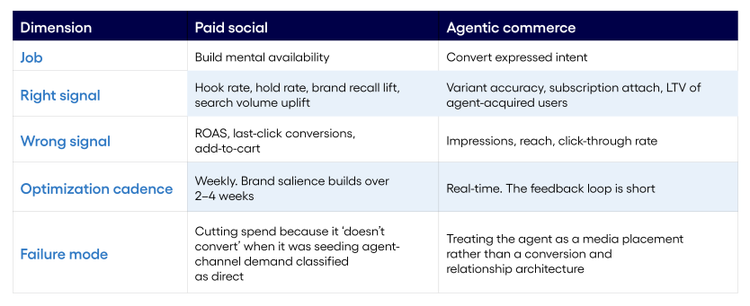
<p>TikTok, Instagram and other similar social channels are primarily brand awareness platforms. Their job is to build what marketers call mental availability: ensuring that when a consumer's need arises, your brand is in the consideration set. A piece of content viewed on a Tuesday may influence a purchase decision the following Friday. The effect accrues over time rather than in a single measurable event.</p>
<p>The right signals for paid social are creative performance metrics—hook rate (did the first three seconds hold attention?), hold rate (did the viewer stay?), swipe-away rate (did they disengage?)—and downstream brand signals, such as search volume uplift post-campaign, direct navigation to the brand's DTC platform and brand recall in survey panels.</p>
<p>The wrong signals are conversion metrics: return on ad spend (ROAS), add-to-cart events, last-click conversions. Optimizing a TikTok campaign for last-click conversions is like evaluating a billboard by how many people drove directly from the billboard to the shop. Some do. Most don't. The billboard is still working.</p>
<h3><span class="h4">Agentic commerce: the conversion and relationship instrument</span></h3>
<p>An agent-native commerce layer—whether deployed as a brand agent on a DTC website or discoverable via the Universal Commerce Protocol across third-party AI platforms—operates at the bottom of the funnel. Its job is to convert expressed intent into the right product or subscription.</p>
<p>The right signals for the agent channel are conversion architecture metrics: variant accuracy (did the agent recommend the right product?), subscription attach rate, HITL completion rate (did the human confirm?), lifetime value of agent-acquired users versus one-time buyers.</p>
<p>The wrong signals are reach metrics: impressions, clicks and click-through rates. Measuring the agent channel by how many people saw the agent's response is as misguided as measuring a sales rep by how many people they spoke to rather than deals closed.</p>
<h3><span class="h4">The framework at a glance</span></h3>
<h3><span class="h4"> Fixing the attribution problem </span></h3>
<p>If the attribution architecture is not fixed, the brand will see a confusing picture: Paid social looks expensive and underperforming, and the agent channel looks like it generates organic traffic. Neither is true.</p>
<p>When a consumer discovers a brand and its products through AI agents like Gemini, ChatGPT, Perplexity or Google's AI Overviews—all of which query UCP-compliant product catalogs—and then navigates to the brand's DTC platform or retailer portal to complete a purchase, the agentic referral source is often lost. The paid social campaign that built the mental availability for that consumer to type a brand name into an AI assistant receives no credit. </p>
<p>Brands can fix this attribution problem by implementing three things:</p>
<ul>
<li><b>A tracking architecture</b> that follows the consumer from paid social impression through the DTC agent conversation, labelling the visit as a distinct acquisition source, not direct.</li>
<li><b>An agent referral tracking layer</b> that captures which AI platforms referred the consumer to the brand's agent channel.</li>
<li><b>A measurement cadence that matches the channel</b>—weekly for paid social, daily for agent-channel—rather than applying the same real-time dashboard to both.</li>
</ul>
<p>None of this requires new technology. It requires brands to build the tracking architecture before the campaign launches rather than retrofitting it afterward.</p>
<h3><span class="h4">Reframing the channel optimization question</span></h3>
<p>Once the attribution architecture is in place, the question of real-time optimization becomes both more tractable and more interesting. The question moves from, “Which platform should receive more budget, based on real-time performance?” to, ”Which platform's audience is more likely to seek this brand in an agent conversation three days later?”</p>
<p>This reframe has practical implications. If TikTok content drives measurably more queries to a UCP-compliant catalog endpoint, that is a meaningful paid-social performance signal. Seeing it requires connecting social data to AI-channel data through a shared view of the customer. </p>
<p>The brands that will win are the ones that understand the two-layer model, attribute correctly across both layers, and optimize each instrument against its actual job.</p>
<h3><span class="h4">Industry lens: where this matters most</span></h3>
<p>The urgency of using the two-layer model differs by industry. Below is a brief orientation of where this dynamic is most acute.</p>
<p><b>Consumer health and nutrition.</b> These purchase decisions are rarely made at the moment of content exposure. When the need arises, consumers are far more likely to use a health-focused AI query than to return to the social media channel. Brands without UCP-compliant product catalogs are structurally invisible to these queries. Paid social should be evaluated primarily on brand recall and search intent lift, with conversion expectation reserved for the agent channel.</p>
<p><b>Retail and CPG.</b> This category was the first mover in UCP adoption. As a result, paid social is increasingly a brand salience investment that seeds agent-channel discovery. The real-time optimization question is, ”Which creative drives more brand name queries in AI shopping assistants?” Brands that still measure TikTok by ROAS need to change their direction.</p>
<p><b>Healthcare and life sciences.</b> The attribution challenge is compounded by regulation and fast-growing query volumes. For brands with patient- or caregiver-facing products, the agent channel is the primary discovery pathway. Paid social investment that does not account for this pathway is systematically undervalued in any standard attribution model.</p>
<p><b>Financial services.</b> Consumers increasingly use AI for product comparisons, understanding terms and identifying providers. Paid social should be evaluated on its contribution to AI-assisted research intent, not on direct lead generation. The agent channel is increasingly the first point of structured brand interaction after an AI research phase.</p>
<p><b>Travel and hospitality.</b> Decisions in this category are historically slow and non-linear. AI assistants can accelerate this with itinerary planning, destination comparison and booking intent formation. Paid social is most effective when it prompts a consumer to begin AI-assisted planning. Conversion increasingly happens through agent channels, not through direct click. Brands that measure their social investment by booking conversions will under-invest in the content that seeds agent-channel demand.</p>
<h3><span class="h4">Asking the right question about channel optimization</span></h3>
<p>The right question for chief digital officers and chief marketing officers today is, ”Does our attribution architecture correctly capture the contribution of paid social to agent-channel demand?” Once they have their answer, they can ask the budget questions.</p>
<p>The two-layer model—paid social as the reach and salience instrument, agentic commerce as the conversion and relationship instrument—is a description of how consumer purchase journeys now work. The brands that internalize this model, fix their attribution architecture and optimize each instrument against its actual job will have a sustainable structural advantage over those still running both channels through the same dashboard.</p>

Rachna works with enterprise clients across healthcare, technology, retail, financial services and CPG on agentic AI strategy for customer experience, go-to-market enablement and DTC transformation.