
The bridge to AI value will be built, not bought
<p><br>
<span class="small">March 05, 2026</span></p>
The bridge to AI value will be built, not bought
<h2 class="h6">Our recent research shows that enterprises see the real value of AI—and understand the intensive construction effort it will take to build it.<p></p>
</h2>
<p>The conversation around artificial intelligence often feels like a pendulum swinging between two extremes: a utopian future of effortless productivity and a dystopian vision of mass job displacement and hollowed-out economic growth. This "ghost GDP" thesis—the idea that AI will create statistical gains that fail to circulate through the real economy—stokes anxiety for business leaders and the public alike.</p>
<p>But the facts on the ground from enterprises tell a different story. It’s a more pragmatic, grounded and ultimately more optimistic narrative. The evidence doesn't point to a speculative bubble or a workforce collapse. Instead, it shows a global economy in a period of foundational construction. </p>
<p><a href="https://www.cognizant.com/us/en/about-cognizant/ai-builder">As AI builders</a> working with the world’s leading companies, we see this firsthand at Cognizant. Enterprises are not chasing hype; they are making serious, long-term investments to build more intelligent, efficient and resilient systems. Far from being a story of redundancy, we’re hearing from business leaders that they’re in a state of fundamental redesign.</p>
<h3><span class="h4">AI investment patterns signal a new foundation, not a bubble</span></h3>
<p>If AI were a speculative flash in the pan, capital would be volatile and uncommitted. The data shows the opposite. Cognizant’s recent survey of 600 enterprise AI decision-makers reveals that AI is deeply embedded in corporate budgets<sup>1</sup>. A remarkable 84% of firms now maintain formal AI budgets and 91% expect those budgets to increase. In fact, half (50%) expect their budget to increase by double digits over the next two years, indicating meaningful year-over-year increases.<br>
</p>
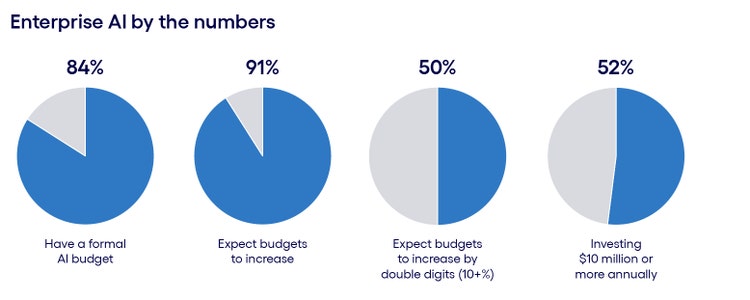
<p>The scale of this spending is significant: More than half (52%) are investing $10 million or more annually, making them core operational expenditures on par with the foundational investments made in cloud computing a decade ago. This pattern of recurring, expanding capital commitment is not the signature of a bubble. It is the hallmark of infrastructure being built—the digital bridges, roads and factories of the next-generation economy.</p>
<h3><span class="h4">The future of work is collaborative, not automated away</span></h3>
<p>One of the greatest sources of anxiety is the fear of mass labor displacement. The data, however, should provide significant reassurance. Enterprises are not forecasting the sweeping removal of their workforce. They are planning for a sophisticated, hybrid future.</p>

<p><br>
Across 13 major enterprise functions, the highest expectation for full automation is a mere 20% (in sales), while critical functions like finance register at just 10%.</p>
<p>Interestingly, this echoes the data in another recent Cognizant study, <i><a href="https://www.cognizant.com/us/en/aem-i/ai-and-the-future-of-work-report" target="_blank" rel="noopener noreferrer">New Work, New World 2026</a></i>, which utilized US Labor data to show just 10% of all job tasks today are fully automatable. </p>
<p>All told, this data overwhelmingly supports a model of collaboration. In customer service, for instance, 76% of leaders expect workflows to be AI-dominant, yet only 9% believe they will be fully automated. This reveals the true goal: AI is being integrated to handle repetitive tasks, analyze complex data and augment human capability, freeing up people to focus on strategic, creative and empathetic work. The era of the "always human" process may be ending, but it is being replaced by a more powerful partnership: humans and machines working together.</p>
<h3><span class="h4">Embracing the ‘messy middle’: The necessary work of scaling AI</span></h3>
<p>The path to integrating AI is not frictionless. The journey from initial concept to enterprise-wide scale is what we call the "messy middle"—a critical phase of development that involves navigating significant operational hurdles. But these challenges are not signs of failure; they are indicators of serious, institution-level construction. This is where AI builders are a critical bridge builder for enterprises on their transformation journey.</p>
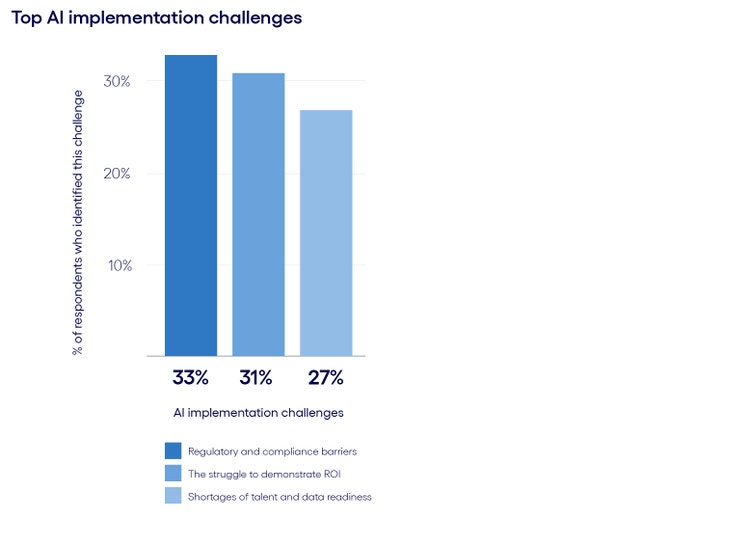
<p>Today, 63% of enterprises report moderate-to-large capability gaps between their AI ambitions and their current reality. The primary barriers are not technological limitations but the hard work of enterprise integration. That’s why enterprises think the most important characteristic in an AI partner is the ability to provide customized solutions and flexible engagement models. When asked about their specific challenges, leaders cite regulatory and compliance barriers (33%), the struggle to demonstrate ROI (31%) and shortages of talent and data readiness (27%).</p>
<p>This is precisely the work of builders: creating governance frameworks, reengineering processes to unlock value, upskilling the workforce and preparing data for an intelligent future. Speculative technologies may scale frictionlessly for a time, but enduring value is created by solving these complex, real-world problems. This transitional period of friction is essential to building AI that is not only powerful but also responsible, secure and fair.</p>
<h3><span class="h4">Redesigning for a smarter future with human-AI collaboration</span></h3>
<p>When you synthesize the evidence—the committed capital, the focus on human-AI collaboration and the dedicated effort to overcome institutional hurdles—the conclusion is clear: AI is driving a fundamental redesign of business. This transitional moment will include both disruption and immense opportunity. The goal is not to replace people but to augment them, creating smarter systems that make work more valuable and businesses more effective.</p>
<p>The evidence shows that enterprises are investing in a future where AI and people work in concert. This is not a ghost economy. It is a frontier under construction, and the builders are laying the foundation for a more prosperous and productive world.<br>
<br>
<i><span class="small"><sup>1</sup>The survey was designed by Cognizant and fielded by Avasta, an independent research firm, in November 2025.</span></i></p>



Latest posts
Related posts

Generative AI
Multi-agent AI is set to revolutionize enterprise operations
AI agents that collaborate across business systems are redefining enterprise operations. Explore how multi-agent AI boosts efficiency, insight and adaptability.

Artificial Intelligence
Rethinking the user experience in the age of multi-agent AI
As these systems transform the way users interact with enterprise computing, we need to consider new benchmarks and work to ensure trust and patience.

Artificial Intelligence
AI engineering: turning opportunities into competitive edge
Bridging the gap between today’s AI initiatives and the large-scale, mission-critical programs businesses increasingly need.

Artificial Intelligence
A blueprint for real-time AI assurance
AI compliance is evolving; no longer static, it’s becoming a continuous operational discipline that must be embedded directly into system design, deployment and governance.