
COGNIZANT RESEARCH
How retailers and consumer brands can close the AI value gap
<p><br>
<span class="small">September 22, 2026</span></p>
<h2><span class="h6"><b>A lack of frontline AI training and high rates of project abandonment put retail near the bottom of our recent cross-industry research on AI maturity.</b></span></h2>
<p>Retailers and consumer brands have always moved quickly on advanced technologies like AI when the customer-facing benefits are clear. They are currently moving far slower, however, on some of the key aspects of AI adoption that ensure business value.</p>
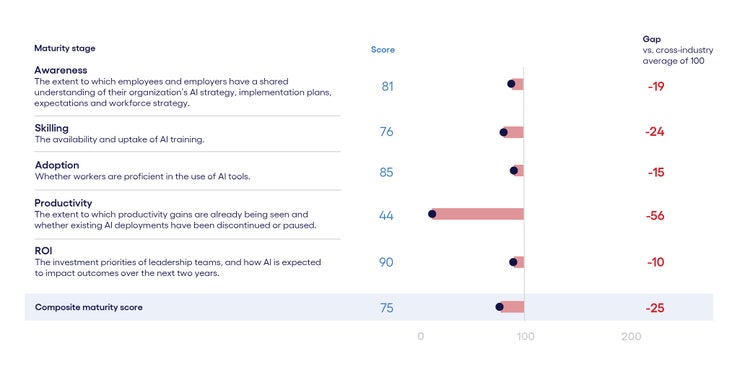
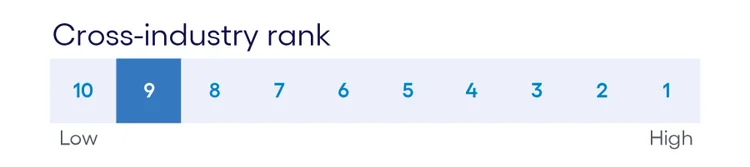
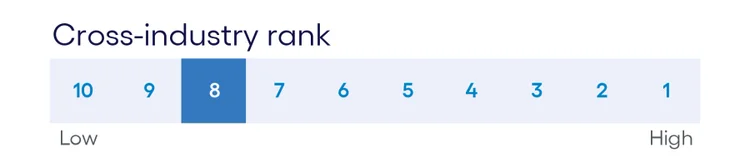
<p>In our recent research, retail and consumer goods businesses train their workers at lower rates than almost any other sector and abandon projects more than all of them. These are just two factors that result in its placing ninth out of 10 industries in AI maturity, with a score that’s a full 25 points below the cross-industry average.</p>
<p>While retail and consumer goods organizations arguably know where AI pays off, they have not built the workforce capabilities to use it, made sufficient investments in the foundational tech infrastructure or kept their deployments alive long enough to turn that knowledge into returns at scale.</p>
<p>This report is part of our series of studies exploring the numerous elements necessary for closing the gap between AI's technical capabilities and real-world results. The analysis in this report is based on data collected from 426 employees and 112 senior executives from the retail and consumer goods industry, globally.</p>
<p>We’ve calculated a maturity score for each industry included in the study, based on how they rate themselves in the five dimensions of AI maturity: awareness, training, adoption, productivity and ROI. The composite score gauges their preparedness for adopting and realizing the full value of AI (see Figure 1).</p>
<p>As described in our <a rel="noopener noreferrer" target="_blank" href="/content/cognizant-dot-com/us/en/insights/insights-blog/workforce-upskilling-for-ai-value.html">previous research</a>, businesses that sequentially work through these five phases sequentially to achieve their AI objectives.</p>
<p> </p>
<p><b>Retail and consumer brands’ AI maturity falls below the cross-industry average</b></p>
<p><span class="small">Click to enlarge<br>
*Average of the five maturity stage scores <br>
Source: Cognizant <br>
Base: 426 workers and 112 senior executives from the retail and consumer goods industry <br>
Figure 1<br>
<br>
</span></p>
<p>Four findings from our study stand out:</p>
<ul>
<li><b>The appetite for AI is there, but the support is not, especially at the frontline.</b> Retail and consumer goods workers are keen on AI, with 72% enthusiastic about using it; however, they are among the least trained and least proficient with AI tools. Sales staff—those closest to much of the sector’s customer interactions—received the lowest amount of training than any major role. The demand is real; what is missing is the training, tools and direction to act on it.<br>
<br>
</li>
<li><b>Management and workers describe different realities.</b> Business leaders are nearly unanimous in believing they have clarified how AI should be used in each role; however, workers disagree. In fact, retail and consumer goods has the lowest AI awareness score among its workforce of any industry.<br>
<br>
</li>
<li><b>Tool proficiency trails in every category.</b> On average, 47% of retail and consumer goods workers report clear or expert proficiency across a range of AI tools, well below the cross-industry average of 55%, with the widest gaps in generative and agentic AI.<br>
<br>
</li>
<li><b>Retail and consumer goods businesses abandon AI projects more than any other industry.</b> More than one-third of organizations in the industry have paused or discontinued an AI deployment, even though workers and managers report solid productivity gains from the tools already in use.</li>
</ul>
<p>In this report, retail and consumer goods leaders will learn where their industry stands in the five stages of AI maturity, as well as the industry’s biggest opportunities and challenges for realizing AI value. Knowing this, executives can focus their efforts on what matters most for attaining the full potential of AI.</p>
<h3><span class="h4" style="font-weight: normal;">A look at retail and consumer goods on the AI maturity path</span></h3>
<p>Retail and consumer goods' performance reflects the realities of the industry. In retail particularly, margins are thin, competition is intense and a large share of the workforce is frontline, hourly and prone to high turnover. These conditions make sustained investment in workforce capability difficult to prioritize.</p>
<p>Where the most heavily regulated industries answer to compliance requirements, retail and consumer goods answers to margin and to the speed at which an initiative has to pay off. AI projects are expected to prove their value quickly, and those that do not are cut, a dynamic visible in the sector's high rate of project abandonment.</p>
<p>Here is how we see retailers and consumer brands progressing on the AI maturity path.</p>
<h4><span class="h5" style="font-weight: normal;">Awareness: AI enthusiasm staunched by poor communication</span></h4>
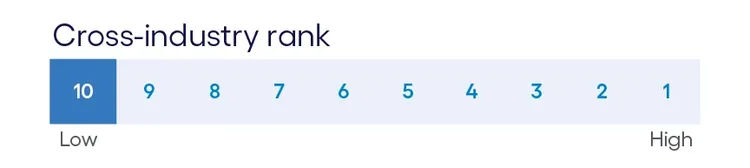
The first phase of AI maturity is establishing a shared understanding of how AI will be used in the organization. However, retail and consumer goods business leaders are far more likely than their workers to believe they have set clear expectations for how employees should use AI in their roles, with 92% believing this to be the case versus just 62% of workers.
Industry leaders have told their workforce that AI matters without informing them what it actually means for the jobs they do. That ambiguity has an impact on both adoption and productivity.
The workforce has met that ambiguity with a mix of appetite and frustration. Workers are keen on AI, with 70% enthusiastic about the technology, but that appetite has not been matched with the means to act on it.
<h4><span class="h5" style="font-weight: normal;">Skilling: The frontline is being left behind</span></h4>
Skilling converts awareness into capability, and retail/consumer goods invests too little of it where the workforce is largest. Just 41% of retail and consumer brands workers report receiving employer-provided AI training in the past 12 months, among the lowest rates of any industry and well behind the cross-industry average of 54%.
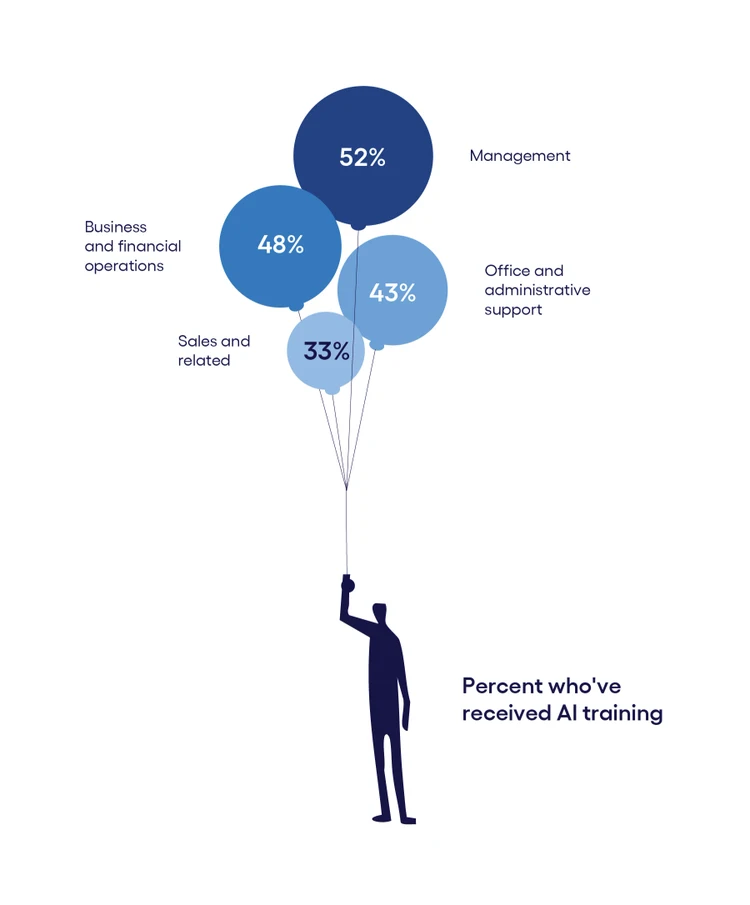
This skilling trend is in conflict with where retail businesses, in particular, make their money. The best-trained roles are in the head office, management, business operations and administrative areas, while sales staff—the largest group in the workforce and the closest to the customer—are trained the least of any major role (see Figure 2).
There is some logic to prioritizing back-office AI training, since these are the roles where quick, automatable wins are easiest to find. But retail earns most of its value at the point of customer contact, and neglecting the frontline leaves most of that opportunity untouched.
Big gap in rates of frontline vs. management skilling
<p><span class="small">Source: Cognizant<br>
Base: 426 workers and 112 senior executives in the retail and consumer goods industry<br>
Figure 2<br>
</span></p>
<p>Sales staff are nearly as enthusiastic about AI as their own managers, with 70% expressing enthusiasm versus 85% of management staff. However, only 33% have been trained, compared with 52% of managers. The willingness is there, but the means to act on it are not, which makes this an easy gap to justify closing, because the demand that would repay the investment already exists.</p>
<p>Training time is also lacking. Fewer than one in five workers report more than 30 hours of AI training a year versus roughly one in four cross-industry. That sparse allowance has to cover AI fundamentals, choosing the right tools and using them safely, which may not be adequate for building durable competence.</p>
<h4><span class="h5" style="font-weight: normal;">Adoption: Wide gaps in tool proficiency across the board</span></h4>
Retail and consumer goods again trails the cross-industry average when it comes to workers’ sense of proficiency across the five AI tools in our study (see Figure 3). On average, just 47% of workers said they had a “clear or expert understanding” of these tools versus 55% across industries.
Proficiency gap in all five AI tools
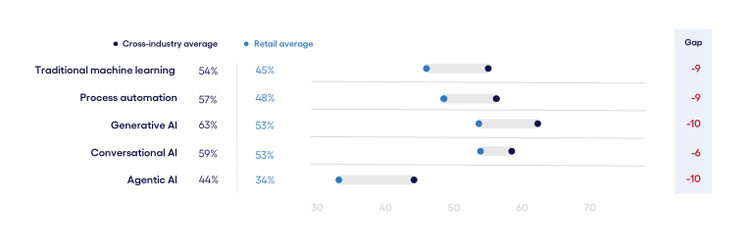
<p><span class="small"><i>Percent of respondents who said they had a clear or expert level of understanding. </i><br>
Source: Cognizant<br>
Base: 426 employees and 112 senior executives from the retail and consumer goods industry<br>
Figure 3<br>
</span></p>
<p>The proficiency gap mirrors the industry’s training deficit. While more than half of managers and business operations staff report clear or expert command of these tools, just 41% of their lesser trained sales staff peers do. The frontline that was trained least is also the least equipped to use what it has.</p>
<p>Asked where AI will have the most realistic near-term impact, retail and consumer goods organizations name decision support and data analysis, followed by process optimization and communications, an agenda led by operations. The targets are clear and sensible; however, to realize them, businesses need to enable their large, distributed workforce with the training and access to run these applications consistently.</p>
<h4><span class="h5" style="font-weight: normal;">Productivity: Strong gains undercut by early exits</span></h4>
Where retail and consumer goods workers have access to AI tools, they report solid gains. Almost three-quarters say the use of AI has made them up to 20% more productive, which is in line with the cross-industry average. Execs in the industry are also slightly more likely than their peers to say they’re already seeing measurable gains in worker productivity.
The factor that diminishes retail and consumer goods’ AI productivity is its very high abandonment rate of AI projects. More than one-third of organizations (36%)—the highest of any industry and well above the cross-industry average of 26%—have paused or discontinued an AI deployment over concerns about ROI, adoption or fit. Some of the reasons for these stoppages are justifiable, such as pilots that have served their purpose or strategy shifts.
Still, each one represents sunk cost and lost momentum, and in an industry with thin margins, the pull toward cutting early is strong. The task for retail and consumer brands businesses is to ensure they are applying AI to the right areas and giving deployments enough time to clear the bar before they are abandoned.
<h4><span class="h5" style="font-weight: normal;">ROI: Underfunded technology foundations</span></h4>
<p>Retail and consumer goods organizations spend an average of $6.5 million a year on AI tools and services, below the $7.2 million average across industries, while devoting roughly 8.5% of their technology budgets to AI, broadly in line with their peers.</p>
<p>Further, their AI investments point to a workable path forward. The sector is ahead of the cross-industry average when it comes to applying AI to the functions that define it. When asked which business areas were the top area for AI investment, the gap between retail and consumer goods business leaders and others for supply chain is 19 points; marketing and content, 17 points; and sales, 12. This is in addition to heavier use of AI than most sectors in customer experience and service. These are the high-volume, customer-facing functions where retail and consumer goods can turn small gains into large returns. This gives the sector a good foundation to build on.</p>
<p>What causes retail and consumer goods to score low in this maturity stage is its underinvestment in the technology infrastructure that AI runs on, with only 22% of leaders naming it as their top investment area, a full 10 points below the cross-industry average (see Figure 4). The sector is also less likely to fund AI through dedicated budgets than its peers, relying instead on reprioritized or reinvested money that is easier to withdraw. </p>
<p><br>
<b>Low tech spending is a detriment to ROI</b></p>
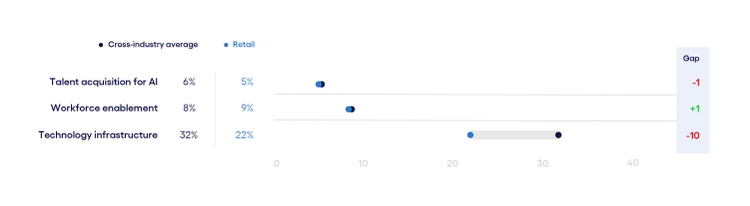
<p><span class="small">Percent of respondents naming each as the top area of AI investment<br>
Source: Cognizant<br>
Base: 426 employees and 112 senior executives from the retail and consumer goods industry<br>
Figure 4<br>
</span></p>
<p>Together, these factors leave retail and consumer goods organizations cautious at a point where they need to scale. Leaders will need to fund their infrastructure and their frontline with the same commitment they already give to the use cases that touch the customer.</p>
<h3><span class="h4" style="font-weight: normal;">Moving up the AI maturity path</span></h3>
<p>Retail and consumer goods organizations have done the hard work of identifying AI’s biggest pay-off areas, such as supply chain and customer experience. What they need now is better follow-through: building the workforce, infrastructure and project resilience to convert that investment into sustained value.</p>
<p>The first area to address is communication. Leaders need to close the gap between what they believe they've communicated and what their workers have actually absorbed, focusing on role-specific guidance on what AI changes about a given job, not general enthusiasm for the technology.</p>
<p>Skilling efforts also need to be redirected toward the frontline. Shifting even a modest share of the training budget toward sales and customer-facing staff would target the part of the business where retail in particular generates most of its value, and where worker appetite for AI is already high.</p>
<p>More discipline is needed in project governance so that fewer deployments are abandoned before they've had a chance to prove out. Pairing longer evaluation windows with realistic milestones would help leaders distinguish between projects that deserve more runway and those that genuinely aren't working.</p>
<p>Lastly, retail and consumer goods’ underinvestment in the technical foundation that supports AI is arguably the most direct explanation for why maturity lags. AI requires not only a modernized foundation but also dedicated, durable budget lines rather than reallocated spending that can be pulled back.</p>
<p>In the end, retailers and consumer brands stand on solid ground for success with AI. What they require is investing in the parts of the organization that turn a correct strategic instinct into a return at scale.</p>