
How to avoid costly contact center compliance mistakes
<p><br> <span class="small">August 21, 2026</span></p>
<h2><span class="h6">AI in the contact center is growing, and so is compliance risk. Here’s what to stop doing, what to build and a framework that ties it together.</span></h2>
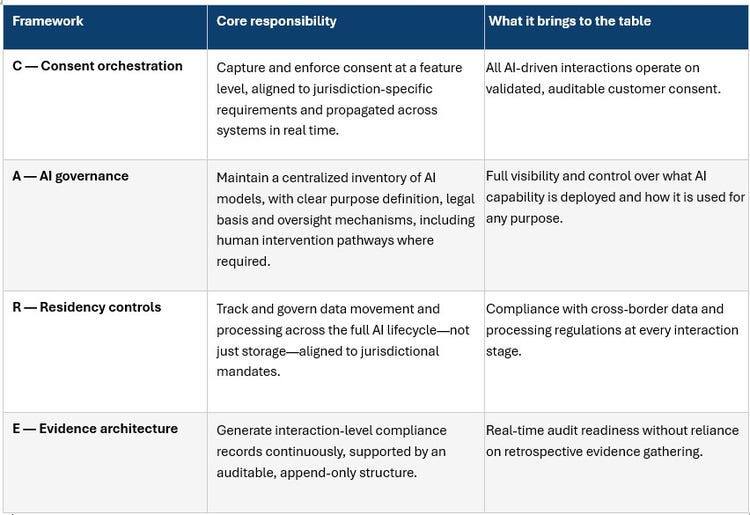
<p>Whether it’s self-service, agentic AI, sentiment analysis, voice biometrics or predictive routing, many enterprises <a rel="noopener noreferrer" target="_self" href="/content/cognizant-dot-com/us/en/insights/insights-blog/bots-to-ai-agents-for-customer-experience.html">have begun adopting AI in the contact center</a>. Meanwhile, contact center regulations are becoming more stringent in every country, and compliance has not evolved at the same pace.</p> <p>In India, the Digital Personal Data Protection Act (DPDP) requires explicit, purpose-specific consent before AI processes customer data, and the country’s telecom regulations mandate real-time Do Not Disturb scrubbing for outbound calls.</p> <p>Class-action lawsuits in the US spurred by the Biometric Information Privacy Act have amounted to multi-million-dollar settlements, and the Telephone Consumer Protection Act now mandates one-to-one consent for outbound communication.</p> <p>Complying with General Data Protection Regulation (GDPR) in the EU requires real-time disclosures when AI influences customer interactions and the ability for customers to request human intervention. </p> <p>And China represents one of the most stringent regulatory environments globally. Its Personal Information Protection Law requires that data processing—including AI inference—occurs within mainland China. And its AI Generated Content regulations require generative AI systems to be registered prior to deployment.</p> <p>Together, these global regulations define a new operating environment in which AI-powered customer interactions are subject to real-time scrutiny and measurable accountability.</p> <h3><span class="h4">The burden falls on the business, not the platform</span></h3> <p>They also converge on a common principle: Enterprises themselves—not the vendors of contact center platforms—are responsible for how AI interacts with customer data. Vendors certify infrastructure, core controls and standard product capabilities, but enterprises still own how AI is configured, localized, disclosed, governed and operated.</p> <p>For example, a "GDPR-compliant platform" only certifies the vendor's infrastructure — not the enterprise's consent architecture, AI feature configuration or data flows. Regulators have stopped accepting vendor certifications as a substitute for enterprise compliance posture.</p> <p>We know of one global life science that launched an AI-enabled IT operation in India on a platform that was certified for infrastructure and core security controls. However, a regulation review found that dialing outbound logic was not aligned with the required operating pattern. The resulting remediation took months, disrupted campaigns and ultimately cost more than the original implementation with a workaround in place.</p> <p>Or consider another example: A contact center deploys sentiment analysis to improve customer experience. The tool performs well operationally. However, consent is not tracked per feature, data processing occurs across regions, and legal validation is delayed. Months later, during an audit, gaps are identified, triggering remediation, potential penalties and reputational impact.</p> <p>The lesson in both cases is clear: Platform compliance credentials do not cover the business workflow that created the exposure.</p> <h3><span class="h4">A fast-growing risk</span></h3> <p>That is why changing platforms rarely solves the problem. The missing layer is the enterprise control layer above the product: the place where jurisdiction, workflow, consent and operational accountability must be designed. Without structured controls, risk can quickly accumulate across millions of interactions.</p> <p>Consider that the average enterprise contact center handles two million to five million customer interactions per month. Each AI-powered interaction—transcription, sentiment score, routing decision—constitutes personal data processing under modern regulations. At this volume, even a marginal non-compliance rate generates thousands of penalty-eligible events every month before anyone notices.</p> <p>For most organizations, the compliance reset requires internal change: retiring old practices and incorporating a new framework.</p> <h3><span class="h4">Three practices to retire before they become liabilities</span></h3> <p>Before building anything new, organizations need to eliminate practices that create the illusion of compliance without delivering real protection.</p> <ol> <li><b>Blanket call recording</b><br> <br> Recording all interactions without a clear legal basis actually increases exposure instead of reducing it. Regulations such as GDPR and DPDP emphasize purpose limitation, not data volume.<br> <br> In its place, businesses should adopt purpose-scoped recording, with a clearly defined legal basis and license and storage retention period, as well as jurisdiction-specific controls.<br> <br> </li> <li><b>Annual compliance audits</b><br> <br> In an AI-driven contact center that processes high volumes of interactions, annual audits are insufficient. By the time an issue is identified, the impact has already accumulated.<br> <br> Instead, businesses should shift to continuous compliance evidence generation, in which records are created per interaction, evidence is available in real time, and issues are identified proactively.<br> <br> </li> <li><b>Legal-only ownership</b><br> <br> In many businesses, legal sets policy, IT manages architecture, and operations launches AI features to capture value quickly. When these functions are not acting in a unified way, compliance gaps stay hidden until after rollout.<br> <br> For example, a sentiment analysis tool may be approved by operations, only to be reviewed by legal months later and mapped by IT even later. By then, millions of customer interactions may have already been processed without a clear legal basis.<br> <br> Businesses should establish shared ownership across legal, IT and operations, supported by a defined RACI model, integrated governance processes and alignment with deployment cycles.</li> </ol> <h3><span class="h4">What comes next: A framework for AI-driven compliance</span></h3> <p>Retiring outdated practices reduces risk—but it does not create a sustainable compliance model. AI-driven contact centers require a different foundation, where controls are embedded into operations, aligned across functions and designed for real-time execution.</p> <p>Rather than introducing fragmented controls, leading organizations are moving toward a structured architecture that integrates four controls for AI-ready compliance into a single operating model: consent, AI governance, residency controls and evidence generation. We call this the CARE Model.</p> <p>The CARE Model brings these controls together into a practical, platform-agnostic framework designed to address both regulatory expectations and internal governance gaps. It defines the minimum viable architecture for compliant, scalable AI deployment in the contact center.</p>
#
<h3><span class="h4"><br> The future of compliance in the AI-powered contact center</span></h3> <p>Most contact centers still operate on legacy practices designed for periodic audits, not for AI-driven, real-time interactions at-scale.</p> <p>But in contact centers today, compliance is not just a vendor requirement but also a design requirement, with real-time operational controls embedded into every interaction. Organizations that recognize this shift will deploy AI faster, scale with confidence and reduce regulatory friction.</p>

<p>Nitesh is a CX Consultant with 14+ years of experience driving customer and agent experience transformation across industries. He specializes in designing digital roadmaps, self-service strategies and contact center transformations that enhance efficiency and satisfaction. He is passionate about blending technology with human-centered design to deliver measurable, lasting business impact.</p>

<p>Sriram has worked in the customer interaction management domain for 24 years, managing and delivering contact center solutions to enterprise customers. He delivers transformation of customer experience driven by AI-powered CCaaS platforms such as AWS, Google CCAI and Genesys Cloud.</p>