
How banks can de-risk SME lending with a new approach to early warning systems
<p><br>
<span class="small">October 14, 2026</span></p>
<h2><b><span class="h6">A modern, AI/ML-driven early warning system helps banks protect capital, strengthen SME relationships and stay competitive in a high-growth segment</span></b></h2>
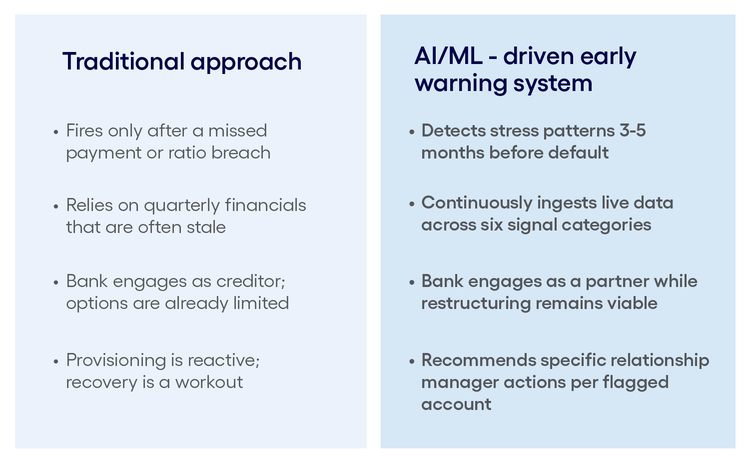
<p>For most banks, credit slippage for small and medium-size enterprises (SME) builds gradually through cash flow irregularities, rising overdraft dependency, delayed tax filings or a lost key customer long before a missed payment. By the time a traditional early warning system flags it, the bank’s options have narrowed to reactive provisioning and restructuring.</p>
<p>The problem is less about credit quality than visibility: The signals were there but weren’t monitored, connected or acted on in time. SME portfolios across major banking markets carry the highest non-performing loan (NPL) ratios of any lending segment, a gap largely explained by systems built for a different era.</p>
<h3><span class="h4">What a modern early warning system does</span></h3>
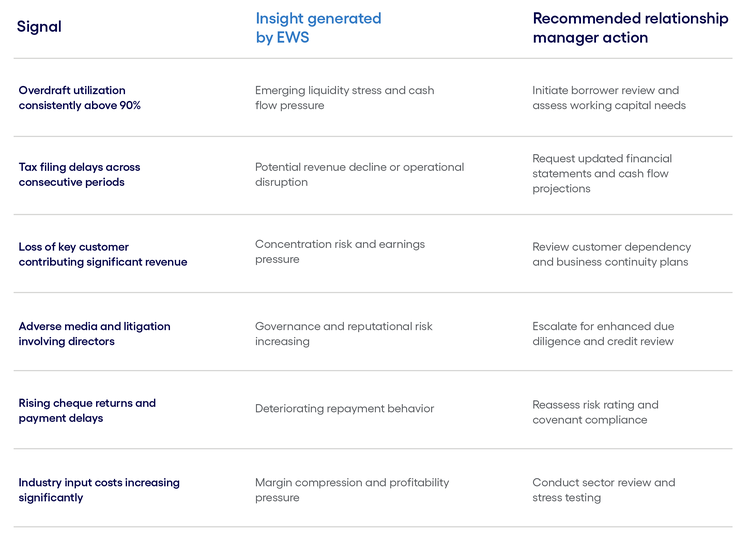
<p>A modern early warning system is AI/ML-driven, pulling data from internal and external sources to surface stress patterns rule-based systems miss, often months before they appear in financial statements. In addition to flagging risk, it explains why and recommends a specific next action for the relationship manager.</p>
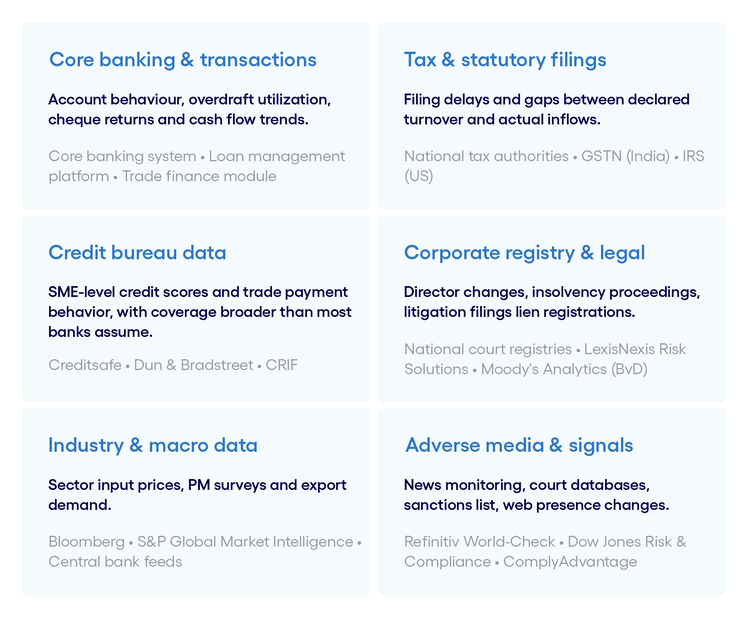
<p>This is increasingly expected by regulators globally, including the <a href="https://www.bis.org/bcbs/publ/d350.pdf" target="_blank">Basel Committee's guidance</a> on forward-looking credit risk management and the IFRS 9 expected credit loss framework. A modern EWS architecture, with six data streams feeding an AI/ML engine that outputs scores, alerts and relationship manager guidance, is built for exactly this.</p>
#
Next-generation EWS will add generative AI and agentic workflows by generating risk narratives, summarizing contributing factors and helping relationship managers prepare engagement strategies.
An early warning system’s signal quality depends on the data it can see. The most effective frameworks connect six categories simultaneously, and it is the connections between them, not any single source, that produce the early signal.
#
<p> </p>
<h3><span class="h4">What early detection looks like at the individual account level</span></h3>
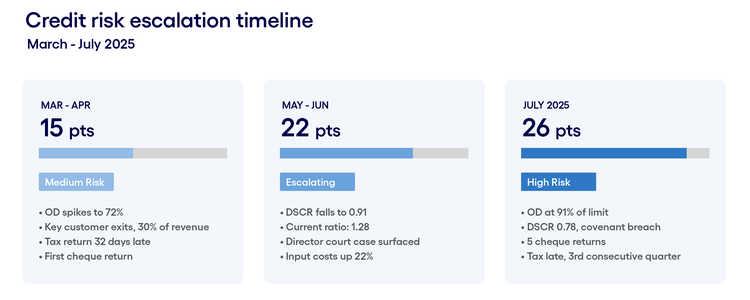
<p>The real value of a modern EWS isn’t the portfolio view but what it reveals about a single account. Take “Pinnacle Engineering Works,” a hypothetical steel fabrication business with $4.8 million in exposure and a seven-year clean credit history. </p>
<p>In January, the account is healthy; by July, it’s in the red tier, with a debt service coverage ratio (DSCR) below 1.0, overdraft utilization at 91% for six weeks straight, and five cheque returns in the quarter.</p>
<p>What the EWS detected was signals building across six categories over six months, such as the overdraft spike visible in March, four months before the eventual covenant breach, while tax filing delays flagged the revenue decline early.</p>
#
<p><br>
Beyond flagging risk, an EWS enables portfolio prioritization by helping relationship managers focus where intervention is most likely to change outcomes.</p>
<p>At the portfolio level, the same framework gives relationship managers and credit committees a consolidated view of the SME book, surfacing risk concentrations before they turn into provisions.</p>
#
<p> </p>
<p>When we build the business case with senior banking leaders, four outcomes drive the decision. Detection can happen <a rel="noopener noreferrer" target="_blank" href="https://www.pwc.co.uk/banking-capital-markets/assets/documents/future-of-ews.pdf">three to five months earlier</a>. Non-performing assets can decline <a rel="noopener noreferrer" target="_blank" href="https://www.ey.com/en_us/insights/banking-capital-markets/the-future-of-early-warning-systems-in-banking">20% to 40%</a> within targeted SME segments, IFRS 9 alignment improves via tier-to-stage-migration linkage, and RM productivity rises as banks engage borrowers earlier with better information.</p>
<p>Beyond risk management, a modern EWS enables portfolio growth. Earlier visibility lets relationship managers support viable borrowers, protect wallet share and spot restructuring or advisory opportunities sooner.</p>
<h3><span class="h4">A phased approach from assessment to scale</span></h3>
<p>Modernizing an early warning system doesn’t require a multi-year transformation. It can happen in a phased approach, with clear, time-bound deliverables.</p>
<h4><span class="h5">Phase 1: Data integration & foundation building</span></h4>
<ul>
<li><b>EWS data audit:</b> Map current signal coverage against target categories and flag gaps.</li>
<li><b>Source connectivity: </b>Prioritize feeds by value, cost and API availability. </li>
<li><b>Data infrastructure & governance: </b>A scalable, versioned data store with clear ownership and GDPR-compliant governance.</li>
<li><b>Feature engineering:</b> Convert raw inputs into signals, ratios and cross-source consistency checks.</li>
</ul>
<h4><span class="h5">Phase 2: Model development & scoring</span></h4>
<ul>
<li><b>Signal and threshold definition:</b> Calibrate green, amber and red thresholds per segment, back-tested against defaults.</li>
<li><b>Model architecture & validation:</b> A hybrid rule-plus-ML approach balances accuracy with explainability, validated in parallel with the existing system.</li>
<li><b>Model risk documentation: </b>Model cards, MRM compliance, IFRS 9 alignment and audit-ready sensitivity analysis.</li>
<li><b>Explainability layer: </b>Plain-language output per account that relationship managers can act on immediately.</li>
</ul>
<h4><span class="h5">Phase 3: Operationalization & governance</span></h4>
<ul>
<li><b>Relationship manager workflow integration: </b>Alerts and recommended actions embedded directly in CRM and loan systems.</li>
<li><b>Alert design and escalation:</b> Severity levels, response times and closure-tracking per risk tier.</li>
<li><b>Training:</b> Capability-building for relationship managers and credit officers on EWS outputs and early borrower conversations.</li>
<li><b>Governance, monitoring & regulatory alignment:</b> Risk committee, quarterly reviews and IFRS 9/Basel-EBA reporting readiness.</li>
</ul>
<h3><span class="h5"><span class="h4">Ensuring success with an early warning system</span></span></h3>
<p>The SME lending segment will only become more competitive over time. Portfolios will grow, volatility will persist, and supervisory expectations around forward-looking risk management will tighten. </p>
<p>The banks that perform best will be the ones that see risk forming early enough to act on it and can reach out to the borrower as a partner before the moment of distress arrives. A modern early warning system is how that becomes possible.</p>
<p>Banks can ensure success with their early warning system by doing the following:</p>
<ul>
<li><b>Treat it as a strategic asset. </b>A modern EWS is one of the highest-impact capabilities a bank can deploy in SME credit and should be treated that way.</li>
<li><b>Understand the regulatory direction.</b> Basel III, IFRS 9 and global supervisors require forward-looking risk management; banks that delay will catch up under pressure.</li>
<li><b>Invest in the data foundation first.</b> Bureau feeds, tax data and registry signals deliver disproportionate value for the effort required.</li>
<li><b>The transition is achievable in months.</b> A disciplined three-phase program delivers measurable results without replacing existing systems. The biggest risk is not starting.</li>
</ul>
<p><i>The authors would like to thank Maheswar Adhikary, Senior Consulting Manager, for his contributions to this blog.</i></p>

Sathya heads the Global India Banking & Financial Services consulting practice. As a practice lead, he is responsible for driving the transformation and changing agenda for BFS clients. Sathya has more than two decades of experience in consulting Fortune 500 clients based in North America, Europe, Middle East and Asia Pacific.

Sourav is a consulting leader with 18+ years of experience in banking and lending, driving AI-led transformation, digital modernization and platform strategy. He brings deep expertise across commercial and business lending, corporate banking and broker-dealer ecosystems, with extensive experience advising global banks across geographies on strategic business and technology transformation initiatives.

Pranjal brings 15 years of experience in banking and financial services, specializing in capital markets, retail banking, wealth management and credit cards. He helps global banks navigate regulatory change, digital transformation and payments modernization, with a recent focus on AI-led lending workflows that streamline end-to-end processes.

Hemant brings over 11 years of experience in banking and financial services, specializing in lending transformation, credit risk modernization and AI-driven banking solutions. He works with global financial institutions to modernize lending operations and enhance credit risk decision-making across the lending lifecycle. His recent focus includes AI-enabled risk management.