
Many financial services firms have strong AI foundations—and now need to accelerate returns
<p><br>
<span class="small">October 01, 2026</span></p>
<h2><span class="h6"><b>In our recent research, banking and financial services ranks fourth among 10 industries, reflecting a strong foundation for growth. Here’s how leaders can translate AI readiness into greater productivity and returns.</b></span></h2>
<p>AI presents significant opportunities for the banking and financial services sector to enable hyper-personalization, proactive risk management and enhanced products and services. All of these AI-powered capabilities will be essential for fending off competition and meeting fast-changing customer demands.</p>
<p>Financial firms have done much of the hard work of building a strong foundation for their AI initiatives. According to our recent research, the industry exhibits one of the highest rates of AI workforce training, and workers’ proficiency with AI tools is also above the cross-industry average. </p>
<p>Our study also indicates that the banking and financial services (BFS) sector is one of the biggest spenders in AI across the 10 industries studied. These foundational elements place the industry fourth in overall AI maturity. </p>
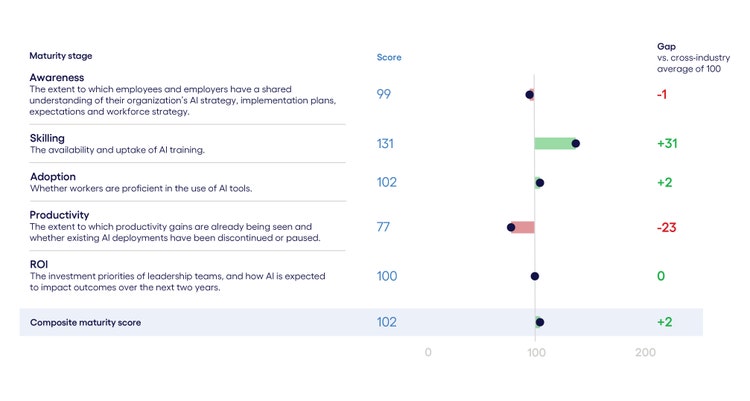
<p>However, these strengths have not yet translated into comparable enterprise-wide results. The sector’s realization of AI-driven productivity is 23 points below the cross-industry average, and many expect measurable returns not immediately but in years to come. A stringent regulatory environment and aging infrastructure are making this gap harder to close.</p>
<p>This report is part of our series of studies exploring the numerous elements necessary for addressing the gap between AI investments and capabilities and real-world results. Analysis in this report is based on data collected from 470 employees and 111 senior executives from the banking and financial services industry.</p>
<p>Our calculation of maturity scores is based on how industry leaders rate themselves across the five dimensions of AI maturity: awareness, skilling, adoption, productivity and ROI. The composite score gauges their preparedness for adopting and realizing the full value of AI (see Figure 1). </p>
<p><a rel="noopener noreferrer" target="_blank" href="https://www.cognizant.com/us/en/insights/insights-blog/workforce-upskilling-for-ai-value">As described in our previous research</a>, businesses need to work through these five phases sequentially to achieve their AI objectives.</p>
<p><b>Banking and financial services AI maturity is above the cross-industry average</b></p>
<p><span class="small">Click to enlarge<br>
* Average of the five AI maturity stage scores<br>
Source: Cognizant<br>
Base: 470 employees and 111 senior executives from the BFS industry<br>
Figure 1</span></p>
<p>Four findings from our study stand out:</p>
<ul>
<li><b>Businesses believe employees have a better grasp on the AI strategy than they actually do.</b> When asked whether they have clearly communicated the expected impact of AI on roles, 91% of leaders say they have. However, only 68% of workers agree.<br>
<br>
</li>
<li><b>AI training is widespread, with an opportunity to broaden access across all workforce levels. </b>Financial services organizations exceed the cross-industry average for skilling, which has resulted in higher-than-average proficiency with AI tools. However, resources are unevenly distributed, with 80% of executive leadership and 70% of senior management accessing training in the past 12 months, compared with just 59% of junior employees.<br>
<br>
</li>
<li><b>Productivity gains are slow to appear. </b>Only 36% of financial services organizations report measurable productivity gains from AI investments today, and many expect to wait several years to see them. The regulatory environment could be a major cause of the delay. Nearly one-third (30%) rank regulatory change as the biggest factor shaping their AI strategy, compared with 20% across industries.<br>
<br>
</li>
<li><b>ROI remains challenging because financial services firms have a broad range of investment priorities</b>. The sector dedicates more of its technology budget to AI than many of its peers; however, this spending is diluted by the need to prioritize critical risk and compliance investments. The sector is far more likely to focus spending on governance, risk and compliance than the cross-industry average, with 23% of executives saying it’s a top priority, compared with the cross-industry average of 15%.</li>
</ul>
<p>In this report, banking and financial services leaders will learn where their industry stands in the five stages of AI maturity, as well as the industry’s biggest opportunities and challenges for realizing AI value. Knowing this, executives can focus their efforts on what matters most for attaining the full potential of AI.</p>
<h3><span style="font-weight: normal;" class="h4">A look at banking and financial services on the AI maturity path</span></h3>
<p>The banking and financial services sector’s position on the maturity index highlights the challenging operating environment it faces today.</p>
<p>Customers increasingly expect banking to be as seamless and personalized as other digital services they use, while emerging areas such as digital assets and tokenized financial instruments are creating new expectations for the products and services banks provide. </p>
<p>Competition is also fierce from banking rivals. Fintechs such as Revolut and Klarna offer digital-first financial services, while retailers such as Amazon, and technology firms such as Apple and Google, also use payment services to take a share of the large financial services market.</p>
<p>This consumer-driven and competitive landscape is top of mind for banking executives. According to our research, consumer expectations and competitor activity rank among the top three factors shaping the urgency and direction of their AI strategy, alongside ever-present regulatory concerns. To remain competitive, investing in AI projects that deliver real results has never been more pressing for the sector.</p>
<p>Here is how we see banking and financial services organizations progressing on the AI maturity path.</p>
<h4><span class="h5"><span class="text-regular">Awareness: Communication disconnects present risks</span></span></h4>
The first phase of AI maturity is establishing a shared understanding of how AI will be used in the organization and how it will affect operations and workers. Alignment on business goals, which guide strategy and performance, is critical to successful AI adoption.
Banking scores 99 in this maturity dimension, just one point below the cross-industry average. In large part, this is due to a critical disconnect between financial services leaders’ perception of the effectiveness of their AI communications versus employees’.
For example, 93% of executives believe they have clearly communicated their AI strategy, compared with just 75% of employees. Similarly, far more leaders (91%) believe employees know how AI should be used in their specific roles, compared with employees (68%).
Even understanding which tools are available to use is a source of confusion. Fully 89% of executives say their organization has a clear policy on enabling access to AI tools, compared with just 72% of workers.
This ambiguity presents significant challenges for a tightly regulated sector. In practice, employees who face uncertainty as to which tools they can use internally are quick to seek options elsewhere. Sixty-one percent of employees admit they resort to non-sanctioned AI tools when their organization's in-house tools fall short.
<h4><span class="h5" style="font-weight: normal;">Skilling: Widespread training but tilted toward the top</span></h4>
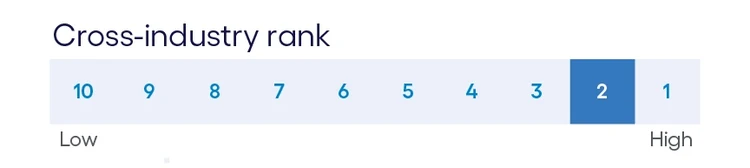
Skilling matters because AI can create value only when employees know how to apply it safely and effectively. Banking ranks highly, with a score that’s 31 points above the cross-industry average, placing it second among 10 industries in this maturity dimension.
A total of 70% of banking employees have completed AI-related training provided by their organization in the past 12 months, well above the cross-industry rate of 54%. By comparison, 46% of employees in life sciences, another highly regulated sector, have completed training.
Training budgets also demonstrate this strong commitment, with 80% of banking organizations allocating more than $10 million to AI training initiatives.
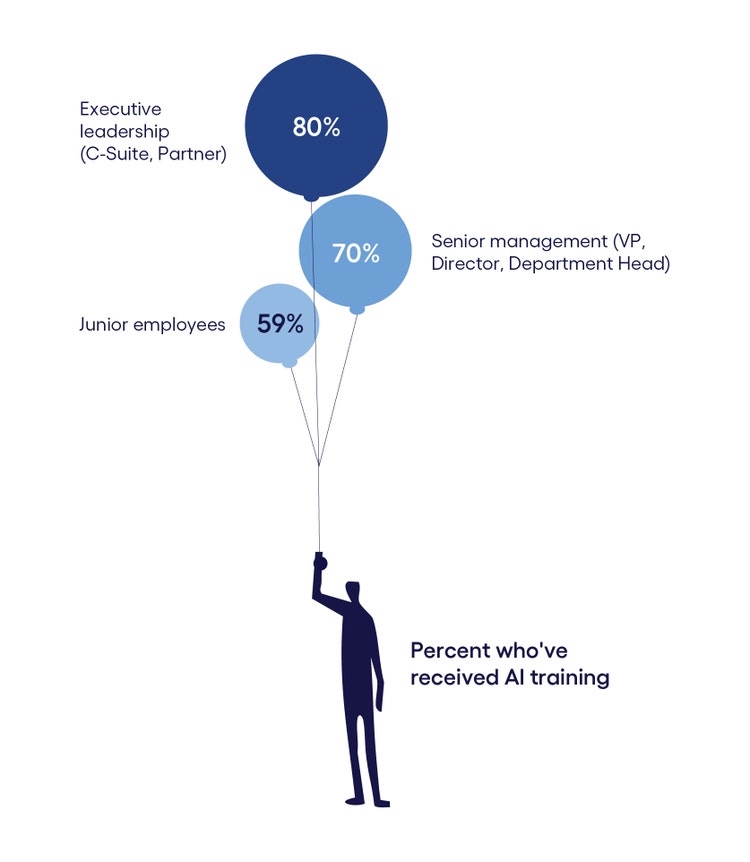
Yet, there is also a critical disparity among those receiving training, with access meaningfully tilted toward more senior roles. Executive leadership leads with an 80% training completion rate, while junior employees, including analysts, operational staff and process specialists, trail at 59% (see Figure 2).
Closing this gap matters. Front-line workers often have a clearer view of where AI can add significant value in their team or organization. Among banking employees, 93% say AI has the potential to significantly impact their work, whether that means working faster or performing tasks at a higher level. Training offers a vital pathway to workers delivering these gains.
Gap between executive and junior employee training rates
<p><br>
<span class="small">Source: Cognizant<br>
Base: 470 employees and 111 senior executives from the BFS industry<br>
<span data-rte-class="rte-temp">Figure 2 </span></span></p>
<h4><span class="h5" style="font-weight: normal;">Adoption: High proficiency is combined with a clear understanding of AI’s value</span></h4>
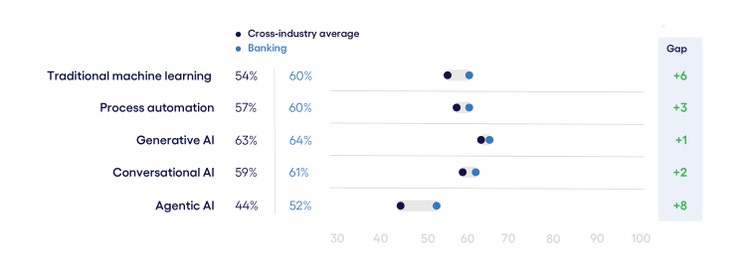
The high skilling rates in the sector seem to be paying off. When compared with the cross-industry average, workers in the banking and financial services sector have higher proficiency across the full range of AI tools available (see Figure 3).
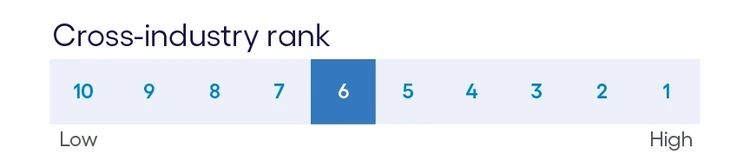
The industry’s sixth-place ranking reflects the progress all industries have made in this area, resulting in a tight clustering of scores. Where banking and financial services stands out is in workers’ proficiency in some of the newest, most advanced AI technologies, such as agentic AI, where more than half of banking workers say they have clear or expert levels of proficiency, fully eight points above the cross-industry average.
High proficiency across all AI tools
<p><span class="small"><br>
Percent of respondents who said they had a clear or expert level of understanding.<br>
Source: Cognizant<br>
Base: 470 employees and 111 senior executives from the BFS industry<br>
Figure 3 </span></p>
<p>Banking employees also have a clear understanding of where AI can best be deployed. When asked which tasks AI can realistically support, employees highlighted areas of work common in the sector, including data analysis and reporting (54%), research and summarization (48%) and forecasting and trend analysis (44.6%).</p>
<p>Banking is also one of the most bullish industries when it comes to AI deployments. A full 68% of banks are at least piloting generative AI, with 28% in a mature phase (scaling, embedding or optimizing initiatives), ahead of the 23% cross-industry average. They are also leading adoption of more advanced forms of AI, with 73% at least piloting agentic AI in their business and 16% reaching the more mature stages of adoption, compared with 11% cross-industry. </p>
<h4><span style="font-weight: normal;" class="h5">Productivity: Compliance and aging infrastructure drag down results</span></h4>
Despite this strong foundation, the sector is struggling to turn AI initiatives into tangible returns. Workers themselves say they’ve seen AI-driven productivity gains, with over three-quarters (76%) reporting productivity gains of up to 20%. Of those, nearly half (48%) reported more than a 10% productivity gain. When asked what productivity gains they’d expect to see if given the right resources, 25% of workers said they’d be able to realize productivity gains of more than 20%.
Yet, industry executives paint a different picture. Only 36% of senior leaders say they have already seen measurable worker productivity gains from AI deployments, which is 6 percentage points below the cross-industry rate of 42%, and many do not expect to see gains for several years.
Despite pressure from consumers and competitors alike, the sector has many sources of friction slowing it down. Unsurprisingly, a tight regulatory environment is a key inhibitor for many, with 57% of executives saying data privacy concerns inhibit adoption, and 41% citing the effect of regulations.
The sector is also hindered by complex, aging infrastructure. Eighteen percent say their existing technology estate is preventing them from realizing their AI ambitions, while 40% worry about the availability of compute power, the highest share among all industries analyzed. More concerns center on aging infrastructure. Only one-quarter of executives say their data quality or data lineage are excellent.
When translating worker experiences of productivity into the real-world, this makes a significant difference. For example, a relationship manager might use AI to prep for a client meeting in minutes instead of an hour—a real win on paper. But if the data lives across legacy systems that don't communicate with each other, the tool can only achieve a partial view, so the bank never sees the process itself get faster.
<h4><span class="h5" style="font-weight: normal;">ROI: High spending levels with a focus on compliance</span></h4>
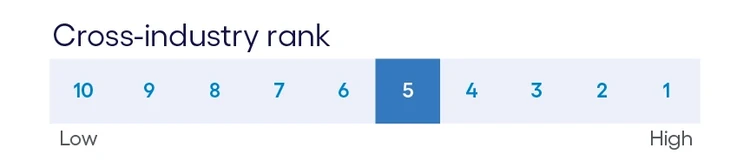
Banking and financial services leaders are investing heavily in AI. The sector ranks among the top three AI spenders, allocating 8.7% of its annual technology budget to AI tools. On average, leaders expect this to increase by 11.4% over the next two years. Yet, how this investment is paying off is still uncertain, leaving the industry ranked fifth in this maturity dimension.
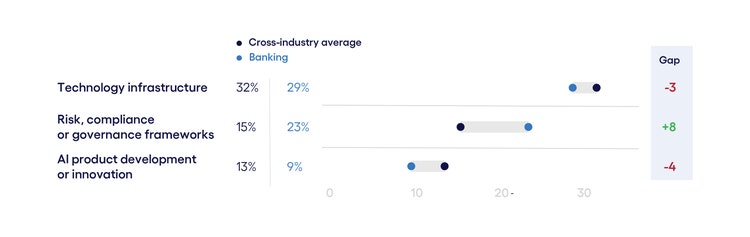
A closer look at the data reveals an investment profile distinctly shaped by the industry's regulatory and risk management imperatives. Financial services organizations are 8 percentage points more likely than the cross-industry average to say their largest AI investment area is risk, compliance or governance frameworks (see Figure 4).
While critical, this investment focus demonstrates the delicate balancing act the sector must perform as it allocates funding. Despite scoring comparatively low among its peers for areas like data readiness and access to computing resources, the sector is also less likely to allocate funding to technology infrastructure (29% versus the 32% industry average).
Spending focus reflects compliance concerns
<p><span class="small"><br>
 Percent of respondents naming each as the top area of AI investment<br>
 Source: Cognizant<br>
 Base: 470 employees and 111 senior executives from the BFS industry<br>
 <span data-rte-class="rte-temp">Figure 4</span></span></p>
<p>Compounding the challenge, funding future AI investments is more likely to rely on reinvesting returns from previous initiatives. Indeed, banks are 4 percentage points more likely than the cross-industry average to plan to reinvest AI-driven cost saving (12% versus 8%) and redirect productivity gains (16% versus 12%) to fund future developments. The challenge, then, is doing so in a way that keeps pace with pressing consumer demands and an increasingly competitive market.</p>
<h3><span style="font-weight: normal;" class="h4">Moving up the AI maturity path</span></h3>
<p>Banking and financial services organizations show strong AI readiness. Workers are well-trained, proficient across even the newest AI tools and clear about where AI can add value in their roles.</p>
<p>The challenge is that these strengths are not yet translating consistently into enterprise-wide results. While three-quarters of workers report meaningful productivity gains, only around one-third of leaders see the same evidence, and many don’t expect measurable returns for years to come. For banking leaders, closing the productivity gap is harder than most industries, with regulatory complexity and legacy infrastructure creating additional hurdles. </p>
<p>The urgency to do so, however, is real. Fintechs continue to outmaneuver incumbents in speed, while retailers and technology giants encroach from the periphery, all chasing the same customers without the same regulatory weight to carry. </p>
<p>Closing the gap between AI ambition and results will require leaders to translate high-level strategy into role-specific guidance, extend sanctioned tool access and training more evenly across seniority levels, redesign workflows and compliance processes around where AI is already helping employees move faster and establish clearer ROI measures to justify continued investment. </p>