
COGNIZANT RESEARCH
Why life sciences companies are struggling to turn AI adoption into results
<p><br>
<span class="small">August 31, 2026</span></p>
<h2><span class="h6"><b>From limited tool access to low productivity gains, life sciences lags on AI maturity.</b></span></h2>
<p>Embedding AI deeply into operations is a strategic imperative for life sciences firms. Many are looking to use AI to accelerate research, improve the precision and speed of clinical and operational decisions, and bring therapies to market more quickly.</p>
<p>Our recent research shows strong awareness of AI among life sciences organizations, as well as high levels of adoption, reflecting a workforce that sees clearly how AI maps to the scientific and analytical work it does every day.</p>
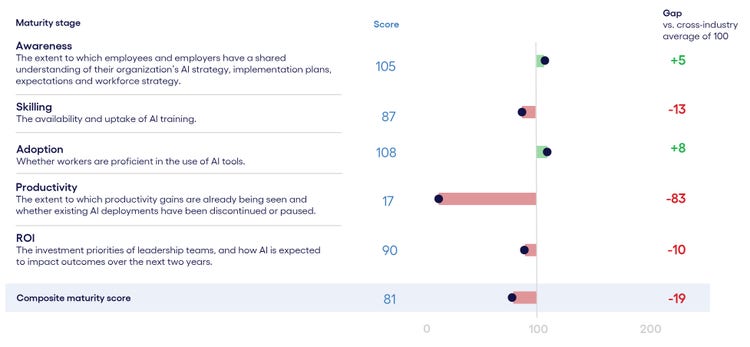
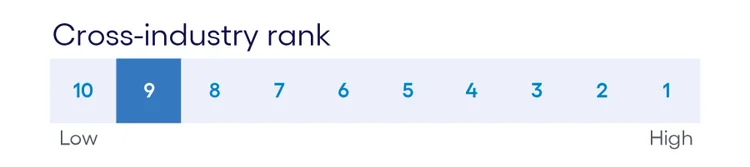
<p>However, these findings are undercut by some of the weakest real-world outcomes of any industry in our cross-industry study on AI maturity. The sector's productivity score is the second lowest of any industry tracked, and its AI training score sits 13 points below the cross-industry average. As a result, life sciences ranks eighth out of 10 industries in terms of AI maturity.</p>
<p>This report is part of our series of studies exploring the numerous elements necessary for closing the gap between AI's technical capabilities and real-world results. The analysis in this report is based on data collected from 380 employees and 108 senior executives globally from the life sciences industry.</p>
<p>We’ve calculated a maturity score for each industry included in the study, based on how respondents rate themselves in the five dimensions of our AI maturity path: awareness, skilling, adoption, productivity and ROI. The composite score is a reflection of their preparedness to adopt and realize the full value of AI (see Figure 1).</p>
<p>As described in our <a rel="noopener noreferrer" target="_blank" href="/content/cognizant-dot-com/us/en/insights/insights-blog/workforce-upskilling-for-ai-value.html">previous research</a>, businesses that sequentially work through these five phases of maturity are best positioned to achieve their AI objectives.<br>
</p>
<p><b>Life sciences AI maturity falls below the cross-industry average</b></p>
<p><span class="small">Click to enlarge<br>
*Average of the five maturity stage scores <br>
Source: Cognizant <br>
Base: 380 employees and 108 senior executives in the life sciences industry <br>
Figure 1<br>
</span></p>
<p>Key insights from our report include:</p>
<ul>
<li><b>Employees are enthusiastic about using AI, but the tools are out of reach.</b> Over three-quarters (77%) of life sciences workers agree AI can assist with tasks completed by their team. Yet, according to senior execs, only about one-third (35%) of employees have access to AI tools.<br>
<br>
</li>
<li><b>AI demand and ambiguity are spilling into shadow adoption.</b> In total, 42% of life sciences employees report they’ve used AI tools that are not sanctioned by management. And only 37% say their organization has clearly communicated how AI should be used in their specific role or function.<br>
<br>
</li>
<li><b>Productivity lags other sectors.</b> Just 33% of senior execs say they are already seeing measurable worker productivity impact—9 points below the cross-industry average of 42%. The sector also suffers from high AI project discontinuation rates, with 31% of industry executives pausing or stopping initiatives, well over the cross-industry average of 25%.<br>
<br>
</li>
<li><b>Compliance concerns drag down ROI.</b> The life sciences sector stands out for its high commitment to governance, with leaders more likely than the cross-industry average to name risk, compliance and governance frameworks as the top AI investment area. While vital, this emphasis is pulling investment away from other areas needed for AI, such as technology infrastructure and workforce enablement.</li>
</ul>
<p>In this report, life sciences leaders will learn where their industry stands in the five stages of AI maturity, as well as the industry’s biggest opportunities and challenges for realizing AI value. Knowing this, executives can focus their efforts on what matters most for attaining the full potential of AI.</p>
<h3><span class="h4" style="font-weight: normal;">A look at life sciences on the AI maturity path</span></h3>
<p>The life sciences industry is at a crossroads. In many respects, the hardest part of the AI adoption journey is over. Hearts and minds have been won, and employees understand exactly where AI can support them in their work. </p>
<p>This enthusiasm is translating into employees pursuing external sources for AI training and the use of their own tools when sanctioned ones aren’t available. This embrace of AI is not yet translating into enterprise-wide impact, largely because enterprise resources are lagging employee ambition.</p>
<p>Here is how we see life sciences organizations progressing on the AI maturity path:</p>
<h4><span class="h5" style="font-weight: normal;">Awareness: Strategic clarity breaks down outside the C-suite</span></h4>
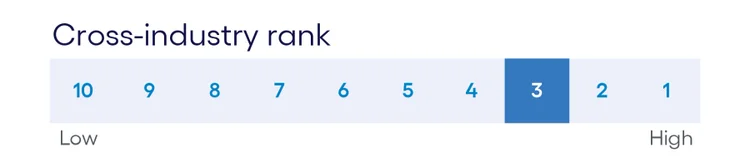
The first phase of AI maturity is establishing a shared understanding of what the organization intends to do with AI and how it will impact operations and workers. In this dimension, life sciences ranks third out of 10 industries, scoring modestly above the cross-industry average.
Even more telling, a full 77% of employees believe AI can help with their team's work, well above the cross-industry rate of 62%.
This conviction, however, is offset by a series of strategic disconnects. Take AI strategy and implementation plans. While 78% of life sciences employees agree that their organization has clearly communicated its overall direction with AI, far fewer (37%) say they’re clear on how AI should be used in their specific role or function—a 41 percentage-point gap.
This presents a major challenge for an industry operating in a tough regulatory environment. In particular, confusion about how, when and where AI can be used is holding back workforce adoption and enablement. Fully 59% of life sciences employees say when the situation is unclear, they wait for leadership to confirm direction. Meanwhile, 66% of workers say they are actively asking for AI tools from their management.
The governance architecture that should underpin role-level clarity is also underdeveloped. Only 58% of employees say their organization has a centralized AI governance committee, and only 57% report the existence of a centralized AI ethics committee—despite 80% describing AI as a critical enabler of their organization’s business objectives.
<h4><span class="h5" style="font-weight: normal;">Skilling: Low training rates and limited real-world applicability push workers to self-learn</span></h4>
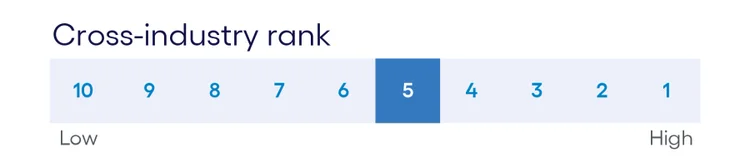
Training matters because AI can create value only when employees know how to apply it safely and effectively. However, the sector ranks fifth out of 10 industries for skilling, with 46% of employees having completed organization-provided AI training in the past 12 months versus the cross-industry average of 54%. In comparison, workforce skilling in the banking and financial services industry (another highly regulated sector) exceeds 70%.
This is not due to a lack of employee enthusiasm. What the organization is not providing, employees are funding themselves, with 61% of life sciences employees independently spending on external AI courses and certifications.
Of the skilling opportunities that organizations make available, technical upskilling is the most commonly offered format (47%), while role-specific enablement—the format most directly linked to changing day-to-day behavior—reaches only 29% of employees.
Indeed, only 61% of life sciences employees agree that their organization’s AI training initiatives effectively equip them to use AI in their work, and just 32% say their organization prioritizes training that would be recognized externally or represent a meaningful addition to a resume.
This pattern suggests training programs are being designed for organizational compliance rather than genuine capability development. They are broad enough to demonstrate investment but not deep or contextualized enough to change how people work. In a sector where the highest-value applications demand scientific judgment and domain-specific adaptation, generic upskilling will only get employees so far.
<h4><span class="h5" style="font-weight: normal;">Adoption: High potential is constrained by limited tool access</span></h4>
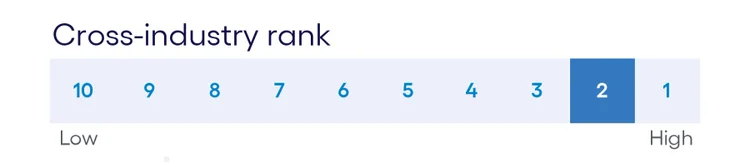
<p>Life sciences ranks second overall for adoption, with a score that exceeds the cross-industry average by 8 points. This is the sector’s strongest dimension, and it reflects alignment between AI capabilities and the analytical, research-intensive nature of the life sciences industry.</p>
<p>However, this high score conceals both a pronounced literacy gap between life sciences executives and the employees they lead, as well as a workforce that believes AI can help but lacks consistent access to it.</p>
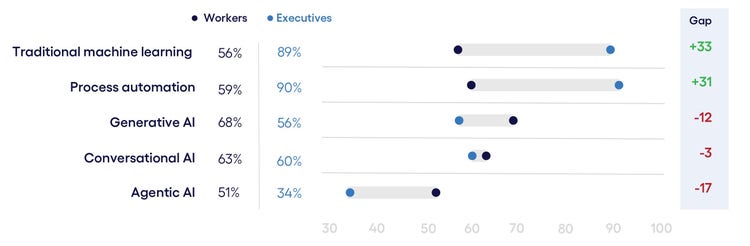
<p>Overall, the life sciences industry scores highly for employee proficiency across all five AI technologies in our study (see Figure 2), which pushes average adoption scores up. However, a closer look reveals a disconnect: Executives profess greater proficiency than employees with the more foundational AI technologies and far lower expertise with more advanced tools.<br>
</p>
<p><b>Execs lack proficiency in advanced tools</b></p>
<p><span class="small"><i>Percent of respondents who said they had a clear or expert level of understanding. </i><br>
Source: Cognizant<br>
Base: 380 employees and 108 senior executives in the life sciences industry<br>
Figure 2<br>
</span></p>
<p>For example, 89% of executives claim a clear or expert grasp of machine learning compared with 56% of employees. For process automation, the gap is 90% for executives versus 59% for employees. In many respects, these are the tools driving the most recent wave of digital transformation, and the leaders who came up through operations and analytics know them well.</p>
<p>But on newer technologies, the inverse is true. For generative AI, executive understanding drops to 56%, compared with 68% among employees. For agentic AI, executive expertise falls to just 34% versus 51% of staff. This inversion could cause issues, particularly as those defining the AI strategy are the least familiar with the technology.</p>
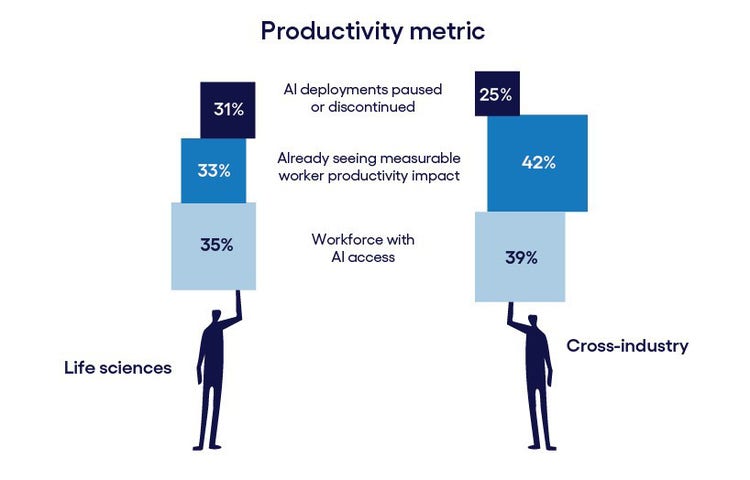
<p>The repercussions of this disconnect play out in AI tool access. When executives were asked about the percent of their employees with access to AI tools, the mean response was just 35%. Worse, 40% reported fewer than one-quarter of their workforce has access to AI tools.</p>
<p>The result is a predictable work-around: employees turning to non-sanctioned alternatives. Fully 42% of life sciences employees report using technology not approved by management, and senior managers are among the most likely to do so, at 50%. In a tightly regulated sector, this creates risks that go well beyond productivity leakage—including proprietary data exposure, cybersecurity vulnerabilities, inconsistent model outputs and potential noncompliance with governance standards.</p>
<p>The enthusiasm to adopt AI is due to its high applicability for work done in the sector. For instance, when asked how AI could realistically support their work, employees point to core capabilities: research and summarization (55%), data analysis and reporting (52%), forecasting and trend analysis (41%) and project management (39%). There’s little wonder that they’d take it upon themselves to get the tools they need.</p>
<h4><span class="h5" style="font-weight: normal;">Productivity: Exec perception of productivity is low, while deployment discontinuation rates are high</span></h4>
<p>This combination of strong demand and limited sanctioned access helps explain why workers’ AI proficiency is high, but productivity results are not. While the life sciences sector has one of the lowest productivity scores of any industry, workers themselves believe the potential exists for much higher gains.</p>
<p>When life sciences workers were asked how much more productive they could be if they could use the AI tools they actually need, 26% of employees said they could achieve gains above 20%, and 31% said gains of 10% to 20% were within reach.</p>
<p>Indeed, life sciences employees who currently use AI tools are experiencing genuine productivity improvements. Over half (57%) of employees using AI report productivity gains of 10% or more.</p>
<p>This reveals another disconnect between workers and those who lead them. Only 33% of life sciences executives say they are already seeing measurable gains in worker productivity due to the use of AI—9 points lower than the cross-industry rate of 42%. On business productivity, the figure falls to just 24%, and nearly half do not expect measurable impact for more than a year.</p>
<p>The industry also suffers from a high discontinuation rate, perhaps due to the need to “fail fast” or mothball initiatives for regulatory reasons. Regardless of cause, this represents a significant degree of sunken cost that is inhibiting results from AI investments. Fully 31% of life sciences organizations have discontinued or paused an AI deployment due to lack of ROI, adoption failure or other concerns, 6 points above the cross-industry average of 25% (see Figure 3).<br>
</p>
<p><b>Low tool access and poor productivity go hand in hand </b></p>
<p><span class="small">Source: Cognizant<br>
 Base: 380 employees and 108 senior executives in the life sciences industry<br>
 Figure 3<br>
</span></p>
<h4><span class="h5" style="font-weight: normal;">ROI: AI investment is primarily focused on compliance</span></h4>
The industry’s mean percentage of technology spend dedicated to AI is 7.9%, which falls below the cross-industry mean of 8.3%. Its investment allocation profile also diverges from the cross-industry norm in terms of where that spending is directed.
Specifically, life sciences organizations are directing comparatively more of their AI budget toward governance and risk management than toward capabilities that would generate measurable returns, such as the deployment infrastructure, workforce enablement and product innovation.
In fact, 19% of life sciences executives named risk, compliance and governance frameworks as the largest AI investment area versus 15% for the cross-industry average. This reflects the sector’s nonnegotiable obligation to operate within frameworks that govern data use, clinical validity and regulatory reporting.
Meanwhile, technology infrastructure is less of an investment focus than other industries (with 25% of life sciences execs naming this as the top AI investment area versus 32% cross-industry average). This raises questions about whether the underlying data architecture and compute capacity are sufficient to support enterprise-scale AI deployment. Workforce enablement, meanwhile, receives the smallest share of any category, with 5% of leaders naming this as the top AI investment, compared with an already modest 8% cross-industry average.
In terms of long-term investment, the sector has a rosier view. All executives surveyed say they expect to see investment increase over the next two years, and the mean expected growth of 10.3% annually suggests sustained commitment. However, connecting this investment to organizational strategy and the measurement of real results will remain challenging.
The issue is not whether life sciences leaders see the link between AI spend and value: 60% rate their ability to connect investment to expected business value as good or excellent, in line with the cross-industry average. The challenge is whether spending is balanced enough to deliver those returns. Compliance, risk and governance will remain essential, but they need to be matched by investment in infrastructure, workforce enablement and financial planning disciplines that help AI scale and prove its value.
<h3><span class="h4" style="font-weight: normal;">Moving up the AI maturity path</span></h3>
<p>Life sciences organizations are not lacking AI ambition. Employees see clear relevance for AI in their work, adoption is comparatively strong and leaders expect investment to rise. The challenge is in the sector’s gaps between leaders’ intentions and workers’ day-to-day reality.</p>
<p>Closing these gaps will be essential. It starts with a more role-specific understanding of what employees need: which tools they require, what training would help them use AI safely and effectively, and where sanctioned tool access is currently falling short. Better matching tools and skilling to real work could reduce the need for shadow AI use and, in turn, help fend off compliance, data and governance risks.</p>
<p>Leaders also need a clearer grasp of what newer AI tools can do and what their workforce is already achieving with them. The gap between workers’ perceived productivity gains and executives’ view of measurable impact suggests that some momentum may be happening out of sight. If leaders cannot see where AI is working, they cannot scale the use cases, supports and controls that would turn isolated gains into enterprise value.</p>
<p>Regulatory concerns will continue to shape the pace of AI progress in life sciences, and they cannot be wished away. But by improving sanctioned tool access, role-specific enablement and leadership understanding, firms can make AI use more visible, governable and productive. That, in turn, could help reduce risk, rebalance spending away from defensive compliance alone and create a clearer path from AI adoption to sustained ROI.</p>