
COGNIZANT RESEARCH
What ails AI adoption in healthcare
<p><br>
<span class="small">September 3, 2026</span></p>
<h2><span class="h6"><b>Recent research shows healthcare scoring last among 10 industries in terms of AI maturity. By understanding the gaps, healthcare leaders can work to close them.</b></span></h2>
<p>If there was ever an industry primed for AI-driven transformation, it would be healthcare. The sector is under relentless pressure to do more with less amid staffing shortages and the continuous need to eliminate errors and deliver high-quality care at a lower cost.</p>
<p>Small wonder, then, that healthcare executives are bullish about the future of AI in the sector. Fully 88% say AI is critical to achieving their business goals. The same percentage are investing in generative AI and even looking into newer forms of the technology such as agentic.</p>
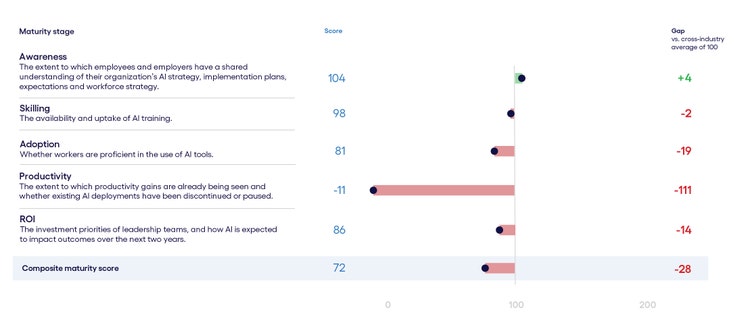
<p>However, factors such as the long-standing structural and regulatory barriers within healthcare have impeded the healthcare AI journey. In our recent research, healthcare demonstrates the lowest AI proficiency and productivity scores of all 10 industries in our study, placing the sector at the bottom of the list in AI maturity. All told, the healthcare industry’s total maturity score of 72 places it 28 points below the cross-industry average (see Figure 1).</p>
<p>This report is part of our series of studies exploring the numerous elements necessary for closing the gap between AI's technical capabilities and real-world results. The analysis in this report is based on data collected from 415 healthcare professionals and 108 senior executives from the healthcare industry, globally.</p>
<p>We’ve calculated a maturity score for each industry included in the study, based on how they rate themselves in the five dimensions of AI maturity: awareness, skilling, adoption, productivity and return on investment (ROI). The composite score gauges their preparedness for adopting and realizing the full value of AI.</p>
<p>As described in our <a rel="noopener noreferrer" href="/content/cognizant-dot-com/us/en/insights/insights-blog/workforce-upskilling-for-ai-value.html" target="_blank">previous research</a>, businesses that sequentially work through these five phases of maturity are best positioned to achieve their AI objectives.<br>
</p>
<p><b>Healthcare AI maturity falls below the cross-industry average</b></p>
<p><span class="small">Click to enlarge<br>
*Average of the five maturity stage scores <br>
Source: Cognizant <br>
Base: 415 workers and 108 senior executives in the healthcare industry <br>
Figure 1<br>
<br>
</span></p>
<p>Some highlights from this study include:</p>
<ul>
<li><b>Healthcare business leaders are out of synch with workers on their AI mission.</b> Healthcare leaders consistently overrate how well their workforce understands the organization’s AI strategy. As an example, 84% of healthcare leaders say their staff is given dedicated time to learn AI. Yet only 63% of healthcare workers confirm this sentiment, a 21-point gap. More concerning, only 59% of frontline workers, who provide the services that drive the industry, are in synch with management in this regard.<br>
<br>
</li>
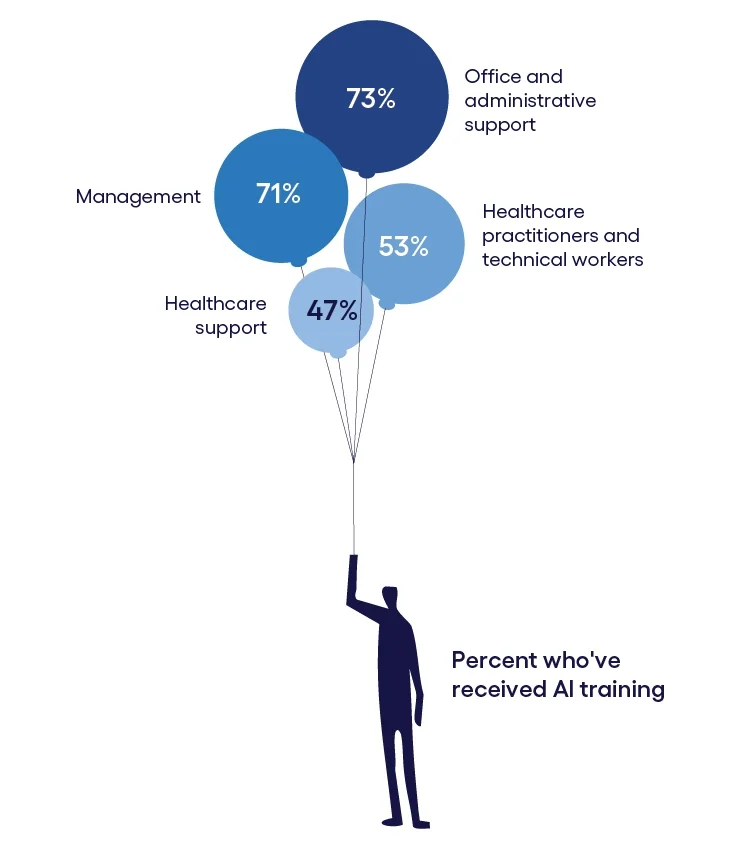
<li><b>Healthcare organizations are favoring administrative automation over clinical innovation.</b> More than three-quarters of staff in healthcare management roles have received AI training, compared with roughly half of frontline clinical workers. This investment choice points to healthcare organizations prioritizing cost savings through back-office automation over augmenting elements of patient care with AI.<br>
<br>
</li>
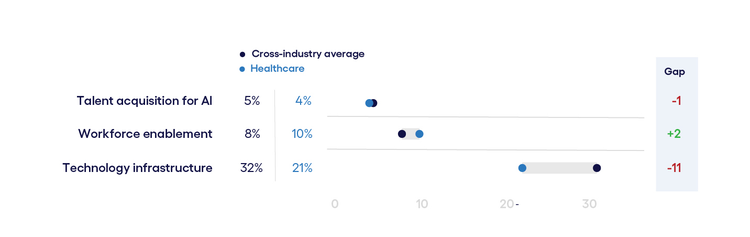
<li><b>Technology investment lags other industries. </b>While healthcare organizations are on par with other industries when it comes to investing in skilling, their tech infrastructure spending is 11 points lower than the cross-industry average. This under-investment in infrastructure and uneven staff training helps explain why healthcare workers report the lowest levels of expertise in the AI tools measured in the study.<br>
<br>
</li>
<li><b>Unpreparedness points to low productivity.</b> Healthcare organizations report the lowest AI-driven productivity scores of all industries, while enduring the highest level of AI project discontinuation, with 31% of senior leaders reporting a paused AI deployment. Ultimately, low productivity and project disruption prolongs achieving AI return on investment.</li>
</ul>
<p>In this report, healthcare leaders will learn where their industry stands in the five stages of AI maturity, as well as the industry’s biggest opportunities and challenges for realizing AI value. Knowing this, executives can focus their efforts on what matters most for attaining the full potential of AI.</p>
<h3><span style="font-weight: normal;" class="h4">A look at healthcare on the AI maturity path</span></h3>
<p>Healthcare companies’ performance is shaped by a frontline workforce primarily focused on patient outcomes and perpetually under time constraints. For them, unlike their peers in business management, the bottom line and key performance indicators are largely out of focus. These differences likely factor into the disconnect between frontline workers and healthcare senior leaders, which underlies the industry’s low AI maturity score.</p>
<p>Here is how we see healthcare organizations progressing on the AI maturity path:</p>
<h4><span style="font-weight: normal;" class="h5">Awareness: A persistent perception gap</span></h4>
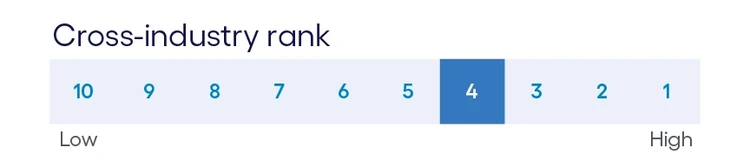
The first phase of AI maturity is establishing a shared understanding of how AI will be used in the organization and its impact on operations and workers. Alignment on business goals, which guide strategy and performance, is critical for successful AI adoption. Here, healthcare ranks fourth among 10 industries, roughly in line with the cross-industry average.
A closer look, however, reveals the disconnect between how management and workers understand the organization’s AI strategy and its implications. When asked whether workers understood how AI should be used within their specific roles, management’s assessment is more than 26 points higher than workers’. This is a fundamental misread that likely impacts productivity downstream.
Another example: 90% of senior managers say their company has an AI ethics committee, while 57% of workers say the same. A similar disconnect exists between management and workers when it comes to using non-sanctioned AI tools. While 59% of workers said they resorted to using non-sanctioned AI tools when in-house provided tools were insufficient to the task, only 35% of management said the same (a 24-point disconnect).
These gaps are not only sizable but are also persistent and create friction coming out of the gate. Further, they call into question whether organizations’ AI governance is up to the task.
<h4><span style="font-weight: normal;" class="h5">Skilling: Administrative efficiency is prioritized over front-office innovation</span></h4>
<p>Skilling matters because AI can create value only when employees know how to apply it safely and effectively. Overall, 53% of healthcare workers report receiving AI training in the past 12 months—close to the cross-industry average of 54%, placing healthcare fourth in this area. At the same time, healthcare workers receive fewer training hours than other industries: Only 21% receive more than 30 hours annually, compared with 24% overall.</p>
<p>Of more concern is where AI skilling is targeted. Far more senior managers and back-office support staff have received AI training than the practitioners and patient support staff themselves (see Figure 2). This suggests the strategic priority for AI, in many cases, is to gain efficiencies versus innovating patient care.</p>
<p>However, given that AI implementation in healthcare largely intersects with regulated practices and protocols (particularly for frontline workers), this suggests that worker training should be a much higher priority for healthcare organizations, and mandatory.<br>
</p>
<p><b>Big gap in skilling at the front line</b></p>
<p><span class="small">Source: Cognizant<br>
Base: 415 workers and 108 senior executives in the healthcare industry<br>
Figure 2<br>
</span></p>
<p>There is also a marked gap between healthcare leaders and staff in their perceptions on training. While an overwhelming majority (95%) of senior leaders say AI is expected to be learned on the job, only 66% of workers (59% of frontline workers) said the same. The one area where worker sentiment was higher than execs’ was on whether AI training was mandatory. Here, 55% of senior managers agreed, compared with 60% of workers (and 50% of frontline workers).</p>
<h4><span style="font-weight: normal;" class="h5">Adoption: Proficiency lags in all AI tools</span></h4>
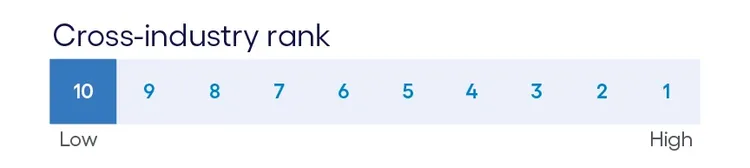
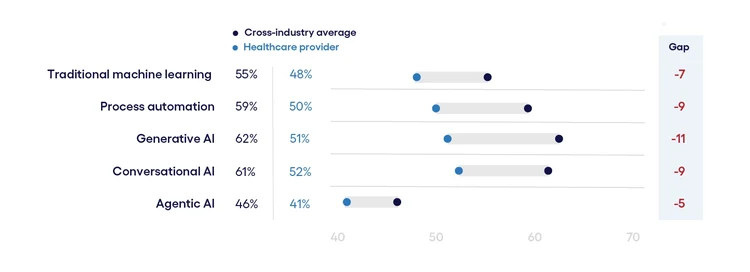
<p>Healthcare lags the cross-industry average in terms of workers’ proficiency in using the five AI tools included in our study (see Figure 3). Just 48% of healthcare workers said they had a “clear or expert” understanding of these tools versus the cross-industry average of 57%.</p>
<p>This 9-point gap reflects both limited skilling opportunities and insufficient time provided to gain experience and build skills, placing healthcare last among the 10 industries measured.<br>
</p>
<p><b>Proficiency gap in all five AI tools</b></p>
<p><span class="small"><i>Percent of respondents who said they had a clear or expert level of understanding. </i><br>
Source: Cognizant<br>
Base: 415 workers and 108 senior executives in the healthcare industry<br>
Figure 3<br>
</span></p>
<p>Generative AI shows one of the largest proficiency gaps despite its strong potential to improve healthcare productivity. Only 51% of healthcare workers say they feel proficient in using generative AI in their work, compared with 62% across industries. Proficiency is uneven by role, with administrators again demonstrating higher proficiency than frontline staff.</p>
<p>Nearly three-quarters (71%) of healthcare organizations identify decision support as the most impactful near-term AI use case, followed by data analysis and reporting. Significant opportunities also exist in hospital operations such as staffing, care coordination, billing, claims processing and customer service, where AI can reduce costs and improve efficiency.</p>
<h4><span style="font-weight: normal;" class="h5">Productivity: Low returns, early exits</span></h4>
Technology adoption not only builds confidence in using AI tools, but it also inspires workers to improve and innovate in how they work and deliver services, thus driving productivity. However, only 30% of healthcare organizations say they’ve seen business impact resulting from AI deployment—12 percentage points below the cross-industry rate of 42%, placing healthcare at the very lowest ranking among the 10 industries.
Here again, we see a gap between managers’ and workers’ perceptions. Over three-quarters of healthcare workers (77%) report productivity gains of up to 20%, slightly ahead of the 73% cross-industry figure. Here, the disconnect appears to come from workers over-estimating their progress, while management suggests these observed gains aren’t enough.
One expression of the productivity quandary can be found in the large number of AI projects that healthcare organizations have had to discard. Nearly one-third (31%) of healthcare organizations have discontinued or paused AI deployments, compared with 26% industry-wide.
Project stoppage may happen for various justifiable reasons (experimentation, funding reallocation, change in business strategy). However, as illustrated earlier, healthcare management and workers are out of synch on many aspects of their AI intent, and research shows poor communication of objectives is often associated with project failure. But whatever the cause, project abandonment represents sunk resources and productivity loss.
<h4><span style="font-weight: normal;" class="h5">ROI: Unaligned investments, low expectations</span></h4>
<p>AI spending represents roughly 8% of healthcare organizations’ IT budgets, which is in line with the cross-industry average. Yet healthcare’s weak investment in technology overall is a big factor for its low score in the final stage of AI maturity (see Figure 4).</p>
<p><br>
<b>Low tech spending is a detriment to ROI</b></p>
<p><span class="small">Source: Cognizant<br>
Base: 415 workers and 108 senior executives in the healthcare industry<br>
Figure 4<br>
</span></p>
<p>The industry does have its strengths. While healthcare organizations appear to be underfunding both technology and the people who use it, they are also demonstrating leadership in other areas. For example, when asked the primary vehicle for funding their AI investment, more healthcare leaders (38%) named discrete budget allocation than the cross-industry average (33%). Healthcare leaders also reinvest cost savings from AI at a similar level as the cross-industry average (with 9% of healthcare execs saying this versus the 8% cross-industry average).</p>
<p>Healthcare leaders are targeting similar functional priorities for AI-enablement as other industries. When asked which business function has seen measurable business impact from AI, healthcare leaders were more likely than the cross-industry average to name data analytics, business intelligence and strategic decision support as the top area (71% vs. 67% industry-wide), with cybersecurity and risk management placed second. This success provides a platform it can build on.</p>
<p>However, they also voiced lower expectations than other industries when it comes to seeing future AI impact. Only 17% of healthcare organizations anticipate increased output volume from AI over the next two years, compared with 20% industry-wide. This expectation gap may be setting the bar too low, resulting in a self-imposed, low-return constraint on AI-driven output.</p>
<h3><span style="font-weight: normal;" class="h4">Moving up the AI maturity path</span></h3>
<p>Healthcare's AI performance gap is measurable, with the steepest shortfalls in productivity and ROI. But that gap can be closed with the right strategic steps.</p>
<p>The first priority is aligning the many disconnects that exist between management and frontline workers. When leaders and staff share an accurate understanding of how AI is meant to be used, governance policies are more likely to be followed rather than worked around, training investments are aimed where they're actually needed and projects are less likely to stall from miscommunication about their goals.</p>
<p>Closing this gap would directly address the productivity and project-continuity problems that are dragging down healthcare's maturity score today.</p>
<p>Further, healthcare needs to correct its skilling imbalance. With decision support already identified by 71% of organizations as the most impactful near-term use case, redirecting training toward frontline clinical staff would align investment with where healthcare leaders themselves see the greatest opportunity.</p>
<p>Third, technology infrastructure spending needs to catch up to other industries. Without adequate infrastructure, even well-trained workers struggle to build real proficiency with AI tools. Stronger infrastructure investment would give AI initiatives the runway they need to demonstrate impact, which in turn should help lift healthcare's ROI expectations.</p>
<p>No AI project will succeed without bringing the workforce—those who will drive process improvement through AI-driven innovation—along. Clearly, the post-COVID era has put the healthcare industry, and in particular, frontline workers, under immense pressure. AI can help alleviate this, but only if healthcare organizations first make the needed investments in training, tech infrastructure and cross-organizational communication that have so far lagged behind the industry's ambitions.</p>